
The Ban!
When Anthropic introduced the Claude Mythos Preview in early April under the codename Project Glasswing, it was not released publicly. Instead, access was restricted to a carefully selected group of around 50 organizations with deep expertise in software security and critical infrastructure. The goal was to use the model's advanced reasoning capabilities to identify vulnerabilities in complex software and cybersecurity systems before malicious actors could exploit them.
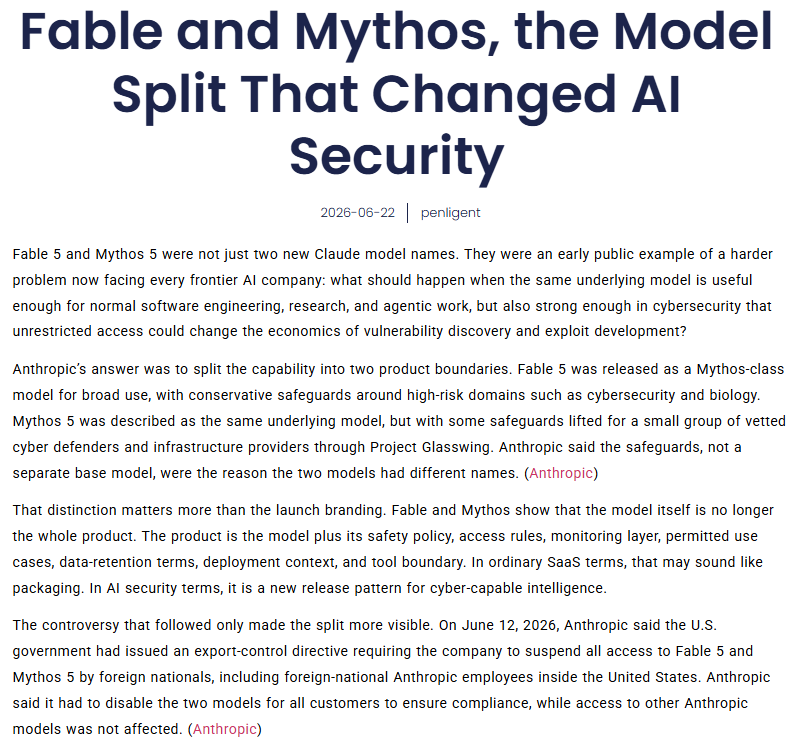
The initial participants included some of the world's leading technology and cybersecurity companies, including Apple, Google, Microsoft, Amazon, and CrowdStrike.
Recognizing both the model's immense defensive value and the risks of misuse, Anthropic kept distribution tightly controlled. Rather than opening access broadly, it expanded the program in a measured way, adding approximately 150 more organizations across 15+ countries. The second phase also widened participation beyond technology firms to include operators of critical infrastructure, such as power grids, water utilities, healthcare systems, and telecommunications networks. The program reflects a growing recognition that advanced AI is becoming an important tool for strengthening cyber resilience and protecting national-scale digital infrastructure.
In geopolitical terms, it was treated as ordnance. The United States government blocked Anthropic from expanding the program beyond 50.
Then, on June 12th, 2026, at twenty-one minutes past five in the evening, an export control directive ordered the suspension of all access to Fable and Mythos for any foreign national anywhere on earth, including Anthropic's own non-citizen staff.
The company, unable to filter by nationality in real time, shut both models off for every customer worldwide. The kill switch moved from theory to operational fact in a single afternoon, and by some accounts, the company was given roughly ninety minutes to comply.
Anthropic shared a public statement to that effect.

The unreleased model demonstrated high-order, autonomous code reasoning and vulnerability discovery capabilities that exceeded those of standard software analysis tools.
Tremors Across Global Capitals
The disclosure of Claude Mythos' capabilities triggered immediate policy concerns in capitals around the world. As it did in New Delhi.
On April 23, 2026, Union Finance Minister Nirmala Sitharaman convened a high-level emergency meeting with the heads of major public- and private-sector banks, key financial stakeholders, and IT Minister Ashwini Vaishnaw. The objective of the meeting was to assess India's systemic exposure to the cyber threats posed by autonomous, AI-enabled exploit-generation platforms.

Sitharaman directed the Indian Banks' Association (IBA) to establish a coordinated institutional mechanism, led by the chairman of the State Bank of India (SBI), to identify financial vulnerabilities, evaluate technology investments, and explore defensive AI deployments. She also advised banks to onboard specialized security agencies, maintain close coordination with authorities, and build a robust mechanism for real-time threat intelligence sharing with the Indian Computer Emergency Response Team (CERT-In).
The urgency of this intervention stems from a structural vulnerability within the Indian financial and critical infrastructure sectors: the compounding risk of legacy technology debt. India has successfully built modern, high-throughput digital interfaces such as the Unified Payments Interface (UPI) and the broader digital governance infrastructure of the JAM (Jan Dhan-Aadhaar-Mobile) trinity. However, these consumer-facing applications are built on top of centralized Core Banking Systems (CBS) that run on rigid, slow-moving legacy frameworks.
To support modern features, financial institutions build specialized software wrappers around these legacy cores, adding layers of custom code and third-party APIs.This architectural layering creates a large, complex, and poorly audited attack surface. Many of these legacy cores contain latent, decades-old vulnerabilities that have survived standard security audits yet remain highly susceptible to the deep-semantic code reasoning of models like Claude Mythos.
As Abhishek Kumar writes in his Substack article on Indiafintech (The Mythos Moment: What Anthropic’s Most Dangerous Model Means for India’s BFSI Cyber Stack | Episode 84).
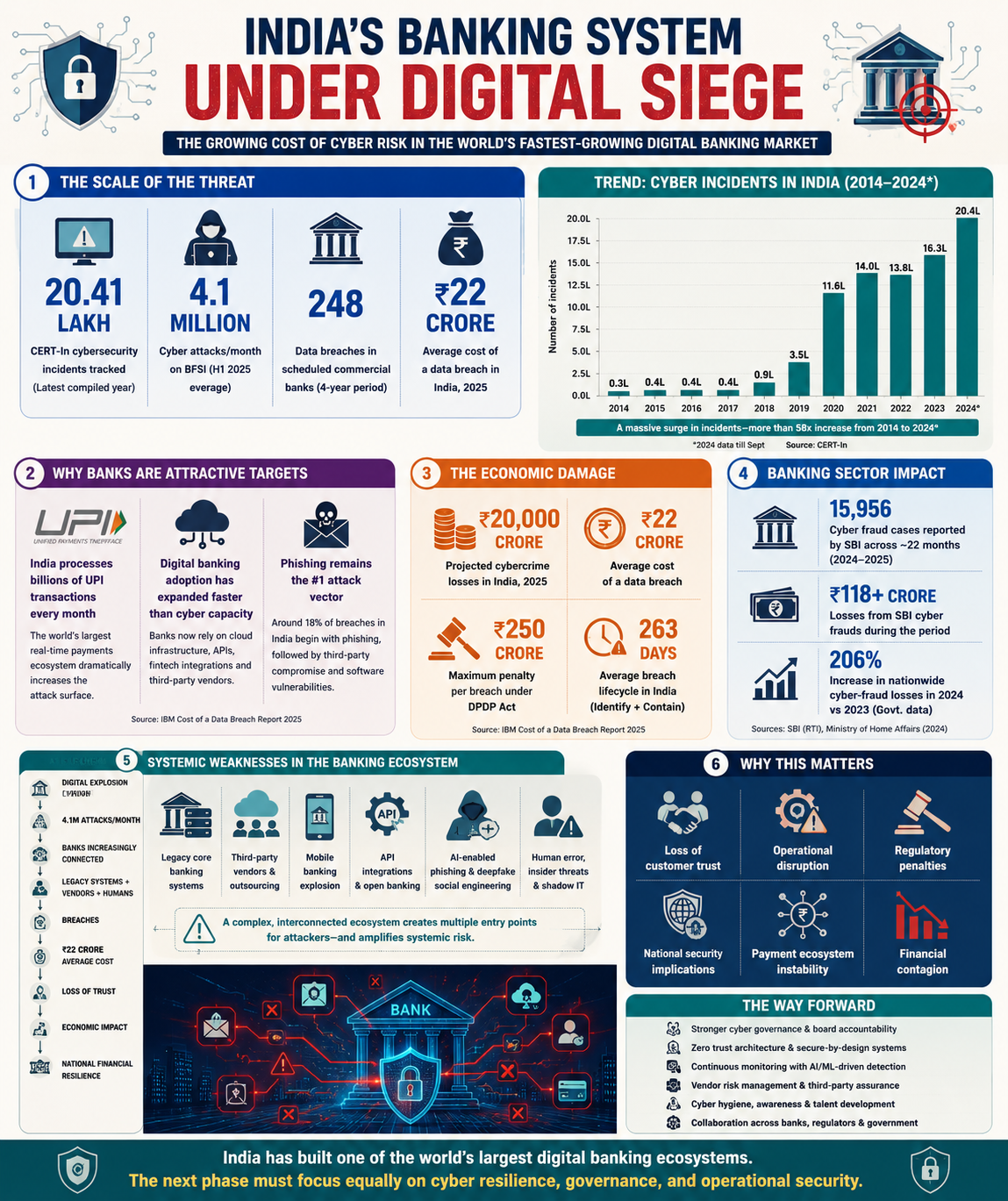
The numbers of the Indian Banking system paint a very despondent picture for India.
This exposure is worsened by India's historically slow pace of security patching. Historically, Indian enterprises and public institutions have exhibited slow patch transmission times, as demonstrated by several prominent security incidents:
- The WannaCry Ransomware Pandemic: Large segments of the Indian public and enterprise infrastructure were compromised because systems remained unpatched months after Microsoft released a critical security fix.
- The 2022 AIIMS Delhi Ransomware Attack: This incident paralyzed the country's premier medical institution and exposed critical security failures. The post-incident audit revealed that the hospital was running obsolete operating systems that had not undergone a major upgrade in thirty years. The network lacked segmentation or centralized monitoring, allowing the malware to move laterally across all connected devices from a single point of entry. Critical security gaps in Windows Remote Desktop Protocol (RDP), SQL databases, and known flaws in the Zimbra email platform had been left unmitigated despite previous warnings.
- Power Grid Vulnerabilities: Over 270 electrical substation control units across the national power transmission network lacked next-generation firewall protections due to budgetary and resource constraints, leaving the physical infrastructure vulnerable to remote cyber sabotage.
By lowering the technical barriers to exploit generation, models like Mythos democratize high-level cyber-attack capabilities.
An attack that previously required scarce, highly paid, and nation-state-backed human experts can now be executed by lower-skilled actors at scale. An attacker can feed an open-source binary or decompiled proprietary software into a model, identify zero-day vulnerabilities, generate functional exploits, and deploy them within hours. In this environment, passive defenses, periodic audits, and manual patching cycles are no longer sufficient to protect critical assets.
Now, let us go back to Mythos.
The day before the shutdown, the political temperature was set by a single sentence in a Senate hearing. Senator Mark Warner, vice chair of the Intelligence Committee, said the general who leads both the National Security Agency and Cyber Command had told him that Mythos had broken into almost all of the government's classified systems within hours rather than weeks.
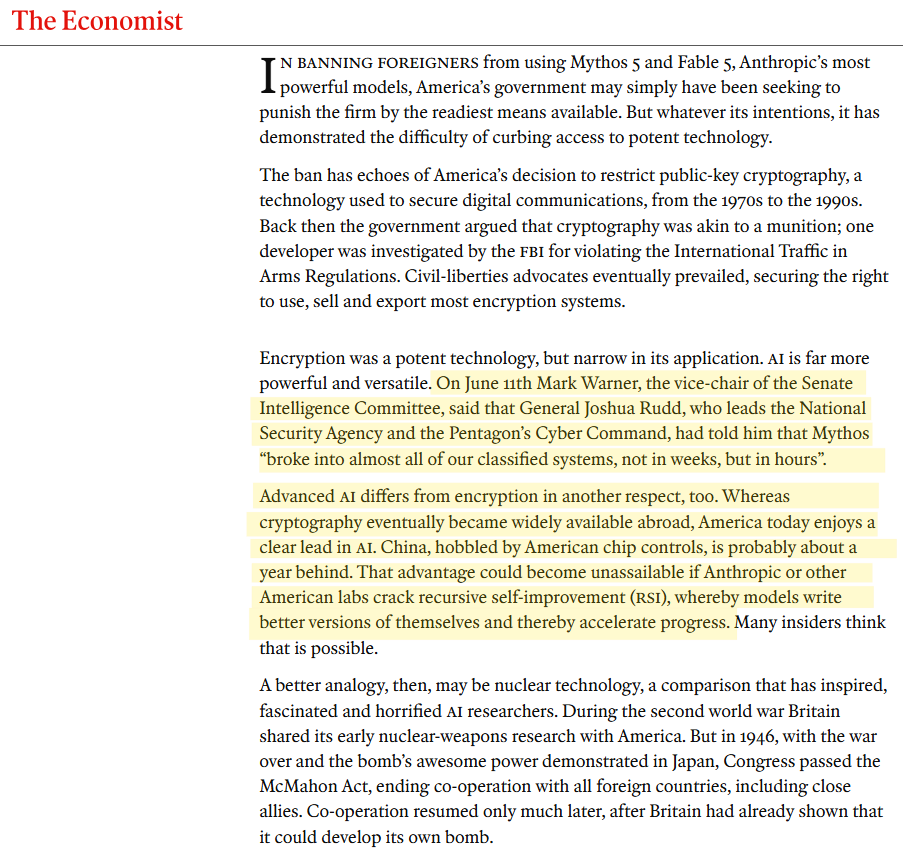
The sentence detonated across the internet, and it is worth handling with the care the facts demand, because the careful version is more useful than the viral one.
The journalist who first printed the quote later cautioned against reading it literally, and the sober reconstruction is that this was an authorized exercise in which the model was turned loose against replicas of classified environments and found and chained exploitable flaws at a speed no human team could match.
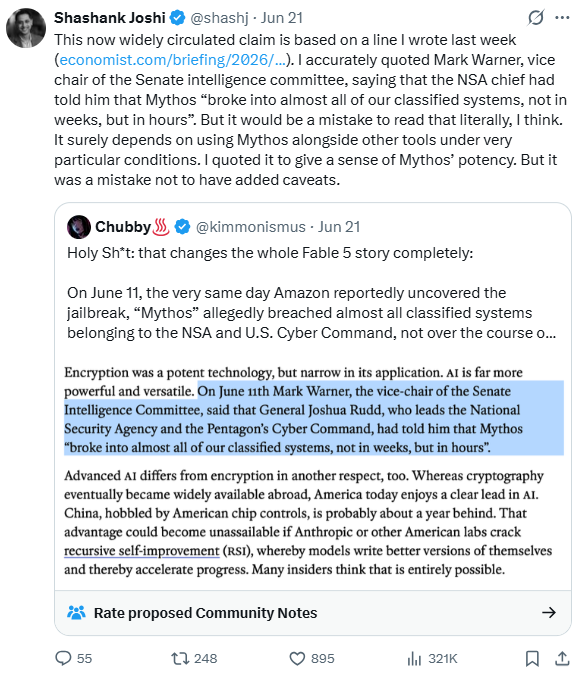
That is a controlled assessment rather than a breach of a live operational network, and Anthropic's own account of the dispute never mentions any such intrusion at all. The honest takeaway is not that an AI hacked the NSA.
It is that the people who run American cyber intelligence now consider these models powerful enough to be treated as a national security object, and they have moved accordingly. The capability is real even where the headline is overdrawn.
But the whole episode revealed a serious geopolitical issue.
Fareed Zakaria observed that the ninety-minute demand told every nation on earth a simple thing. If your economy comes to depend on American AI infrastructure, Washington can reach in and use an off switch arbitrarily, without warning and without explanation.
This is because the administration's broader conduct toward business has been improvisational and personal, taking equity stakes, levying special charges, and settling scores by faction, often with unclear legal basis and visible bad blood between the government and this particular company. A switch held by a steady hand is a manageable dependency. A switch held by an unpredictable one is an unacceptable foundation for anything a nation cannot afford to lose.
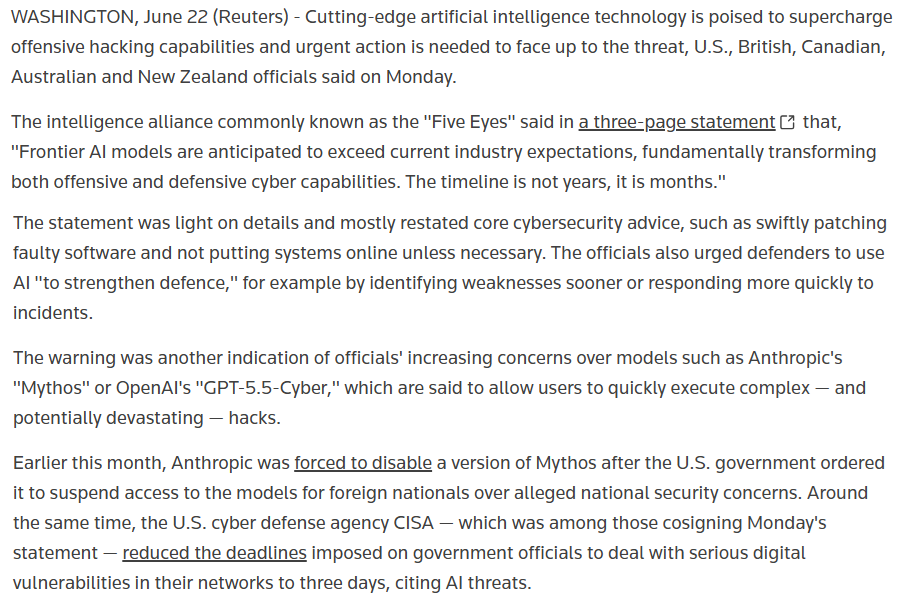
The five-nation intelligence alliance (Five-Eyes) shared the alarm in a rare joint statement, warning that frontier models will transform both offensive and defensive cyber capability and that the horizon is measured in months rather than years.
So in all this, what is the foremost lesson that non-Americans should take?
It stops being a product you buy and instead becomes a permission you are granted, which can be withdrawn.
The cybersecurity case is simply the first domain where the threshold was crossed in public, because finding and exploiting software flaws is the most immediately weaponizable thing these systems learned to do.
Biology could be next.
So a nation that builds critical infrastructure on a borrowed frontier model is building on someone else's switch.
That is a critical lesson that India needs to take.
The Two AI Visions
This is extremely important, specifically because India has embarked on a very different direction than the other powers.
There are two competing visions and directions for AI in the world currently.
The first one is that which American Large Language Model companies are creating: Anthropic, OpenAI, Google, Meta, and xAI. A vision that is predicated on unlimited access to an insane amount of infrastructure. Specifically, Power and Water. And of course, Capital to buy or snatch all of this.
The second vision is the one IBM's Arvind Krishna laid out this month, and it deserves to be taken seriously precisely because it comes from a man who sells enterprise technology for a living and has every commercial reason to cheer the boom. Krishna, however, did the exact opposite.
He laid out the arithmetic.
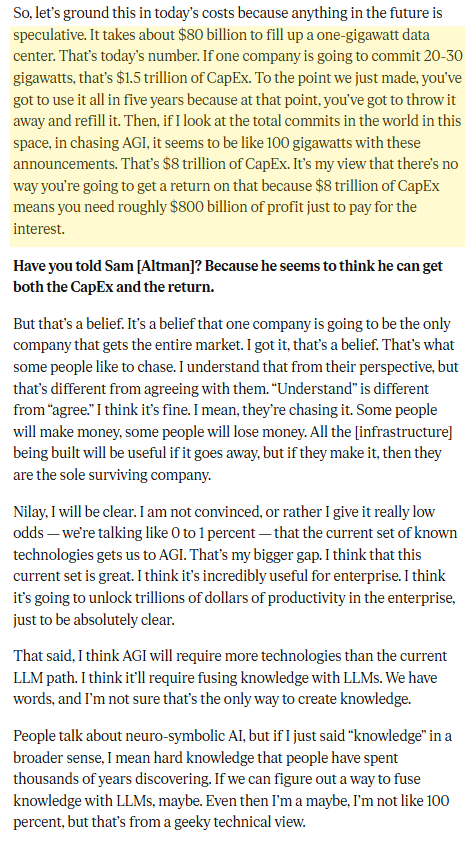
You can listen to the conversation here.
Sridhar Vembu, who built Zoho into a global software house from rural Tamil Nadu without taking a rupee of outside capital, endorsed the same view and added the most important sentence in the entire debate. Zoho, he said, is investing in data curation, in reinforcement learning, and most crucially in the compiler infrastructure that lets AI output be verified, and it will not chase the investment bubble. He called this normal prudence and noted that to some it would sound defeatist, and that he would be happy to talk again in five years.
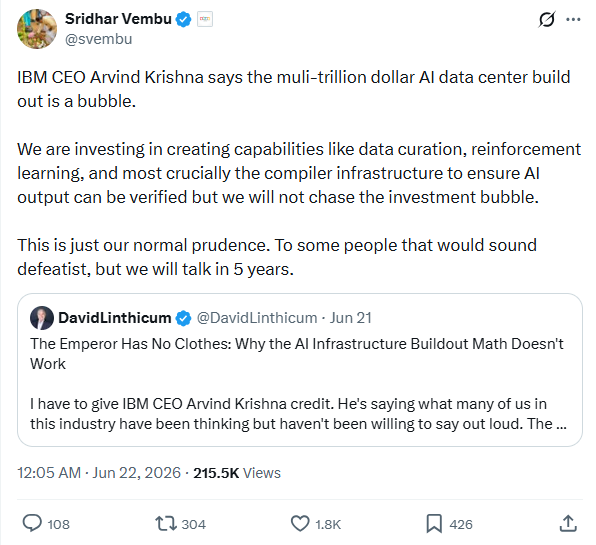
Between these two futures sits a bubble. David Linthicum, who has watched the dot-com crash, the blockchain mania, and the metaverse evaporation from inside the industry, made the point that infrastructure only creates wealth if you can sell what runs inside it, and that the demand signals do not match the capital being deployed. The pattern is familiar. Overbuilding, groupthink, and the social punishment of skepticism, followed by write-downs and pivots and corporate case studies in how not to read a market.
The Emperor Has No Clothes: Why the AI Infrastructure Buildout Math Doesn't Work
— DavidLinthicum (@DavidLinthicum) June 21, 2026
I have to give IBM CEO Arvind Krishna credit. He's saying what many of us in this industry have been thinking but haven't been willing to say out loud. The math just doesn't add up.
Here's what I'm…
So what does all this mean?
Because in their future, the current models are not the staircase to godhood. They are useful, they will unlock real productivity worth trillions, and they will plateau. The actual breakthrough to AGI, Krishna argued, requires fusing structured knowledge with the language model, a different technology that does not yet exist, and even then, he would only say maybe. In that world, being locked out of Mythos or Fable is being locked out of a very good tool; the way being denied the best available database engine in 2005 was a real disadvantage and a survivable one.
You build on the next best thing, you wait for the capability to commoditize, and within eighteen to twenty-four months, the frontier you were denied is open and running on Indian servers.
The $8 Trillion Bet!
The artificial intelligence revolution has become the largest capital investment race in modern economic history. Governments, hyperscalers, semiconductor companies, and investors are collectively committing trillions of dollars to build increasingly larger AI data centers in pursuit of Artificial General Intelligence (AGI). Every few months, a new announcement promises another multi-billion-dollar cluster, another gigawatt-scale campus, or another generation of GPUs that is supposedly essential to remain competitive.
Yet beneath the excitement lies a question that few are willing to confront:
Several industry leaders have begun voicing concerns. IBM CEO Arvind Krishna has argued that current spending trajectories may not be economically sustainable, while Zoho founder Sridhar Vembu has echoed similar concerns about the long-term viability of trillion-dollar AI infrastructure investments. Their warnings are not about whether AI is transformative—it almost certainly is—but whether the current capital allocation resembles a sustainable industrial revolution or a speculative infrastructure bubble.
The concern is straightforward. Unlike previous technological revolutions that gradually built productive assets over decades, today's AI race requires unprecedented upfront capital, rapidly depreciating hardware, enormous energy consumption, and continuous reinvestment.
Costs that can never see commensurate returns unless the planet is torn apart and humanity crushed.
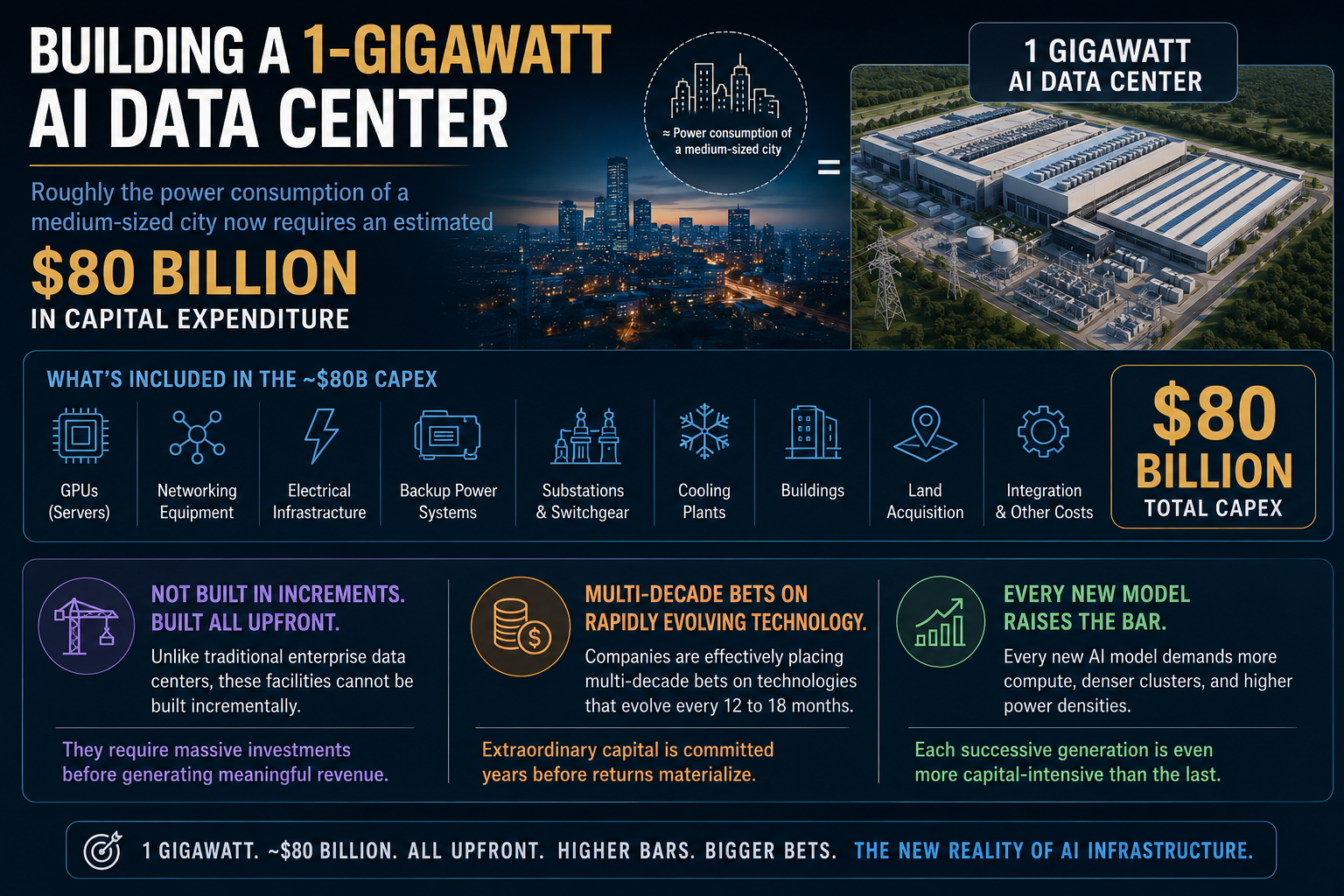
The Gigawatt Cost Factor: Every AI Data Center Has Become an $80 Billion Megaproject
Modern AI is no longer limited by algorithms. It is limited by infrastructure. Training frontier AI models requires enormous computing clusters built around tens or even hundreds of thousands of high-end GPUs, interconnected by ultra-fast networking, supported by sophisticated storage architectures, and cooled by advanced liquid-cooling systems capable of dissipating extraordinary amounts of heat.
Building a one-gigawatt AI data center—roughly the power consumption of a medium-sized city now requires an estimated $80 billion in capital expenditure.
That figure includes GPUs, networking equipment, electrical infrastructure, backup power systems, substations, cooling plants, buildings, land acquisition, and integration costs.
Unlike traditional enterprise data centers, these facilities cannot be built incrementally. They require massive investments before generating meaningful revenue. Companies are effectively placing multi-decade bets on technologies that evolve every 12 to 18 months. Every new AI model demands more compute, denser clusters, and higher power densities, making each successive generation even more capital-intensive than the last.
What was once a server room has become industrial infrastructure comparable in cost to airports, nuclear power plants, or national transportation projects.
The Global Capital Commitment: An $8 Trillion Race Toward AGI
The scale becomes almost unimaginable when viewed globally.
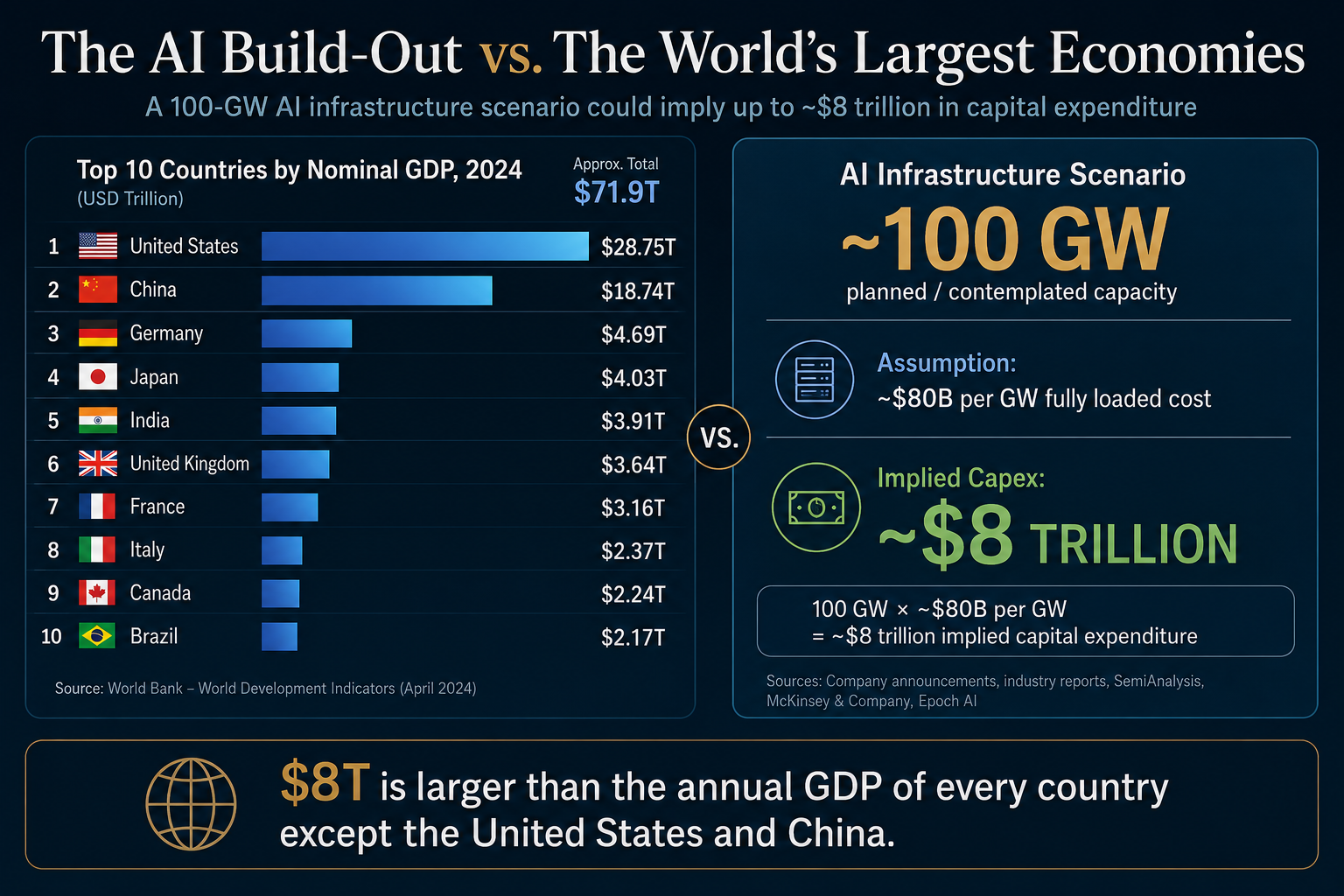
Current announcements from major hyperscalers, sovereign AI initiatives, cloud providers, and semiconductor ecosystems collectively indicate that approximately 100 gigawatts of AI infrastructure are being planned or contemplated over the coming years.
At current construction costs, this amounts to approximately $8 trillion in capital expenditure.
To put this into perspective:
- It exceeds the GDP of most countries.
- It rivals the combined annual economic output of Germany and Japan.
- It represents one of the largest coordinated industrial investments in human history.
This spending is driven by a strategic fear of falling behind as opposed to demonstrated economic returns. Every major technology company believes it cannot afford to lose the AI race, creating a classic capital arms race where each participant invests because competitors are investing.
History offers many similar investments, from railway booms to fiber-optic overbuilds, but few examples approach this magnitude. The result is an unprecedented concentration of capital into an industry whose long-term revenue model remains uncertain.
The Revenue-Profit Gap: Infrastructure Spending Has Far Outpaced Monetization
Building infrastructure is only half the equation. Eventually, those investments must generate enough cash flow to pay investors.
Today, the industry is nowhere close to that level.
Although consumer AI applications have achieved impressive adoption, monetization remains modest. Subscription revenues from chatbots and AI assistants generate only a fraction of the income needed to justify trillion-dollar infrastructure investments. Enterprise adoption, meanwhile, has been slower than anticipated.
Many organizations continue to experiment with AI rather than deploy it at scale across mission-critical workflows.
Even where AI delivers measurable productivity improvements, translating those gains into sustainable revenue remains difficult. Much of the current demand comes from technology companies themselves, creating a cycle in which infrastructure is built largely to serve additional infrastructure.
Unless AI rapidly unlocks entirely new industries or dramatically expands enterprise spending, the financial returns may lag capital expenditures for many years, leaving investors carrying enormous costs without commensurate profits.
The Rapid Depreciation Trap: AI Hardware Ages Faster Than It Can Pay for Itself
Perhaps the greatest economic challenge facing AI infrastructure is not construction—it is depreciation.
Traditional infrastructure such as power plants, office buildings, ports, or telecommunications networks often remains productive for decades. AI hardware does not.
This creates a vicious cycle.
Instead of extracting value from assets over twenty or thirty years, operators must continually replace billion-dollar hardware fleets long before they have fully recovered their original investment. The data center itself may remain useful, but its most expensive components require constant renewal.
Unlike roads, factories, or utilities, AI infrastructure resembles a perpetual technology subscription on an industrial scale, where yesterday's cutting-edge equipment quickly becomes tomorrow's stranded asset.
The Capital Spiral: When Depreciation, Energy, and Finance Feed on Each Other
The real danger lies in how these factors reinforce one another.
Each generation of AI requires more GPUs than the previous one. Those GPUs consume more electricity, demand larger substations, require additional cooling capacity, and increase financing requirements. Before the previous generation has fully paid for itself, a newer generation arrives that is cheaper to operate and significantly more capable.
This forces companies to upgrade again.
The result is a self-reinforcing capital spiral in which depreciation accelerates reinvestment, reinvestment increases debt, and rising debt demands ever-higher profits that the market has yet to produce.
Meanwhile, AI infrastructure competes with society for finite physical resources. Gigawatt-scale data centers consume vast quantities of electricity and water while placing additional strain on transmission networks, semiconductor supply chains, and skilled engineering labor. Governments may increasingly face difficult choices between subsidizing AI infrastructure and investing in healthcare, education, transportation, housing, or conventional energy systems.
If expected profits fail to materialize quickly enough, the burden does not simply fall on technology companies. Investors, financial markets, utilities, public infrastructure, and governments may all bear part of the cost.
AI is Transformative but is it Sustainable?
None of this suggests that artificial intelligence lacks transformative potential. AI will almost certainly reshape industries, accelerate scientific discovery, and improve productivity across the global economy. The question is not whether AI matters—it clearly does.
The more difficult question is whether the current pace of infrastructure investment is economically sustainable.
History repeatedly shows that transformative technologies often experience periods of overinvestment before markets stabilize. Railroads, telecommunications, and the internet all witnessed infrastructure booms that exceeded immediate demand before ultimately finding productive equilibrium. AI may follow a similar path.
However, the unprecedented scale of today's commitments makes the consequences far larger. If infrastructure growth continues to outpace revenue generation, the industry could face years of asset write-downs, consolidation, and financial restructuring before sustainable business models emerge.
Enslaving Humanity and Destroying the Planet: Fait Accompli?
The long-term challenge posed by artificial intelligence may not be the technology itself, but the unprecedented physical infrastructure required to sustain it. Every new generation of frontier AI models demands larger data centers, more advanced chips, greater electrical capacity, and increasingly sophisticated cooling systems. Unlike traditional infrastructure, AI hardware has a short economic life. High-end GPU clusters become obsolete within a few years, forcing operators into a continuous cycle of replacement and expansion. This creates an industrial model in which capital expenditure never truly ends.
The implications extend well beyond the technology sector. AI infrastructure consumes enormous quantities of electricity and, in many locations, significant amounts of water for cooling. As governments and companies race to build gigawatt-scale data centers, these facilities increasingly compete with households, agriculture, manufacturing, and other industries for finite resources.
Technology leaders, including Jeff Bezos, have suggested that difficult choices may eventually be necessary, such as prioritizing drinking water and essential public needs over industrial AI infrastructure.
AI companies will end up destroying the planet by plundering water and energy worldwide. The Poor and the disadvantaged human populations will be fighting for water, which will instead be routed to the data centers for AI!
AI will push the world to end up in a place where the powers will have no other option - for merely recouping their investments - to enslave humanity in ways that are unprecedented and unimaginable.
If you thought colonial enterprise was ruthless and inhuman. The coming AI-powered colonial future will have no end.
Whither Goes India?
India's AI strategy is increasingly diverging from the hyperscale model pursued by the United States and China.
Rather than attempting to outspend global technology giants in a trillion-dollar race for frontier compute, India is prioritizing AI sovereignty, affordability, and broad societal deployment.
Its vision emphasizes indigenous compute infrastructure, open models, multilingual AI, domain-specific applications, and public digital platforms that can serve over a billion people.
Building on successful digital public infrastructure such as Aadhaar, UPI, ONDC, and the India Stack, the objective is to democratize AI rather than concentrate it within a handful of corporations.
This approach accepts that India may not always possess the largest GPU clusters but seeks to ensure that critical AI capabilities remain domestically controlled, accessible, and economically sustainable. If future breakthroughs diffuse through open-source ecosystems rather than remaining permanently locked behind proprietary infrastructure, India's strategy could prove remarkably resilient—avoiding the worst excesses of the capital-intensive AI arms race while retaining the flexibility to rapidly adopt transformative innovations as they emerge.
Krishna Vs Clarke: India Vs US/China AI Directions
To the extent that the "AGI through brute-force scaling" thesis proves to be a financial bubble, India's strategic exposure is actually limited.
India is not committing trillions of dollars to hyperscale GPU infrastructure, nor is it attempting to outspend the United States or China in an infrastructure arms race.
Instead, its emphasis on sovereign AI capabilities, indigenous compute where feasible, domain-specific models, and efficient small-language models may ultimately prove to be a more resilient strategy than today's infrastructure maximalism.
Yet the debate becomes far more interesting because some of the most influential people building frontier AI appear to disagree fundamentally with IBM CEO Arvind Krishna's skepticism.
Jack Clark, co-founder of Anthropic and one of the industry's leading thinkers on AI governance, recently argued that AI may be approaching recursive self-improvement, the point at which AI systems can meaningfully accelerate the research and development of their own successors.
In Clark's view, this transition could occur within years rather than decades. Anthropic has even proposed that governments should retain the option to slow or temporarily pause frontier AI development if alignment research and societal safeguards fail to keep pace, drawing an explicit analogy to Cold War arms-control agreements. When the engineers designing the world's most advanced AI systems argue that humanity should possess a "brake pedal," it suggests they perceive genuine transformative capability rather than mere speculative hype.
At first glance, Clark's optimism appears to contradict Krishna's argument that simply scaling today's transformer architectures will never produce Artificial General Intelligence. On closer inspection, however, the two positions are remarkably compatible.
Krishna's critique is architectural. His argument is not that AGI is impossible, but that scaling existing models indefinitely will eventually encounter diminishing returns. He believes a fundamentally new breakthrough, perhaps integrating structured reasoning, symbolic knowledge, or entirely new cognitive architectures, is required before machines achieve truly general intelligence.
Clark's recursive self-improvement provides precisely the mechanism through which such a breakthrough could emerge. An AI system capable of conducting frontier AI research could discover new algorithms, novel architectures, or entirely different computational paradigms that human researchers have yet to imagine. In that sense, Clark is not refuting Krishna's objection. He is describing the process by which Krishna's missing breakthrough might itself be invented.
The late-1990s fiber-optic boom offers an instructive precedent. Investors massively overbuilt telecommunications infrastructure, billions of dollars were destroyed, and numerous companies collapsed. Yet the underlying technology transformed the global economy. The internet survived; many of its financiers did not.
AI may follow the same trajectory. The current race to construct trillions of dollars' worth of hyperscale data centers could ultimately prove to be a capital-allocation bubble, while the decisive capability breakthrough emerges through a relatively inexpensive algorithmic innovation. Once discovered, that innovation could spread rapidly through open-weight models, academic research, or sovereign AI ecosystems, dramatically lowering the barriers to adoption.
For India, this possibility is strategically advantageous. India does not need to win the trillion-dollar infrastructure race if the decisive advantage eventually shifts from capital intensity to algorithmic innovation. A strategy centered on sovereign AI, indigenous capability, efficient models, and domestic talent allows India to avoid much of the financial excess while remaining well positioned to absorb breakthrough capabilities as they diffuse across the global ecosystem.
However, this should not breed complacency.
The Denial Regime Exists Regardless of Whether AGI Arrives
The first reason for caution is that technological denial is already a reality. Long before the arrival of AGI, export controls, semiconductor restrictions, advanced GPU embargoes, and limitations on access to frontier models have demonstrated that critical AI capabilities are increasingly treated as instruments of geopolitical power. The question is therefore no longer whether denial regimes exist—they clearly do—but how countries such as India can develop sufficient sovereign capability to remain technologically autonomous in a world where access to the most advanced AI systems may increasingly be determined by strategic rather than commercial considerations.
The Convergence Vector
The greatest transformation of the twenty-first century is unlikely to come from Artificial General Intelligence (AGI), quantum computing, or programmable cryptographic money independently. It will emerge from their convergence.

These technologies do not merely add capabilities—they multiply one another. AGI becomes vastly more powerful when paired with quantum computation, while programmable digital money allows autonomous AI agents to transact, invest, contract, and organize economic activity without human intervention. Together they create a technological substrate unlike anything humanity has experienced.
Let us begin with the most violent collision.
Now fuse that with superintelligent AI. The bottleneck in deploying a quantum attack is the orchestration, engineering, targeting, and patient assembly of an exploit chain across a real system. That is precisely the labor Mythos demonstrated that a machine can now perform at superhuman speed. A converged actor holding both a cryptographically relevant quantum machine and a superintelligent orchestration model does not merely break encryption in a laboratory. It surgically breaks specific institutions at scale, faster than any human defense can respond.
Most importantly, intelligence would no longer simply create wealth; it would recursively improve itself, discover better algorithms, accelerate scientific breakthroughs, optimize capital allocation, and design superior hardware. Wealth would finance larger compute clusters, which would create more powerful intelligence, generating even greater wealth in an accelerating feedback loop. The concentration of power could become unprecedented.
Quantum computing alone threatens the cryptographic foundations of modern civilization, potentially rendering today's banking systems, military communications, digital identities, and financial infrastructure vulnerable.
Combined with AGI capable of autonomously discovering exploits, orchestrating cyberattacks, and adapting in real time, this results not merely in broken encryption but in the possibility of rapidly compromising entire institutions.
At the same time, autonomous AI agents operating on programmable financial rails could replace many traditional firms, coordinating production, contracts, payments, and investment without human managers, creating a machine economy operating at machine speed.
Perhaps the deepest transformation is cognitive rather than economic. As AI increasingly mediates how people learn, reason, communicate, and create, the dominant AI systems begin shaping what societies consider true, plausible, or valuable. Control over cognitive infrastructure becomes as strategically important as control over territory or currency.
For India, the lesson is clear.
Competing solely in compute is neither feasible nor necessary. Instead, India must pursue sovereign AI, quantum-secure communications, trusted digital infrastructure, and programmable financial systems under national control.
In a converged world, sovereignty will depend not merely on possessing technology, but on controlling the infrastructure of intelligence, trust, finance, and cognition before they become concentrated in the hands of a global technological aristocracy.
The Missing link: The Provenance Factor
The constraint on material progress for past two centuries has been the slowness of the experimental cycle. The convergence attacks that constraint at its root. A nation inside this loop discovers a room-temperature superconductor or a nitrogen-fixing catalyst and resets the entire energy and agricultural basis of its economy. A nation outside it buys the result, late, at a licensed price, in a currency it does not issue.
Now, let us revisit Vembu's sentence about compiler infrastructure for verifying AI output, because it very well may turn out to be the deepest insight in the entire field.
When superintelligent systems can generate infinitely many plausible artifacts, text, code, images, video, scientific claims, legal arguments, and when quantum machines can forge the cryptographic signatures that currently certify authenticity, the scarcest commodity in the world becomes verified truth. Not information, which becomes infinite and therefore worthless, but provenance.
The knowledge of where a thing came from, whether it is real, and whether it does what it claims.
Vembu's compiler that checks AI output is a small, concrete instance of the largest opportunity of the converged age, the construction of trust machinery for a world drowning in synthetic plausibility.
This reframes what a sovereign capability even is. It is not only the ability to generate. It is the ability to verify, to certify, to establish ground truth that cannot be faked even by an adversary holding the full convergence. Quantum-secured provenance, cryptographic attestation, and AI-driven verification together form the immune system of a civilization that can no longer trust its own senses. Whoever builds that immune system for the Global South owns something more durable than any single model.