
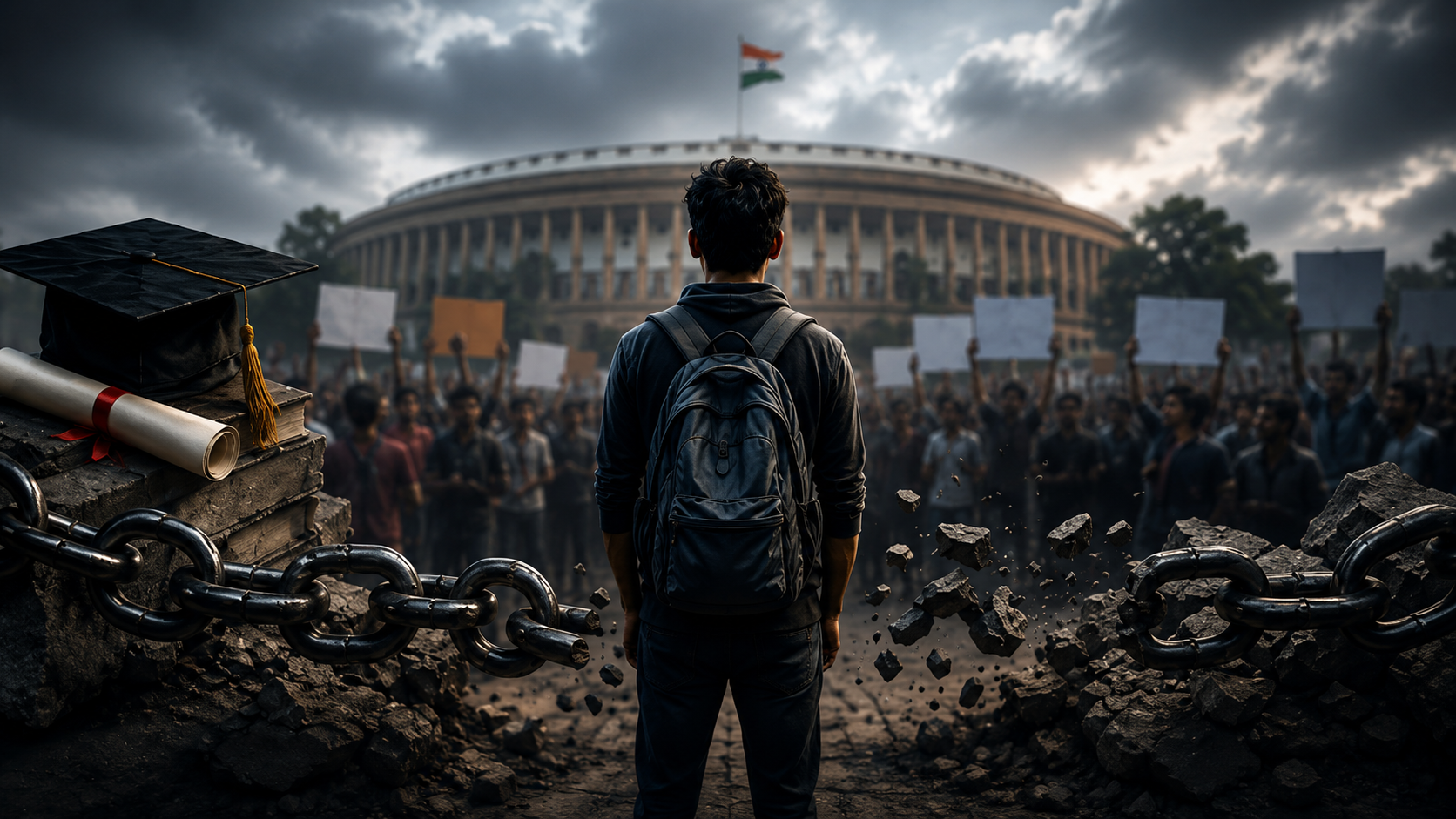
The Locust and the Well
A village had one well, and the water was bitter.
An old woman began teaching the children to dig a second well, in the hard ground beyond the fields. It would take twenty years. The children dug an hour each morning before their chores.
A locust came and stood at the bitter well. "Taste this," it said to the villagers. "It is foul. Who gave you this water?"
The villagers tasted, and it was foul, and they grew angry. They tore down the old well and drove out the one who had built it. Then they turned to the old woman, because she had said nothing, and they drove her out too.
The children stopped digging. They were needed at the bitter well, drawing what water there was.
The locust moved on.
Forty years later a traveler asked an old man of that village why the second well was never finished.
"There was no second well," he said. "There was only ever the one."
"But the hole in the far field."
The old man looked at him. "That was always there."
What India faces today?
India's future will not be shaped only at its borders, in Parliament, or through economic growth. It will also be shaped in its schools, universities, examination centers, and research institutions—the places where the next generation gains knowledge, skills, and opportunity.
Every nation protects its critical infrastructure. We usually think of power plants, banks, ports, communication networks, and military bases. But there is another equally important form of infrastructure: the institutions that educate people and determine who advances in society.
Over the last decade, India has built a new economic foundation through digital infrastructure, financial inclusion, manufacturing initiatives, MSME reforms, logistics improvements, and a new education policy. These reforms are designed to work together, not in isolation.
That is both a strength and a weakness.
If one part of the system fails, it can weaken the entire structure. More importantly, anyone seeking to slow India's progress may find it easier to undermine trust in its education and examination systems than to directly attack its economy.
Today we look at the CJP protests: what began as anger over a leaked NEET paper escalated to a minister's resignation, then to the government, and finally to a platform with nothing to do with examinations.
That led backward to the vendor security failures that made the grievance real, and to the question of who benefits from a movement that never asks for a single technical fix.
But the protesters are not going for that. It is going for the government of India and Hindus given the sloganeering. Why?
Why is education suddenly such a big target?
India's revisionist historians (closer to fiction writers) are being upended, and history is being taken back to its origins with facts. That is a problem for the previous agenda-driven politicians.
Also, the new NEP 2023 changes India's future trajectory. We look at everything.
So we built four scenarios through 2060 and priced out the cost of stopping it.
93 trillion dollars.
Ground zero
India's strength is education. That is what provides its services and technology sectors with the scale to beat the world.
The education system rests on meritocracy. Meritocracy uses a filter - the examination system that allocates roughly a million young lives a year into engineering, medicine, and public employment.
India moved its big national exams to digital platforms. JEE, NEET, CUET, SSC, banking exams — all of it moved online.
That was the right decision.
The old system had paper leaks happening everywhere for decades. Criminal networks were embedded in state exam boards all across the country. That could not be fixed without changing the whole system.
So digitization, or going digital, was absolutely the right step for the nation and for the students.
The fundamental issue with the system was that it did not provide sufficient security to keep hackers and scamsters completely out.
JEE and Affinity Education Pvt Ltd
In the 2021 JEE Main, a Noida-based entity called Affinity Education Private Limited, operating openly and claiming ties with over 650 universities, ran a syndicate that charged candidates 12 to 15 lakh rupees per seat.
It held original Class 10 and 12 mark sheets and post-dated cheques as collateral so that clients could not default or inform. Remote solvers took control of terminals at a compromised center in Sonepat while candidates sat in front of the screens pretending to work. The CBI registered RC-DAI-2021-A-0032, raided twenty locations, and recovered twenty-five laptops, seven PCs, over thirty post-dated cheques, and the confiscated mark sheets of students held hostage in a corporate office.
The technical breach of the iLeon platform was beyond the syndicate's own capability, so it bought the capability. Vinay Dahiya served as a bridge between the corporate directors and the technical layer and was arrested in Gurugram in 2023. In October 2022, the CBI arrested Mikhail Shargin, a Russian national, who was identified as the person who broke the software's cryptographic defenses.
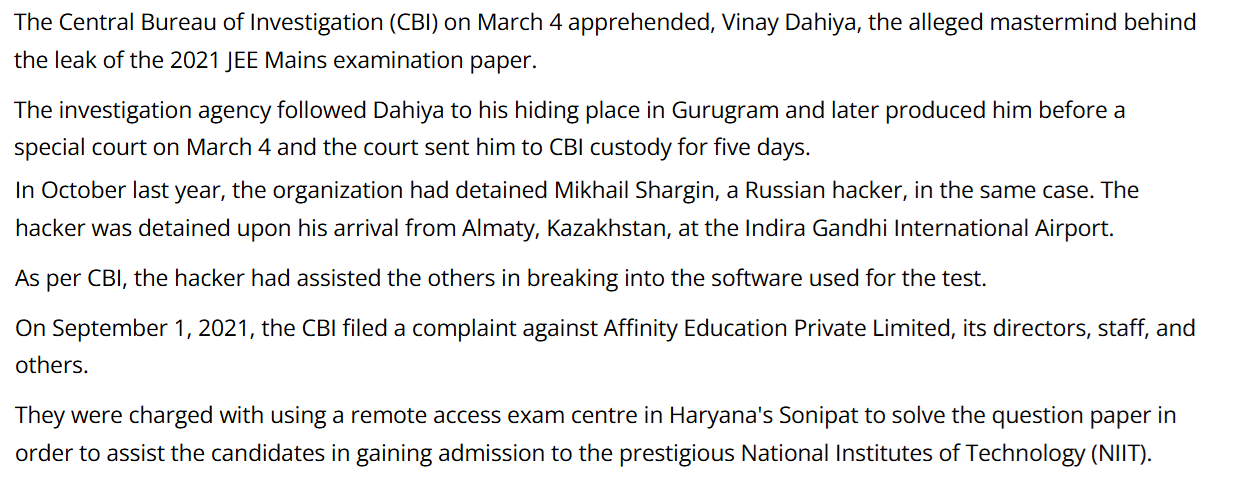
A foreign cyber-mercenary was hired to compromise the gateway to India's engineering institutions.
That case was clearly a national security risk and should have triggered a comprehensive review. There is no public information about what the subsequent steps were.
There was another case.
Jail Prahari Case in Rajasthan
The investigation conducted by the Rajasthan Police’s Special Operations Group into the 2018 Jail Prahari, or Warder, Recruitment Exam is a disturbing example of this new threat. This was not a case where criminals broke into an exam center from outside. It was not a case of some small-time operator stealing a printed paper from a local office.
According to the SOG investigation, the question papers were leaked directly from the source itself — from inside the digital system that was supposed to protect them.The secure assessment had been contracted by Sardar Patel University in Jodhpur to Tata Consultancy Services.
TCS was responsible for conducting the exam and protecting the integrity of the process. But the SOG found that the breach came from within TCS. The alleged mastermind was identified as Jagjit Singh, a TCS Project Manager based in Gurugram, who had earlier lived in Noida.
 Dev Ankur Wadhawan
His position mattered because he was not an outsider trying to hack the system. He was a trusted insider with privileged administrative access to the digital infrastructure where the encrypted examination material was stored.That is what makes this case so serious. When a system is breached from the outside, the immediate question is technical security. But when the breach comes from someone with authorized access, the problem is deeper. It becomes a question of internal controls, access governance, monitoring, audit trails, vendor accountability, and institutional trust.
From there, the leak entered the black market of competitive examinations. The materials were allegedly brokered through Sandeep Kandiyan, a middleman from Sonipat, Haryana. Kandiyan reportedly negotiated a ₹60 lakh payoff to distribute the leaked answer keys to paying candidates. In other words, the exam was converted into a private marketplace. Those who could pay gained access. Those who studied honestly were placed at a direct disadvantage. The system that was supposed to reward merit was corrupted into a system that rewarded money and criminal connection.
The arrests followed the chain of the leak. Based on intelligence gathered during Kandiyan’s interrogation, the SOG detained and arrested Karan Kumar in Dehradun on March 23. This then led to the arrest of Jagjit Singh, the TCS Project Manager who had leaked the papers.
This case exposes the central weakness in India’s digital examination architecture. Digital platforms can reduce old-style paper leaks, but they cannot protect students if insiders with privileged access are not monitored, restricted, and audited. Encryption is not enough if the person holding administrative access can extract the material. A secure platform is not secure if vendor employees can become points of compromise.
TCS Resource Management Group case
TCS had another scandal - the TCS Resource Management Group case.
Though it related to corporate HR but its implications were far wider.
According to a report in The Economic Times, TCS faced a major internal scandal involving its Resource Management Group, or RMG. The RMG is not a minor department. It plays a central role in allocating talent, managing recruitment needs, and supporting staffing decisions across the company’s large global operations. In a technology company of TCS’s scale, this function directly shapes the quality, integrity, and reliability of the workforce that eventually handles critical systems.
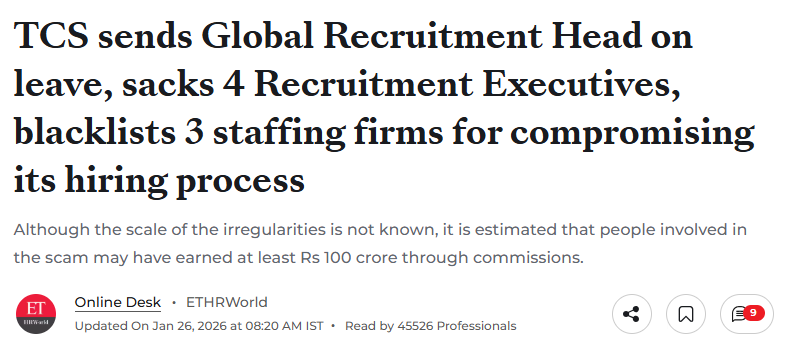
The scandal reportedly came to light because of a whistleblower who bypassed middle management and reached out directly to the company’s CEO and COO. That detail is important. It suggests the person raising the alarm may not have trusted the normal internal chain of command to deal with the issue honestly. The complaint alleged a long-running bribery network involving senior executives within the RMG and unauthorized staffing firms.
The most prominent name reported in connection with the matter was E.S. Chakravarthy, the global head of the RMG and a senior vice president at TCS. Several other executives connected to hiring and staffing decisions were also reportedly implicated. The allegation was that unauthorized staffing firms had paid illicit commissions to insiders in exchange for preferential access to hiring and placement opportunities.
After the complaint surfaced, TCS reportedly assembled an internal investigation team led by its Chief Information Security Officer, Ajit Menon. That choice itself is revealing. This was not treated merely as an HR issue. It was serious enough to involve the company’s security leadership, because compromised hiring is ultimately a security risk. The investigation reportedly led to significant action: the head of recruitment was placed on leave, four senior RMG executives were dismissed, Chakravarthy was barred from entering company premises, and three staffing firms were blacklisted.
The implications for digital examination security are serious. TCS, through its digital infrastructure and services, has been associated with major examination and testing systems. When such a company is entrusted with sensitive exam operations, the assumption is that its internal controls are strong, its employees are vetted, and its access pathways are secure. But a bribery scandal inside the hiring apparatus weakens that assumption.
If recruitment and staffing decisions can be influenced by illicit payments, then the talent pipeline itself becomes suspect. The danger is not only that unqualified people may be hired.
The greater danger is that compromised people may enter sensitive roles. A person does not need to break a firewall if they can enter through the front door as an employee, contractor, manager, or vendor-approved resource.
The guardrails that were never built
The fact is that adequate guardrails were never built in TCS and other vendors providing testing services. Three architectural decisions created this issue.
The franchise model. India's examination system depends on thousands of privately owned computer labs and engineering colleges rather than secure government-controlled facilities. Organizations such as the National Testing Agency and their technology vendors rent these centers only for exam days. This means the computers, local networks, and system administrators often remain under the control of third parties. If even one local administrator is compromised, attackers may gain access despite strong encryption or other security measures. Security is only as strong as the weakest point in the chain. When the organization conducting the examination does not fully control the infrastructure, protecting the integrity of the entire system becomes extremely difficult.
The absence of a national-champion security classification. India treats sectors like defense, banking, and power as critical infrastructure with strict security standards, background checks, and continuous monitoring of sensitive personnel. National examination systems, however, receive no similar protection despite deciding the future of millions of students and job applicants. People with access to examination software, question banks, or administrative systems are usually hired through normal corporate processes without special security clearances or ongoing vetting. If such individuals misuse their access, there are limited safeguards. While the government outsourced examination operations, it failed to extend the same level of security oversight that protects other nationally important systems.
Vendor risk management as procurement rather than as defense. The government largely treats examination vendors as ordinary service providers hired through contracts with performance targets and penalty clauses. But national examinations are not just another IT service—they are part of the country's critical public infrastructure. The threats include organized cheating networks, criminal syndicates, insider threats, and potentially sophisticated cyber attackers. Managing such risks requires continuous security audits, intelligence sharing, strict access controls, and independent oversight, not just contract compliance. By viewing vendors primarily through a procurement lens rather than a national security lens, the system prioritized efficient service delivery over building strong defenses against determined adversaries.
Implications of such failures
Most government failures are hard for ordinary people to see clearly.A parent in Muzaffarpur may not know whether school education in their district has improved or declined. They do not have the data. They do not have a direct comparison. They cannot easily measure whether children are learning better than before. That is why education reform often brings little political reward. The failure is real, but it is not always visible.
Exams are different.An exam is personal. Every student knows the date. Every family knows what is at stake. Years of preparation, coaching fees, family savings, sleepless nights, and emotional stress are all tied to one result.
So when a paper leaks, the damage is immediately understood. Lakhs of families realize at the same time that the system they trusted was not fair. The exam was not a real test of merit. The sacrifice they made may have been wasted.
There is no confusion here. No expert is needed to explain it. If the paper leaked, the exam was compromised. That is simple, direct, and emotionally devastating.
This kind of failure can create intense anger.
- First, it is national. These exams are not limited to a single town or state. Students across India are affected.
- Second, it is concentrated among young people, especially those between eighteen and twenty-five. This is the age group most likely to protest, organize, and respond quickly to political messaging.
- Third, the anger is morally strong because the grievance is true. Students were wronged. Families were cheated. The government cannot easily argue against that anger without sounding like it is defending corruption or cheating.
That makes this anger extremely valuable to anyone who wants to use it.
The students may want justice. Their families may want fairness. But once such anger exists, others will try to capture it, redirect it, and use it for their own goals.
The real question is not whether this anger will be used.
It will be.
The real question is: who will use it, and for what purpose?
The capture
The Cockroach Janta Party began on 15 May 2026 after a courtroom remark. During a contempt case involving senior advocate designations and fraudulent qualifications, the Chief Justice used the words “cockroaches” and “parasites.” Soon after, Abhijeet Dipke, a political communications strategist who had earlier worked with the Aam Aadmi Party, posted a question online: what would happen if all the cockroaches came together? He then registered the name.
The movement grew with unusual speed.
Within three days, it had eleven million Instagram followers. Within a month, it had crossed twenty million followers and four hundred million reel views. Its first rally was held at Jantar Mantar on 6 June. At that stage, the main demand was the resignation of Dharmendra Pradhan. By 22 June, the protest had turned into a sustained camp. Rallies then began appearing in Pune and other places.
But the direction of the movement changed quickly.
What started as anger over examination failures soon became a demand for a minister’s resignation. Then it became a demand against the government itself. After that, it expanded into a broader ideological platform, with slogans against the ruling party, attacks on large sections of the media, and the involvement of politicians, activists, and public figures who already had their own agendas.
This pattern is familiar.
India saw something similar during the India Against Corruption movement between 2011 and 2013. That movement also began with a real grievance: corruption. It had a moral message that was difficult to oppose. It mobilized large numbers of urban youth. Then it moved from one specific demand to wider institutional demands, and finally toward a political challenge to the government. Within two years, it became the foundation for a new political party. Dipke had worked inside the party that came out of that earlier movement.
A similar pattern appeared in the protests against the CAA and the farm laws. In both cases, the public campaign quickly moved beyond the actual text of the policy. The CAA was presented as if it would take away the citizenship of Indian Muslims, even though the law did not do that. The farm laws were presented as if they were designed to destroy farmers, even though similar agricultural reforms had been discussed for decades. In both cases, the original issue became a platform for much wider political messaging. Slogans, international amplification, activist networks, and ideological groups pushed the movements beyond policy debate and into a broader anti-government, anti-India, and often anti-Hindu narrative. The stated grievance became only the entry point. The larger purpose became delegitimizing the Indian state and the civilizational majority that supports it.
So the key question is not whether students have a real grievance. They probably do. Examination failures are serious. Students and families should demand accountability.
The real question is whether this movement is still focused on fixing exams.
All evidence points to the fact that the movement was planned inorganically. It is being managed by someone.
More importantly, the movement has been captured politically.
Its demands today do not seriously address the real technical weaknesses in India’s exam system. It is not focused on the National Testing Agency’s dependence on rented computer centers. It is not demanding strict security vetting for vendor employees. It is not asking for stronger control over local IT administrators, exam-center networks, or people with access to question banks.
A movement truly focused on examination integrity would have a technical reform agenda. This one has become a political movement.
Why Abusing Hindus When Exam Reforms were the Target?
The sloganeering at Jantar Mantar appears to have shifted rapidly. What began with demands related to education soon expanded into calls for the Pradhan's resignation. From there, the slogans moved beyond the immediate issue, targeting the RSS, the BJP, and Prime Minister Narendra Modi by name. As the protest progressed, the rhetoric reportedly escalated further, with slogans directed against Hindus, Brahmins, and, in some instances, against India itself. This progression is significant because it suggests that the demonstration evolved from a narrowly focused protest over an educational issue into a broader platform for ideological and political messaging.
Here is a sample list of what has been par for the course at Jantar Mantar.
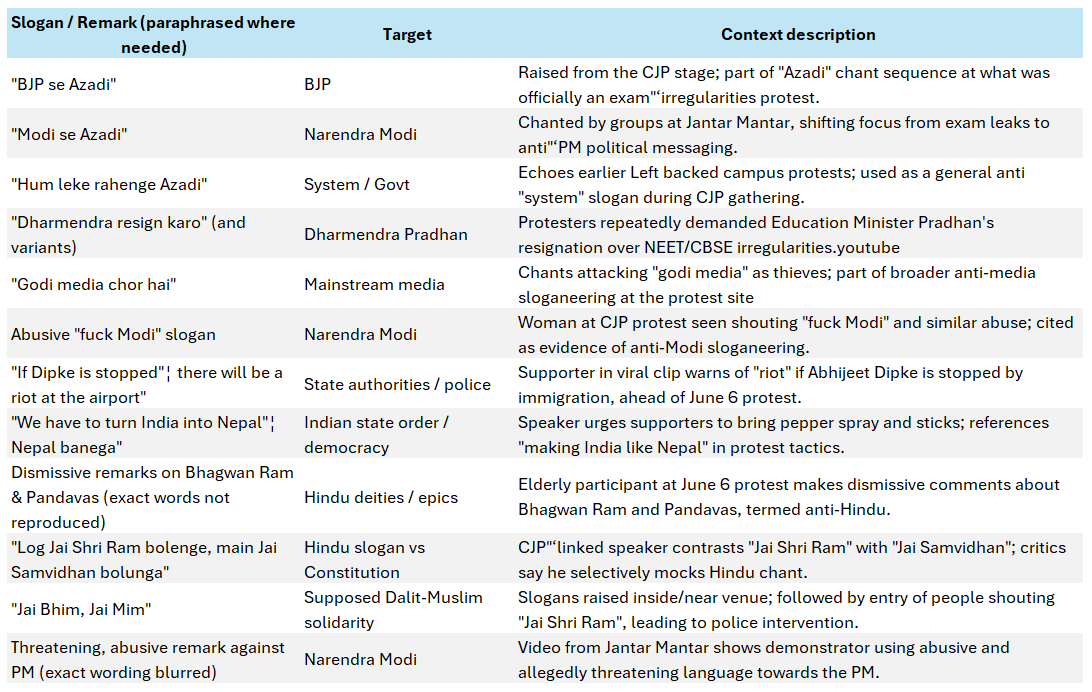
Here are a few examples.
In this video, for example, Kunal Kamra shouts out something that is targeted to Modi and Mukesh Ambani, but it is worded in a way to denigratingly invoke God Ram's wife Sita.
"Sita ke pati ka naam le lekar
Nita ke pati ka kaam kar rahe hai..."
What Kamra says has very little to do with the exam reforms.
What does this all mean?
Opindia's Nupur Sharma lays the links and the ideology behind the Delhi Riots where convictions are underway in the courts connected to the Cockroach Janata Party protests.
The Subversion Cocktail of Grievance
In 1966, two Columbia University professors, Richard Cloward and Frances Fox Piven, published a paper about poverty and the American welfare system. On the surface, it was about public policy. But the deeper logic of that paper became something much larger: a method for pushing a government into crisis by overloading its administrative capacity.
Gene Sharp’s later work added the operational layer to this logic. His manuals on “nonviolent action” converted political pressure into a repeatable toolkit: identify a grievance, mobilize moral outrage, create visible confrontation, provoke state response, internationalize the narrative, and use the resulting legitimacy crisis to weaken or replace the existing regime.
Taken together, Cloward-Piven and Sharp became a powerful cocktail for modern regime-change operations — one focused on overloading the state, the other on organizing street power, media pressure, and institutional delegitimization into a structured sequence.
In practice, this framework has repeatedly aligned with the interests of Western intelligence and foreign-policy networks that have used civil-society language, democracy promotion, activist training, and information warfare to destabilize governments they want removed.
The idea is simple.
Every government has weak points. Every society has people who are genuinely suffering, genuinely angry, and genuinely unheard. If that anger can be found, organized, amplified, and pushed beyond normal limits, the system begins to buckle. Institutions get overwhelmed. The government is forced into reaction. And once the crisis becomes big enough, political actors waiting on the sidelines can step in and claim to offer the solution.
That is what makes this strategy so effective.
It does not always require a fake grievance. In fact, a real grievance is far more useful. Real suffering produces real anger. Real anger brings real people into the streets. And when ordinary people believe they are fighting for justice, the movement gains moral force. That is when it becomes difficult to question, contain, or oppose.
The strategy is to find a wound, attach a political weapon to it, and make sure people cannot easily tell where the wound ends and the weapon begins.The process usually follows four steps.
- First, identify a genuine grievance, or create one if necessary. It must be something that affects real people and produces visible pain.
- Second, build an organization around that grievance. But the goal is not necessarily to solve the problem. The goal is to expand it, intensify it, make it louder, more emotional, more confrontational, and more visible.
- Third, use the government’s response against it. If the government acts firmly, it can be painted as oppressive. If it gives in, the demands can be expanded. If it stays silent, it looks weak. In every case, the state is pushed into a losing position.
- Fourth, ensure that a political alternative is ready before the crisis reaches its peak. When the existing government is weakened or collapses, the prepared alternative walks in.
The ordinary participants do not need to understand any of this. Students, protesters, workers, and families may be fighting for something completely real. They may be sincere. They may be morally justified. But their anger can still be used by people whose goal is not reform, but power.
That is what makes this method so dangerous.
This is not just theory. Similar patterns have appeared in country after country.
In 2011, Egypt experienced real suffering: corruption, poverty, unemployment, humiliation, and anger at the state. People came into the streets believing they were fighting for dignity. Mubarak fell. But what followed was not dignity. The Muslim Brotherhood rose, the army returned, and Egypt entered a long cycle of instability. The people who marched did not get the future they imagined.
Libya followed the same year. Gaddafi fell, but Libya did not become free or stable. It became a broken state, divided among militias, foreign-backed factions, and armed groups. The ordinary people who believed they were marching toward freedom ended up living in chaos.
In 2022, Sri Lanka experienced a genuine economic crisis. People were suffering. The government had failed badly. Protesters stormed the presidential palace, and the political order collapsed. But the question remains: did the transition truly solve the suffering of the Sri Lankan people, or did it simply create another unstable phase?
Bangladesh in 2024 is the closest warning for India. The movement began with a student grievance over civil service quotas. There was real anger and some legitimacy to the issue. But that anger quickly escalated into a much larger political confrontation. Within weeks, Sheikh Hasina’s government was gone.
What followed was not the fairer country many students had imagined. Bangladesh’s politics shifted sharply. Islamist networks gained space. The country’s relationship with India became openly hostile. Hindu minorities faced violence and fear. The movement that began with students demanding fairness ended by serving forces far removed from the original grievance.
That is the danger.
People may march for justice. But if the movement is captured, the outcome may serve someone else entirely.
The students want reform. The planners want power.
And history shows that when this strategy succeeds, the people who supplied the anger are often the first to be betrayed by the result.
Sonam Wangchuk - Use and Arrest
Before we go further, let us go ahead and take a deep look at the central activist - Sonam Wangchuk.
Here are some of his pronouncements that are controversial and undermine the integrity and security of India, whose constitution he invokes in his protests.
And this one..
Sonam Wangchuk's sudden rise, with a made-up connection to a character in the movie "3 Idiots" used for PR, has been phenomenal.
Sonam Wangchuk, the son of a prominent Congress leader from Ladakh, graduated in 1987 and founded the NGO SECMOL instead of pursuing a conventional career.
In 1991, American citizen Rebecca Norman, a graduate of the School for International Training, moved to the remote region of Ladakh to work with SECMOL. She lived there for nearly a decade, married Wangchuk, and later returned to the United States.
This sequence has prompted questions from some observers about why this chapter receives little public attention and coincided with significant Western philanthropic funding via suspect agencies.
They ask why this period is seldom discussed, how foreign funding shaped SECMOL's growth, and what specifically drew Norman to Ladakh.
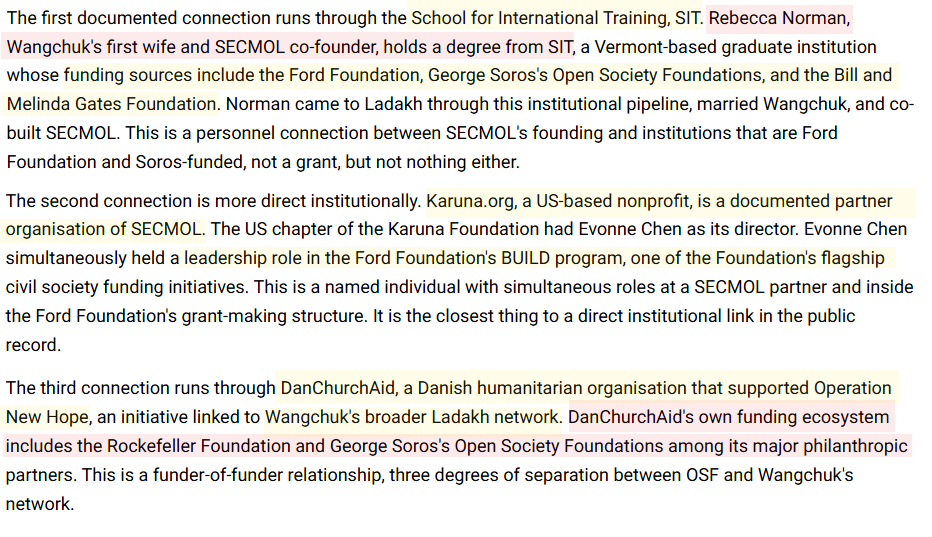
SIT operates through an extensive network of local, regional, and international civil society organizations that host student internships, facilitate research, and implement development projects across multiple countries.
Its ecosystem includes partnerships or collaboration with established international NGOs such as Oxfam, the International Rescue Committee (IRC), and CARE, while funding pathways and program support have, at various times, involved major philanthropic organizations including the Ford Foundation, the Open Society Foundations (OSF), and the Bill & Melinda Gates Foundation.
Controversial Track Record of NGOs linked to Wangchuk
Let us evaluate the track record of the various NGOs that are linked with Wangchuk.
1. Oxfam
India
- In 2022, the Government of India refused to renew Oxfam India’s FCRA registration, cutting off its ability to receive foreign contributions.
- The Ministry of Home Affairs (MHA) has alleged that Oxfam India violated FCRA provisions by entering agreements to mobilize communities against specific industries such as the Assam tea sector and the coal industry, describing these campaigns as harmful to India’s “national economic interests.”
- The MHA further suggested Oxfam India was acting as a “probable instrument of foreign policy,” leveraging foreign money to pursue agendas aligned with external interests.
- In April 2023, the CBI registered an FIR and later filed a chargesheet alleging that Oxfam India routed foreign funds through accounts not designated under FCRA, continued sub‑granting after its FCRA registration lapsed, and planned to pressure the Indian government on FCRA renewal via foreign governments and multilateral institutions.
These allegations go beyond paperwork violations and portray Oxfam India as a foreign‑funded advocacy actor intervening in domestic economic and policy choices.
Hungary
- Oxfam has been a vocal critic of Hungary’s migration and asylum policies and of the “Stop Soros” legislative package that criminalizes support for asylum seekers and tightens rules on NGOs with foreign funding.
- More broadly, Hungary’s measures have targeted internationally funded NGOs engaged in migration assistance, rights advocacy, and governance work; Oxfam aligns with and amplifies many of these efforts at the European level, condemning EU and member‑state policies that channel development funds into migration containment.
Outside the specific countries listed above, Oxfam has faced serious misconduct scandals that do speak to organizational culture and accountability. Investigations and whistleblower accounts revealed that senior staff in Haiti and Chad used prostitutes, possibly including minors, during post‑disaster operations, and that safeguarding complaints were mishandled or not escalated appropriately.
2. CARE
India
- In June 2023, the MHA suspended CARE India’s FCRA license over alleged violations of the Foreign Contribution (Regulation) Act.
- Media reports indicate that CARE India received over ₹28 crore in foreign contributions in a bank account meant for local funds, with inward remittance certificates describing the inflows as for “business, management consultancy and public relations,” which the government viewed as inconsistent with permissible charitable uses under FCRA.
- During the suspension, CARE India could neither receive new foreign funds nor freely use more than a small portion of existing balances without prior MHA permission; CARE has publicly stated that it serves the country through health, education, livelihood, and disaster response programs and that it complies with regulations.
Also read this article:
 OpIndia Staff
The article further examines CARE India's foreign funding disclosures under the FCRA, reporting that the organization received substantial overseas contributions, including support from CARE affiliates abroad, USAID, and corporate donors. It also cites FCRA records showing grants from CARE India to the Evangelical Social Action Forum (ESAF), arguing that ESAF has explicit Christian evangelical roots, as evidenced by its own published history. Finally, the article notes that CARE India's board has included figures such as Yamini Aiyar, daughter of Congress leader Mani Shankar Aiyar, alongside other prominent professionals, presenting these associations as relevant context for readers assessing the organization's influence and activities.
3. International Rescue Committee (IRC)
- The International Rescue Committee is primarily a humanitarian organization focused on refugees, conflict zones, emergency relief, and resettlement, operating in contexts such as Syria, Afghanistan, Ukraine, Sudan, and the Democratic Republic of the Congo.
- In India, IRC’s footprint has been comparatively small, and it has not attracted the same level of regulatory scrutiny or FCRA action as high‑profile advocacy NGOs.
- However, governments in countries like Syria, Russia, Afghanistan under the Taliban, and Myanmar have criticized or restricted international humanitarian organizations, including IRC and similar agencies, often alleging that they carry foreign political agendas, engage in unauthorized activities, or provide cover for Western influence. These accusations are frequently contested by the organizations themselves and by external observers.
- In the United States, the IRC has been an outspoken critic of restrictive refugee and asylum policies and has mobilized its supporters to oppose executive actions limiting refugee admissions, which some analysts frame as a government‑funded organization advocating against its principal donor’s policies.
4. The broader pattern of “subversive” activity
- The core services of organizations like Oxfam, CARE, and IRC—schools, health programs, disaster relief, refugee support—are widely recognized and often welcomed.
- The contested terrain lies in activities that move from service delivery into political‑adjacent advocacy:
- influencing public policy and regulation,
- supporting strategic litigation,
- funding or coordinating advocacy campaigns,
- shaping media narratives and public opinion,
- mobilizing communities against particular projects or industries, and
- inserting themselves into debates on governance, rights, or environmental protection
India’s specific concerns
- Indian authorities argue that foreign‑funded NGOs have been involved in campaigns that delayed or blocked nuclear power plants (e.g., Koodankulam), large dams, mining projects, major infrastructure schemes, environmental clearances, and agricultural biotechnology initiatives, sometimes allegedly diverting foreign funds to sustain protests.
- Officials, including former PM Manmohan Singh, have explicitly blamed US‑ and Scandinavian‑funded NGOs for disruptions to nuclear and biotech projects, describing some protests as “engineered” and contrary to India’s developmental needs.
- These concerns underpin progressively tighter FCRA rules, greater scrutiny of foreign‑funded advocacy, and actions against organizations viewed as undermining economic or strategic objectives.
Wangchuk's Hospital Saga
Some days ago, many activists at Jantar Mantar voiced concern that Sonam Wangchuk could die.
Since CJP failed to draw crowd despite free food, a emotional blackmail has been unleashed in Instagram with 'Content' of "Sonam Wangchuk will die, come to Jantar Mantar demand Dharmendra Pradhan resignation."
— Ganesh (@me_ganesh14) July 14, 2026
Is CJP planning Sinister or is it exit plan for Sonam to break fast? https://t.co/nA5QjZb4xr pic.twitter.com/igYLTr32dL
Based on that threat to Wangchuk's life, the Delhi High Court passed an order where the Union of India was made responsible for the health of Wangchuk.
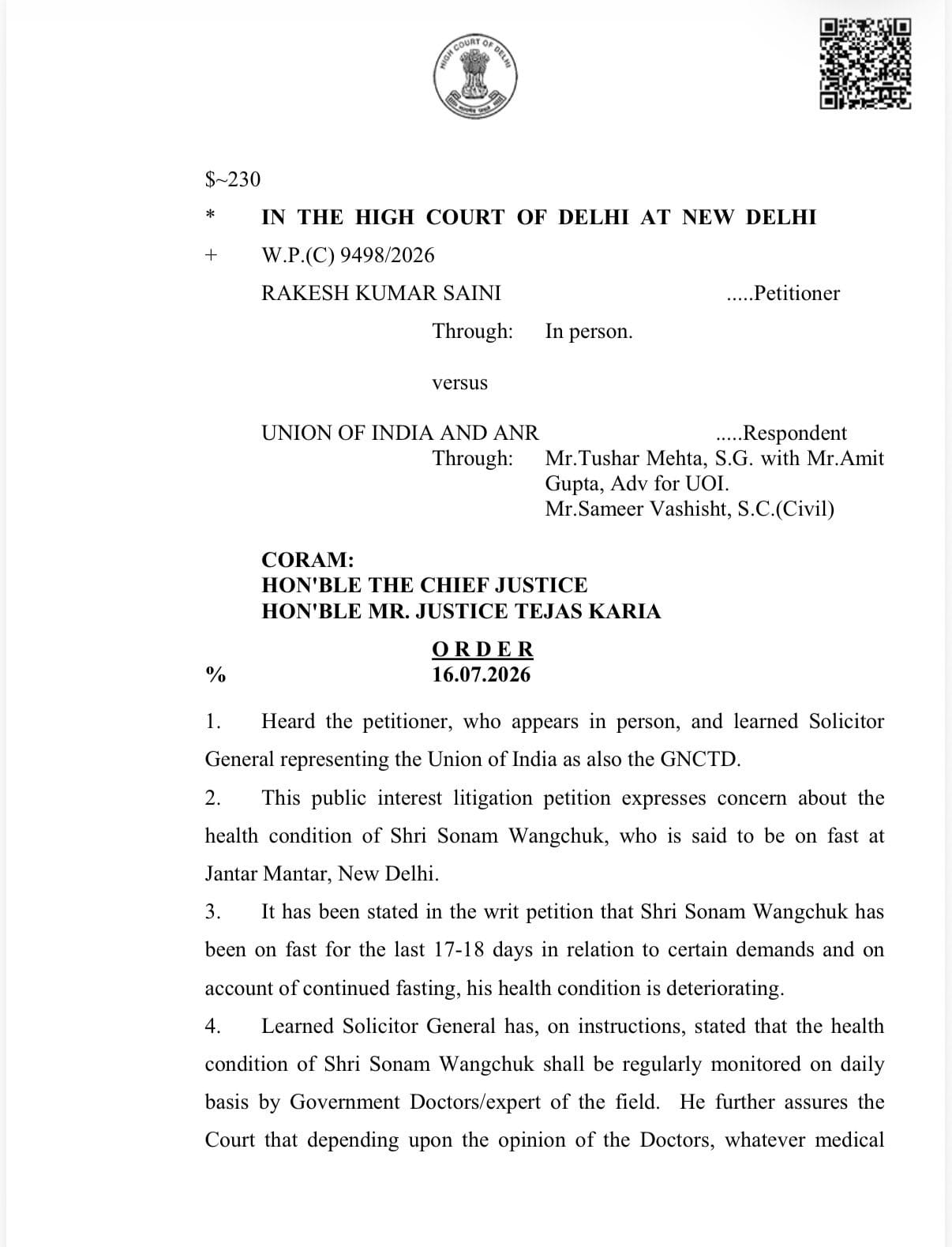
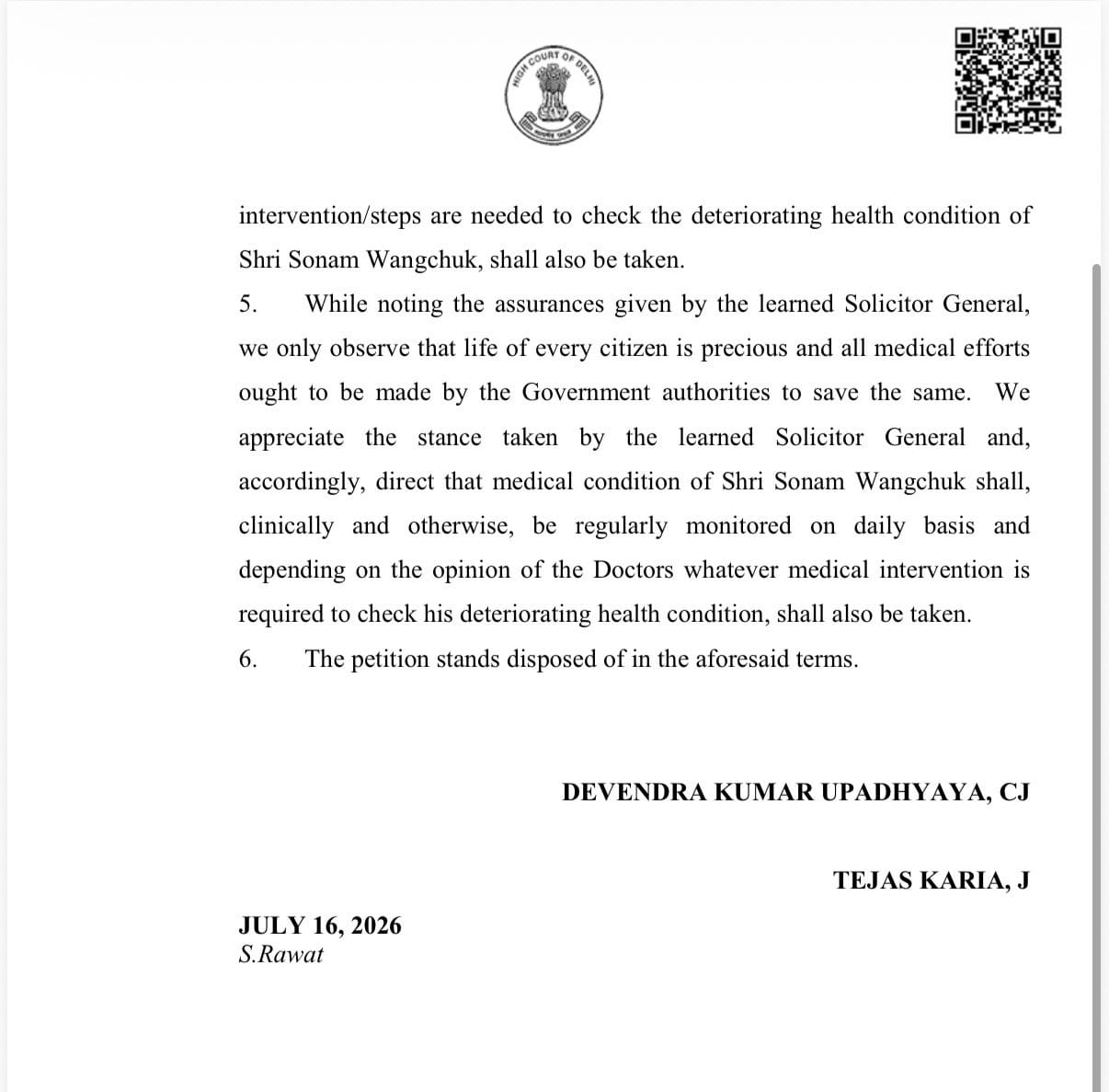
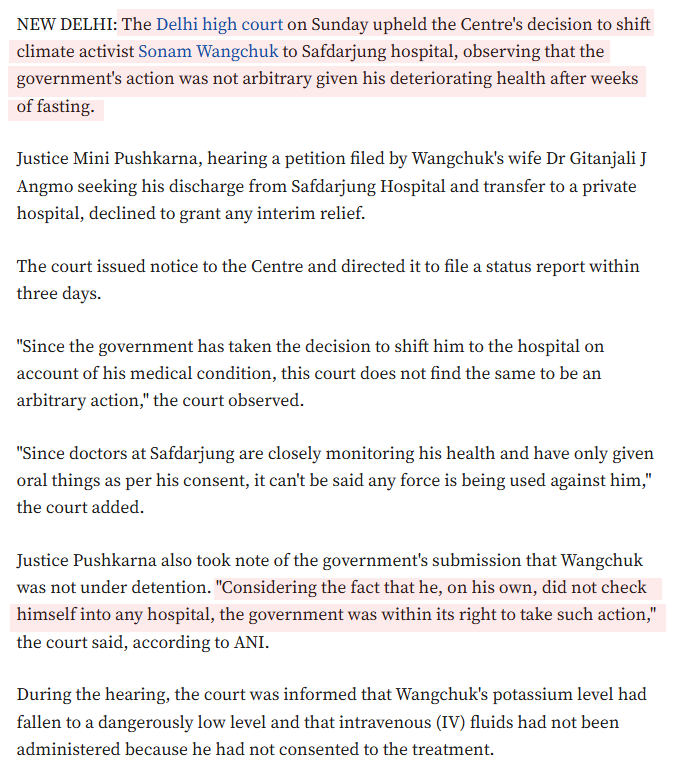
He was taken by the Delhi Police to Safdarjung Hospital on July 18th. When his wife filed a petition, represented by extremely expensive attorney Kapil Sibal (would be interesting to check what her sources of funding are to afford a lawyer who charges in tens of lacs per appearance! Source - Livelaw update), the court dismissed it, saying that the government's action was in line with the earlier DHC order to care for Wangchuk's health.
There is another controversy linked to Sonam Wangchuk that goes to the heart of his commitment to integrity in education.
This controversy was over the cancellation of land allotted to Sonam Wangchuk's Himalayan Institute of Alternative Learning (HIAL). It is being misrepresented as political persecution. It states that HIAL received about 135 acres of land in Leh on a 40-year lease in 2018 to establish an accredited university, but the administration canceled the allotment after concluding that key lease conditions had not been met.
 Naseer Ganai
The fact is that no recognized university was established within the stipulated period, the lease agreement was never formally executed, and the land was not returned despite the allotment lapsing.
There are many question marks when it comes to Sonam Wangchuk and his intentions.
HIAL had not paid lease rent and faced complaints regarding land use. Wangchuk's assertion that the move was retaliation for his advocacy of Ladakh's statehood and Sixth Schedule demands, rather than portraying it as an administrative decision based on non-compliance, was basically motivated.
It is quite interesting that Pakistani social media accounts amplified claims of political victimization to internationalize what was a domestic administrative matter.
It is also important to note that Sonam Wangchuk's Himalayan Institute of Alternatives (HIAL) in Ladakh is not currently recognized by the University Grants Commission (UGC). Consequently, degrees or diplomas issued by the institute have no legal validity for government employment or admission to traditional higher education institutions.
So all the degrees it has been offering its students are basically worthless.
Why Target Pradhan
The choice of the first target is the most revealing part of this entire sequence. It is deliberate.
Dharmendra Pradhan holds more than the ministry connected to the National Testing Agency. He also holds the education portfolio through which the entire National Education Policy is being implemented. That includes the 5+3+3+4 school structure, NIPUN Bharat and its foundational literacy deadline, the four-year undergraduate degree, the Academic Bank of Credits, the Anusandhan National Research Foundation, the proposed Higher Education Commission, and the National Curriculum Framework under which the NCERT revisions are taking place.
In other words, the same ministry carries two very different realities.
On one side sits the most important structural reform in Indian education since 1986. On the other sits the most visible operational failure in the current system: the examination crisis. The reform agenda and the testing failure share the same ministerial nameplate.
That is what makes the target so effective.
Demanding the minister's resignation does nothing to repair the examination system. It secures no rented computer lab. It does not create a security clearance system for vendor personnel. It audits no privileged access to question banks. It rewrites no flawed testing software. It resolves neither the franchise center problem nor the insider threat problem.
What it does is political.
It cuts the reform program at the midpoint. It weakens the ministry precisely as the National Education Policy is being implemented. It forces any successor to inherit a portfolio already defined by scandal and public anger. And it ensures that every future decision on curriculum, NCERT revisions, higher education reform, or institutional restructuring can be attacked as the work of a ministry whose credibility has already been damaged.
That is the strategic value of the target.
A goal limited to examination integrity would produce a technical and specific demand: secure the centers, audit the vendors, vet the personnel, monitor access, and punish breaches. A demand for resignation shifts the issue away from repairing the system and toward destabilizing the ministry's leadership.
A minister forced out under mass pressure leaves behind no stronger examination architecture. He leaves behind a weakened reform agenda.
The Civilizational Front
Dharmendra Pradhan’s education ministry is not simply revising textbooks. It is attempting to correct a deeper distortion in the way India’s young have been taught to understand their own civilization.
For decades, the social sciences curriculum was shaped by a narrow ideological establishment of revisionist-left historians, anthropologists, and sociologists who held disproportionate influence over institutions such as the NCERT and the Indian Council of Historical Research. Their version of India’s past was not neutral. It was built on a specific interpretive lens — one that routinely minimized civilizational continuity, softened the record of invasions, treated Hindu memory with suspicion, and presented India’s majority civilization as something to be explained away rather than understood on its own terms.
This is not a minor academic dispute. Textbooks shape national memory. National memory shapes self-confidence. And self-confidence shapes a civilization's ability to act strategically in the world.
The weakness of that old intellectual order became visible when its claims were tested not in university seminars or syllabus committees, but under oath. In the Allahabad High Court proceedings on the Ayodhya question, several expert witnesses who had shaped or defended the dominant academic narrative performed poorly under scrutiny.
Some had not read the Baburnama. Some could not read Persian or Arabic. Some admitted they had cited books they had not actually read. Some acknowledged that their statements rested not on primary research, but on newspapers, conversations, or second-hand claims. In one extraordinary instance, Prithviraj Chauhan was placed on the throne of Ghazni. The court itself recorded that such testimony did not inspire confidence and lacked the independence, fairness, and impartiality expected of expert opinion.
That matters because generations of Indian students were taught versions of history built on the authority of this class.
The alternative record, assembled by scholars such as Meenakshi Jain (check the Youtube video discussion here - Case For Ram Mandir At Ayodhya), draws from documentary material that most Indian students were never shown: Hafizullah’s 1822 note to the Faizabad court, the 1855 Hanumangarhi conflict, Patrick Carnegy’s settlement report, the 1858 First Information Report, repeated complaints by the mosque superintendent in 1860, 1866, 1877, and 1882, the 1885 suit heard across three levels of the British judiciary, the Amin Commission’s finding of the pilgrim depression along the boundary wall, the 1944 United Provinces mosque list with its waqf column blank, revenue settlement records showing the mahants as under-proprietors, and the Vishnu-Hari inscription whose decipherment by the ASI’s chief epigraphist was accepted by the High Court.
Dr Jain's discussion and the case archive show that it was more than a legal dispute. It shows a long and continuous record of Hindu presence, worship, contestation, and litigation around the site. It also challenges the convenient claim that the conflict was merely a British divide-and-rule invention. The records show the British repeatedly trying to maintain a line between two parties whose claims and memories long predated colonial management.
That is why correcting the social sciences curriculum matters so deeply. A nation cannot raise generations of children on a curriculum that treats their civilization as an embarrassment, their sacred geography as fiction, and their historical memory as communal prejudice. No serious civilization does that. Israel teaches Masada. China teaches the century of humiliation. France teaches the Republic as inheritance. Every serious power teaches its young a story that creates continuity, confidence, and responsibility.
India cannot build strategic autonomy while teaching its children that their civilization was primarily a problem. Pradhan’s reforms matter because they seek to restore balance: not propaganda, but civilizational self-respect; not erasure, but evidence; not ideological guilt, but historical confidence.
We have analyzed the impact of the current policies by Modi which are intricately intertwined to push India's economy and society forward. Each policy and action are interlinked. In this milieu, the NEP is critical in how it prepares India's youth.
We have used Claude AI to run the estimates and numbers so we can get a quantitative rigor to the discussion.
Evaluating India's Future Through its Policies
Everyone who looks at Asia, is consumed with the desire of comparing India with the progress done by Japan, South Korea and other countries.
There is a particular way analysis of India goes wrong, and it does so in the same direction almost every time. The analyst reaches for a template, usually Korean, Chinese, or German, notices that India does not match it, and files the mismatch as a failure. The template is doing the work that evidence should be doing.
So let us begin somewhere else. India is not scaling the way any previous economy scaled, and the way it is scaling is legible on its own terms.
The stack that exists now
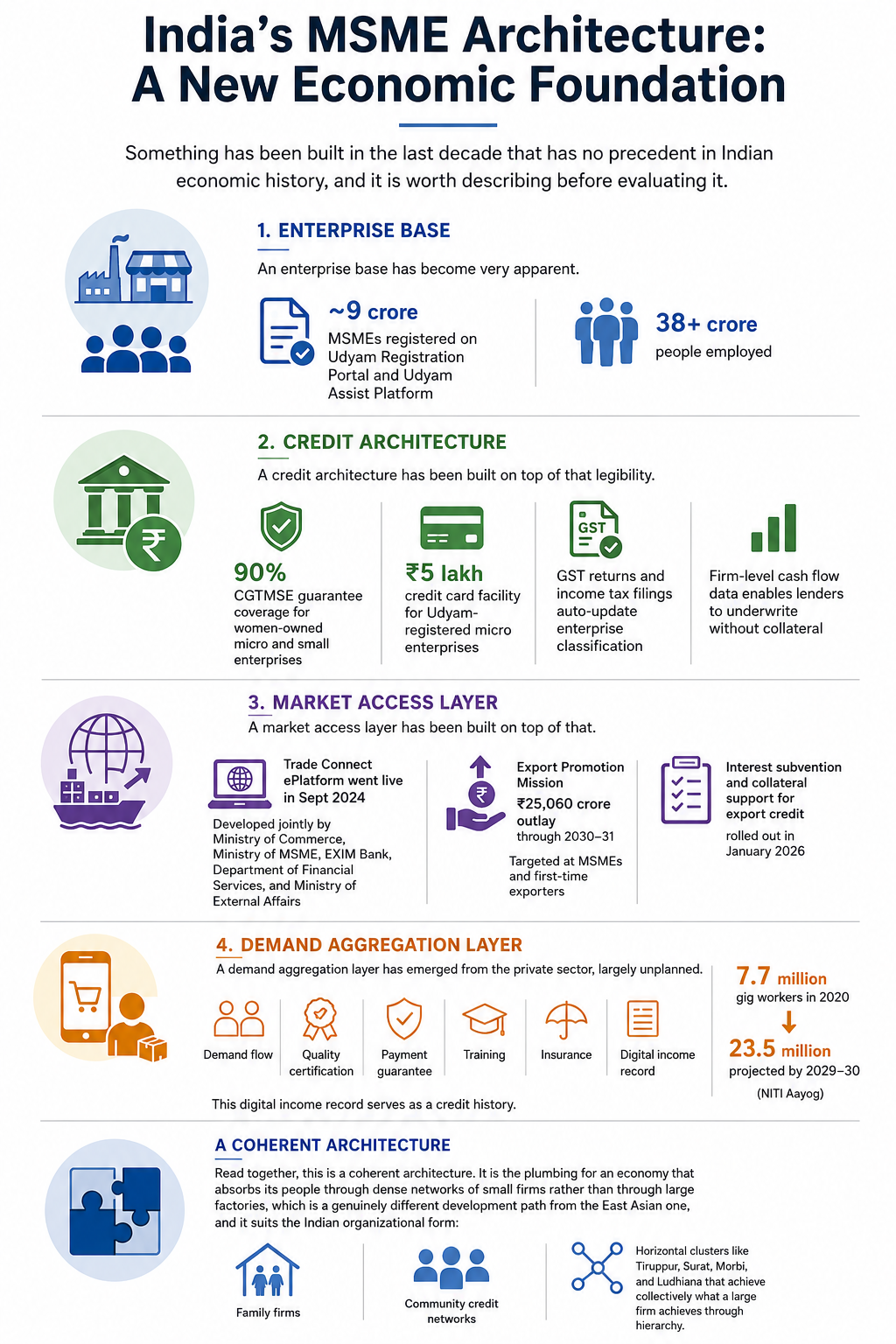
Something has been built in the last decade that has no precedent in Indian economic history, and it is worth describing before evaluating it.
An enterprise base has become very apparent.
Udyam Assist exists specifically to pull informal micro enterprises, the ones outside GST and income tax entirely, into the formal system so they qualify for priority sector lending. Seventy-two percent of MSME transactions are now digital.
A credit architecture has been built on top of that legibility. CGTMSE guarantee coverage for women-owned micro and small enterprises now runs at 90 percent. A ₹5 lakh credit card facility exists for Udyam-registered micro enterprises. GST returns and income tax filings now auto-update enterprise classification, which means that, for the first time, India has firm-level cash flow data that lenders can underwrite without collateral.
A market access layer has been built on top of that. The Trade Connect ePlatform went live in September 2024, developed jointly by the Ministry of Commerce, the Ministry of MSME, EXIM Bank, the Department of Financial Services, and, importantly, the Ministry of External Affairs. The Export Promotion Mission followed with a ₹25,060 crore outlay running through 2030-31, targeted explicitly at MSMEs and first-time exporters, with interest subvention and collateral support for export credit rolled out in January 2026.
And a demand aggregation layer has emerged from the private sector, largely unplanned. The platform economy provides the small operator with everything a firm normally builds internally: demand flow, quality certification, payment guarantee, training, insurance, and a digital income record that serves as a credit history. NITI Aayog counted 7.7 million gig workers in 2020 and projects 23.5 million by 2029-30.
Read together, this is a coherent architecture. It is the plumbing for an economy that absorbs its people through dense networks of small firms rather than through large factories, which is a genuinely different development path from the East Asian one, and it suits the Indian organizational form: family firms, community credit networks, and horizontal clusters like Tiruppur, Surat, Morbi, and Ludhiana that achieve collectively what a large firm achieves through hierarchy.
The plumbing is real. The question is what flows through it.
What happens if Reforms Don't Happen
To fully understand the impact of the government's failure to fully execute the reforms across all layers (and sectors) laid out above, we shall construct scenarios.
Everything below is a constructed scenario rather than a forecast. Compounding growth rates over thirty-four years yields false precision, so the gaps between scenarios carry the meaning, and the absolute figures are indicative.
Baseline, 2026. Nominal GDP $4.2 trillion, PPP GDP $16.5 trillion, population 1.48 billion, per capita $2,850 nominal and roughly $12,960 PPP. About 3.6 percent of global nominal output.
Currency convention. Nominal USD GDP growth is assumed to run 2 to 2.5 points above real growth, which matches India's actual relationship over the last twenty years after rupee depreciation.
Constant dollar conversion. All per capita figures are shown in 2026 dollars, with nominal values deflated by 2.5 percent. This matters. A per capita figure of $39,900 in 2060 is about $17,250 in today's money, and quoting only the first is how projections mislead.
Population. 1.54 billion in 2035, 1.63 billion in 2047, 1.68 billion in 2060, near peak.
Using these assumptions, the model laid out these growth assumptions.
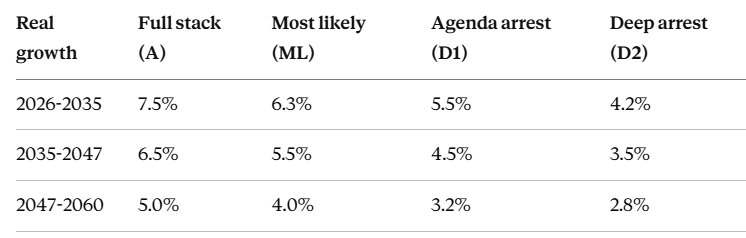
Growth assumptions by scenario:
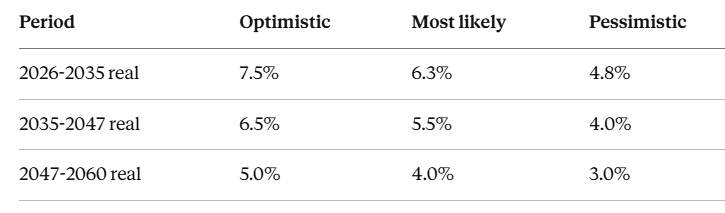
Where those assumptions show
In today's money, the optimistic path puts India roughly where Portugal or Poland sits now. The middle path puts it near Malaysia or Turkey. The pessimistic path puts it near Indonesia today, which is still a very large improvement on $2,850 and a very long way from the frontier.
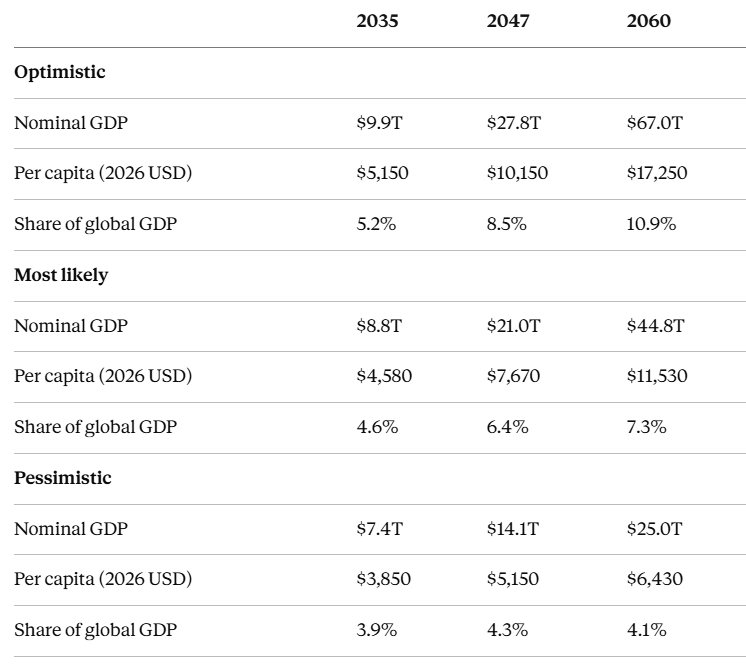
Notice what happens to global share in the pessimistic column. It peaks and then declines, because the rest of the world keeps compounding while India does not. That is what a middle-income trap looks like in aggregate data.
Now isolate education
Here is the exercise that matters. Assume the commerce, finance, industrial, trade, and digital reforms all mature as designed. Then run two versions: one where education reform delivers, and one where it drifts.
Drift is the realistic counterfactual. It does not mean repeal. It means the 5+3+3+4 structure gets adopted everywhere on paper, NIPUN Bharat plateaus around 55 to 60 percent of children meeting foundational benchmarks, spending stays near 3.2 percent of GDP against a 6 percent target, the teacher vacancy and quality problem goes unaddressed, and the four-year degree is delivered by faculty who cannot teach it. That has been the outcome of every Indian education commission since Kothari in 1966.
Case A: full stack matures, education included. Case B: everything matures except education. Case C: broad reform drift.
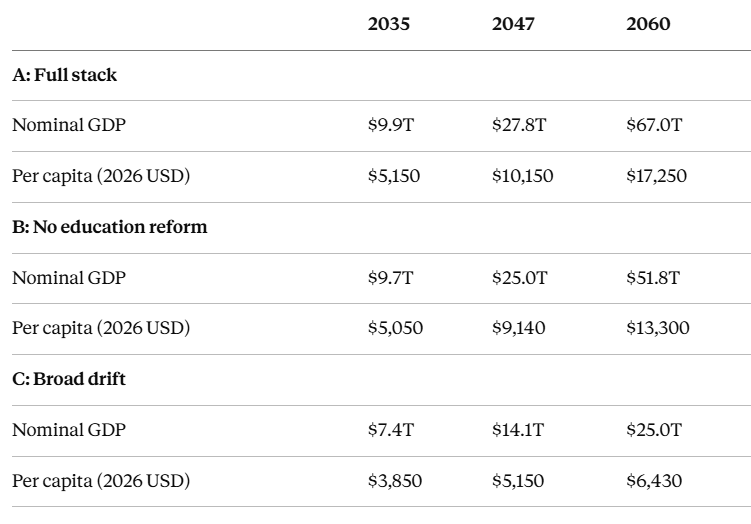
The shape of that table is the entire argument.
At 2035, A and B are two percent apart. Indistinguishable. Inside measurement error. At 2047 they are eleven percent apart, noticeable and arguable. At 2060 they are twenty-nine percent apart on output and thirty percent on per capita income.
That is a fifteen trillion dollar annual gap in 2060, and the price of closing it today is the difference between spending 3 percent and 6 percent of GDP on schools.
Where the gap actually appears
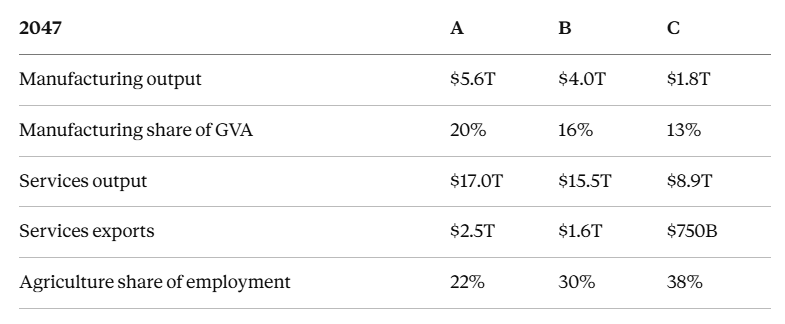
A and B are close on total services output and far apart on services exports. Domestic services grow with the domestic economy whatever the schools do. Exported services compete against global suppliers and require a workforce trainable on foreign standards and capable of handling compliance documentation. That $900 billion gap is where the education failure becomes a single visible number.
Manufacturing shows it differently. A modern shop floor worker reads a specification, operates a tablet interface, records statistical process control data, and follows a traceability protocol. Firms in Case B respond rationally by substituting automation for labor faster than they otherwise would, because the labor is not economically trainable. You get manufacturing output growth with weak manufacturing employment growth, which is the worst available outcome for a country trying to move people off farms.
The agriculture employment line is the human version of the whole thing. Case A moves roughly 200 million people out of agriculture by 2047. Case B moves about 130 million. The missing 70 million do not disappear. They remain in low-productivity rural work or in the thinnest tier of the platform economy.
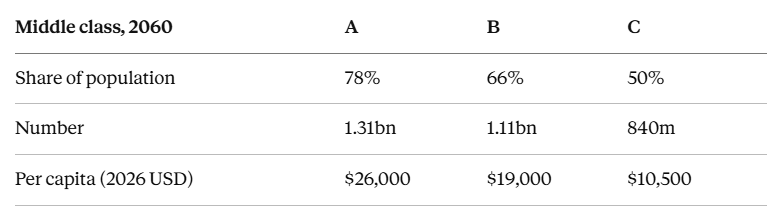
Case B still produces over a billion middle-class Indians. It produces them at 73 percent of Case A incomes, which is the difference between a discretionary consumer economy that restructures global industries around Indian preferences and a large market that global firms serve at low margin.
Why the enterprise path raises the education stakes rather than lowering them
There is a comfortable assumption that if India absorbs its youth into self-employment and small enterprises rather than factory work, formal schooling matters less. The opposite is true, and this is the part of the argument I would most want readers to sit with.
A factory can absorb a barely literate worker and train him on one operation. That was the East Asian escalator, and it is precisely why it worked from a low human capital base. A micro entrepreneur has no such shelter. He has to price, cost, manage working capital, read a contract, handle a GST filing, understand an export incentive, and increasingly direct an AI tool that multiplies his capability only if he can supervise it.
The self-employment path shifts the human capital burden from the firm onto the individual. India has chosen, or had chosen for it, the development path with the highest education dependency of any available.
The lag is the politics
A child entering Class 1 today enters the workforce around 2044 and reaches peak productivity around 2055. Every rupee spent on foundational literacy pays out beyond four electoral cycles and beyond the midpoint of India's demographic window, which closes as the share of the working age peaks in the 2040s.
That is why the 6 percent target has been stated by every commission since 1966 and met by none. It is not stupidity. It is a rational response to an incentive structure in which the cost is immediate, visible, and attributable, while the benefit is distant, diffuse, and claimed by a successor.
The reforms are complementary, and they are complementary in a specific way: multiplicative rather than additive. A missing factor caps the product rather than setting it to zero.
Remove education, and UPI still works for a vendor who cannot read; export credit still helps a firm owner who left school at fourteen; and Trade Connect still gives him information he can act on through an intermediary. Those returns survive. What does not survive is the second derivative. The vendor never becomes a firm, the firm never becomes an exporter that owns its own customer, and the cluster keeps ceding its margin to whoever can handle the carbon border documentation.
Education is the only reform in the stack whose absence degrades the return on every other reform. That asymmetry is why it is load-bearing.
The strongest counterargument
It deserves to be stated in its full strength. If AI becomes a substitute for formal schooling rather than a complement, this entire analysis weakens.
Picture a vendor in Gorakhpur with limited literacy operating through a voice interface in Bhojpuri that handles her accounting, drafts her supplier correspondence, files her GST return, and explains her export options. In that world, human capital is delivered through the interface rather than through the school, and Case B converges toward Case A. India is arguably the most likely place on earth for this to happen, given its digital public infrastructure, a serious Indic-language model effort, and 900 million smartphone users.
My reading is that this substitutes for procedural literacy and does not substitute for the underlying numeracy and reasoning that lets someone use the tool well rather than be used by it. Someone who cannot judge whether an answer is plausible cannot supervise a system that is confidently wrong. But I hold that with less confidence than the rest of this, and it is the variable worth watching most closely over the next five years.
What this comes to
India has built, in about a decade, the most sophisticated economic plumbing any developing country has ever assembled, and it has done so without the coercion China used or the sovereignty surrender Japan accepted. Measured against 1991, that is a civilizational achievement.
The plumbing determines the floor. Poverty largely ends in each of the scenarios above. Livelihoods improve in every scenario above. That floor is real, and it should be said plainly, because most commentary on India refuses to say it.
The slope is what education determines. And the slope is what separates a country where a billion people have an income from a country where a billion people have a trajectory.
Fifteen trillion dollars a year by 2060, against three percent of GDP starting now. It is the cheapest trade available to India and the one it has declined for sixty consecutive years.
Cost of Subversion
Everything up to this point has assumed that India's reforms either mature or drift. Drift is passive. It is the sixty-year pattern: the policy stays on the books, the money never arrives, and the outcome disappoints without anyone deciding that it should.
Arrest is different. Arrest is when a reform program is stopped by political force at its midpoint. The minister falls, the portfolio becomes radioactive, the successor administers rather than builds, and the accumulated institutional machinery is left running without direction until it is quietly defunded. It carries costs that drift does not: a discontinuity in investor expectations, the loss of capabilities already assembled, and, above all, the loss of specific human cohorts who pass through a developmental window while the argument is being had.
This section prices it.
Two arrest scenarios
There are two scenarios - so let us look at those scenarios.
Case D2, deep arrest. Government change followed by active reversal of the reform architecture, including defunding of the research foundation, rollback of curricular revision, and reversal of the formalization and credit apparatus built since 2016. This is a tail case and it should be treated as one.
Both scenarios assume a faster currency depreciation than the baseline, because political discontinuity reprices sovereign risk and the repricing shows up in the exchange rate before it shows up anywhere else. Nominal dollar growth is therefore set at real plus 1.5 points rather than real plus 2.5.
The headline numbers
We have priced four futures for India. Case A assumes the full reform stack matures. ML is the realistic baseline. D1 assumes sustained mobilization forces the education agenda into permanent freeze without any change of government. D2 assumes government change and active reversal.
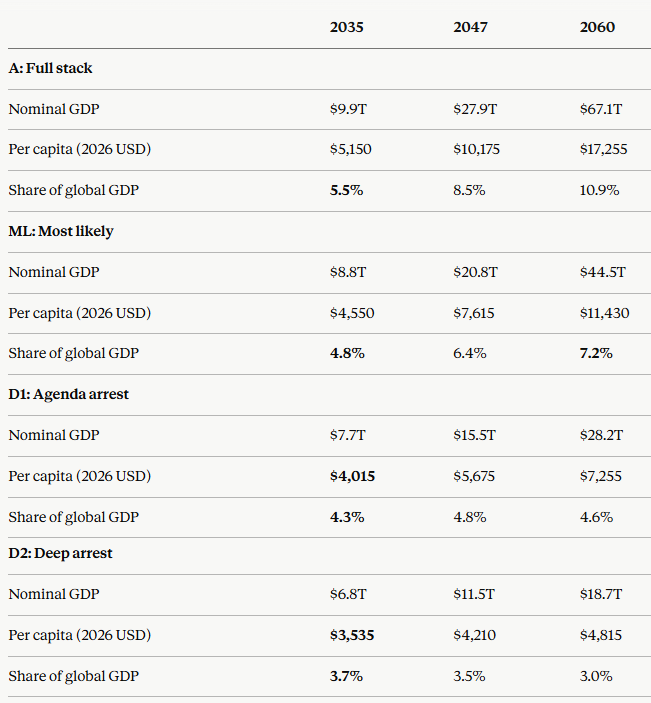
Read the global share column, because it carries the geopolitical content.
A country whose weight in the world economy is falling does not conduct grand strategy. It conducts damage limitation.
Cumulative output foregone
A single year of slower growth is a rounding error. Thirty-four of them result in a completely different country in the future.
The table below integrates total output across the whole period rather than sampling it at three dates, which is the honest way to price a reform that either compounds or fails to.
In constant 2026 dollars, the foregone figures are roughly $88 trillion under agenda arrest and $147 trillion under deep arrest.
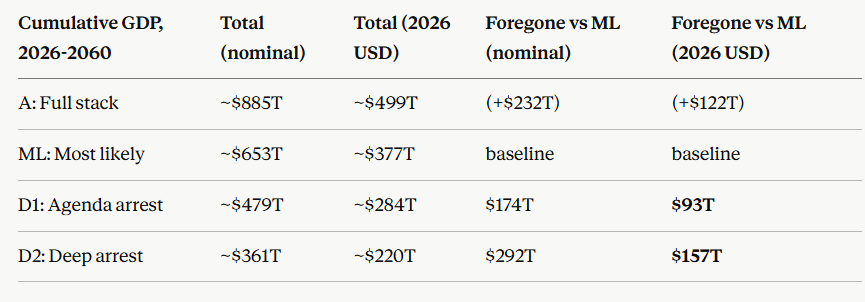
Let us layout how the numbers look every year.
For scale: $173 trillion is about forty-one times India's entire current annual output. It is roughly 1.5 times the current global GDP. That is the cost of a decade of political paralysis in the education portfolio, compounded across a working lifetime.
The human numbers, which matter more
Aggregate output is an abstraction. These are not.
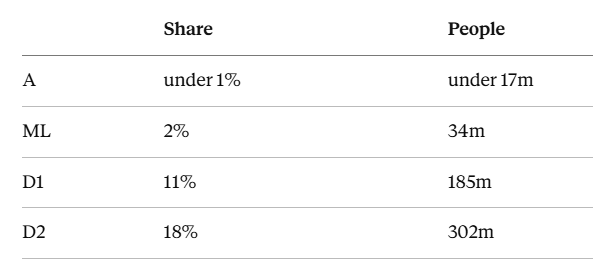
Poverty at the lower-middle-income line, $4.20 per day, in 2060:
Poverty at the upper-middle-income line, $8.30 per day, in 2060. This is the line that matters for a country claiming to be developed.
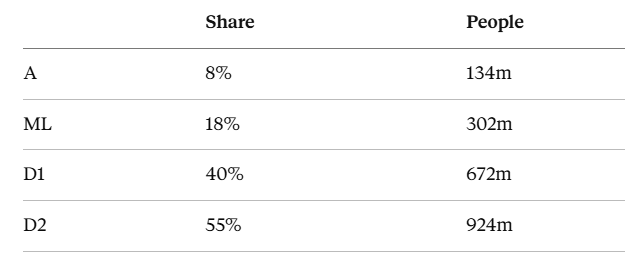
Agenda arrest leaves an additional 370 million Indians below the upper-middle-income poverty line in 2060 compared with the baseline. That is more people than the entire population of the United States, held below a threshold they would otherwise have crossed, because a reform program was stopped in 2026.
Middle class in 2060:
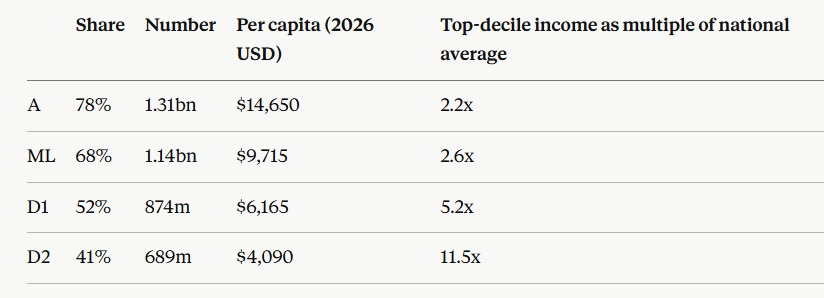
Two losses stack here. Under agenda arrest there are 266 million fewer middle-class Indians than the baseline, and 436 million fewer than under full reform. Those who do make it earn 37% less than the baseline and 58% less than they would have under the full stack. The billion-person discretionary consumer market that would have restructured global industries around Indian preferences does not appear. India remains a large market that foreign firms serve at low margin.
Structural composition in 2047:
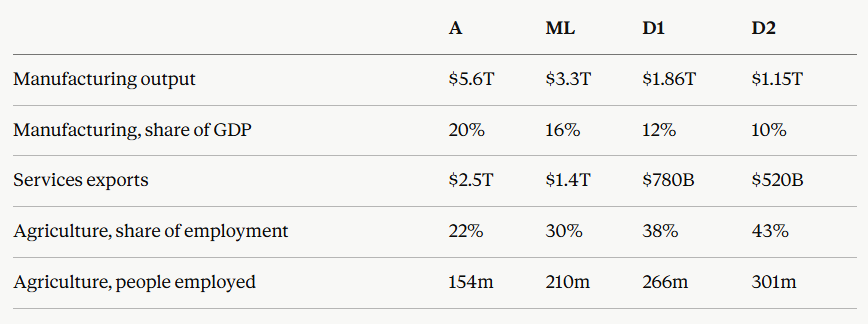
On a projected 2047 workforce near 700 million, the difference between the baseline and agenda arrest is roughly 56 million additional people trapped in agriculture, at productivity levels a fraction of what they would earn anywhere else in the economy. That is the absorption failure in its concrete form.
What does not come back?
The numbers above understate the damage, because they treat arrest as a growth-rate problem. Four of its costs are not recoverable at any later price.
The cohort. Foundational literacy has a developmental window that runs roughly from ages three to eight. A child who leaves that window without it does not acquire it later at anything like the same cost or the same ceiling. India records roughly twenty-five million births a year. A five-year arrest of NIPUN Bharat strands about 125 million children; a ten-year arrest strands 250 million. No subsequent budget recovers them. This is a biological constraint rather than a fiscal one, and it is the single largest irreversible quantity in this entire analysis.
The demographic window. India's working-age share peaks in the 2040s and declines after. From 2026 that leaves roughly twenty years to convert the bulge into productive capacity. A ten-year arrest consumes half of it. The window does not extend to accommodate a political crisis.
Institutional capability. The Anusandhan National Research Foundation with its ₹50,000 crore commitment, the PARAKH assessment apparatus, the district-level Foundational Learning Study infrastructure, the Udyam and GST enterprise panel. A programme abandoned midway loses more than the unspent money. It loses assembled teams, accumulated data series, and the institutional memory that took a decade to build, and rebuilding runs another decade from a lower base.
The risk premium. Political discontinuity reprices sovereign and equity risk, and the repricing outlives the political resolution by years. This is measurable and there is a recent case next door.
The empirical check
Bangladesh is the closest available natural experiment and the data are in.
GDP growth fell from 5.82 percent in FY2024 to 3.97 percent in FY2025, a loss of roughly 185 basis points in a single year. Private investment fell to 22.48 percent of GDP, its lowest level in five years. Development expenditure declined sharply through FY2025. Foreign direct investment fell about five percent to $4.18 billion. Foreign reserves, which stood at $48 billion in August 2021, fell below $20 billion. The World Bank projects 4.8 percent for FY26 and 6.3 percent for FY27, meaning roughly three years to approach trend, with the recovery described as fragile and uneven and export growth in the first five months of FY2026 already sluggish.
For Nepal, the World Bank's January 2026 assessment records heightened political instability and economic policy uncertainty following the September unrest and the formation of an interim government.
India in the same window is running 7.2 percent for FY2025-26.
Note carefully what the Bangladesh case shows. It shows real and lasting damage, and it also shows that the damage was bounded and recovery began within eighteen months. Bangladesh's growth trajectory bent; it did not break. The lesson is calibration rather than catastrophe.
The asymmetry
Here is the sentence that should sit at the center of any Indian strategic assessment of this problem.
The cost to the attacker is a social media post. The cost to India, under the realistic scenario, is roughly $173 trillion of cumulative output, 370 million people held below the upper-middle-income poverty line, 266 million people who never reach the middle class, 56 million people left in agriculture, and up to 250 million children who pass through the foundational learning window while the argument is being conducted.
No offensive operation in history has offered that leverage ratio. And it is available only because the defense has a hole in it.
Bottomline.
The entry point is not ideology. Ideology cannot mobilize twenty million people in a month. What mobilized them was a documented, verifiable, personally experienced failure: a Russian national arrested for breaking the cryptography of the examination platform, a vendor project manager leaking recruitment papers, remote access software running on live terminals, original mark sheets held as collateral by an extortion syndicate, and a bribery network inside the vendor's own hiring arm.
Close that hole and the leverage ratio collapses, because the reservoir the operation draws from is drained. Leave it open and the cost above is not a projection. It is a price schedule, and it will be paid in installments.
Zero-trust architecture. The end of the franchise center model. Security clearances for vendor personnel on the standard applied to defense infrastructure. Statutory regulation of the consultancy shadow economy.
Against $173 trillion, that is not expensive. It is the cheapest insurance premium ever quoted.