The Two Men on the Rope Bridge
An old master once told his students a story he had heard from a traveler who came through the mountain pass.
Two men stood on opposite ends of a rope bridge strung across a deep gorge. The bridge swayed under any weight, and the rope that held it was frayed in places neither man could see. Both men wanted to cross. Both feared falling.
The first man stepped forward and shook the ropes, just slightly, to remind the second man how far down the gorge went. He called out, "I do not wish to fall. But I will keep walking closer to the middle, and you must decide how much shaking you can bear before you step back."
The second man answered by cutting a small notch in his own end of the rope, in plain view. "See this," he said. "I have made my side weaker too. If you keep shaking the bridge, we may both find out together how deep this gorge really is."
A young student asked the master, "Which man was wise?"
The master said nothing for a long while. Then he asked the student to fetch a bowl of water and carry it across the courtyard without spilling a drop.
The student walked slowly, eyes fixed on the bowl, and reached the far side with the water still.
"Now," said the master, "walk the same distance while I shake your arms."
The student tried, and the water spilled everywhere.
The master said, "Every man on that bridge believes he understands exactly how much shaking the rope can absorb before it breaks. He does not. No one does, not the one who shakes it, not the one who cuts it. The rope does not consult either man's calculations before it frays."
He continued, "Power is not wisdom. Threat is not certainty. A man may shake a bridge a thousand times, and nothing happens, and on the thousandth first time, he learns the rope was never as strong as his confidence."
The student asked, "Then should the men not shake the bridge at all?"
The master smiled. "That is the wrong question. Ask instead why two men needed a swaying bridge over a gorge to speak with each other in the first place. The wise man builds a path where no one must guess how much weight the rope can bear. The unwise man spends his life perfecting the art of guessing."
The students sat with this for a long time, watching the courtyard, where the spilled water had already disappeared into the stones.
The Escalating Ukraine War
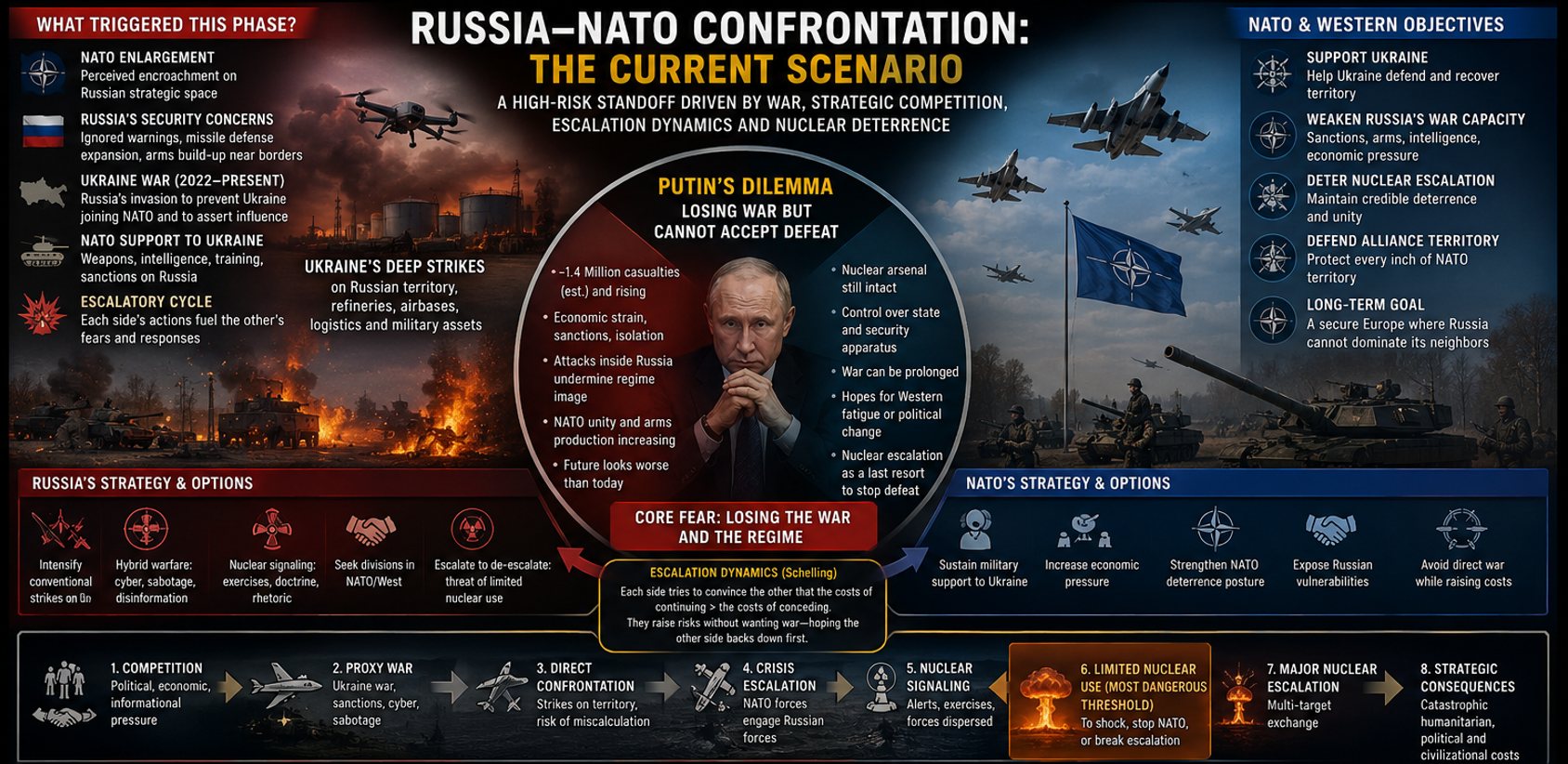
Russia's Ukraine war has changed in a dramatic manner in the last 6 months. Specifically, post-US attacks on Iran.
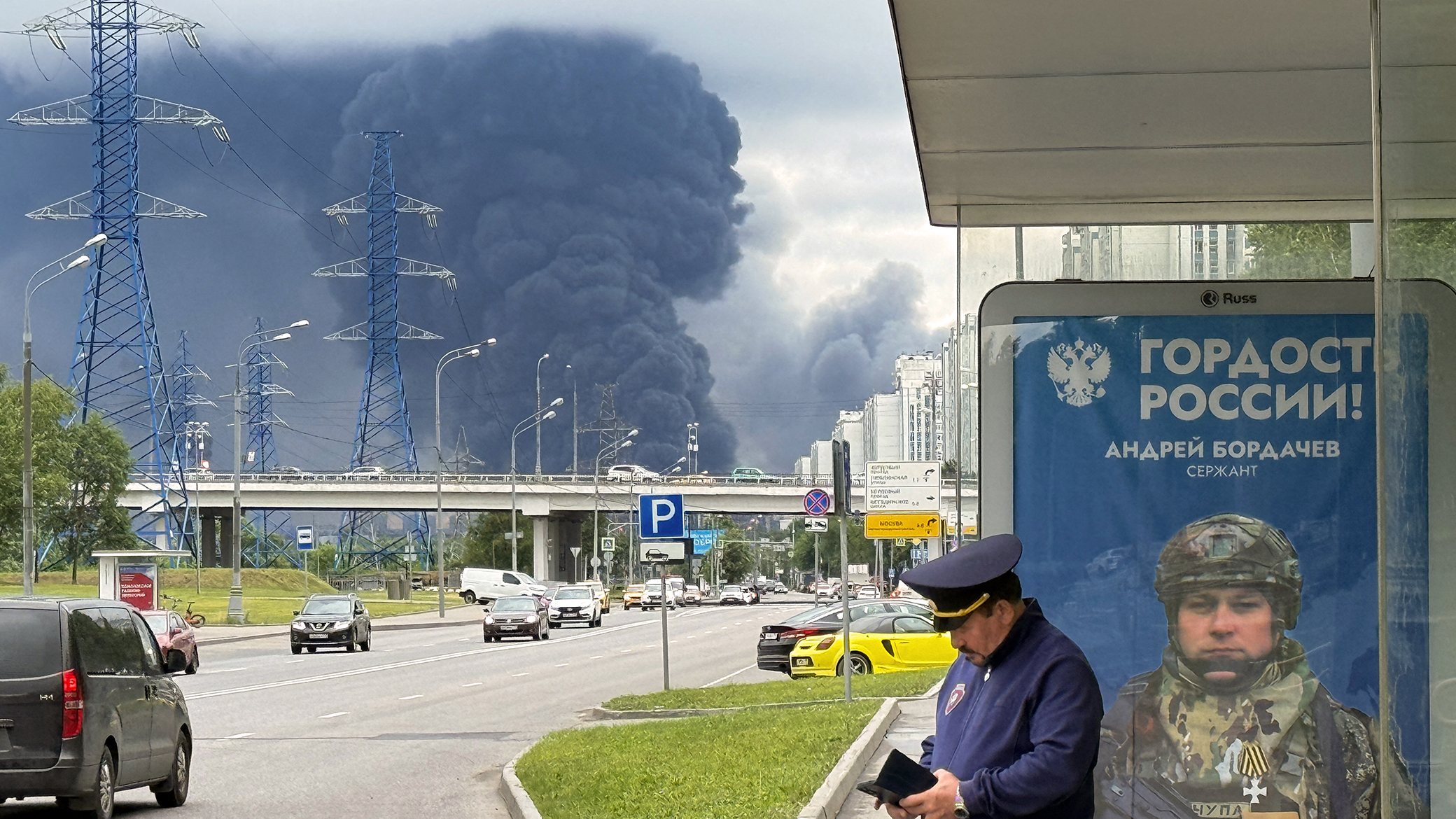
The war has increasingly reached Russia's own doorstep. In a striking admission of the growing security challenges facing Moscow, President Vladimir Putin significantly scaled back Russia's annual Victory Day military parade in May 2026 amid concerns over potential Ukrainian long-range drone and missile attacks. What was once presented as a distant "special military operation" is now being felt across Russia itself.
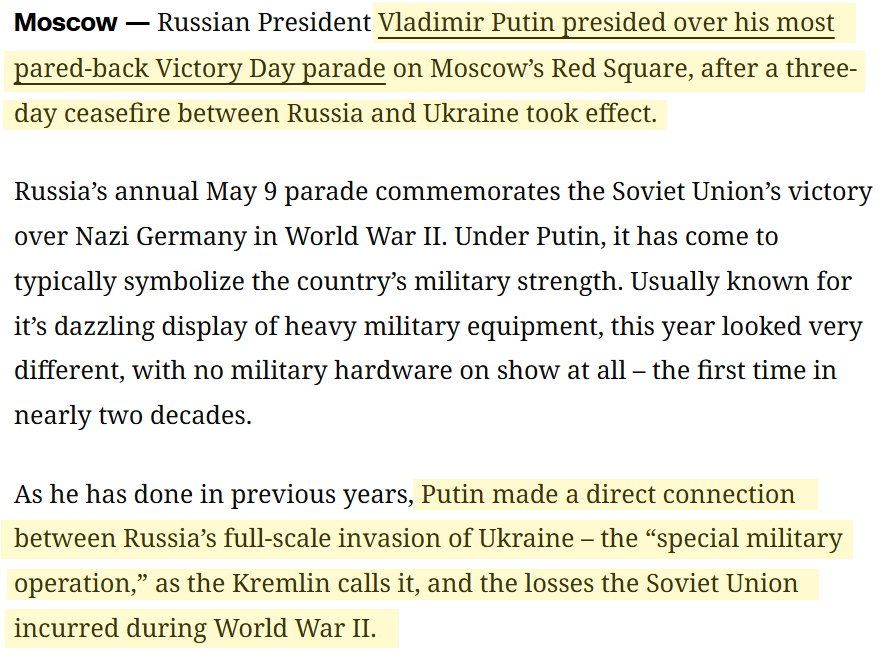
Equating its losses with those of World War II is quite significant.
Ukraine has now expanded its ability to strike deep inside Russian territory. Major cities, including Moscow and St. Petersburg, have faced repeated drone incursions, while border regions such as Belgorod, Bryansk, and Kursk remain under persistent attack. Crimea, once portrayed by the Kremlin as securely integrated into Russia, has become a frequent target as Ukrainian strikes disrupt fuel supplies, damage critical infrastructure, cause electricity outages, and force the closure of beaches and summer camps.
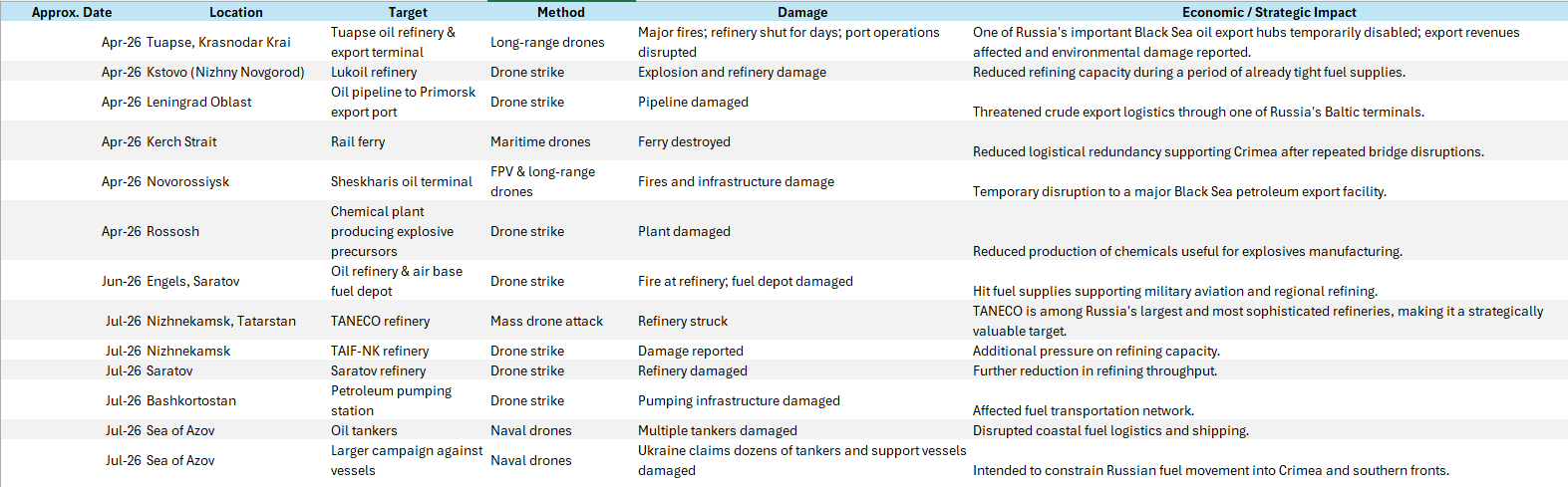
For ordinary Russians, 2026 has become a year of mounting hardship. A slowing economy, rising food and consumer prices, higher taxes, tighter internet controls, and an intensifying crackdown on dissent have all combined to expose the domestic costs of the war.
Now the battlefield is no longer confined to Ukraine. It is reshaping life inside Russia itself.
The human and material costs for Russia are extraordinary. CSIS estimates approximately 1.4 million Russian casualties, including about 450,000 fatalities, for relatively limited territorial gains.

Let us briefly discuss NATO's structure and pronouncements so we are grounded before we analyze the war situation at this moment.
NATO's Structure
NATO's deterrence posture is built on a simple strategic proposition: Russia must conclude that neither conventional aggression nor hybrid coercion can produce a favorable political outcome against the Alliance.
By combining forward-deployed forces, rapid reinforcement, resilient societies, expanded defense-industrial capacity, and sustained military investment, NATO is positioning itself for a long-term strategic competition rather than a finite conflict.
The underlying objective is not simply to deter war, but to convince Moscow that escalation cannot deliver victory, coercion cannot fracture Alliance unity, and any prolonged contest will ultimately favor NATO's superior collective economic, industrial, and military capacity.
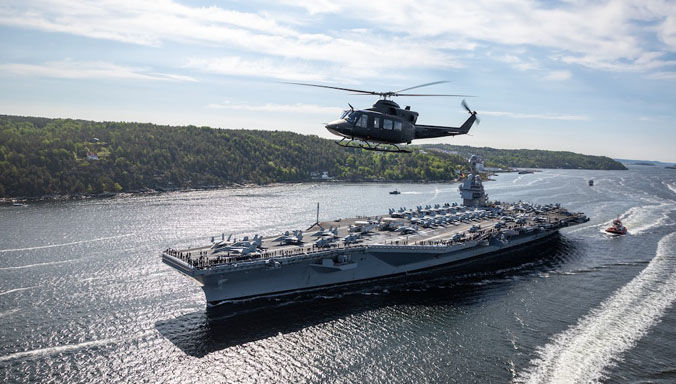
Basically, NATO’s 2025 Defense Ministers agreed on capability targets in: air and missile defense, long-range weapons, logistics, large land maneuver formations, and broader warfighting readiness.
The goal is to implement the regional defense plans in full, not merely to posture.
So, NATO and its members are getting ready for a large-scale war very soon.
Given NATO's posture, investments in Ukraine and daring attacks by Ukraine on Russia, Putin has started the mandatory step of nuke threats to "keep the enemy guessing (and scared he would hope)".
Putin's Nuke Threat
In the last few months, Putin and those in the Russian administration have been threatening nuclear retaliation against NATO and/or Europe.
As it still is today, the Russian Army was then stagnant across the front lines in the Donbas and in southern Ukraine. Moscow’s response at that time? Russian President Vladimir Putin began raising the specter of potentially using nuclear weapons in Ukraine. He authorized the transfer of nuclear weapons to Belarus. He also signaled that he might expand the war to NATO when he withdrew Russia from the Treaty on Conventional Armed Forces in Europe. Fast forward to today. Putin is once again rattling the nuclear saber, as his military loses, on average, 30,000 troops a month in Ukraine. Kyiv’s deep-strikes against Russia’s oil and energy sector are pummeling the Russian economy. In May, the Russian Ministry of Defense announced that it had delivered “nuclear munitions to field storage points in the operational area of a missile unit in the Republic of Belarus as part of military exercises.” Moscow’s message was primarily aimed at Ukrainian President Volodymyr Zelensky and his generals, but again, it was also aimed at NATO. For years now, Moscow has conducted a hybrid campaign against Europe by threatening nuclear sites in the West. Last month, Daniel Salisbury of The International Institute for Strategic Studies observed that “Russia is interested in manipulating nuclear risks to turn up the pressure on Western capitals.” (Source: "Losing in Ukraine, is Putin finally down to his nukes?" / The Hill)
Every attack that led to those threats and thereafter is meant to call Putin's bluff.
So what do we make of this? Well, possessing nuclear weapons does not automatically create a usable military option.
In many scenarios, nuclear weapons become less useful as a conflict progresses because the political and strategic costs of using them rise while the military benefits remain uncertain.
The key issue is not "Can Russia use nuclear weapons?" It unquestionably can. The issue is "Under what circumstances would Russian leaders conclude that using them improves rather than worsens Russia's position?"
Since 1945, nuclear-armed states have fought numerous wars, sometimes against each other indirectly, without resorting to nuclear use.
The reasons are fairly consistent, specifically in these times!
Nuclear weapons are often far less useful than many assume.
They cannot stop swarms of inexpensive drones, eliminate dispersed special operations forces, repair broken logistics, protect vulnerable refineries, restore damaged air defenses, rebuild industrial capacity, reverse economic sanctions, or occupy and hold territory.
Most modern wars are fought across widely dispersed networks of infrastructure, supply lines, and mobile units rather than concentrated armies.
So, a nuclear strike may devastate a specific location, but it may rarely deliver a decisive operational advantage to Russia. In many cases, it creates enormous political, humanitarian, and strategic costs while leaving the underlying military and economic problems largely unresolved.
It is quite obvious that Russia faces that classic question in deterrence theory: if nuclear weapons don't solve battlefield problems directly, can they be used to fundamentally change the political calculus by imposing unbearable costs?
Strategically, this is exactly the question military planners have studied for decades. But it's important to distinguish between theory and likely reality.
The theory is that a state facing a conventional disadvantage might seek to impose an asymmetric shock that forces the opponent to stop or negotiate. The reality is that, since 1945, no nuclear-armed state has demonstrated that nuclear first use reliably produces that outcome against another nuclear alliance.
The question that such a leadership, as Putin's faces today, can be summed up in this question.
In strategic literature, this concept is known as coercive escalation or escalation for bargaining leverage.
The objective is not necessarily military victory but changing the opponent's political decision-making.
Whether that would work depends on what the opponent believes.
If NATO concluded that conceding after nuclear use would encourage future coercion, it might become less willing to compromise rather than more.
Traditional military thinking assumed that victory came from destroying an adversary's forces. Schelling argued that nuclear weapons changed this logic fundamentally. Because a nuclear exchange could inflict catastrophic losses on both sides, the real value of nuclear weapons lay not in fighting wars but in shaping an opponent's decisions before war occurred.
This led to one of Schelling's most influential ideas: the "threat that leaves something to chance."
The central insight is deceptively simple. A state does not always need to promise deliberate escalation. Instead, it can deliberately create circumstances in which the risk of escalation becomes increasingly difficult for either side to control.
Imagine two people standing on the edge of a cliff connected by a rope. Neither wants to fall. One person begins moving closer to the edge—not because he intends to jump, but because doing so increases the danger for both. The other person must now decide whether continuing the confrontation is worth the growing risk that events spiral beyond either person's control.
In Schelling's framework, risk itself becomes a bargaining instrument.
Rather than saying: "I will definitely attack."
the coercing state is effectively saying:
This is why Schelling described coercion as the diplomacy of violence.
The objective is not necessarily to use force but to convince the opponent that continuing resistance becomes progressively more dangerous than making concessions.
Three decades later, James Fearon approached the problem from a different perspective.
In his landmark 1995 article, Rationalist Explanations for War, Fearon asked an apparently paradoxical question:

His answer transformed international relations theory.
Fearon argued that wars usually occur not because leaders are irrational, but because certain structural conditions prevent mutually acceptable bargains from emerging before violence begins.
He identified three main reasons why wars occur despite their immense costs.
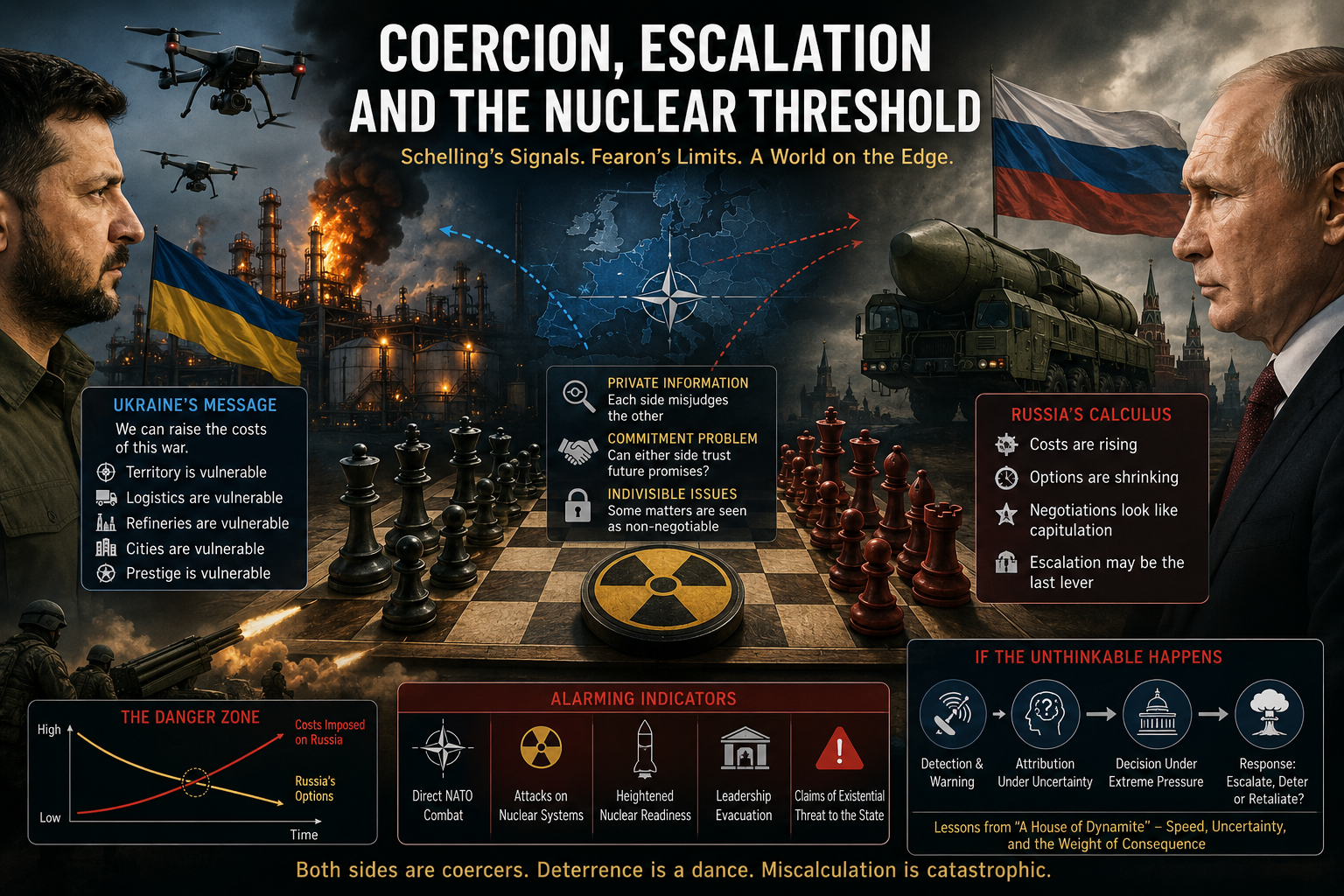
- First, private information: states often misjudge each other's military strength or resolve because governments conceal weaknesses or exaggerate capabilities.
- Second, commitment problems: even if an agreement is reached, neither side may trust that it will be honored as the balance of power changes, making preventive war appear rational.
- Third, indivisible issues: disputes over sovereignty, national identity, or regime survival are often viewed as impossible to compromise on.
Together, these factors explain why diplomacy can fail even when war ultimately leaves both sides worse off.
Thomas Schelling and James Fearon offer complementary explanations for why international crises sometimes end in peace and other times in war.
Schelling focuses on how states bargain under the shadow of force. During a crisis, rivals seek to influence each other's decisions through military deployments, economic pressure, political signaling, and credible threats. The objective is not necessarily to fight, but to shape the opponent's calculations without crossing the threshold into war.
Fearon explains why this bargaining process can still collapse. Negotiations may fail because each side misjudges the other's capabilities or resolve, doubts that future commitments will be honored, or views the issue at stake—such as sovereignty, national identity, or regime survival—as politically non-negotiable. Under such conditions, even rational leaders may conclude that war is preferable to an unreliable peace.
Taken together, these theories suggest that coercive escalation is not simply a matter of threatening greater violence. It is a process of deliberately manipulating an opponent's expectations about future risks, hoping those risks will induce political concessions before uncontrolled escalation occurs.
Whether such a strategy succeeds depends on how the opponent interprets the situation. If the target concludes that the coercer remains rational and ultimately seeks negotiation, concessions may become attractive. If, however, the target believes the coercer is bluffing, cannot credibly commit to future agreements, or would become even more dangerous if rewarded, the coercive strategy may instead strengthen resistance.
This is precisely why crises between major powers are so perilous. Schelling demonstrates how leaders intentionally increase uncertainty to gain bargaining leverage, while Fearon reminds us that uncertainty itself can undermine bargaining by encouraging misperception, mistrust, and commitment problems. The result is that strategies designed to avoid war can, under certain conditions, contribute to the very conflicts they seek to prevent.
Interpreting the Ukraine War using Schelling and Fearon Frameworks
We have discussed the history of the Ukraine conflict and how NATO set up the situation in a way that Putin had few options except invading Crimea and Ukraine.
Today, however, the direction of coercive pressure has increasingly shifted.
Ukraine is seeking to demonstrate that Russia cannot fully protect its own territory, and that key strategic assets, including Crimea, logistics networks, oil refineries, major cities, and symbols of military prestige, remain vulnerable to sustained attack. Rather than merely defending itself, Kyiv is raising the costs of continuing the war inside Russia itself.
At the same time, NATO is reinforcing this pressure by signaling that sanctions will remain in place, defense production will continue to expand, and military support for Ukraine will not simply fade with time.
In Thomas Schelling's framework, both sides are engaged in coercive bargaining, each trying to reshape the other's assessment of costs, risks, and potential gains. The roles are no longer those of a single coercer and a reluctant target.
Both sides are now coercing each other. The central question is which strategy is more effectively changing the opponent's calculations.
How would Schelling See It?
Thomas Schelling would likely interpret the Russia–Ukraine war as a contest over expectations rather than a purely military struggle. Neither side may believe that complete battlefield victory is immediately achievable. Instead, each seeks to convince the other that the costs of continuing the war will eventually exceed the costs of accepting a negotiated settlement. In this sense, the battlefield becomes an extension of political bargaining.
Every destroyed refinery, successful drone strike, new sanctions package, NATO summit, mobilization order, or weapons shipment serves two purposes. It is both a military action and a strategic signal intended to shape the opponent's perceptions of future costs, resolve, and endurance. This is the essence of Schelling's theory of coercive bargaining: using force—or the credible threat of force—not simply to destroy an adversary, but to influence its decisions.
How would Fearon See it?
James Fearon would ask a different question: if both sides recognize the enormous costs of the war, why has bargaining failed to produce peace?
His answer would center on three mechanisms.
- First, commitment problems. If Russia withdrew, could it trust that Ukraine would not deepen military integration with NATO? If Ukraine accepted neutrality or territorial concessions, could it trust Russia not to renew the invasion later? Mutual distrust makes even potentially beneficial agreements difficult to sustain.
- Second, private information. Both sides may believe that time favors them. Russia could expect Western unity to weaken, Ukrainian manpower to diminish, or political change to reduce support for Kyiv. Ukraine, meanwhile, may believe that sanctions, economic pressure, and deep strikes will steadily erode Russia's capacity to wage war while continued Western assistance improves Ukraine's position. If both expect future conditions to strengthen their bargaining leverage, compromise becomes less attractive today.
- Finally, indivisible issues sharply narrow the scope for negotiation. Crimea is a prime example. For Russia, it carries military, political, historical, and domestic significance. For Ukraine, it represents sovereignty and territorial integrity. When both sides treat the same territory as non-negotiable, the space for compromise contracts dramatically, making prolonged conflict far more likely.
Where Does Putin Stand Now?
This is where the insights of Thomas Schelling and James Fearon intersect most clearly. Ukraine's deep strikes into Moscow and other regions are doing more than damaging infrastructure or military assets—they are reshaping Russia's bargaining environment.
The strategic message is straightforward: the costs of continuing the war can be raised steadily and persistently.
In Schelling's terms, this is coercive signaling designed to alter Russia's cost-benefit calculation without necessarily seeking immediate battlefield victory.
The critical question for Vladimir Putin is whether these growing costs are temporary setbacks or signs of a long-term deterioration in Russia's strategic position.
One way to think about this is in terms of two converging curves.
- The first represents the rising costs imposed on Russia: economic strain, attacks on energy infrastructure, domestic insecurity, logistical disruption, and the steady expansion of NATO's military support for Ukraine.
- The second represents Russia's narrowing strategic options. As these curves converge, Russian leaders may conclude that every passing month weakens their future bargaining position.
Fearon would argue that this is precisely when bargaining becomes most difficult. Leaders who believe they will negotiate from an even weaker position tomorrow may become more willing to accept greater risks today in an attempt to improve—or at least preserve—their leverage.
This does not mean nuclear escalation becomes inevitable. Rather, it suggests that the incentive for increasingly risky conventional actions, escalation, or attempts to shift the strategic balance can grow as perceived bargaining power declines.
So when does Russia resort to the nuclear option?
We have seen that - per CSIS estimates - Russia has suffered close to or over half a million fatalities in the war till now.
That is an extraordinary human and military loss.
So, in effect, Russia’s leadership has already demonstrated that casualties alone do not determine its nuclear threshold. At least as of now.
Up until now, Putin has accepted losses many times greater than those suffered by the Soviet Union in Afghanistan without yet facing a decisive domestic rebellion.
It seems, as of now, Russia can lose soldiers, equipment, refineries, prestige, and even occupied territory while still retaining a survivable nuclear deterrent and control over the Russian state.
Russia’s revised November 2024 nuclear doctrine widened the circumstances under which Moscow says it may consider nuclear use.
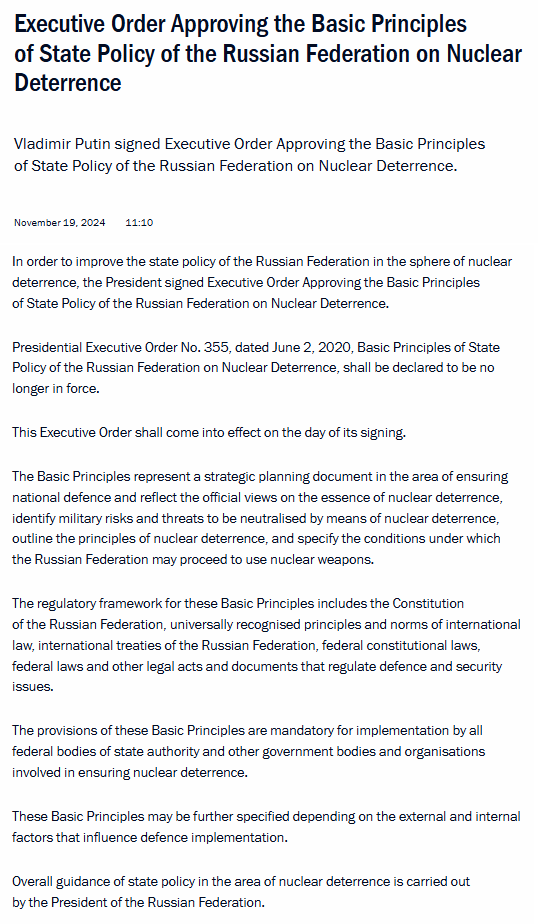
It treats aggression by a non-nuclear country supported by a nuclear power as a joint attack and allows nuclear consideration when conventional aggression creates a “critical threat” to Russian or Belarusian sovereignty or territorial integrity. It also preserves nuclear retaliation for nuclear or other weapons-of-mass-destruction attacks and for reliable warning of a large aerospace attack.
But it seems that doctrine is no longer an automatic firing mechanism. Basis the current situation, it seems to be performing three functions:
- setting real planning parameters;
- preserving flexibility for leaders;
- attempting to frighten adversaries away from approaching the threshold.
And ostensibly it is in that gap of uncertainty that NATO is willing to call Putin and Russia's bluff via Ukraine.
Where is this leading to?
The most dangerous lines in the Russia–Ukraine war are not defined by a single geographic boundary but by a set of escalating conditions that could sharply increase nuclear risk.
- First, direct NATO entry into combat would be a major inflection point. Supplying Ukraine is one level of involvement; NATO forces directly striking Russian assets—air defenses, command centers, or territory—would fundamentally change the conflict’s character and dramatically raise escalation risks.
- Second, attacks on Russia’s nuclear deterrent systems would be especially destabilizing. Strikes on command-and-control networks, early-warning systems, or strategic forces could be interpreted as preparation for a disarming first strike. In such a scenario, Moscow could fear losing its ability to retaliate, creating a classic “use-it-or-lose-it” dilemma.
- Third, a broader conventional collapse threatening the Russian state, not just battlefield setbacks in Ukraine, could trigger extreme responses. This would involve multiple failures: loss of territory within Russia, breakdown of command structures, regime instability, and a perception that state survival itself is at risk. At that point, the line between regime survival and national survival could blur dangerously.
- Fourth, any perceived attempt to decapitate Russian leadership targeting Putin, senior officials, or nuclear command authorities could be interpreted as a prelude to a larger disabling strike.
- Fifth, the most sensitive threshold is the potential loss of Russia’s second-strike capability. While territorial losses can be reversed, a neutralized nuclear deterrent cannot. If Moscow believes this capability is at risk, incentives for preemptive use would rise sharply.
Crimea, while strategically and symbolically vital, is not an automatic nuclear trigger. Its loss would likely provoke escalation, but the key factor is interpretation: whether it is seen as a limited setback or the opening phase of a broader campaign against the Russian state.
Putin still has options short of nuclear use.
They may include mobilization, negotiation, hybrid warfare, or strategic retrenchment.
These are difficult choices but safer than crossing the nuclear threshold.
The real danger lies in perception: if Russian leadership concludes that its position is rapidly deteriorating, negotiations equal capitulation, and escalation has lost credibility, nuclear use may appear as a last remaining lever.
The most alarming indicators would include
- direct NATO combat,
- attacks on nuclear systems,
- heightened nuclear force readiness,
- leadership evacuation, and
- claims that the state’s survival, not just battlefield outcomes, is under threat.
Having said that, let us go into some of the attacks that could qualify coming dangerously close to these extreme red lines.
Operation Spiderweb in June 2025: struck nuclear-capable strategic bombers. That was an attack on part of Russia’s nuclear force, but not necessarily on its most survivable retaliatory capability, nuclear command-and-control system, early-warning network, or deployed ballistic missiles. CSIS noted that Moscow had previously responded relatively cautiously when Ukrainian-built drones struck nuclear-capable aircraft.
On June 1, Ukraine launched drone attacks against strategic airbases across Russia. Ukrainian President Volodymyr Zelenskyy claimed that the strikes—dubbed Operation “Spider’s Web”—damaged or destroyed 34 percent of Russia’s strategic cruise missile–carrying bomber fleet. Ukrainian government sources subsequently reported that the attacks hit 41 and destroyed “at least 13” aircraft at four bases, including two facilities over 1,000 miles from Ukraine. Open-source satellite imagery and videos suggest that the attacks destroyed and damaged multiple strategic aircraft, but the attacks’ full impact will likely become clearer as additional imagery becomes available over the coming days. (Source: Ukraine’s Drone Swarms Are Destroying Russian Nuclear Bombers. What Happens Now? / CSIS)
Zaporizhzhia Nuclear Power Plant in occupied Ukraine: This happened recently in May 2026. This territory was not recognized as Russian sovereign territory. Yet it is currently occupied by Russia. Russia attributed the drone to Ukraine; Ukraine denied responsibility. The IAEA confirmed damage to the exterior of a turbine hall, but did not publicly establish attribution or report a radiation release.
Obviously, these incidents are serious, but they have not yet clearly crossed the nuclear thresholds. So this gives us a peak into the mindset and decision making by Putin's Russian administration.
Stage-wise Game Playing of the Nuclear Scenario
As we have discussed earlier, President Putin is unlikely to suddenly decide that nuclear weapons are his only option. A more plausible path is one in which conventional setbacks, regime insecurity, and fears about Russia's strategic deterrent gradually merge into a single existential crisis.
- The first stage begins when Moscow concludes that the war is becoming strategically irreversible. This would not be triggered by another refinery strike or a drone attack on Moscow, but by a sustained deterioration: Russian battlefield reverses, Crimea becoming militarily untenable, repeated Ukrainian strikes deep inside Russia, a resilient Western military-industrial base, mounting economic strain, and the realization that negotiations would merely formalize defeat. At this point, Russia would almost certainly exhaust conventional options first—escalating missile attacks, cyber operations, sabotage, mobilization, and strikes on Ukraine's political, economic, and energy infrastructure.
- The second stage emerges if the Kremlin concludes that NATO has effectively become a direct participant in the war. Russian doctrine now allows greater ambiguity in treating aggression by a non-nuclear state supported by a nuclear power as a joint attack. Domestically, the conflict would increasingly be framed not as a war against Ukraine but as a struggle for Russia's survival against NATO itself.
- The gravest danger arises if Russia begins to fear that its own nuclear deterrent is being systematically degraded. Simultaneous attacks on early-warning radars, strategic command-and-control systems, missile bases, submarine communications, mobile launchers, or national leadership facilities could create uncertainty about whether Russia was facing isolated attacks or the opening phase of a disarming campaign. Here, James Fearon's "private information" problem becomes existential: Russia would not need certainty that a first strike was imminent—only the belief that waiting might leave it unable to retaliate.
Before crossing the nuclear threshold, Moscow would likely issue increasingly explicit warnings through heightened nuclear readiness, leadership dispersal, strategic exercises, and other demonstrative signals designed, in Thomas Schelling's words, to shift the burden of escalation onto its adversaries.
Now let us expand our game playing further.
What If Russia Attacked a NATO Country but Tried to Stay "Below the Threshold"?
A devastating missile strike on a NATO member would not realistically remain below the Article 5 threshold simply because Moscow denied responsibility. The decisive issue would not be Russia's public statements, but whether NATO could confidently attribute the attack.
For this, let us look at the scenario in the recent movie "The House of Dynamite".
The film presents an unidentified missile headed toward an American city, an uncertain interceptor outcome, and a president confronted with nuclear options before knowing conclusively who launched the weapon. Experts have described its interagency communications and institutional pressures as broadly plausible, although the single-missile premise is unusual and the United States would ordinarily rely heavily on its second-strike capability rather than feeling compelled to retaliate before impact. That difference is crucial.
A secure second-strike capability gives leaders time not to act. The United States does not need to launch immediately merely because one missile is incoming. Russia likewise possesses enough dispersed nuclear forces that attacks on several bombers do not compel immediate use.
The danger increases when leaders believe those survivable forces may no longer be survivable.
We have analyzed the movie and its ramifications.
 Desh Kapoor
But could the unattributable missile situation be real? If so, what would the implications be?
Well, modern missile launches leave a substantial technical signature. NATO and the United States would analyze satellite launch detection, missile-warning systems, radar tracks, debris, electronic signatures, launch-platform movements, intelligence intercepts, and changes in Russian military readiness.
While plausible deniability can complicate attribution in cyberattacks, sabotage, or covert operations, it is far less credible after a large-scale missile strike causing mass casualties.
Importantly, Article 5 does not mandate an automatic nuclear response. It commits allies to regard an armed attack on one as an attack on all, while allowing each member to determine the measures it considers necessary. NATO's response options span a broad conventional and nuclear deterrence ladder.
A major Russian strike would most likely trigger immediate Alliance consultations, heightened nuclear readiness, reinforcement of air and missile defenses, and significant conventional retaliation against Russian military assets involved in the attack.
There could be additional measures that could be brought into play. These could include cyber operations, maritime interdiction, expanded sanctions, and a clear ultimatum backed by visible military preparations.
Let us probe the "House of Dynamite" scenario a bit more.
The Most Plausible NATO Response to an Ambiguous Russian Attack
Imagine a Russian missile devastates a major military installation or urban district in Poland, Romania, or one of the Baltic states.
Moscow immediately denies responsibility, claiming the strike resulted from a missile malfunction, a Ukrainian provocation, or the actions of an unidentified third party. Such denials would almost certainly delay political decisions, but they would not prevent NATO from responding.
The Alliance's first priority would be crisis management rather than retaliation. National leaders would be moved to secure command locations, military readiness levels would increase, and intelligence agencies would rapidly assemble attribution using satellite launch detection, radar tracking, missile debris, electronic signatures, intercepted communications, and other intelligence sources. At the same time, confidential military and diplomatic channels with Moscow would likely remain active to reduce the risk of miscalculation.
Once attribution reached a high level of confidence, the affected member would request consultations under Article 4 or invoke Article 5. NATO's immediate challenge would be to build Alliance consensus around both responsibility and a proportionate response. Rather than escalating directly to nuclear retaliation, the most probable initial response would be a powerful conventional strike against the military system responsible for the attack, such as the launcher, supporting base, command node, or associated military infrastructure.
Simultaneously, NATO would strengthen deterrence by dispersing nuclear-capable aircraft, increasing the readiness of strategic forces, reinforcing air and missile defenses, and publicly warning that any further aggression would carry increasingly severe consequences. Equally important would be private communication with Moscow emphasizing that NATO's response remained limited, defensive, and did not constitute the opening phase of a campaign aimed at regime change or the destruction of Russia's nuclear deterrent.
Now, the calculus changes fundamentally if Russia were to employ a nuclear weapon against NATO territory, attack NATO's nuclear command-and-control systems, launch multiple missiles indicating a broader nuclear campaign, or continue escalating after absorbing a major conventional response.
Under those circumstances, NATO would almost certainly consider a much wider range of options, including limited nuclear employment alongside overwhelming conventional operations.
Yet even then, there is no such thing as a reliably controllable "limited" nuclear exchange. Once the nuclear threshold is crossed, every subsequent action becomes clouded by uncertainty. Each side must determine whether the first detonation was an isolated demonstration, the opening phase of a larger campaign, or the prelude to a disarming strike, precisely the uncertainty that has made nuclear deterrence both powerful and perilous since the beginning of the atomic age.
The Real Danger
The greatest danger is not that President Putin believes nuclear weapons can win the war. It is that he comes to believe they are the last remaining instrument capable of interrupting a trajectory toward strategic defeat.
In that situation, Russian leaders might conclude that a limited nuclear action could shock NATO into halting the conflict before Russia loses its ability to shape the final settlement.
This is the danger identified by combining the insights of Thomas Schelling and James Fearon. Schelling explains how leaders may deliberately increase the risk of catastrophic escalation to regain bargaining leverage. Fearon shows why such bargaining can fail when intentions are uncertain, commitments lack credibility, and both sides believe time favors the other.
However, the developments witnessed so far do not necessarily indicate that Russia has reached this point. They do suggest that thresholds once considered politically or militarily untouchable, such as Russian territory, strategic aviation, and infrastructure linked to Russia's nuclear posture, are increasingly being tested.
The gravest risk would arise if Moscow began interpreting these attacks not as isolated military operations, but as part of a broader campaign to degrade Russia's leadership or undermine the credibility of its nuclear deterrent.