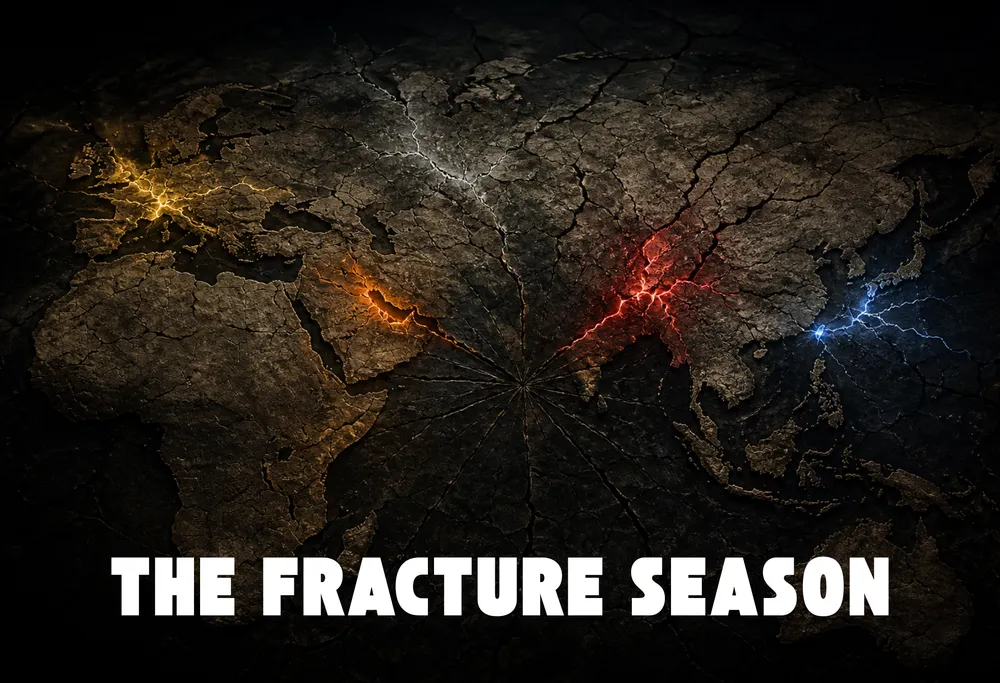

The Cup
A student came to the master and said, "The great wall has stood for a thousand years. Surely it will stand a thousand more."
The master poured tea into the student's cup. He continued pouring. The tea overflowed onto the table, then onto the floor.
The student said, "Master, the cup is full. It can hold nothing more."
The master set down the pot and said, "The wall does not fall because an enemy is strong. It falls because those inside believed it could not fall. That belief was heavier than any stone, and it blocked every door."
The student thought for a moment. "Then what protects a civilization?"
The master picked up the empty pot. "Not the wall. The knowledge that the wall is already falling — and the wisdom to have built somewhere else before it does."
The student looked at the tea still spreading across the floor and said, "But master, who decides where to build?"
The master smiled. "The one who watched the cup filling and said nothing waits for someone else to decide. The one who moved the cup — he has already decided."
That night, the student dreamed of five cups filling simultaneously. In the dream he ran between them, pouring from one into another, and the floor was always wet.
He woke before the last cup overflowed.
He was not sure whether this was wisdom or merely luck.
In the morning, he asked the master which it was.
The master was already pouring tea.
"There is no difference," he said, "at the moment before the overflow. Only afterward, when someone is telling the story, does one become wisdom and the other become catastrophe."
The Ceasefire that Wasn't
The ceasefire struck nearly four weeks ago is hanging by a thread. The nuclear question remains the core red line — Trump is demanding guarantees that Iran cannot build a weapon, while Tehran insists on its right to enrich uranium for peaceful purposes. Both sides are dug in, and Iran remains deeply distrustful of the US, in part perhaps because it doesn't understand why the US abandoned the last round of talks in Pakistan.
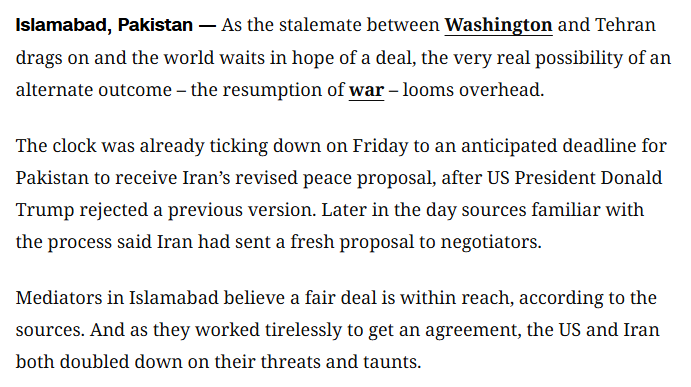
Iran's latest proposal would essentially defer nuclear negotiations to some future date, offering to end its chokehold on the Strait of Hormuz only in exchange for the US lifting its port blockade and agreeing to a permanent truce — without addressing the nuclear program at all. That's a non-starter for Trump.
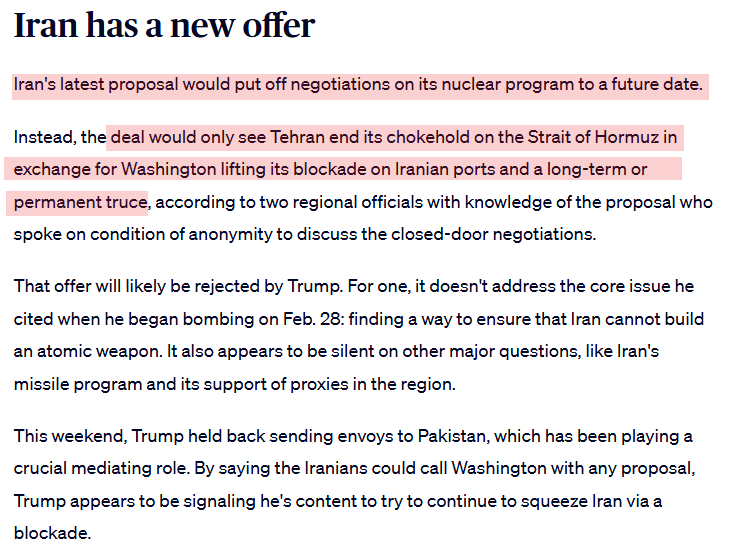
On 22 April, US officials said Trump had given Iran three to five days to engage in negotiations. The naval blockade remains in place, and the military was told to stay prepared to resume fighting.
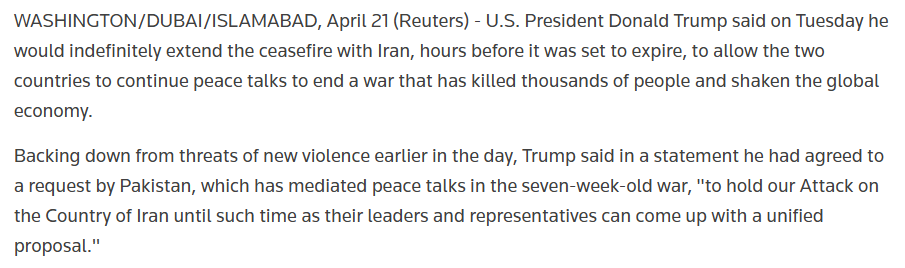
Pakistan even dismantled the checkpoints and security infrastructure it had set up for talks in Islamabad, a signal that there's no immediate hope of talks resuming. Meanwhile, the US military presence in the region continues to grow, with three aircraft carrier groups now stationed in the Middle East.
So why the quiet?
First, let us share some confirmations about the first leg of the conflict. Things that the world knew, but there was no real confirmation from the American side.
CNN and other news organizations are now confirming the damage that occurred across the Middle East.
At least 16 American military installations across the Middle East have reportedly sustained damage following coordinated Iranian missile and drone strikes, according to emerging defense assessments and regional reporting. These sites span critical U.S. operational hubs in countries such as Iraq, Syria, and the Gulf, forming a substantial portion of Washington’s forward-deployed military infrastructure in the region.
The strikes were not limited to symbolic targets. Several reports indicate that high-value assets, including radar installations, logistics depots, air defense systems, and possibly aircraft support facilities, were either damaged or temporarily rendered inoperable.
Analysts note that the scale, precision, and simultaneity of the attacks suggest a level of planning and intelligence integration that challenges previous assumptions about Iran’s conventional strike capabilities.
The implications go beyond immediate battlefield losses. The attacks obviously raise serious questions about the survivability of U.S. bases in a war environment, particularly against adversaries that bring serious drone and missile arsenals and surveillance networks.
They also expose vulnerabilities in regional air defense coordination among U.S. allies. More broadly, the strikes have triggered renewed debate in Washington about the long-term sustainability—and strategic rationale—of maintaining an extensive military footprint across an increasingly volatile Middle East.
Adding to the controversy, journalist Ana Kasparian has alleged that the Trump administration privately pressured commercial satellite imaging firms to restrict or delay the release of high-resolution imagery showing the extent of the damage. According to the TYT story, officials feared that widely circulated visual evidence of destroyed or heavily damaged U.S. bases would undermine American deterrence and project weakness on the global stage.
Officially speaking, these allegations remain unverified.
But they do touch on the broader pattern seen in past conflicts, in which governments attempt to control the information environment during periods of military vulnerability.
However, if true, such actions would signal not just concern over battlefield losses, but over narrative dominance itself. One would recognize that in modern warfare, perception can be as consequential as physical damage.
The episode, its veracity contested but aligning with the other reporting regarding the damage and suppression of that information until now, reflects how tightly military outcomes and information control are now intertwined.
Let us first deal with some questions.
When every strategic understanding suggests that China wants US weak and embroiled in the Iran conflict, why was China secretly supporting the Iran ceasefire discussions? At least the pretense of it all?
This is one of the most important strategic questions that we should address. At least in our own minds if not in a full geostrategic framework.
So, we know that China and Russia have been materially supporting Iran. China has provided spare parts for missiles, satellite positioning via BeiDou to direct attacks across the region, chipmaking tools via SMIC, and Chinese firms linked to the PLA that market geospatial intelligence on the positions of US forces.
Multiple sanctioned Iranian ships carrying sodium perchlorate, which is a solid-propellant rocket precursor, have traveled from China to Iran since the war began.
After the ceasefire, US intelligence indicated China was preparing to ship man-portable air-defense systems (MANPADs) to Iran through third countries to mask their origin — the same class of systems Iran used to shoot down an American F-15. Russia, for its part, has been providing intelligence sharing that helped Iran proactively target US troops and assets throughout the war.
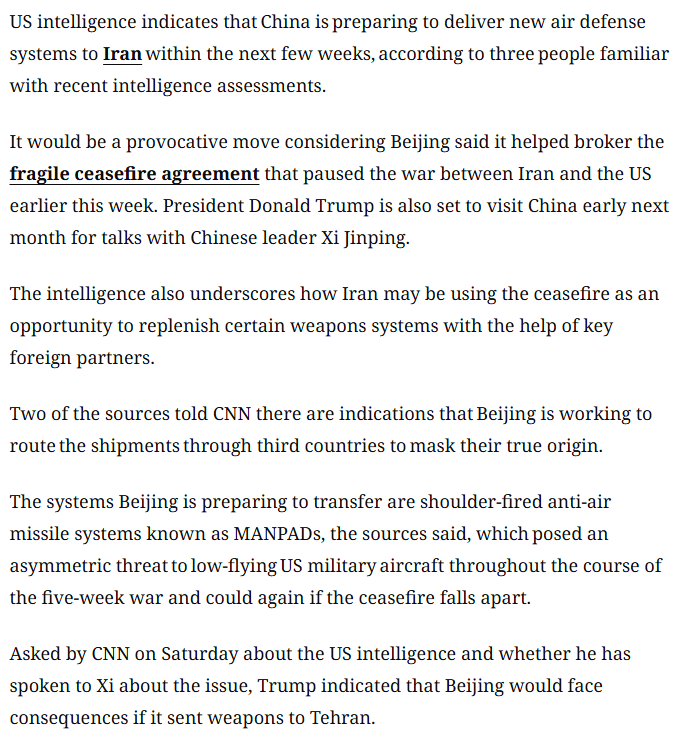
So China helped broker the ceasefire on the diplomatic track while simultaneously preparing weapons shipments on the covert track.
Why?
Let us go into it.
The Chinese calculus may be - and we are in analysis mode here - multi-layered. A look into that.
- First, one US intelligence source told CNN that China sees no real strategic value in overtly entering the conflict. They know a direct confrontation with the US and Israel would be unwinnable. Instead, Beijing is positioning itself as Iran's continued friend while maintaining outward neutrality so it can claim deniability after the war ends.
- Second, China is heavily exposed to the Strait of Hormuz economically. A prolonged closure bleeds China too, not just the West. China's stake in Gulf stability is significant. Pakistan provided the practical channel for the ceasefire, China provided the political weight and strategic backing. Convincing Iran to accept the two-week truce served China's near-term economic interest.
- Third, the critical question that arises is - if US arsenal depletion serves Chinese Taiwan ambitions, why would China allow the US to pause, recoup, and rearm? Well, rivals such as China and Russia are clearly learning lessons from the Iran conflict at the United States' expense. The war has exposed the limits of US military dominance, particularly the doctrine of preparing for conflict against a single adversary in a single theater. The Iran war has revealed something alarming: US weapons shipments to Taiwan have already been delayed — including Stinger missiles and Paladin howitzers. All due to the cumulative drain from Ukraine, Israel, and now Iran. The US scaled back from its Cold War posture of fighting two regional wars simultaneously to a single-theater doctrine. Iran has exposed the ceiling of that doctrine.
The structural answer to the last question is more complicated than one would think - China does not want to allow the US a clean recoup, but it also does not want Iran destroyed or the war to spiral into a US occupation of Tehran.
Since the Iran war began in late February, the United States has burned through around 1,100 of its long-range stealth cruise missiles built for a war with China, close to the total number remaining in the U.S. stockpile. The military has fired off more than 1,000 Tomahawk cruise missiles, roughly 10 times the number it currently buys each year. The Pentagon used more than 1,200 Patriot interceptor missiles in the war, at more than $4 million a pop, and more than 1,000 Precision Strike and ATACMS ground-based missiles, leaving inventories worrisomely low, according to internal Defense Department estimates and congressional officials. The Iran war has significantly drained much of the U.S. military’s global supply of munitions, and forced the Pentagon to rush bombs, missiles and other hardware to the Middle East from commands in Asia and Europe. The drawdowns have left these regional commands less ready to confront potential adversaries like Russia and China, and it has forced the United States to find ways to scale up production to address the depletions, Trump administration and congressional officials say. (Source: "Iran War Has Drained U.S. Supplies of Critical, Costly Weapons" / New York Times)
A dead or collapsed Iran is useless to Beijing — no oil, no overland corridor, no Hormuz leverage, no forward pressure on the Gulf states.
A surviving but weakened Iran, re-armed covertly by China during the ceasefire window, serves China far better than either a US military victory or an Iranian collapse. The MANPAD shipments during the ceasefire tell you everything that China is using the quiet period to rebuild Iran's asymmetric defenses, not to normalize the situation.
The one variable that complicates the China-Taiwan calculus is Trump's upcoming Beijing summit. At the Chinese Foreign Ministry press conference, a reporter directly raised the question of whether Trump and Xi would discuss US arms sales to Taiwan during their meeting.
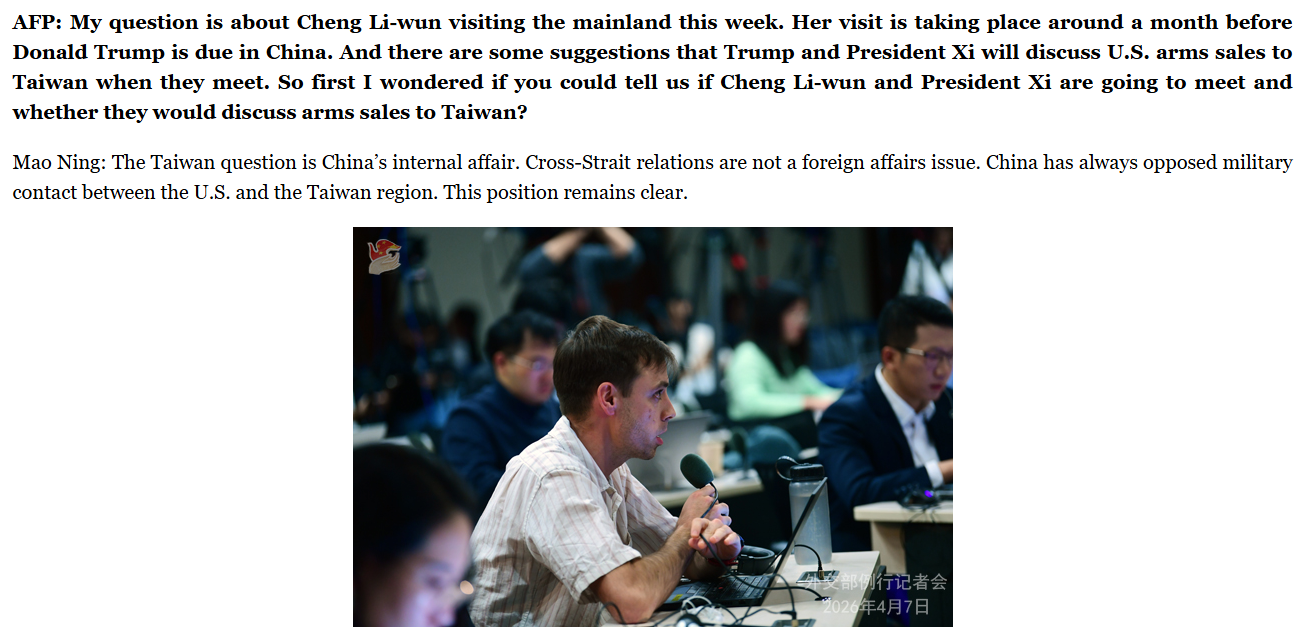
Trump is simultaneously running the Iran war and negotiating with Xi, which basically means there's a real possibility that Taiwan arms sales get traded as a diplomatic chip in exchange for Chinese pressure on Iran.
That would be the most dangerous outcome of all for Taiwan's long-term security posture, and it would confirm that the war with Iran has fundamentally reshuffled the board.
Let us now play a game.
Given all the pieces we have at our disposal, we will put together a story of the world battling multipolar, multi-regional conflicts as the great global powers change in character and potency.
A fictional take on "what the heck is happening?" We try to look at different conflicts and see if looking at them in an interconnected way can help us anticipate the future in ways that analysis of individual story does not afford.
This is a novel attempt on our part to use a different idiom for geopolitical analysis. Please do share what you think of it.
Part One: The Quiet That Wasn't
May – July 2026
The ceasefire held the way old concrete holds. Not because it was strong, but because no one had yet applied enough pressure to the exact right crack.
In the third week of May 2026, a Pakistani diplomatic convoy departed Islamabad for Tehran carrying what its foreign ministry described as a "framework for durable de-escalation." The document was forty-one pages. It proposed a phased reopening of the Strait of Hormuz, a monitored suspension of Iranian uranium enrichment, and a sanctions relief calendar tied to Iranian compliance benchmarks. It was, in the assessment of the three Iranian deputy ministers who read it that evening, a document produced by people who had never governed a country under siege.
The IRGC's response came not in writing but in action. Two days after the convoy's arrival, sea mines (not Iranian, officially) were discovered forty nautical miles east of the Omani coast. A Danish-flagged bulk carrier struck one at 3:47 AM. Eleven sailors died. The Strait had been, in technical terms, partially reopened. It was now, in functional terms, closed again.
In Washington, Trump posted on Truth Social at 6 AM that Iran had "totally violated" the ceasefire and that the United States was "considering all options."
His National Security Council had spent the previous two hours in a situation room, divided between advisors who wanted to resume strikes and advisors who pointed out that the USS Abraham Lincoln's Tomahawk inventory was at 34% capacity and that the defense procurement cycle for replacements was a minimum of 18 months under current industrial throughput.
In Beijing, this was not a secret. General Zhang Wei, deputy chief of the PLA's Joint Staff Department, had been receiving weekly briefings on US weapons expenditure rates since the first week of March. The analysis was precise, as Chinese military intelligence always was when American vulnerability was the subject.
What Beijing chose to do with that window was the question that would pivot the next decade.
But there was a variable in that calculation that General Zhang's brief did not yet fully price: what India was quietly planning along the Pakistani border, in the mountains of Balochistan, and in the high passes of the Afghan frontier.

In New Delhi, the External Affairs Ministry was managing two crises simultaneously
One it showed the world, and one it was preparing for in silence.
The visible crisis was the Hormuz emergency. Two-thirds of India's crude oil transited the strait. The government had negotiated emergency supplies from the United States at premium prices and from Russia, whose Urals crude was now flowing to Indian refineries at rates that would have been politically impossible eighteen months ago. The rupee had weakened. Inflation was running at 7.2%. The cooking fuel subsidies that had kept working-class India stable were costing the government forty billion dollars more than budgeted.
The invisible crisis was Pakistan.
Since Operation Sindoor in May 2025, which had destroyed the bulk of Pakistan's functioning air bases in a campaign that lasted 88 hours, the Pakistani military under General Asim Munir had been reconstructing with a determination that was observable in satellite imagery and in the procurement patterns flowing through three intermediary countries.
The Americans were supplying F-16 sustainment parts through a congressional waiver that the State Department described as "alliance maintenance." The Chinese were moving more deliberately whatever they could.
J-10CE fighter components, HQ-9 air defense system batteries, and something that Indian intelligence assessed, with moderate-to-high confidence, as a new short-range ballistic missile program sited in the Khyber Pakhtunkhwa hills.
Of course, all of this was dressed in commercial paperwork that held together until the third layer of analysis.
The Indian assessment, circulated to Modi's inner cabinet in late May, was specific in its conclusion: Pakistan's air defense reconstitution would reach a threshold of operational significance within eight to twelve months. Not parity. Not even near-parity. But enough to complicate the kind of strike package that Sindoor had executed with near-impunity.
The window for Indian action was narrowing, not because Pakistan was getting strong, but because it was getting just strong enough to make the cost matter.
Rajnath Singh, speaking publicly about Sindoor's legacy in June, chose words with a precision that his speechwriters had honed over three drafts: India had stopped when it chose to stop. The implication that the choice could be revisited was unmistakable to anyone in uniform in Rawalpindi.
Munir understood. His response was to do what Pakistani army chiefs had always done when they felt the ground shifting: he gave a speech.
He spoke of Pakistan's sovereignty, of its nuclear deterrent, of the world community's obligation to prevent Indian aggression.
In Balochistan, where the Baloch Liberation Army had been fighting the Pakistani state for two decades with varying intensity and sporadic foreign support, the summer of 2026 brought something potent: coordination.
The BLA's military wing began receiving, through channels that ran through Iranian Balochistan and were not inconsistent with Israeli intelligence practice, material that was qualitatively different from what had sustained them through previous campaign cycles. Encrypted communication protocols. Targeting systems for drone applications. Satellite imagery of Pakistani military logistics nodes.
The timing was not coincidental.
India was not directing the BLA. The relationship was more deniable, more functional, and more effective than direction would have been. It was creating conditions. Removing friction. Making sure that when the moment came, the Western Front would not be waiting for instructions.
In Afghanistan, the Taliban government's relationship with Pakistan had deteriorated from managed tension to active hostility. Pakistani airstrikes on Afghan border areas in the February-March 2026 period — part of a counter-terrorism campaign against TTP sanctuaries that the Taliban government had refused to dismantle — had produced a response that Islamabad had not anticipated: the Taliban were not deterred. They were mobilized. Afghan fighters were crossing into Khyber Pakhtunkhwa in small, persistent groups, attacking Pakistani military outposts with an operational patience that suggested external coordination without external control. The TTP, newly re-energized and resupplied from Afghan territory, had conducted eleven major attacks on Pakistani military installations between April and June 2026.
Pakistan was, by the summer of 2026, bleeding from three directions simultaneously.
And it had not yet understood that all three bleeds were connected.
In Europe, June saw a unilateral French announcement of its nuclear posture. Macron confirmed that France had begun deploying components of its nuclear deterrent to undisclosed continental locations under what he called a "European solidarity umbrella."
Moscow called it a fundamental alteration of the strategic balance. For seventy-two hours, markets fell 8%. Then nothing happened. The cycle of proclamation without consequence had become so routine that it had its own rhythm.
But the French nuclear deployment was 'not' nothing.
Part Two: The Architecture of Acceleration
August – October 2026
In August, the Semnan intelligence broke. Satellite thermal signatures at coordinates in Iran's interior, confirmed within seventy-two hours by IAEA emergency monitors, showed centrifuge arrays running at a facility that had never appeared in any inspection declaration. Iran had been enriching. The IAEA's director used the word "months" in describing the timeline to weapons-grade capability — careful language, but devastating in its precision.
The United States resumed strikes on November 9th.
But before the Semnan crisis fully consumed Washington's attention, a quieter event in September reshaped the subcontinent's calculus in ways that would matter enormously three months later.
Indian intelligence confirmed, to a threshold of certainty that General Anil Chauhan described in the cabinet briefing as "actionable," that Pakistan had successfully test-fired a modified Fatah-II ballistic missile from a new facility in Khyber Pakhtunkhwa. The missile's CEP (circular error probable, a measure of targeting precision) had improved by 40% compared with Pakistan's previous-generation missile.
The Chinese fingerprints on the guidance package were not in dispute. What was in dispute was the timeline. The earlier assessment of eight to twelve months had been optimistic. The real number was six to eight.
Modi convened the Cabinet Committee on Security on September 14th. What was decided in that room has not been publicly disclosed. What happened in the six weeks that followed makes its content inferable.
Indian Army units along the Line of Control that had been on standard alert posture moved to heightened readiness, with logistics prepositioning requiring explanations to corps commanders classified at the highest level. The Research and Analysis Wing's stations in Kabul, Tehran, and three Gulf capitals received instructions that their heads of station described, in encrypted traffic that was routine in its transmission and extraordinary in its content, as "Phase Zero coordination." The Israeli Mossad station chief in New Delhi had three meetings with his RAW counterpart in October that were not logged in any official calendar.
Russia's contribution was quieter still. In September, a Russian arms shipment to India, authorized under the S-400 sustainment agreement and therefore unremarkable in its paperwork, included a set of electronic warfare components not included in the original sustainment contract. They were not flagged. They were received.
In Balochistan, October was a month of careful positioning. The BLA's eastern columns moved into positions near Turbat and Panjgur, maximizing their ability to sever the southern arteries of the China-Pakistan Economic Corridor.
The CPEC was Pakistan's economic lifeline and Beijing's primary physical investment in the subcontinent. Threatening it was not merely a military act. It was a message to China about the cost of its Pakistan policy.
A message composed not in diplomatic language but in the positioning of armed men near fiber-optic cables and highway infrastructure that represented $62 billion in Chinese capital.
This was the most audacious element of the India-shaped architecture being assembled around Pakistan. It was also the most deniable. The BLA had been threatening CPEC infrastructure for years. What had changed was the quality of their intelligence about what to hit and when to hit it.
In Washington, the resumed Iran campaign consumed the NSC's bandwidth entirely from November 9th onward. The weapons stockpile was at levels that made the original campaign impossible to replicate in scale. What remained was targeted and conservative — three facilities, precision munitions held in reserve for exactly this scenario. But Iran's response was ferocious. Missiles hit US bases in Qatar and Bahrain. Forty-three American servicemen and women died in the first forty-eight hours. The Strait closed completely for the second time in eight months. Oil hit $147.
Trump was managing three simultaneous crises — Iran, oil prices, and the PLA movement near Taiwan that US signals intelligence had detected in October. His NSC was producing memos on all three, none of which resolved each other, all of which competed for the same pool of depleted military resources.
It was in this moment, with Washington overloaded, Beijing recalibrating, the global energy market in a second acute shock, Europe shivering through its coldest winter in forty years, that India moved.
Part Three: Operation Sindoor II
December 2026
The operational name was internal. What the world saw, initially, was ambiguous: reports of explosions near Sargodha air base on the night of December 3rd, then conflicting Pakistani military statements, then a complete blackout of Pakistani official communications for eleven hours that was, in itself, more informative than anything Rawalpindi could have said.
India did not need more than that.
The operation unfolded on three axes simultaneously, which was its essential difference from Sindoor I.
On the eastern axis, Indian Air Force strikes targeted what remained of Pakistan's rebuilt air defense network — the HQ-9 batteries in Punjab, the reconstructed radar installations at Nur Khan, the command-and-control nodes that Sindoor I had damaged and Pakistan had spent fourteen months repairing. The Israeli-provided electronic warfare systems suppressed Pakistani radar coverage in the first ninety seconds of the operation. By minute twelve, Pakistan's integrated air defense was functionally blind across a 600-kilometer arc.
On the western axis (and this was the element that no outside analyst had fully anticipated in its coordination), the BLA's eastern columns struck simultaneously.
The Turbat cell destroyed the fiber-optic relay station that carried CPEC's primary data backbone. The Panjgur cell disabled the M8 highway bridge, severing the road connection between Gwadar port and the northern CPEC corridor. These were not symbolic attacks. They were surgical removals of Pakistan's economic connectivity with China, executed within hours of the Indian air campaign's opening.
On the northern axis, TTP units crossing from Afghanistan launched coordinated attacks on seven Pakistani military posts in Khyber Pakhtunkhwa, including the Torkham gateway post that controlled the primary road from Afghanistan into Pakistan.
The Taliban government in Kabul issued no statement for forty-eight hours. A silence that was itself a form of complicity, understood as such in every capital that followed the region.
General Asim Munir, reaching for the nuclear deterrent language that was Pakistan's ultimate instrument of survival, discovered in the first 12 hours that it was not producing the effect it had previously.
His calls to Washington, to Beijing, to Riyadh, the capitals that had always, in previous crises, applied sufficient pressure to restrain India, went through. The conversations were polite. They were not productive.
Washington was fighting Iran. The NSC advisor who took Munir's call at 3 AM EST was a deputy, not a principal, and he said what deputy advisors say in crises they have not been authorized to resolve: he noted US concern, called for restraint on all sides, and said the matter was being elevated. It was elevated. It sat in a queue behind the Strait of Hormuz, the oil price emergency, and a Taiwan Strait signals intelligence alert that had come in at 11 PM.
Beijing's response was sharper in its alarm but no more effective in its delivery. The Chinese ambassador in New Delhi was summoned; it was India doing the summoning, not Pakistan, and presented with a document that the Indian foreign ministry described as a "factual briefing on the security environment."
The document included satellite imagery of the J-10CE components at the Khyber facility. It included procurement documents showing the Chinese guidance package for the Fatah-II modification.
The ambassador returned to his embassy. Beijing went quiet.
The nuclear question, the one that every Pakistan crisis raised, was handled differently this time.
India's operation was explicitly and publicly not targeting Pakistan's nuclear storage sites. The Indian foreign ministry spokeswoman said so at 7 AM on December 4th in language that was precise to the point of being clinical: India was targeting Pakistan's conventional military capacity. Nuclear installations were not being approached. IAEA monitoring of Pakistan's nuclear sites was invited. This was not restraint born of weakness.
It was a restraint designed to remove Pakistan's nuclear argument from the diplomatic toolkit. To say, in effect, your deterrent is not threatened, which means you cannot use it as justification for escalation, which means you have no escalation left.
It was the most sophisticated use of the nuclear communication channel in the subcontinent's history.
Its architecture bore Israeli fingerprints, as precision messaging under crisis conditions tends to bear the fingerprints of the country that has done it most often.
Part Four: The Disintegration Begins
December 2026 – February 2027
Pakistan did not collapse on December 4th. Countries do not collapse on specific days. What happened was more like a building from which the load-bearing walls have been removed: it stands, for a time, on structural memory.
The Pakistani military's command authority over Balochistan became theoretical within three weeks of the operation. The provincial capital Quetta remained nominally under federal control. The roads connecting it to the rest of Pakistan did not.
The BLA consolidated positions that gave it effective control over Balochistan's resource-extraction infrastructure (the gas fields, the highway corridors, the CPEC arteries) and administered them with an efficiency that surprised even its external supporters. The Baloch people, who had been fighting for autonomy for seven decades under conditions of savage suppression, did not need to be told what to do with the space that had opened. They had been planning for it for generations.
In Khyber Pakhtunkhwa, the dynamic was different and more volatile. TTP control of border areas created a zone of ambiguity that was neither Pakistani territory nor Afghan territory but something that the Taliban's Kandahari leadership was disinclined to clarify, because ambiguity served them better than any formal claim. Pakistan's writ in the tribal belt had been fictional for years. December made the fiction official.
Sindh was watching. The Sindhi nationalist movement, which had long existed on the margins of Pakistani politics, began to receive attention from quarters that had previously regarded a Punjabi-dominated Pakistan as a more convenient interlocutor.
The Sindhu Desh argument, that Sindh had been absorbed against its will into a Pakistan project that primarily served Punjabi military interests, was not new. The audience for it, in late December 2026, was larger than it had ever been.
Punjab and Rawalpindi retained control.
The Pakistan Army was not defeated. It was encircled.
It held the core but had lost the periphery, and in a country whose geography makes the periphery the majority of the territory, holding the core is a form of strategic contraction that has only one long-term trajectory.
Munir gave speeches.
Four in the first two weeks of December, three more in January.
They were attended to by foreign audiences with the muted sympathy that powerful nations extend to smaller ones in their final configurations.
Acknowledging the performance, declining to be moved by it.
His speechwriter, Farooq Latif, resigned on January 8th, citing "personal reasons." He did not give interviews.
The United States scrambled, but its efforts were hampered by what it had.
The Iran campaign was consuming its carrier-based air power in the Gulf. Its diplomatic bandwidth was already at maximum utilization amid the Tehran talks, the Hormuz negotiations, the European energy crisis, and the Taiwan Strait signals that kept arriving from the Pacific.
Sending a significant military or diplomatic intervention to the subcontinent, the kind that might have forced India to stop, would have required withdrawing resources from another crisis, each with its own constituency in the NSC and its own political cost of deprioritization.
Trump made the calculation that successful American presidents have always made when confronted with simultaneous crises: he triaged.
Iran was affecting oil prices, which affected its domestic political standing. November midterms had left him vulnerable in Congress, and the threat of impeachment was real.
Pakistan's disintegration was affecting a country that most American voters could not locate on a map. The triage was not difficult.
China's calculation was both more alarmed and more constrained. The CPEC damage was not merely an economic loss — it was a signal that India was willing to attack Chinese investment infrastructure as a strategic instrument. This was a genuinely new development. India had always been careful, in previous confrontations, to keep Chinese assets out of the target set.
The BLA strike on the CPEC corridor, which Beijing understood was not entirely uncoordinated with New Delhi, regardless of what the deniability architecture looked like, was India telling China: the rules have changed.
On December 6th, Indian Navy assets at the Andaman and Nicobar Command conducted what New Delhi described as "scheduled maritime domain awareness exercises" in the southern approaches of the Malacca Strait.
The phrasing was bureaucratic. The positioning was not.
Great Nicobar Island, where India had been constructing a deep-water naval base and transshipment port since 2022, now hosted surveillance infrastructure capable of tracking every vessel entering the world's most consequential chokepoint.
Forty percent of global trade moves through Malacca. Eighty percent of China's oil imports transit it.
The PLAN calls this the "Malacca Dilemma" in its own doctrine. The nightmare of a hostile power sitting at the throat of China's energy lifeline. India had just placed its hand on that throat, gently, without squeezing, and made sure Beijing felt the pressure of fingers that were not yet closing.
Oh no, it wasn't a threat directly. Yet.
It was the demonstration that a threat was available.
Beijing convened emergency Standing Committee sessions on December 5th, 6th, and 9th.
The sessions produced a communiqué calling for "immediate cessation of hostilities and respect for Pakistan's territorial integrity." They produced quiet consultations with Washington about joint pressure on India.
They produced precisely zero results, because India had correctly calculated that both Washington and Beijing were overloaded and that neither had the bandwidth to enforce a demand for Indian restraint.
Russia said nothing publicly. Privately, the Russian ambassador in New Delhi had a warm meeting with his Indian counterpart on December 7th, described in official records as "routine bilateral consultations" and lasting three hours.
Israel said nothing publicly. Its deniability was impeccable. Its fingerprints were everywhere, and everyone knew it, and it made no difference.
Part Five: The Cascade Converges
March – April 2027
The winter of 2026-27 was the coldest in Europe in forty years. Natural gas demand spiked 34% above seasonal norms. Europe's gas storage fell from 87% capacity to 41% between November and February — a drawdown rate that had energy ministers in Berlin and Paris in quiet crisis-management mode, with nothing to do with geopolitics and everything to do with whether elderly Germans were going to freeze to death in March.
Russia, with gas to sell, was present for exactly these conversations. The back-channel engagement between the German economics ministry and Gazprom's commercial division — through the Turkish Stream route and through Hungary, which was willing to act as a transit facilitator for a fee — was not publicized. Europe was being re-tethered to Russian energy by weather, by the failure of the Hormuz reopening, by the inadequacy of LNG import capacity that would take three more years to build to scale, and by the simple economic reality that Russian gas, even through expensive intermediaries, was cheaper than American LNG at $147 oil.
Macron's nuclear umbrella. Germany's €400 billion rearmament. The ReArm Europe plan. The language of strategic autonomy. All of it was happening simultaneously with Europe's energy policy drifting, through necessity and frostbite, back toward Moscow. This was not a betrayal of principle. It was the discovery that the principle, applied against sufficient material constraint, eventually yields to the material constraint.
The inflection point came not in a single moment but in a seventy-two-hour convergence that reordered everything.
On April 3rd, the IAEA released its assessment confirming that it could no longer verify Iran's nuclear program. The inspection architecture had ceased to function. Iran remained an NPT signatory on paper. The paper meant nothing.
On April 4th, Saudi Arabia suspended its normalization talks under the Abraham Accords.
MBS had concluded, watching what India had done to Pakistan, watching what the US had failed to prevent, watching what China had failed to protect, that the architecture of external security guarantees was not reliable enough to base a kingdom's future on.
The bilateral security framework with China, which had been under negotiation since December, was quietly ratified.
On April 5th, Easter Sunday, the PLA's Eastern Theater Command executed Joint Sword-2027. One hundred and eighty-three sorties into Taiwan's air defense identification zone.
PLAN amphibious assault ships within operational landing distance of Taiwan's western coast. Submarines blocking three of Taiwan's four commercial shipping routes.
In Washington, the National Security Council looked at the map and saw what no American NSC had ever wanted to see: simultaneous active military crises in the Gulf, the subcontinent, and the Taiwan Strait, with an arsenal at 45% of pre-Iran-war capacity, three carrier groups in the Middle East, and a Japan that was rearming fast but not yet fast enough to carry the Pacific deterrence burden that had been America's since 1945.
Trump called Xi. The call was fifty-two minutes. The American statement afterward contained a phrase that had been in every US-Taiwan statement for forty years, and that was now being read for its omissions. It did not say the US would defend Taiwan militarily if China attacked.
In Taipei, the omission was heard with absolute clarity.
In Beijing, the response to the Pakistan situation had fundamentally altered the Standing Committee's Taiwan calculation — but not in the direction India had intended, or perhaps exactly in that direction, depending on which reading of New Delhi's strategic culture one found more convincing.
The Pakistan precedent had demonstrated two things simultaneously.
- First, that a mid-sized regional power could execute a multi-front disintegration operation against a nuclear-armed state, manage the nuclear-escalation dynamic through precise communication, and succeed despite American and Chinese objections.
- Second, and more troublingly for Beijing, that American commitment credibility was now a variable rather than a constant — that Washington would triage crises, and that the crises it chose to deprioritize would be decided by domestic political calculation rather than by formal alliance commitment.
For China's hawks, this argued for moving on Taiwan before the window closed. The US arsenal would recover. Japan would rearm. The moment of maximum American distraction was now, or near now.
For China's institutionalists, the faction that believed the Pakistan precedent argued for caution, the lesson was precisely the opposite.
India had moved on Pakistan and succeeded not because of its military power alone, but because it had built the diplomatic, economic, and intelligence architecture for the operation over seven months, coordinated with Russia and Israel, managed the nuclear communication channel with sophistication, and exploited a specific window of American overloading that would not last forever.
China, moving on to Taiwan, would face a US that had every reason, unlike in the Pakistan case, to prioritize its response. The Seventh Fleet, even depleted, was not nothing. Japan was already at 3.1% GDP defence spending. Australia's submarine program was accelerating.
The Standing Committee's deliberations in April 2027 did not resolve this argument. They extended it. The decision was not made. It was deferred, again, while the intelligence continued to accumulate and the window continued to open and close in a rhythm that was becoming as familiar as breathing.
Part Six: Where the Story Ends and Doesn't
April 2027 and Beyond
History does not end. It accelerates, diffuses, refolds.
By April 2027, Pakistan had ceased to exist in the sense that mattered most: as a coherent security actor capable of projecting force beyond its own contracting perimeter.
The Army held Punjab and the nuclear installations. The periphery was a different question answered by different people. Balochistan was administering itself. The tribal belt was disputed ground between Taliban influence and TTP control. The formal structures of Pakistani sovereignty — the parliament, the presidency, the foreign ministry issuing statements that went unanswered — were maintained with the care given to institutions whose purpose has become ceremonial.
General Munir had not resigned. He had not been removed. He had become something the Pakistani military had occasionally produced before: a commander whose authority existed within the walls of GHQ Rawalpindi and was not meaningfully tested outside them. He issued statements. Farooq Latif had been replaced by a younger speechwriter who did his job with professional competence and no emotional investment in the outcome whatsoever.
The NPT was functionally dead. The Hormuz crisis had stabilized at a level of managed disruption that shipping companies had priced into their rates. Iran was enriching. The IAEA was watching from the outside.
Russia's war chest, refilled by oil revenues buoyed by the Hormuz crisis, was sustaining its position in Ukraine.
The frozen conflict was neither war nor peace. Europe was rearming seriously, integrating haltingly, and quietly re-engaging with Russian energy through Hungarian intermediaries while maintaining the rhetoric of strategic autonomy at a volume calibrated to drown out the sound of gas flowing back through the pipes.
India had done something that no country in the post-1945 order had done in quite this way: it had used a multi-front, coordinated operation to permanently alter the strategic geography of its neighborhood, managed the great-power response by correctly calculating that Washington and Beijing were overloaded, and emerged with its international relationships essentially intact.
Damaged in some quarters, strengthened in others, but not isolated.
The FTA blitz with the UK, EU, Oman, and New Zealand was building the trade infrastructure of a country that understood it was now operating in a world where the rules-based order was aspirational rather than functional, and that the countries that thrived in such a world were the ones that had built alternative architectures before the primary one failed.
The question that every capital was asking, in different languages and from different vantage points, was the same and the system could not stop it, what does that tell us about what can be done to us?
For China, facing Taiwan, the question was literal.
For Europe, facing Russia, the question was structural.
For the smaller states of Southeast Asia, the Gulf, and Central Asia, the great powers had been rearming, hollowing out institutions, and watching the gap between declared principle and actual practice widen to the point where the pretense was barely maintained; the question was existential.
The difference was this: in 1914, the great powers wanted war and used an assassination as the occasion for it. In 2027, no great power wanted a global war.
What they wanted, strategic advantage, resource security, alliance management, domestic political survival, was leading them toward configurations that made war more likely while each individual actor was trying to avoid it.
The danger was not aggression. It was the structural accumulation of choices made in legitimate self-interest that collectively produced an outcome that served no one's interests.
The fracture was not a single break. It was a pattern of cracks propagating through the load-bearing walls of the post-1945 order at different rates and in different directions.
Iran's nuclear opacity, Pakistan's disintegration, China's Taiwan window, Russia's Ukraine consolidation, Europe's strategic adolescence, India's operational audacity were connected at their origins and converging, slowly and then faster, toward something that would eventually require a different architecture entirely.
Pakistan's disintegration was not the end of that story. It was the proof of concept. It demonstrated, in real time, that the deterrence architecture of the post-Cold War world, which spoke of mutual assured destruction, nuclear taboo, institutional mediation, and an American backstop, could be circumvented by a sufficiently prepared and patient regional power operating in a window of great-power distraction.
That lesson, once demonstrated, could not be undemonstrated.
Every general in every capital had read the operational summary by March 2027. Every standing committee had discussed what it implied for their own strategic calculations. Every nuclear state had updated its deterrence doctrine to account for the possibility that a sophisticated adversary might use the India-Pakistan template on its own periphery.
The world was no safer because of what had happened. It was not more dangerous in the theatrical sense of missiles flying and capitals threatened. It was more dangerous in the architectural sense: the constraints that had kept the system from testing its own limits had been tested, and found to be more negotiable than the architects had designed them to be.
What that meant for Taiwan, for Ukraine, for the South China Sea, for the half-dozen other flashpoints that a declining hegemon and a rising competitor were circling simultaneously.
That was the question that April 2027 posed and did not answer.
The answer would come. History always provides answers, you see.
The question is only who survives to read them.
What force that might be, and who would survive its application, is the question that the next decade will answer, whether anyone wants it to or not.