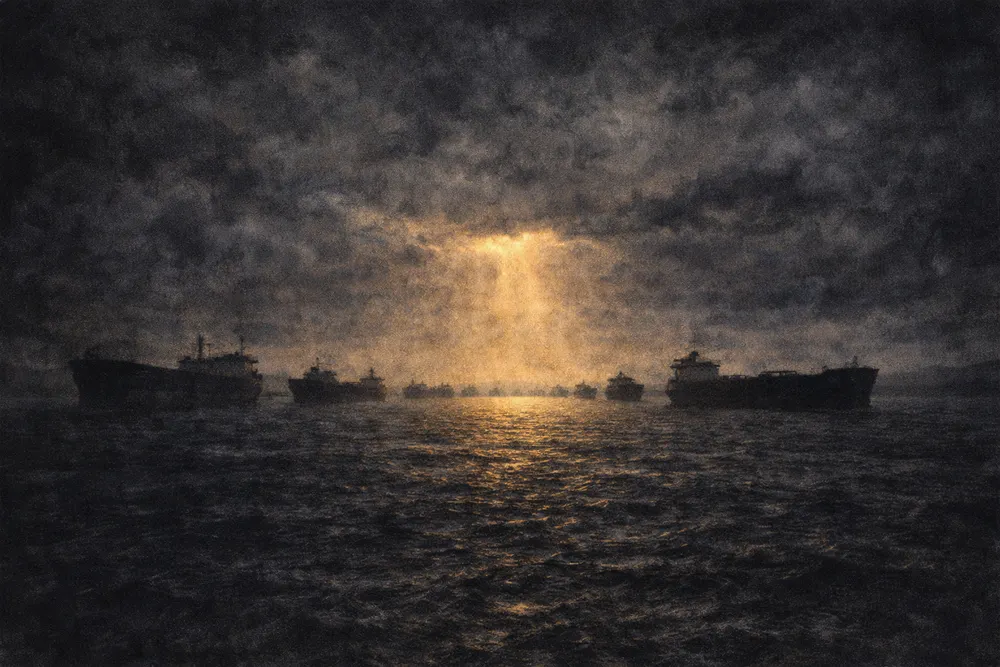
"In Europe, we have maybe six weeks or so of jet fuel left. I can tell you soon we will hear the news that some flights from city A to city B might be cancelled as a result of lack of jet fuel. It's a dire strait now, and it is going to have major implications for the global economy." — IEA Executive Director Fatih Birol, AP exclusive interview, Paris, April 16, 2026
What This Signals
"Dire Straits" is an intentional pun. Birol is the world's top energy official, not a columnist or think tank analyst. When the head of the International Energy Agency says "the largest energy crisis we have ever faced" in an AP interview from Paris, hours before a multilateral Hormuz summit and an Israeli-Lebanese ceasefire announcement, the timing is deliberate. It is a coordinated pressure signal: this is what it costs to stay in this war.
Six weeks of European jet fuel is the number that ends the abstract debate about whether the Strait of Hormuz matters to ordinary people in rich countries. Flight cancellations from London to Amsterdam, Frankfurt to Paris, and Rome to Madrid, due to kerosene running out rather than politics.
Today is the day the war began, structurally, to end. Trump announced a 10-day ceasefire between Israel and Lebanon hours after the Hormuz summit convened.
Modi called Macron and publicly aligned India with freedom of navigation. The S&P 500 erased all its war losses. Iran's parliament speaker met Pakistan's army chief. The second round of US-Iran talks is now expected to take place in Islamabad over the weekend.
The exit doors are opening. Whether the parties walk through them remains, as always, a separate question.
Story #1: Trump Announces 10-Day Israel-Lebanon Ceasefire
The Full Picture
In one of the most consequential announcements of the entire 48-day war, President Trump declared on Truth Social on April 16 that Israel and Lebanon had agreed to a 10-day ceasefire, effective at 5 pm EDT. "I just had excellent conversations with the Highly Respected President Joseph Aoun, of Lebanon, and Prime Minister Bibi Netanyahu, of Israel," Trump wrote. "These two Leaders have agreed that in order to achieve PEACE between their Countries, they will formally begin a 10 Day CEASEFIRE at 5 P.M. EST."
The behind-the-scenes sequence is more revealing than the announcement itself. Secretary Rubio hosted Israeli and Lebanese ambassadors at the State Department on Tuesday, the first direct engagement between the two countries since 1993. No decisions were reached. On Wednesday evening, Trump posted on Truth Social, trying to get both leaders on the phone together. The Lebanese side declined to speak with Netanyahu before a ceasefire was in place. On Thursday morning, Rubio called Lebanese President Aoun. Then Trump called Aoun, the first time he had spoken with the Lebanese president since taking office. Then Trump called Netanyahu. Then the State Department worked with both governments to produce a Memorandum of Understanding. Then Trump announced it.
"Trump pushed this ceasefire through," a senior Israeli official told Axios. Netanyahu's security cabinet learned of Trump's announcement several minutes into an urgent conference call to discuss the ceasefire, before any serious discussion had started. The ministers were confronted with a fait accompli.
The terms: Israel retains the right to self-defense at any time against "planned, imminent or ongoing attacks" in Lebanon. Israeli forces remain in an expanded security zone in southern Lebanon, which Netanyahu described as "more extensive and more continuous than before." Lebanon commits to working toward Hezbollah's disarmament. The ceasefire is extendable by mutual consent. Hezbollah is not a party to the agreement. Hezbollah chief Naim Qassem said any truce must apply "across all Lebanese territory and must not allow the Israeli enemy any freedom of movement."
Why this matters for the Iran war: Lebanon's inclusion in the ceasefire was one of Iran's core demands in Islamabad. IRGC chief negotiator Ghalibaf told Lebanese Parliament Speaker Berri on Thursday that "a ceasefire in Lebanon is as important to us as a ceasefire in Iran." A Hezbollah official, speaking anonymously, confirmed the Lebanon ceasefire "came about through efforts by mediator Pakistan" and was a direct result of Iran's demand that Lebanon be included. Pakistan's army chief, Asim Munir, met with Ghalibaf in Tehran on the same day the ceasefire was announced.
Trump separately confirmed he was open to extending the Iran ceasefire if necessary and told reporters: "If we're close to a deal, would I extend? Yeah, I would do that."
How This Impacts India
The Lebanon ceasefire directly addresses one of India's two core diplomatic objectives in this crisis: preventing the conflict from expanding in ways that could trigger a full resumption of war. Lebanon's ceasefire removes the single biggest Iranian red line that had been preventing a return to the table in Islamabad.
India's MEA should issue a statement welcoming the Lebanon ceasefire and calling for it to serve as the foundation for a comprehensive regional settlement, language that supports Iran's position without endorsing any party's specific terms.
India's UNIFIL troops in southern Lebanon should receive updated security assessments given Israel's stated intention to remain in an expanded security zone that may overlap with UNIFIL positions.
References: CNN live | Arab News | AP/PBS | Axios | NBC live
Story #2: Islamabad II — Pakistan's Army Chief in Tehran, Weekend Talks Now Expected
The Full Picture
The Times of India's liveblog and AP's reporting confirm the most advanced state of Iran-US diplomacy since Islamabad I collapsed on April 12. Pakistan's Army Chief General Asim Munir flew to Tehran on April 16 for direct talks with Iran's parliament speaker and chief negotiator Mohammad Bagher Ghalibaf. This was not a courtesy call. Munir is the operational architect of Pakistan's mediation. His visit to Tehran, combined with PM Sharif's simultaneous shuttle to Saudi Arabia, Qatar, and Turkey, signals that Pakistan believes a second round is imminent and is building the diplomatic scaffolding for it.
Trump confirmed on April 16 that the next round could happen "probably, maybe over the weekend." White House press secretary Leavitt confirmed any delegation would return to Islamabad. The White House had not formally requested a ceasefire extension, but Leavitt explicitly said it had not been ruled out. Trump told reporters, "If we're close to a deal, would I extend? Yeah, I would do that."
The nuclear gap remains: the US demands 20 years, Iran offers 5 years, and the 2015 JCPOA set 15 years as its standard. Senior U.S. officials publicly confirmed that talks had shown "some progress in the past 48 hours." Iran's Ghalibaf told Lebanon's parliament speaker that in the Islamabad negotiations, "we were seriously pursuing efforts to compel the adversaries to establish a permanent ceasefire in all areas of conflict." This was the first signal from Ghalibaf that the Iranian delegation had acted with genuine intent rather than merely performing diplomatic maneuvers. Macron confirmed he had spoken with both Trump and Pezeshkian and was working to "clear up misunderstandings" between the parties. UN Secretary-General Guterres said it was "highly probable" that talks would restart.
The blockade continues, being enforced from the Gulf of Oman, meaning ships can transit Hormuz itself but cannot reach Iranian ports. Iran's National Petrochemical Company has suspended all exports until further notice to prioritize domestic supply. Ghalibaf maintains his dual-track posture, publicly threatening retaliation against Persian Gulf ports while simultaneously meeting Pakistan's army chief in a negotiating capacity.
How This Impacts India
The weekend in Islamabad II creates a specific window for India. If talks restart before April 22 and produce a ceasefire extension, India gains a week of diplomatic breathing room to advance the Chabahar waiver renewal with OFAC, formalize its participation in the Hormuz multilateral framework, and prepare for the back-channel engagement that a second Islamabad round will require.
India's NSA Ajit Doval should be in direct communication with Pakistan's intelligence chief, given Pakistan's central mediation role.
India and Pakistan, despite their bilateral tensions, share a direct interest in the outcome of these talks.
This is one of those rare moments when India-Pakistan back-channel communication serves both countries' interests without requiring any formal diplomatic engagement.
References: Times of India liveblog | AP/Boston Globe | CBS live | Al Jazeera
Story #3: US House Moves to Sanction Chinese and Russian AI "Query-and-Copy" Operations
The Full Picture
Bloomberg's April 16 exclusive confirms that House Republicans are preparing legislation specifically targeting the "query-and-copy" technique used by Chinese and Russian AI labs. The technique involves systematically extracting results from US AI models to develop competing systems. The bill, proposed by Representative Bill Huizenga, would direct the US government to identify entities in China and Russia that use these techniques and prompt consideration of sanctions through the Commerce Department's Entity Blacklist and IEEPA presidential emergency economic powers established under a 1977 law.
Potential targets identified in the draft include Chinese AI labs DeepSeek, Moonshot, and MiniMax, as well as larger Chinese tech companies. The technique works as follows: rather than training a model from scratch, which requires vast compute and data, labs systematically query a frontier model with thousands of carefully designed prompts, collect the outputs, and use them as training data for a domestic replica. The approach effectively distills the knowledge embedded in a frontier model at a fraction of the original training cost. OpenAI formally accused DeepSeek of exactly this approach, describing it as copying "through new, obfuscated methods" in a February 2026 memo to the House Select Committee on China. DeepSeek's V3 model's extraordinarily low training cost has been cited as circumstantial evidence that it benefited from distillation rather than first-principles training.
The legislation represents a significant escalation of the AI technology war between the US and China, moving from hardware controls, such as chip export bans, to software controls, including restrictions on model access and output. The Huizenga bill would add model distillation to the growing list of sanctionable AI-related activities alongside chip smuggling and unauthorized cloud access.
How This Impacts India
This legislation has multiple dimensions for India. Indian AI companies and research institutions that use US frontier models through APIs could be caught in overly broad enforcement if the legislation's "query-and-copy" definition is not carefully scoped. India's IT Ministry should engage the US Commerce Department during the comment period to ensure that legitimate academic, commercial, and development-use queries from Indian institutions are not categorized as sanctionable activity. India's own AI development, particularly under the IndiaAI Mission, should explicitly state that its model training approaches are independent of systematic distillation from US frontier models, both for integrity and for future legal protection. Most importantly, India's National Quantum Mission and IndiaAI program should treat this legislation as an accelerant for developing India's own frontier AI capabilities. If US models become increasingly restricted in their global use, India's strategic interest in developing domestic AI capabilities becomes even more urgent.
References: Times of India | Bloomberg | The Edge Malaysia
Story #4: IEA Chief's AP Warning — Europe Has Six Weeks of Jet Fuel, Flights May Cancel Soon
The Full Picture
The AP's exclusive interview with IEA Executive Director Fatih Birol, conducted in Paris on April 16 hours before the France-UK Hormuz summit, is the most alarming public statement about the energy crisis from a credible international official to date. Birol called it "the largest energy crisis we have ever faced" and specified: "In Europe, we have maybe six weeks or so of jet fuel left." He warned explicitly that "soon we will hear the news that some of the flights from city A to city B might be canceled as a result of a lack of jet fuel."
The additional data points in Birol's interview were equally striking. More than 110 oil-laden tankers and 15 LNG carriers are sitting in the Persian Gulf unable to move. Their cargo alone could ease the crisis but cannot reach markets while the strait remains closed. "Even with a peace deal," Birol warned, "war damage to energy facilities means it could be many months before pre-conflict levels of production are restored." The IEA chief specifically targeted Iran's toll-booth regime as a dangerous precedent: "If we change it once, it may be difficult to get it back. It will be difficult to have a toll system here, applied here, but not there." He cited the Strait of Malacca in Asia as the next potential casualty if Hormuz tolling becomes normalized.
The six-week European jet fuel figure is remarkable for what it implies about the rest of the world. Europe's reserves, backed by IEA member stockholding obligations, are among the best in the world. If Europe has six weeks of jet fuel, most of Asia and Africa have considerably less. The IEA's role as coordinator of the record 400-million-barrel emergency reserve release earlier in the crisis has been exhausted. That buffer is gone. What remains is the structural solution: opening Hormuz.
How This Impacts India
India's jet fuel position requires immediate government assessment and public communication. Indian aviation, including IndiGo, Air India, SpiceJet, and Vistara, is already managing elevated ATF costs. India's jet fuel supply chain runs through domestic refineries, primarily Mangalore, Kochi, Mumbai, and the Jamnagar complex, which have been managing crude diversification. Refined jet fuel availability is a function of the refinery's input mix and throughput, not just crude purchases.
The Petroleum Ministry must confirm by the end of this week whether India's jet fuel production is adequate for the next eight to ten weeks at current airline operating levels. If Birol's warning applies to Europe, which has better reserves than most of Asia, Indian aviation planners should assume a tighter position than official stock numbers suggest. DGCA should be briefed on potential fuel allocation protocols before the next school holiday travel surge.
References: AP / BNN Bloomberg | ABC News | Washington Times
Story #5: Russia Threatens Israeli Drone Firm in Haifa — The Ukraine Supply Chain Reaches the Middle East
The Full Picture
Ynet News documents the specific Israeli dimension of Russia's drone factory target list published by the Defense Ministry on April 15. Among the European and international facilities named is Elsight, an Israeli company based in Haifa, identified as supplying cellular connectivity modules that Moscow describes as "critical for communication and remote control of unmanned systems." Medvedev followed the list publication with his X post declaring all named facilities "legitimate targets."
Elsight's modules are cellular connectivity systems that allow drone operators to maintain communication and control over long ranges, exactly the capability that has made Ukrainian FPV and fixed-wing drones devastating against Russian armor and infrastructure. The company had not immediately responded to questions. Israeli officials did not comment.
The broader list includes facilities in the UK, Germany, Denmark, the Netherlands, Latvia, Lithuania, the Czech Republic, Finland, and Poland, with components also from Turkey and Spain. Italy has at least four named sites. The scope is unprecedented. Russia is publicly threatening military strikes against factories on NATO territory, something Moscow has not done formally at any point during the entire Ukraine conflict.
The context: Ukraine has been launching hundreds of one-way drones daily deep into Russian territory. Russia claims European drone components enable what it calls terrorist attacks. European governments counter that Russia's framing of European drone support as escalatory is hypocrisy, particularly given Moscow's parallel conduct in the Iran war.
How This Impacts India
India has deep and growing defense technology cooperation with Israel, including the Harop loitering munition, Barak air defense systems, the Phalcon airborne warning system, and extensive UAV cooperation. Elsight's connectivity modules are the kind of dual-use technology that could theoretically appear in Indian defense systems with Israeli components. India's Ministry of Defense must ensure that all Israeli-origin defense technology in Indian service has explicit end-use certificates confirming that it has no connection to Ukraine. This matters not because India is suspected of any wrongdoing but because the diplomatic risk of being adjacent to Russia's targeting calculus, as Putin prepares his September BRICS visit to New Delhi, is unacceptably high.
References: Ynet News | RT drone list | RT Medvedev
Story #6: Russia's Nuclear Space Weapon — US and UK Run First "Worst-Case Scenario" Wargame
The Full Picture
The Times' reporting, confirmed by GB News and The News Pakistan, reveals that US Space Command just concluded its first "Apollo Insight Commercial Integration Exercise," a classified wargame explicitly designed around the scenario of Russia deploying a nuclear anti-satellite weapon in Earth orbit. Participating alongside US Space Command were commercial partners and Five Eyes allies: the UK, Australia, Canada, and New Zealand.
US Space Command General Stephen Whiting, speaking at the Space Symposium, described the exercise publicly: "We just concluded our first event last month, and it was an event focused on weapons of mass destruction in orbit. A development we do not want to see come to fruition, but reporting about Russia's plans to launch such a weapon has forced us to prepare." He added a warning that has been quoted widely: "From markets to medicine, from agriculture to aviation, from navigation to notification, we are all synchronized with space. If and when space is struck down, all of society is struck down."
Russia's alleged nuclear anti-satellite weapon is a high-altitude EMP device capable of disabling hundreds of satellites through electromagnetic pulse and radiation effects. The capability was first publicly surfaced by US intelligence in February 2024. In May 2024, US officials assessed that Russia had launched a counter-space weapon into the same orbital plane as a US government satellite. The weapon, if detonated at the right altitude, could render large swaths of low Earth orbit unusable for up to a year. Low Earth orbit is where Starlink, most military reconnaissance satellites, and GPS satellites operate.
The geopolitical context: Russia published its European drone factory target list on April 15, and US-UK space wargames concluded in March 2026. These two developments reflect a Russia that is simultaneously escalating its threats to NATO's conventional and space infrastructure, using the Iran war's distraction of US military attention to signal its deterrence boundaries more aggressively.
How This Impacts India
India's space program is directly exposed to the dynamic described here, not as a target but as an asset vulnerable to collateral damage. India's PSLV and GSLV constellations, its Chandrayaan program, its IRNSS NavIC navigation constellation, and the military reconnaissance and communications satellites India has built over the past decade would all be vulnerable to the electromagnetic effects of a high-altitude nuclear detonation, whether or not India is the intended target. India is not in the US-UK-Australia-Canada-New Zealand Five Eyes space security architecture. It has a separate bilateral US-India civil space cooperation agreement and a defense cooperation MOU with the US Space Command. India should formally request full observer status in US Space Command wargames, beginning with the next Apollo Insight exercise. CSIS noted in April 2026 that "the United States has had discussions about Russia's nuclear space weapon with China and India," confirming that India is in the conversation and that this conversation needs to be deepened into a formal bilateral security arrangement.
References: The Times | GB News | CSIS,
Story #7: America's Foreclosure Surge — 12 Consecutive Months of Rises, Indiana and Florida Hardest Hit
The Full Picture
The Daily Mail's real estate reporting draws on ATTOM data that documents the Iran war's domestic political consequences in terms no White House talking point can paper over. America's housing market is under measurable stress, with foreclosure filings rising for 12 consecutive months through Q1 2026. The Q1 2026 data shows lenders repossessing 14,020 properties through completed foreclosures, up 45 percent year-on-year. Bank repossessions are the hardest measure available. These are not delinquencies or default notices, but families that have lost their homes entirely.
Indiana has the worst foreclosure rate in America: one in every 739 housing units had a foreclosure filing in Q1 2026. South Carolina has one in 743, and Florida has one in 750. Among major metro areas, Lakeland, Florida, at one in 409 and Punta Gorda, Florida, at one in 416 are the worst in the country. The states driving the most foreclosure starts are Texas, Florida, California, Georgia, and Indiana. The Iran war's contribution to this: oil prices crossing $100 per barrel have added inflationary pressure to households already stretched by pandemic-era mortgage borrowing, rising property taxes, and stubborn inflation. ATTOM's CEO, Rob Barber, noted that "overall foreclosure levels remain well below historic norms." The 2010 peak, when one in every 45 homes nationally was in foreclosure, remains far worse. But the 12-month consecutive rise trend, accelerating during the Iran war period, is a political data point Trump cannot ignore as midterms approach.
The foreclosure surge is landing in exactly the states Trump needs electorally. Florida is a must-win, and Indiana is reliably red but under economic stress. The domestic housing pain from the Iran war is landing in Republican constituency mailboxes.
How This Impacts India
US domestic housing stress creates a specific connection to India through two channels. First, Indian-American homeownership is concentrated in high-cost metros in California, New Jersey, New York, and Texas, states with high foreclosure starts. India's Embassy in Washington should assess whether Indian-American H-1B workers on employer-sponsored immigration status face disproportionate mortgage stress when tech-sector layoffs coincide with their inability to change employers without jeopardizing their visa status. Second, US domestic economic stress is a factor in Trump's political calculus for war with Iran. The more foreclosures spike, the more pressure he faces to end the conflict quickly. This makes a deal more likely before the midterm elections in November. India should factor this domestic US political pressure into its diplomatic timeline, treating Trump's urgency to end the war as a shared interest that can quietly be aligned behind.
References: Daily Mail | ATTOM Q1 2026 | ATTOM February 2026
Story #8: The Hormuz Summit in Paris — 40 Nations, One Mission
The Full Picture
Arab News reported on the France-UK Hormuz maritime security summit held via videoconference from Paris on April 17, co-chaired by President Macron and Prime Minister Starmer. The summit brought together approximately 40 countries willing to contribute to a multilateral, defensive mission to restore freedom of navigation in the Strait of Hormuz. The initiative is explicitly separate from both the US blockade and the IRGC toll regime.
The French presidency described the mission as involving "countries prepared to contribute alongside us to a peaceful multinational mission aimed at restoring freedom of navigation in the strait." Starmer reiterated Britain's position: "We are not supporting the blockade. We're not getting involved in the proposal to blockade the strait. On the contrary, we're working with other countries to try and get the strait open and fully open for free navigation." The UK has minesweepers in the region. Starmer confirmed they are "focused from our point of view on getting the strait fully open."
The summit produced no binding commitments on specific military contributions but established the political architecture: a non-belligerent coalition, not participating in the US blockade, committed to UNCLOS-consistent freedom of navigation, ready to deploy defensive measures when security conditions allow. Germany's Merz had previously said Germany would need a UN Security Council mandate and Bundestag approval before contributing forces. France has an aircraft carrier in the Mediterranean and has been coordinating with the UK on planning minesweeper deployments since the ceasefire announcement.
How This Impacts India
The Hormuz summit is a framework India has watched take shape with quiet satisfaction. India does not need a seat at the Paris table to shape the outcome. Macron called Modi this morning, and Modi publicly aligned India with freedom of navigation, on India's own terms, in India's own language. That is not a country seeking admission to someone else's coalition. That is a country that has already been briefed, already been consulted, and has already decided its position.
India has been running its own parallel engagement across every stakeholder in this crisis simultaneously. It has maintained energy partnerships with Russia, Iran, Venezuela, the UAE, Saudi Arabia, and the United States without subordinating any one relationship to another. It has deployed naval assets in the Gulf, maintained UNIFIL troops in Lebanon, and kept open diplomatic channels with Tehran that Washington cannot replicate. When Macron needed public legitimacy for a 40-nation initiative, he called New Delhi first.
India's contribution to the Hormuz multilateral framework, when it is formalized, will be on India's terms. The P-8I maritime patrol aircraft, the minesweeping-capable vessels, the Offshore Patrol Vessels already operating in the Gulf waters, these are assets India brings as a co-equal partner, not as a supplicant seeking entry. The terms of India's participation, including its operational independence, its right to engage Iran directly, and its insistence on UNCLOS-consistent rules of engagement rather than US-defined enforcement parameters, will be set by New Delhi, not Paris or London.
References: Arab News | Bloomberg Macron-Starmer summit | Times of Israel | Athens Times
Story #9: Iran's Ghalibaf Plays Both Boards — Threatening and Negotiating Simultaneously
The Full Picture
Arab News' reporting on the parallel diplomatic tracks running on April 16 and 17 documents the extraordinary complexity of the current negotiating environment. Iran's parliament speaker, Ghalibaf, who led the Islamabad delegation and was simultaneously meeting Pakistan's army chief, Munir, in Tehran, was also on the phone with Lebanese Parliament Speaker Nabih Berri, telling him that "a ceasefire in Lebanon is as important to us as a ceasefire in Iran." On April 15, Ghalibaf had separately called UAE Vice President Mansour bin Zayed to discuss de-escalation. On April 16, he met Munir in a clear negotiating posture. Meanwhile, he continued to authorize IRGC statements threatening to close all Gulf ports.
Iran's diplomatic dual-track approach is the most sophisticated it has employed since the war began: threaten everything publicly while engaging everyone privately. Ghalibaf is systematically building a multilateral context for a return to the table, ensuring that Lebanon, the UAE, and Pakistan are all aligned around a framework before Islamabad II begins.
Arab News also reported on Pakistan's PM Sharif completing his regional shuttle through Saudi Arabia, Qatar, and Turkey, with each meeting focused on building Gulf backing for a ceasefire extension and a second round. Qatar's Emir praised Pakistan's role in de-escalation efforts. Turkey's FM Fidan maintained his proposal for a 45-to-60-day ceasefire extension. The architecture of a second Islamabad round now includes Lebanon's ceasefire in place, Gulf states aligned behind Pakistan's mediation, Turkey supporting an extension, and the US signaling openness to extending the ceasefire if talks are close.
How This Impacts India
The alignment of the Lebanon ceasefire, Gulf state backing for Pakistan's mediation, and Trump's openness to extension creates a specific timing window for India. The Chabahar OFAC waiver expires on April 26, which is now nine days away. The Iran ceasefire expires on April 22, now five days away. India's most critical action this week is ensuring the OFAC call on Chabahar has been made and that India's "friendly nation" passage status with the IRGC is documented in writing before the ceasefire expires and a new phase of the war potentially begins. This window closes on April 22. After that, either there is a deal, in which case the waiver matters even more for operational Chabahar activity, or there is war resumption, in which case the waiver matters even more for humanitarian access. The call must happen today.
References: Arab News | Al Jazeera | CBS liveto anyone below the External Affairs Minister
Story #10: Macron Calls Modi Ahead of Hormuz Summit — India Enters the Frame
The Full Picture
The Hindustan Times and Deccan Herald confirmed what Modi's own X post made official: French President Macron called Prime Minister Modi on April 16, ahead of the France-UK Hormuz summit. Modi's statement was clear: "Received a phone call from my dear friend, President Emmanuel Macron. We discussed the situation in West Asia and agreed on the need to urgently restore safety and freedom of navigation in the Strait of Hormuz." This is the clearest public signal India has given of its position across all 48 days of this war.
"Agreed on the need to urgently restore safety and freedom of navigation" is not a neutral statement. It is a direct alignment with the France-UK multilateral position and an implicit rejection of both the US unilateral blockade and the IRGC toll regime. Modi is using Macron's call as the vehicle for India's most explicit public positioning on the crisis to date, ensuring India's voice is in the frame even though India was not formally a summit participant.
This phone call also signals that Macron actively sought India's alignment before the summit. With approximately 40 nations at the Paris conference, France needed the world's most populous nation and a major Hormuz-dependent economy to be publicly on its side. India's explicit alignment strengthens the summit's legitimacy as a genuinely global initiative rather than a European-Atlantic club exercise.
How This Impacts India
Modi's statement is the foundation of India's Hormuz position and must now be rapidly built upon.
The statement establishes India's alignment with UNCLOS-consistent freedom of navigation. The next step is converting that alignment into formal participation in the multilateral coalition.
The argument India makes is straightforward: India is the world's second-largest oil importer, a major maritime trading nation, a non-belligerent that has supported freedom of navigation since day one, and the host of the BRICS summit in September, where post-war Hormuz governance will need a multilateral framework. India's participation in the coalition is the most important Asian addition available to the group.
No combination of European middle powers can replicate what India brings in terms of global legitimacy, energy security stakes, and credibility with both Washington and Tehran.
References: Hindustan Times | The Tribune India | Deccan Herald
The Dispatch: Editor's Synthesis
Day 48.
Things seem to have taken a structural turn today.
The Lebanon ceasefire addressed Iran's red line. The Hormuz summit assembled the multilateral framework. The IEA chief confirmed Europe has six weeks of jet fuel remaining. The S&P 500 erased all its war losses. Pakistan's army chief is in Tehran. Trump will extend the ceasefire if talks are close. The second round in Islamabad is expected this weekend.
Is this the beginning of the end?
We will see.
There is no deal yet, no final ceasefire announcement, but there is now an alignment of pressures and incentives that makes a deal structurally feasible for the first time since February 28.
What can still go wrong is a long list.
- Hezbollah has said the Lebanon ceasefire must apply across all Lebanese territory and that Israel must withdraw, demands Israel has explicitly rejected.
- The nuclear gap requires a face-saving formula neither side has yet articulated. The IRGC's hardliners maintain their public veto position.
- Trump's domestic political pressure, covering foreclosures, gas prices, and midterms, makes him want a deal fast, and fast deals are not always durable ones.
For India, today's synthesis has three specific parts.
- The Macron-Modi call shows India's engagement is key. Modi's public alignment with freedom of navigation shares India's perspective and stand.
- The IEA's six-week jet fuel warning around the world. India's Petroleum Ministry and DGCA must this week confirm the adequacy of jet fuel supplies for the next 10 weeks and prepare a demand management protocol in case supplies tighten further.
It would seem there is a pause button that could be triggered. Will it be in the interests of all the protagonists, as their objectives are in many ways contradictory.