A young warrior climbed a mountain to seek the counsel of an old Zen master.
"I have studied every battle," he said. "I know every sword, every shield, every fortress. Yet I cannot understand why one kingdom, though smaller and weaker, has kept a greater kingdom occupied for generations."
The old monk smiled and poured tea into two cups.
"Tell me," he asked, "what do you see?"
"A sword," replied the warrior. "The smaller kingdom strikes from the shadows."
The monk nodded. "Good. But why does no one break the sword? Because it hides behind a shield. And what is the shield? The fear that if the greater kingdom strikes back too hard, the world itself may burn."
The monk placed a ceramic bowl upside down over the sword. "And what holds the shield upright?"
The warrior thought for a while. "I do not know."
The monk gently tapped the bowl. "A wall. What wall? The wall no one notices."
The monk drew three circles in the sand. "The sword is what cuts. The shield is what frightens. The wall is what convinces everyone the shield cannot fail."
He looked at the warrior.
"For years, everyone stared at the sword. They cursed it. "They measured its sharpness. They argued whether it belonged to a bandit or a king. But no one asked why the sword could swing so freely."
The monk placed the sword against the bowl. "The sword lived because of the shield."
Then he placed the bowl against a stone wall.
"And the shield lived because of the wall. "
The warrior suddenly understood.
"So if you strike only the sword... ...another sword appears. If you strike only the shield... ...the wall keeps it standing."
The monk smiled. "Now you are beginning to see."
The warrior asked, "Then how does one defeat such a fortress?"
The monk picked up three pebbles.
The first struck the sword. The second cracked the bowl. The third loosened a stone from the wall.
Nothing collapsed. The warrior looked confused.
The monk struck again. Another stone fell. The bowl tilted. The sword slipped.
"Fortresses rarely fall from one blow," the monk said. "They collapse when the things that protect each other stop protecting each other."
The warrior sat silently.
"Master," he finally asked, "if the wall falls, is the war over?"
The monk shook his head. "No. The builder of walls does not stop building. He learns. He digs deeper foundations. He gathers stronger stones. He hires new masons. He may even build another wall in another valley."
The monk traced a river flowing around the mountain. "A clever enemy changes the path. When one gate closes, he seeks another. When one ally weakens, he courts another. When one weapon fails, he buys another. The wise strategist celebrates no single breach. He watches where the builder carries his next stone."
The warrior bowed and stated "So victory is not breaking the wall."
The old monk smiled.
The mountain grew quiet.
The warrior looked once more at the three circles in the sand. They were already disappearing in the wind.
The monk whispered, "The fool fights the sword. The soldier fights the shield. The strategist studies the wall. The sage changes the reason the wall is built."
The Cold Start
The 2001 attack on India's Parliament (which incidentally was closely linked to the Godhra train burning action to break India's military resolve in Operation Parakaram) and then the devastating act of war in the 2008 Mumbai attack by Pakistan and its quasi-state and non-state actors created the need for a new military doctrine.
Cold Start Doctrine (CSD) - a proactive military strategy designed to mobilize combined-arms forces rapidly and execute shallow, limited incursions into Pakistani territory, was the result of that churn.
Within the corridors of South Block, however, this is known as the “Proactive Strategy.”
The main trigger for the CSD was the operational failures of Operation Parakram in 2002, in which India's mobilization of a heavy strike corps took weeks, allowing diplomatic pressure to defuse the crisis.
The pre-Cold Start doctrine was called the Sundarji Doctrine. The Sundarji Doctrine was India’s primary military strategy from the early 1980s until 2004. Designed by General Krishnaswamy Sundarji, it relied on a slow, massive mobilization of forces to execute deep, offensive thrusts into Pakistan to divide the country and destroy its military centers of gravity. In this case, the army was split into seven defensive "holding corps" stationed along the border to repel initial attacks, alongside three heavy offensive "strike corps" located deep in the Indian hinterland (e.g., Mathura and Bhopal).
The doctrine envisaged a single, deep, and geographically destructive counter-offensive intended to bisect Pakistan in a traditional, large-scale war.
Cold Start changed all that, making India's response very nimble in its architecture and mobilization. Instead of waiting for massive corps to assemble, the Indian military reorganized its offensive power into decentralized, division-sized Integrated Battle Groups (IBGs). These groups consist of infantry, armor, artillery, and aerospace assets that can be deployed within 24 to 48 hours of orders.
Instead of relying on a single large invasion, it envisages multiple Integrated Battle Groups launching simultaneous, shallow thrusts, typically 20 to 30 kilometers deep, across several sectors. These rapid advances aim to seize limited territory rather than threaten Pakistan's survival, thereby remaining below the perceived strategic nuclear threshold.
The captured areas would serve as bargaining chips in post-conflict negotiations, creating military and diplomatic leverage to compel Pakistan to curb cross-border terrorism and proxy warfare. A central pillar of the doctrine is close integration between land and air forces.
The Indian Air Force would provide precision strikes, battlefield interdiction, air superiority, and logistical support, enabling fast-moving ground formations to achieve their objectives before international diplomatic pressure forces a ceasefire.
The strategic significance of Cold Start lies in its attempt to operate below Pakistan's nuclear threshold by achieving rapid military objectives before Islamabad can justify nuclear escalation.
To counter this concept, Pakistan developed the Hatf-IX (Nasr), a short-range, low-yield tactical nuclear missile intended to deter advancing Indian armoured formations on Pakistani territory.
India, however, has consistently maintained that it makes no distinction between tactical and strategic nuclear weapons. Its declared doctrine states that any nuclear attack on Indian forces or territory, regardless of weapon yield or location, could invite massive retaliation designed to inflict unacceptable damage on Pakistan.
This position seeks to deny Pakistan the belief that limited nuclear use can remain controlled or localized.
More recent thinking, often described as "Cold Strike," further emphasizes precision stand-off weapons, integrated intelligence, electronic warfare, drones, and long-range strike capabilities to achieve swift conventional objectives while minimizing the risks of uncontrolled escalation.
Countering Pakistan's "Mad Man" Theory
For Pakistan's military establishment in Rawalpindi, Cold Start posed a challenge not merely to military planning but to its long-standing deterrence strategy.
Islamabad had sought to discourage large-scale Indian conventional retaliation by signaling a willingness to resort to nuclear weapons at a relatively early stage of conflict. This is known as Pakistan's "Mad Man Theory" of nuclear posture.
The logic behind Cold Start was to compress decision-making timelines through rapid, limited operations that avoided deep territorial penetration while imposing meaningful military costs.
By restricting objectives to shallow incursions and precision strikes against selected military targets, the doctrine aimed to complicate Pakistan's escalation calculus. At the same time, maintaining a persistently high level of military readiness to counter such a strategy imposed significant financial pressures on Pakistan.
Given the considerable economic asymmetry between the two countries, many analysts argue that matching India's conventional preparedness strained Pakistan's resources, intensifying difficult trade-offs between defense expenditure and broader economic and social priorities, often summarized as "bullets versus atta (flour)."
Playing the Rationality Vs Irrationality Game of Brinksmanship
Let us use Game theory to understand Pakistan's "Mad Man Theory" or perceived irrational posture.
In game theory, what we call Pakistan's "irrationality" is, in the formal sense, a rational strategy. Sharpening that distinction makes our argument stronger, because it reveals what India actually did at Balakot, which was something more interesting than "playing irrational back."
The rationality of irrationality
The governing concept here is Thomas Schelling's "rationality of irrationality," developed in The Strategy of Conflict and Arms and Influence. Schelling's insight is that in a game of brinkmanship, the ability to commit credibly to a reckless-seeming course is a rational instrument. The actor who can convince the other side that he has lost control or removed his ability to back down shifts the burden of avoiding catastrophe onto his opponent.
This exemplified Pakistan's posture.
A sub-kiloton warhead fired at advancing Indian armor on Pakistani soil would, the theory went, halt any incursion at the starting line. The Director General of Pakistan's Strategic Plans Division, Lieutenant General Khalid Kidwai, folded this into a doctrine he called "full spectrum deterrence," a ladder of warheads stretching from zero meters to 2,750 kilometers, leaving India, in his phrase, with "no place to hide."
This was meant to be the "deterrence gap." Pakistan had manufactured a rung on the escalation ladder so low, so easy to reach, that it threatened to nullify India's entire conventional advantage. For years, the assumption held across Western capitals and within parts of India's own establishment: tactical nuclear weapons made limited war against Pakistan unthinkable. The Nasr was treated as a closed door.
So we have not evaluated the use of terror in the overall Pakistani doctrine against India. How Balakot and Op Sindoor fundamentally thwarted that doctrine and created a new baseline. Within the gaming that went on between India and Pakistan, and assessment of posturing, no one refers to terrorism as a state policy being a potent force in deployment by Pakistan against India. It is the elephant in the room that underlines every attack and counterattack between India and Pakistan, starting from the partition to the Kashmir war in 1948, to the war in 1965, to the war in 1971, to Kargil, and then Operation Sindoor.
Without factoring in terror as an instrument of Pakistan's state policy, we cannot evaluate the military strategies of these two countries.
Terror as War Doctrine: Factoring it within the Game Theory
Every serious analysis of the India-Pakistan contest is a study of posture as if we are evaluating pure military stances.
We map the rungs of the escalation ladder, we measure the Nasr against Cold Start, we weigh strike packages and air defenses, we run the brinkmanship as a game of resolve. All of this is correct, and yet all of it is incomplete, because it studies the duel and leaves the dagger off the table.
That dagger is terrorism conducted as state policy.
It is the actual offensive instrument of Pakistan's strategy against India, and the entire elaborate architecture of nuclear deterrence exists to keep that instrument usable. When the strategists posture and counter-posture, they are arguing about the shield while declining to name the sword.
This omission has a cost, because it makes India's decades of restraint look like timidity rather than what it was, a rational response to a game that had been rigged against retaliation. It also obscures what Balakot and Operation Sindoor actually achieved.
Read as military reprisals, they look modest. Read correctly, as the moment India attacked the load-bearing wall of Pakistan's entire doctrine, they are the most consequential strategic shift in South Asia since the nuclear tests of 1998.
Let us be clear: Mumbai, November 2008, was an act of war.
This is an established fact and not an Indian allegation.
Ajmal Kasab, the one attacker taken alive, was tried in an open Indian court and executed. David Headley, the Pakistani-American operative who surveilled the targets, testified under oath in a United States federal court to Lashkar-e-Taiba's operational command of the assault and to the involvement of serving officers of Pakistan's Inter-Services Intelligence. The ten gunmen who killed 166 people across three days were directed in real time, by phone, from a control room across the border, with handlers issuing target-by-target instructions during the siege. A coordinated armed assault on a city, planned, financed, trained, equipped, and commanded from another state's soil with that state's intelligence apparatus in the loop, satisfies any honest definition of an armed attack by that state.
And India's response in 2008 was diplomatic and forensic. Files were assembled, dossiers were handed over, and the world was lobbied. No soldier crossed the border. In the language of the matrix, India played the rational, restrained move, and Pakistan's planners drew the only rational conclusion available to them: even an act of war, if delivered through the proper rituals of deniability, would not break India's threshold. Mumbai was not a failure of Pakistan's doctrine. It was its validation. It was the high-water mark of the arrangement in which Pakistan held the strategic initiative and India held the dossiers.
Pakistan's war architecture: Sword, Shield, and Wall
Pakistan's strategy against India is built in three layers, each protecting the one beneath it.
The sword is proxy terrorism. It is cheap, deniable, attritional, and designed to bleed India through a thousand small cuts while keeping each individual cut below the threshold that would justify open war. Its safety catch is plausible deniability, the studied separation between the non-state group that pulls the trigger and the state that trains, funds, and directs it.
The shield is the nuclear deterrent, and in particular, the tactical nuclear posture built around the Nasr missile and the doctrine of full-spectrum deterrence. Its purpose is not to win a war. Its purpose is to deter India's conventional retaliation and, in doing so, to keep the sword usable. The shield protects the freedom to swing the sword.
The wall is the conventional substrate that makes the shield credible: the air defense network, the survivability of the launchers, and the integrity of the command chain that would authorize their use. The wall is the part nobody talks about, because everyone assumes it holds.
The genius of the design is that each layer answers the one above it.
India cannot easily punish the sword (terrorism) because punishing it means crossing into Pakistan, and crossing into Pakistan runs into the shield (nuclear deterrence).
The shield deters because everyone assumes the wall (conventional) behind it is solid.
Pull the architecture apart this way, and the strategic problem becomes clearly visible.
India does not have one wall to breach. It has three, stacked, and each requires a different instrument.
What Balakot and Sindoor represent is the moment India began attacking all three layers at once.
The sword: terror as policy, and deniability as a reverse commitment device
The sword works on the lowest rung of the escalation ladder, and it works because of a paradox the strategist Glenn Snyder named decades ago: the stability-instability paradox.
Precisely because all-out nuclear war between India and Pakistan is mutually suicidal, and both sides know it, the lowest rungs of the ladder become paradoxically safe for the more risk-acceptant player.
Strategic stability at the top of the ladder manufactures tactical instability at the bottom. Someone willing to operate in the basement, below the threshold that would trigger the unthinkable, can act with relative impunity. Pakistan colonized that basement and furnished it with proxy terror.
The instrument that keeps the sword in the basement is deniability, and here game theory offers a precise and underused insight.
Deniability is a commitment device in reverse. Thomas Schelling taught us that the classic commitment device says, in effect, "I cannot back down," like a driver in a game of Chicken who visibly unscrews his steering wheel and throws it out the window so the oncoming driver can see he is unable to swerve. Deniability inverts this. It says to the adversary, "you cannot prove it was me, so you cannot justify hitting me."
This is why the perpetrators of Mumbai were dressed as a non-state group even though they were a state instrument.
The fiction was the weapon's casing.
The casing let Pakistan inflict the costs of war while denying India the casus belli of war. For two decades, the casing worked because India accepted its terms.
India was playing the game on Pakistan's board, by Pakistan's rules, and losing.
The sword's effectiveness was never a function of its sharpness. A terror attack kills dozens, not divisions.
Its effectiveness was a function of the shield and the wall behind it, which together made the sword too costly for India to answer in kind.
To break the sword, India would have to move past the deniability fiction, attribute the attack directly to the Pakistani state, and then act on that attribution despite the shield.
That is exactly the move it eventually made. But to see why the move was so long in coming, and why it works, we have to understand the shield.
The shield: the Nasr and the rationality of irrationality
When Pakistan unveiled the Nasr in April 2011, it created the shield. As an arsenal, it may not have been substantive, but as we said earlier, its purpose was never to win a war. It was built to make one impossible.
The logic was a direct answer to India's evolving conventional doctrine. The Cold Start Doctrine. It was designed to punish Pakistan and seize a slice of territory before Islamabad felt compelled to escalate. Pakistan's answer was to lower the nuclear threshold to meet the threat.
This is the shield, and it is the purest real-world example of what Schelling called the rationality of irrationality.
The strategist's deep insight is that in a game of brinkmanship, the ability to commit credibly to a reckless-seeming course is itself a rational instrument.
The actor who can convince his opponent that he has removed his own ability to back down shifts the entire burden of avoiding catastrophe onto that opponent. Pakistan's tactical nuclear posture is precisely this. It is the deliberate manufacture of perceived irrationality, the thrown steering wheel, engineered to make Indian restraint the only surviving rational move.
So we must be exact about a thing the popular framing gets wrong.
What made India's restraint rational, in turn, was a credibility trap of its own making.
India's declared nuclear doctrine paired no first use with a promise of massive retaliation.
Against a tactical strike, that threat was too large to be believed.
Would India truly incinerate Lahore and invite the same on Delhi, because a single sub-kiloton round landed on its own tanks inside Pakistani territory?
Everyone understood the answer was no, Rawalpindi included. A disproportionate threat is a self-deterring threat. India's doctrine of massive retaliation deterred India. This is the deterrence gap that Pakistani strategists engineered: a rung on the ladder so low that India's only response to it was a threat so high it could not credibly be carried out.
For years, then, India sat in the rational-restrained quadrant of the matrix, and Pakistan sat in the apparent-irrationality quadrant, and the equilibrium held. The sword swung from the basement, the shield deterred the response, and the wall behind the shield was never tested. Many Indian analysts argued for years that the bluff should be called, that Pakistan's threshold was higher than its rhetoric.
The wall: air defense and the substrate of credibility
Here we arrive at the layer almost no one analyzes, and the one that turns out to be decisive. A commitment device is only as credible as its physical substrate. The driver who throws out his steering wheel only wins if the wheel is genuinely gone and cannot be reattached.
A faked commitment, one the opponent can reverse for you, does not deter. It invites.
Pakistan's nuclear shield is a commitment device. Its credibility rests entirely on the survivability of the launchers and the command chain that authorizes them.
And the thing that keeps those alive is the wall: the air defense network that is supposed to seal Pakistani airspace and protect the apparatus from being struck before it can be used.
The Nasr deters only if it survives long enough to be fired. The full-spectrum ladder holds only if no one can reach up and break the rungs.
This is why the strike on PAF Base Nur Khan during Operation Sindoor in May 2025 is the single most important event in this entire story.
Nur Khan, at Chaklala in the Rawalpindi-Islamabad metropolitan area, is the hub of Pakistan's air mobility and aerial refueling fleet, and it sits roughly one mile from the headquarters of the Strategic Plans Division, the body that guards an arsenal estimated at more than 170 warheads.
A strike there is not just a strike on an airfield.
It is a strike beside the steering column of the entire nuclear posture.
American officials reportedly read it as a demonstration that India could threaten the decapitation of Pakistan's nuclear command, and a ceasefire materialized within hours.
Christopher Clary cautioned that the blow may have been perceived as more dangerous than India intended, which is the whole problem of conventional counter-force compressed into a single sentence. India put a missile next to the column, and the column flinched.
Watch this video for what happened at Nur Khan base and other air bases in Pakistan.
The point of the doctrine is structural.
India demonstrated that it could reach into the airspace over Rawalpindi and place a precision weapon beside the nuclear command. The wall did not hold. And a shield whose wall does not hold is a steering wheel that turns out to be still attached. India is showing that it can reach in and turn the wheel itself, which is to say it can disarm or decapitate the very apparatus the deterrent depends on.
The episode that should sober every Pakistani planner came less than a year later, in March 2026, when the Afghan Taliban administration claimed to have struck Nur Khan and other installations in retaliation for Pakistani airstrikes. That claim must be treated with care.
Tensions between Pakistan and Afghanistan escalated sharply after Afghan Taliban forces reportedly launched armed drone strikes targeting Pakistan’s Command and Control Centre at Nur Khan Air Base in Rawalpindi. The development is particularly sensitive as Nur Khan Air Base was among the Pakistani military sites targeted by Indian forces during Operation Sindoor. Over nine months after the brief but intense four-day conflict between India and Pakistan in May 2025, reconstruction work at the base was still underway. The fresh reported attack by the Afghan Taliban on the base further jeopardises the repair work, causing further damage. (Source: Pak's Nur Khan base, under repair after Op Sindoor, struck by Taliban / India Today)
The Taliban does not field an air force capable of precision strikes deep into Rawalpindi, the claim was issued through propaganda channels during a border war, and independent verification is thin. In strict military terms it is very likely exaggerated.
But deterrence runs on perception, and this is where the weakness of the claim becomes, paradoxically, the strength of the point. The relevant variable is not whether the Taliban truly bombed Nur Khan. It is whether a watching audience updates its estimate that Nur Khan is reachable. When the supposedly impenetrable hub beside the nuclear command is targeted twice inside a single year, by India and Afghanistan, the market value of Pakistani air defense as a guarantor of the nuclear posture collapses. Every observer, India most of all, marks down the probability that the wall is intact.
So the verdict is clear.
Pakistan's deterrence doctrine is a viable equilibrium strategy if and only if its air defenses close the airspace and protect the shield. Operation Sindoor demonstrated that the airspace does not close. The commitment device is really not working.
The three crises: how the equilibrium moved
The clearest evidence that Pakistan's nuclear threshold was always higher than its rhetoric comes from three real crises, each pushing further into territory the doctrine declared forbidden, and each time the sky did not fall.
The 2016 surgical strikes, after the Uri attack, sent Indian special forces across the Line of Control to hit terrorist launch pads. Limited and shallow, yes, but publicly announced, and Pakistan's response was muted and conventional. With that. the first brick came out of the wall.
Balakot in 2019, after Pulwama, sent the Indian Air Force across the international boundary for the first time since 1971 to strike a Jaish-e-Mohammed facility in undisputed Pakistani territory. Pakistan convened its National Command Authority, the nuclear signal unmistakable, and then responded conventionally with an air raid across the Line of Control, in which India lost an aircraft and briefly a captured pilot. The honest reading of Balakot is mixed. India demonstrated reach and will, and it also demonstrated that the Pakistan Air Force could exact a price. But the strategic lesson was decisive: even when India crossed into Pakistan with airpower, and even when it signaled the readiness to climb higher, Pakistan prepared only a conventional answer.
This is the moment the playbook changed, for both sides. What India learned at Balakot was not how to be irrational.
India learned to run brinkmanship, which Schelling insists is a rational activity: the deliberate generation of shared risk, the threat that leaves something to chance.
Read the two crises as costly signals in a game of incomplete information. Each side carries private information about its own type, whether it is the resolved type or the irresolute type.
Pakistan had successfully typed India as irresolute, the player who always swerves. Balakot was India paying a real price, accepting risk and absorbing a loss, in order to credibly revise that type. The mechanism is what political scientists call audience costs. By announcing the strikes publicly, the Indian leadership tied its own hands, because a domestic audience would punish a visible climbdown. Going public is itself a steering-wheel maneuver. It manufactures the same inability to back down that Pakistan's Nasr was built to manufacture. India had learned to throw out its own steering wheel.
Operation Sindoor in May 2025 was the full expression of the new playbook. After the Pahalgam massacre of twenty-six civilians, India opened on May 7 by striking nine sites linked to Lashkar-e-Taiba, Jaish-e-Mohammed, and Hizbul Mujahideen, including the deep-interior hubs at Muridke and Bahawalpur.
In the opening phase even though Pakistan claimed it had downed India's Rafale aircrafts, it was merely a narrative bluster.
A recent tender has sealed the case.
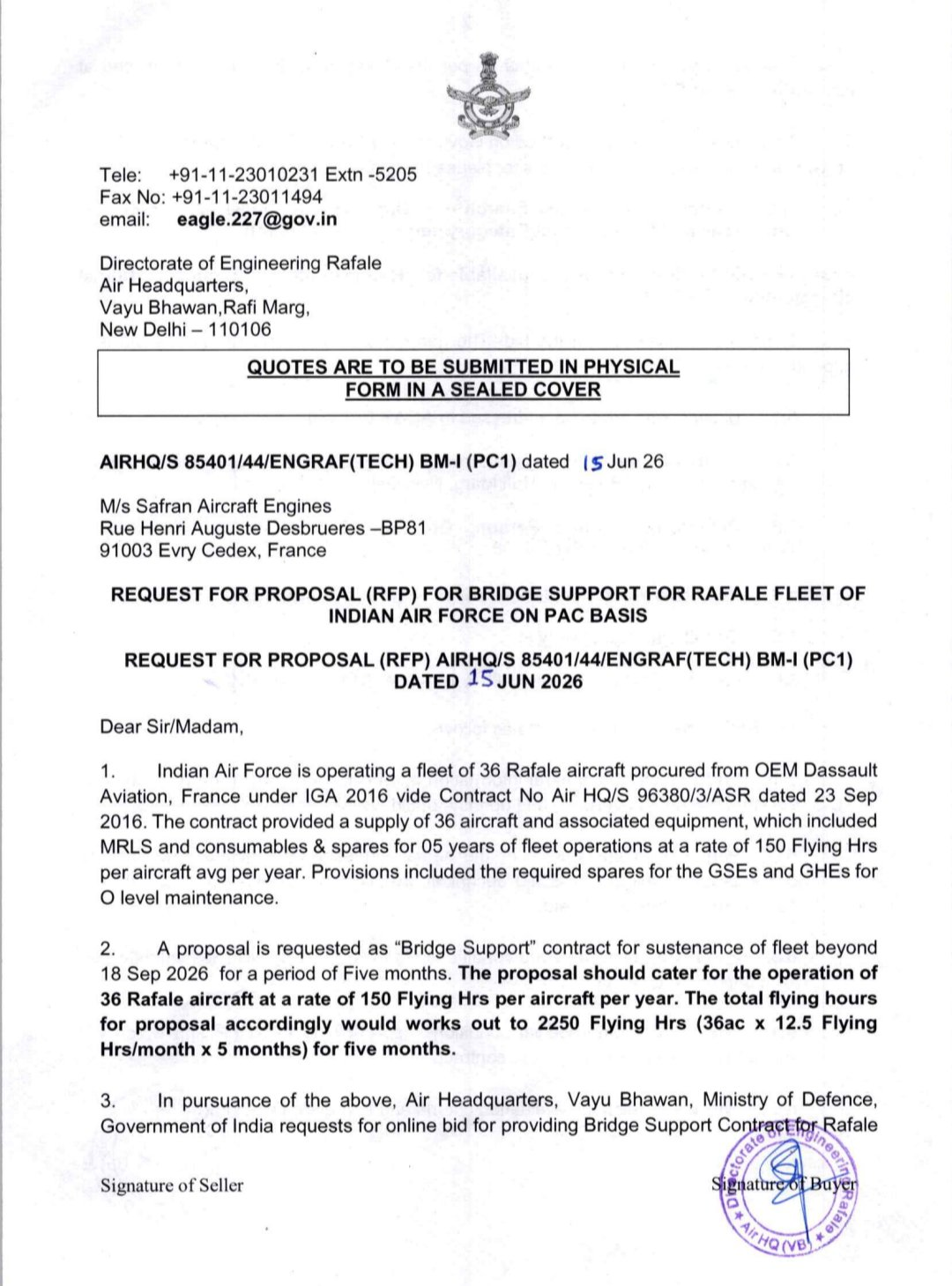
As Business Today reports, the tender shows that the entire fleet is intac:
An Indian Air Force proposal seeking bridge support for all 36 Rafale fighter jets has dealt a fresh blow to Pakistan's claims that several of the aircraft were shot down during Operation Sindoor. According to an Air Headquarters Request for Proposal (RFP) issued in June and accessed by India Today, the IAF has invited bids for a five-month bridge support package covering all 36 Rafale fighter aircraft acquired from France under the government-to-government agreement signed in 2016. The document seeks maintenance, logistics and technical support for the fleet beyond September 2026 and is based on an estimated 2,250 flying hours during the five-month period. The bridge support arrangement is intended to ensure uninterrupted operations until a long-term support contract is finalised. The proposal assumes the availability of the full Rafale fleet, a detail that runs counter to Pakistan's claims that several of the aircraft were destroyed during Operation Sindoor, India's military response to the Pahalgam terrorist attack. (Source: Fresh blow to Pakistan's Rafale claim: IAF's maintenance tender lists all 36 fighter jets - BusinessToday)
Here is the image of the tender.
So what happened?
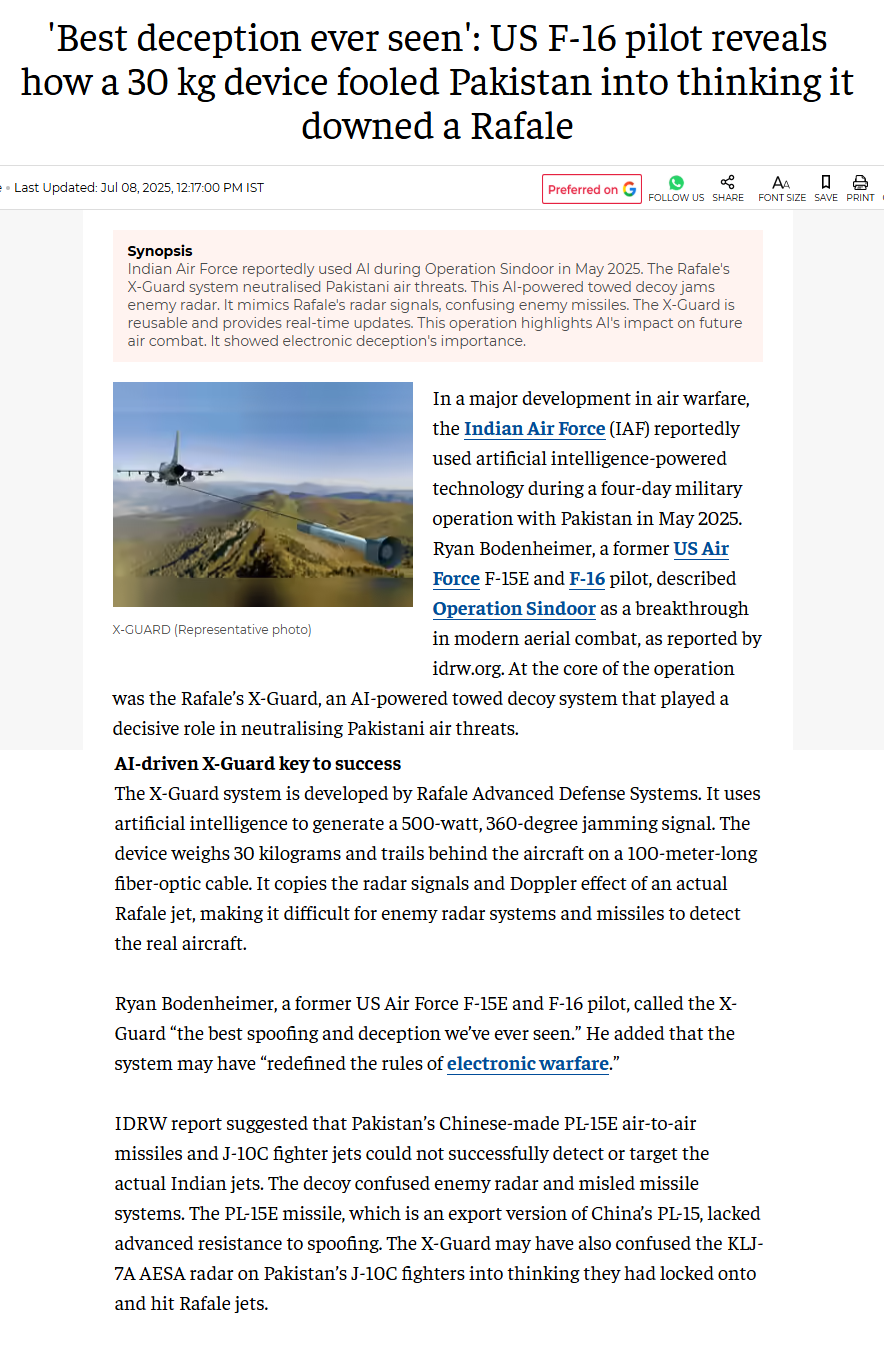
According to air force experts, India used AI to create decoys that Pakistan thought were Rafales.
What India did next is what matters. Over May 8 to 10, it systematically degraded Pakistan's air-defense network, using Israeli-origin loitering munitions to suppress radars and surface-to-air sites, then struck airfields across the depth of Pakistan. A Washington Post review of satellite imagery confirmed damage at six airfields, and Indian accounts put the number of bases struck as high as eleven.
India's strength was that it established air superiority over key sectors of Pakistani airspace, and struck across Pakistan's operational depth. The fact is that India seized escalation dominance: by the end, it had the least to fear from further escalation, and Pakistan sought the ceasefire.
In the language of the matrix, the three crises trace a single arrow, from cell 2 to cell 3.
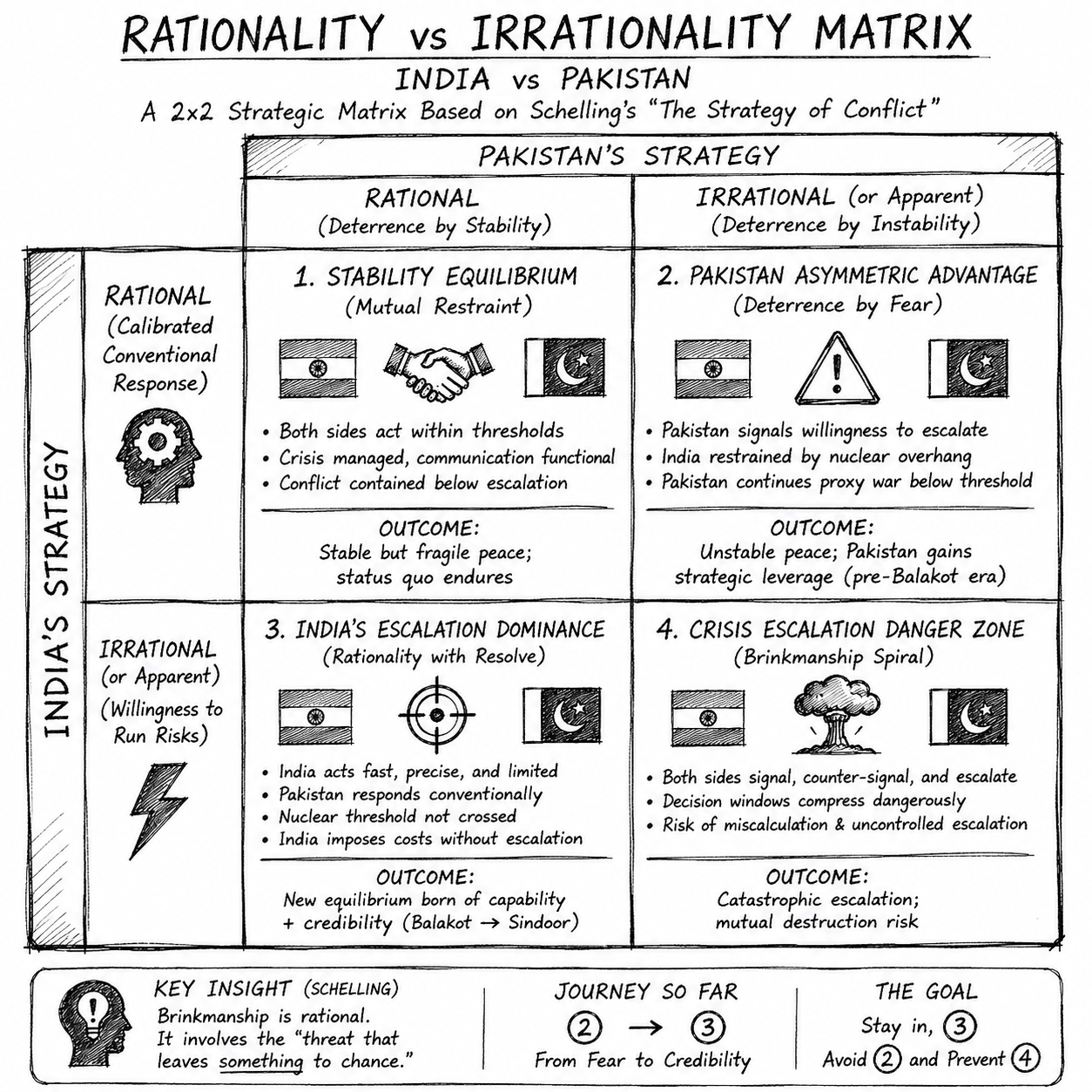
The old equilibrium had India in the rational-restrained box and Pakistan reaping the rewards of apparent irrationality, with the sword swinging and the shield deterring the response. The new equilibrium has India in the box the matrix labels India's escalation dominance, which is better understood as rationality with resolve, the willingness to appear ready to run the irrational risk, grounded in the capability to act before the nuclear question can be forced. India did not abandon rationality at Balakot. It weaponized the willingness to tolerate risk, which is the only thing the rationality of irrationality has ever been.
The instrument: the machine that makes the bluff callable
A willingness to run risk is only credible if it is backed by the physical capability to win the engagement before the nuclear threshold is reached. This is the part of the story that has matured most rapidly since Balakot, and it is what converts India's new resolve from rhetoric into a usable doctrine of conventional counter-force.
The first instrument is organizational, and it attacks the original sin of Indian planning, which was slowness.
The concept, developed under the late General Bipin Rawat, was formally approved for raising in January 2026, with the strike corps converting first and full rollout planned across the force by the end of the decade.
The doctrinal purpose is to exploit the window of opportunity, the narrow span of hours in which India can be inside Pakistani territory and engaged before a de-mated tactical warhead can be mated, dispersed, authorized, and fired. Pakistan's centralized command, the very feature that keeps its arsenal safe in peacetime, becomes a timing vulnerability in war.
The second instrument is precision conventional fire. The centerpiece is the Pralay, a canisterized, road-mobile, quasi-ballistic missile with a range band of 150 to 500 kilometers, a circular error probable reported under ten meters, and a maneuvering terminal phase that makes it very hard to intercept. After user trials in 2025 and a salvo launch of two missiles from a single launcher on the last day of that year, it is moving toward induction.
Its strategic significance lies in being kept strictly conventional, fielded by the field army rather than the Strategic Forces Command that controls nuclear systems, which gives Indian commanders a usable precision weapon to threaten airfields, launchers, and command posts without the ambiguity of a nuclear-capable system. Around it sits the BrahMos supersonic cruise missile, used to effect during Sindoor and now extending past 400 kilometers toward an 800-kilometer variant, alongside the Pinaka and the planned BM-04, explicitly described as a counter-force weapon against silos, airfields, and command centers. India intends to consolidate these conventional strike assets under an Integrated Rocket Force, deliberately separated from the nuclear command.
The third instrument is electronic and informational. A tactical nuclear weapon under centralized control depends utterly on a chain of communication, from the sensor that detects the advance, to the command center that debates authorization, to the field commander who receives the launch order. Sever any link and the warhead becomes inert metal. India's investment in jamming, signals interception, and offensive cyber is aimed precisely at this kill chain, to render tactical launchers blind and deaf, unable to receive the codes that would make them weapons. Against this stands the requirement India is building for itself, the sensor-to-shooter loop that compresses the time between detecting a target and destroying it toward minutes.
At Exercise Amogh Jwala in 2026 the Army demonstrated exactly this compression, a drone detecting, a network validating, a commander deciding, and a shooter engaging, almost in one motion. The same compression that lets India strike a launcher before it fires also lets India strike the command node before it transmits.
 PTI
PTI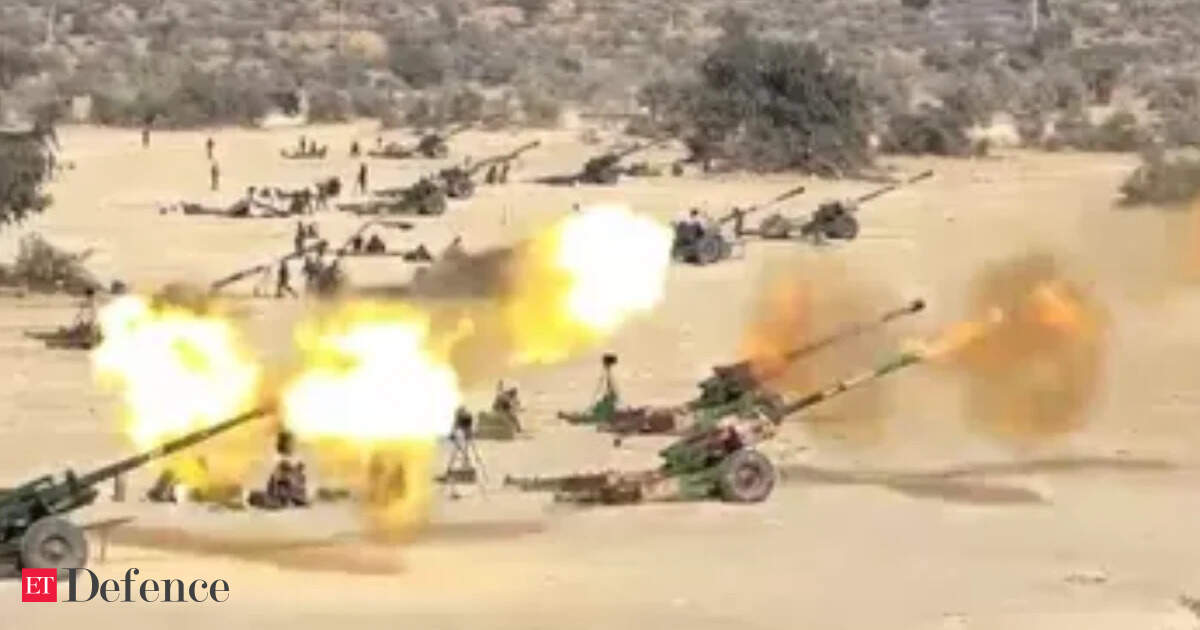
Put the three instruments together, and the strategy lends as a singular instrument.
They are the machine that makes calling the bluff physically possible. They attack each link in the sequence Pakistan needs to complete in order to use a tactical nuclear weapon, and together they are designed to make that sequence impossible to finish in time.
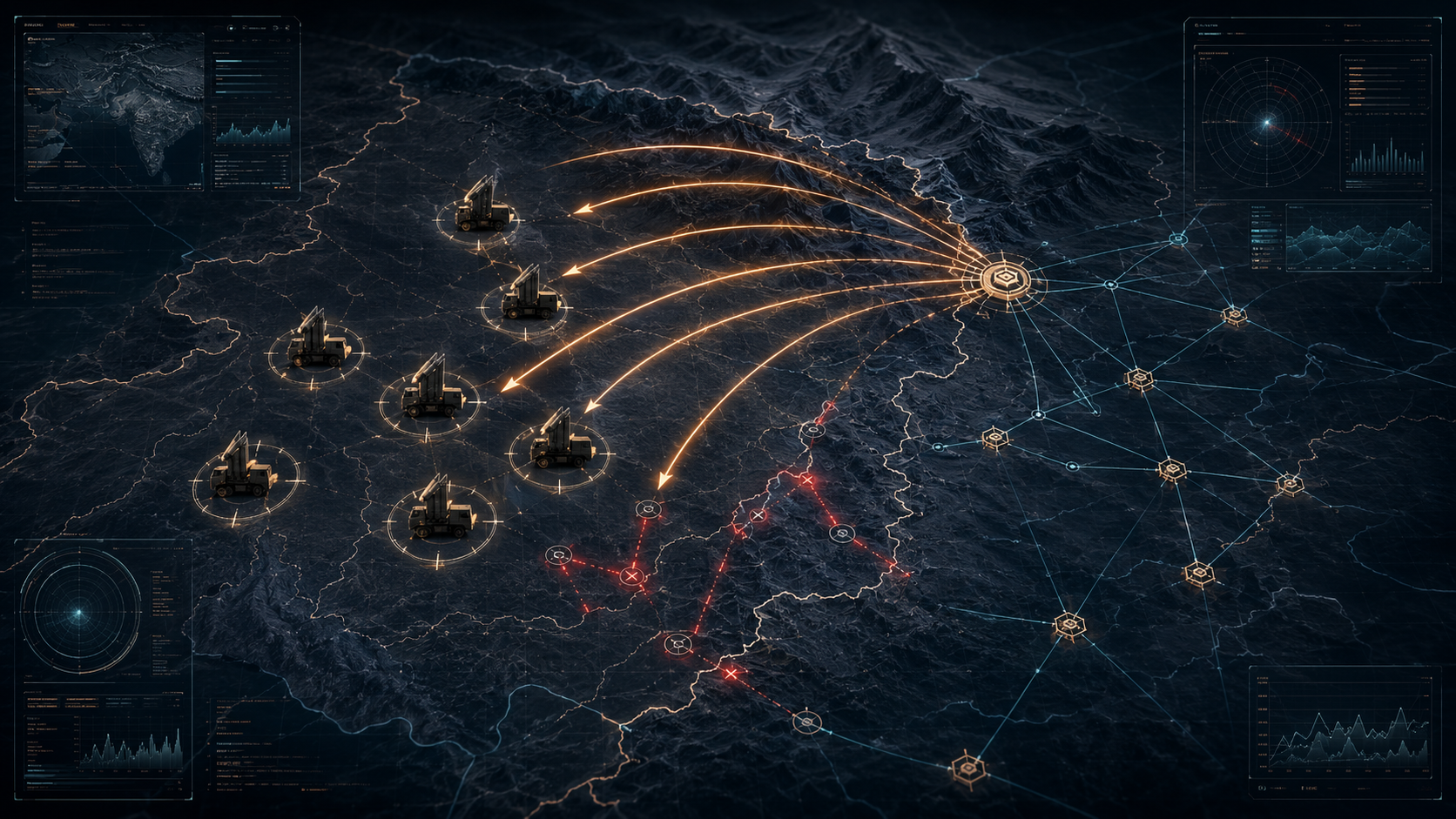
The wall can be broken, the shield can be neutralized, and the sword's protection can be stripped away, because India now possesses the speed, the precision, and the electronic dominance to act inside Pakistan's decision window.
Pakistan's Response to Lost Deterrence
The most important point is that Pakistan's response to Balakot and Operation Sindoor is unlikely to be a strategic surrender.
History suggests military institutions adapt when deterrence is challenged.
If India's growing precision-strike capability has reduced confidence in the survivability of Pakistan's conventional military infrastructure, then Rawalpindi's rational response is to seek alternative ways to restore deterrence while preserving its long-standing reliance on proxy warfare.
That adaptation is already visible. Pakistan continues to rely on terrorist organizations and proxy networks as relatively low-cost instruments against India, even if recent attempts have largely failed to achieve their intended political objectives.
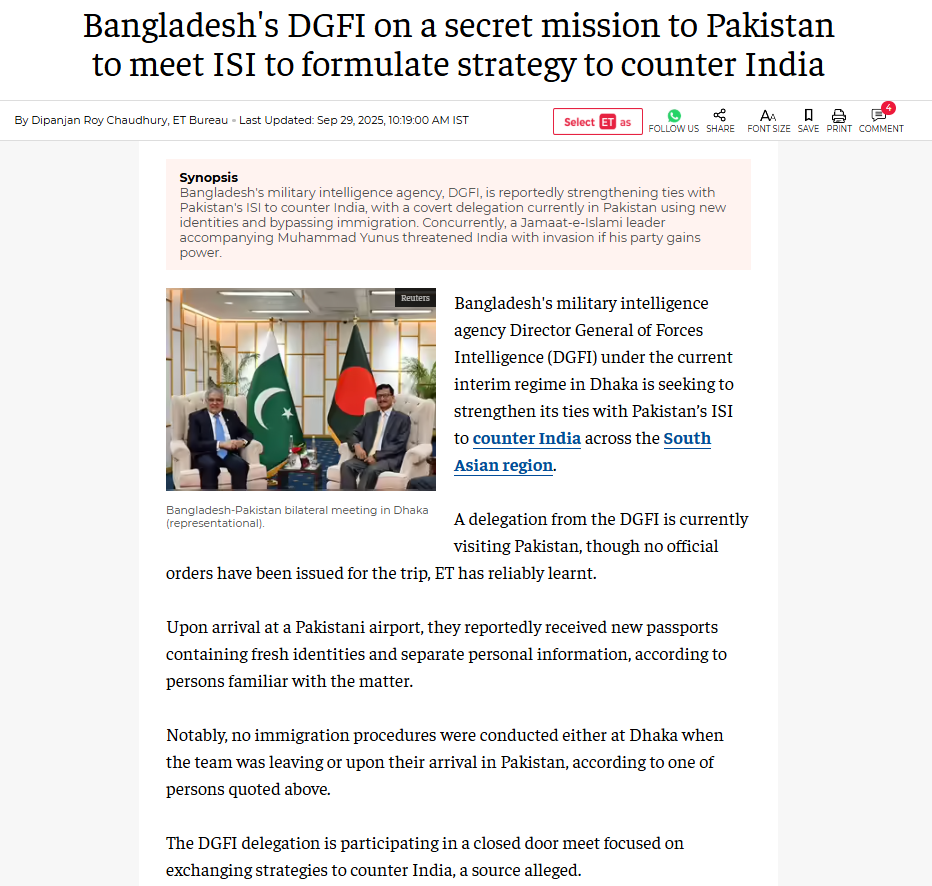
Simultaneously, Pakistan's military establishment appears to be exploring additional strategic depth through closer engagement with Bangladesh after the political changes there, raising concerns in India about renewed attempts to diversify pressure points beyond the western frontier.
Whether these efforts ultimately succeed remains uncertain, but they demonstrate that proxy warfare remains embedded in Pakistan's strategic calculus rather than being abandoned.
The military dimension is evolving as well. Pakistan has accelerated efforts to rebuild conventional deterrence through new missile systems, organizational reforms such as the reported Army Rocket Force Command, and continued procurement of advanced military equipment from China, Turkey and, where available through approved channels, the United States.
On August 13, 2025, the Prime Minister of Pakistan announced the establishment of a new Army Rocket Force Command (ARFC). This directive would possess contemporary technology and the capability to engage the adversary from all directions. There is no revealed public information regarding the ARFC structure, size, or mission. The official statement just discusses that the focus will be on conventional missile systems rather than nuclear delivery vehicles, which remain under the prime control of the Strategic Plans Division (SPD). Some commentators thought that this announcement of an ARFC was a vital step to deter India, which is growing its missile and hypersonic capabilities. However, this ARFC has raised various questions. What is the need for raising a separate command while Pakistan already has an established strategic forces command structure? Additionally, it is also confronting many domestic challenges, such as its political instability, a suffering economy, and security problems. The discussion regarding the formation of a distinct rocket force in Pakistan, or the evolution of its current Full Spectrum Deterrence (FSD) strategy into an advanced variant known as Full Spectrum Deterrence Plus (FSD+) is pivotal to the changing geopolitical landscape of South Asia. (Source: Pakistan’s Army Rocket Force: Strategic Leap or Burdened Gamble? / Small Wars journal)
These acquisitions aim to improve long-range precision strike, air defense, unmanned systems, and battlefield resilience in light of vulnerabilities exposed during recent crises.
This reflects a classic action-reaction cycle described in strategic studies. As India strengthens precision conventional capabilities and integrated air defense, Pakistan attempts to restore the credibility of both its conventional and nuclear deterrence.
Yet none of these measures addresses the underlying challenge created by Balakot and Operation Sindoor.
India has demonstrated a willingness to impose conventional military costs after major terrorist attacks. Pakistan may therefore be able to strengthen its arsenal, disperse its forces and refine its doctrines, but the central strategic equation has changed. Terrorism no longer enjoys the same assumption of immunity under a nuclear umbrella.
Future proxy attacks increasingly carry the possibility that the costs will be borne not merely by deniable organizations, but by the Pakistani military establishment itself.