The Governor and the Dry Wood
A governor climbed Cloud Mountain to the hut of an old teacher who had lived there so long the villagers had forgotten her name.
"Teacher," he said, "clever men are turning my people against me. They mock me with drawings that ride faster than my soldiers. Some are paid in foreign silver. Tell me how to silence them."
The teacher poured tea into his cup, and kept pouring, until it spilled over the rim and ran across the table into his lap.
"You are pouring past the cup," the governor said, jumping up.
"So is your hand," she answered, "each time it reaches for the drawing."
He returned in summer. "I forbade the drawings," he said. "Now every child in the province draws them."
She led him to the hearth, where smoke had gathered under the low roof, and pressed a wide board against it. The smoke bent around her arms and filled the room until both of them wept and coughed.
"Press harder," she said. "The room is not yet full."
He returned in autumn. "They have built a puppet with my face. If I let it stand, the crowd laughs. If I burn it, the crowd laughs louder."
"Then laugh first," said the teacher. "A man who laughs at his own face keeps it. A man who reaches for his sword has handed his face to the crowd."
He returned in winter, still troubled. "But the silver. Foreign hands are fanning this fire."
She pointed to the woodpile beneath the eaves, split and bone-dry. "Wind fans a fire. Wind lights nothing. Where the wood is dry, the smallest breeze will do. Where the wood is green, the strongest gale only howls and passes."
"Then I will hunt the wind," said the governor.
"Hunt the wind all year," she said, "and next winter your wood will still be dry."
He learned, in time, to expose the paid men, and it worked so well that he grew fond of the accusation and laid it on everyone who displeased him. One spring the people stopped believing him, and when a true foreign hand arrived at last, no one would listen. He climbed the mountain ashamed.
"My finest knife has gone dull," he said.
"A knife is neither loyal nor treacherous," said the teacher. "It cuts whatever meets its edge. You wore yours out cutting air."
Two of his officials were quarreling at her gate as he arrived. One said, "It is the agitators who move the province." The other said, "It is the foreign silver that moves it." They asked the teacher to settle it.
"The agitators do not move the province," she said. "The silver does not move the province. The trust in the people's chest moves. Guard that, and the drawings are only ink. Lose it, and your soldiers are only frightened men standing in a crowd."
At last the governor knelt and asked plainly, "Then what is my defense?"
The teacher set before him a bowl heaped with rice and an empty bowl. "Fill the village the way I filled your cup, past the point you think is enough. A fed village does not catch. A heard village does not burn. When the people have rice and a voice, mockery is only laughter, and laughter is a kind of health. This is the one wall a joke cannot climb, and no silver can buy."
The governor bowed. "How will I know whether a fire was lit inside my house or carried in from outside it?"
The teacher leaned over and blew out the lamp.
"Ask a better question," she said in the dark. "Do not ask who struck the spark. Ask why your house stood ready to burn."
In the darkness the governor understood, and understanding, he had nothing left to say. He walked down the mountain before dawn, and in the years that followed no one troubled to mock him, for there was nothing left in him worth mocking.
Milošević and OTPOR
Slobodan Milošević was the president of Serbia from 1989 to 1997 and president of the Federal Republic of Yugoslavia from 1997 until his overthrow in 2000.
Let us learn something about him first.
Nothing in that resume predicted what came next. He was a gray apparatchik until he discovered the one fuel that could carry him past his rivals.
The pivot came on 24 April 1987 when he traveled to Kosovo Polje to meet local Serbs who were complaining of mistreatment by the Albanian majority, and to the crowd he delivered the line that made him: "No one should dare to beat you!"
In doing so, he broke with the settled Tito-era policy that had suppressed nationalist expression since Yugoslavia's founding, and thereafter he rode the wave of Serbian nationalism to consolidate power. Months later, in September 1987, he used a televised party meeting to force out Stambolić and his allies, turning on the patron who had made him. By 1989 he was President of Serbia.
 BBC News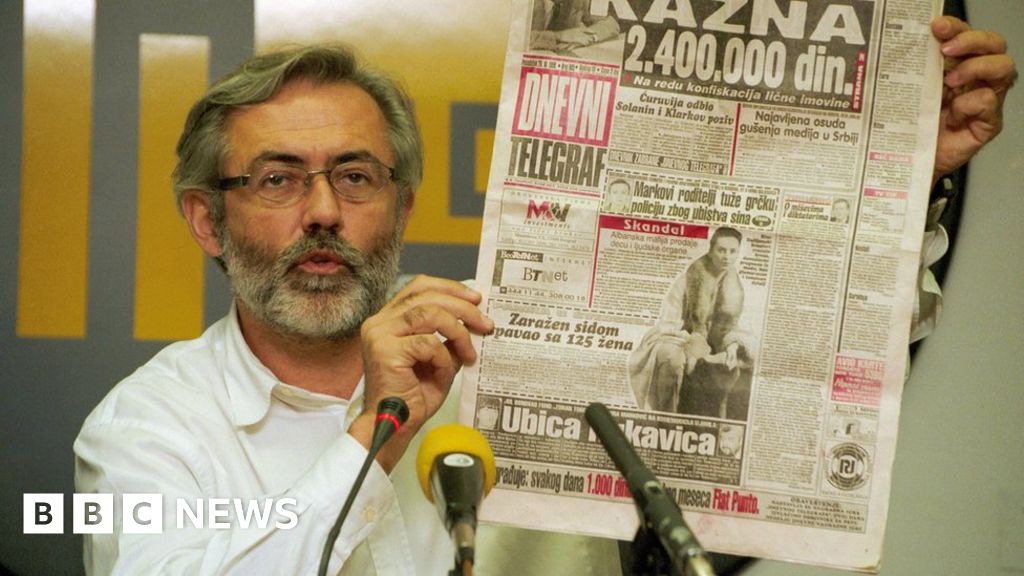
Milošević used and weaponized ethnic grievance. He used his grip on the media, government appointments, the police, and the military to rouse ethnic hatred and build a Serbian nationalist mass movement. In 1989 he stripped Kosovo of the autonomy it had held under the 1974 constitution, and on 28 June that year he stood on the Gazimestan battlefield before a crowd reported at roughly a million Serbs, on the six hundredth anniversary of the medieval Battle of Kosovo, signaling the fusion of ancient myth with present-day power.
The consequences were catastrophic and are the core of the historical case against him. His push for a Greater Serbia contributed to the breakup of the Yugoslav federation in 1991 and 1992 and led to armed conflict with the republics that seceded.
 Ian Black
Serbia backed Serb forces in the wars in Croatia and then Bosnia, the latter producing the siege of Sarajevo and the 1995 Srebrenica massacre. The UN imposed trade sanctions on Yugoslavia in 1992, causing severe economic hardship, compounded by one of the worst episodes of hyperinflation in modern economic history, which wiped out savings and collapsed living standards. At home he controlled the state broadcaster, jailed and harassed dissidents, and presided over a kleptocratic order; the independent journalist Slavko Ćuruvija was murdered in 1999, and Milošević's former mentor Stambolić was abducted and killed in 2000.
There was a brief interlude when the West recast him as a peacemaker, because at the 1995 Dayton negotiations he was the indispensable Serb interlocutor who could deliver a settlement. That rehabilitation did not last. His 1998 to 1999 crackdown on Kosovo Albanians and the KLA triggered NATO's seventy-eight-day bombing campaign in 1999, and in May 1999 the ICTY indicted him, making him the first sitting head of state charged with war crimes. He was arrested in 2001, sent to The Hague, and died in his cell in 2006 before a verdict.
For Serbs, the imperative was homegrown and earned. A decade of lost wars, international pariah status, sanctions, ruined savings, rigged institutions, and a leader who treated the state as personal property had exhausted the society. For the West, removing Milošević was an explicit strategic objective, described openly at the time as a multi-year campaign combining sanctions, the Kosovo bombing, and funding for the opposition, aimed at ending the Balkan instability he generated and clearing the path to European integration.
Milošević had unleashed legislative repression.
Otpor was created in Belgrade in October 1998 in direct response to a University Law of late May 1998 that stripped Belgrade University of its autonomy and curbed free expression, paired with a draconian Media Law that same autumn which fined and shuttered independent outlets and saw papers like Dnevni Telegraf banned. A regime that moved to capture the universities and muzzle the press handed a cohort of politicized students both a grievance and a natural constituency. Otpor began small and student-centered, and the regime's habit of arresting activists for stickers and pranks backfired by casting teenagers as victims of an overreaching state, which is precisely the martyr dynamic the method is built to exploit.
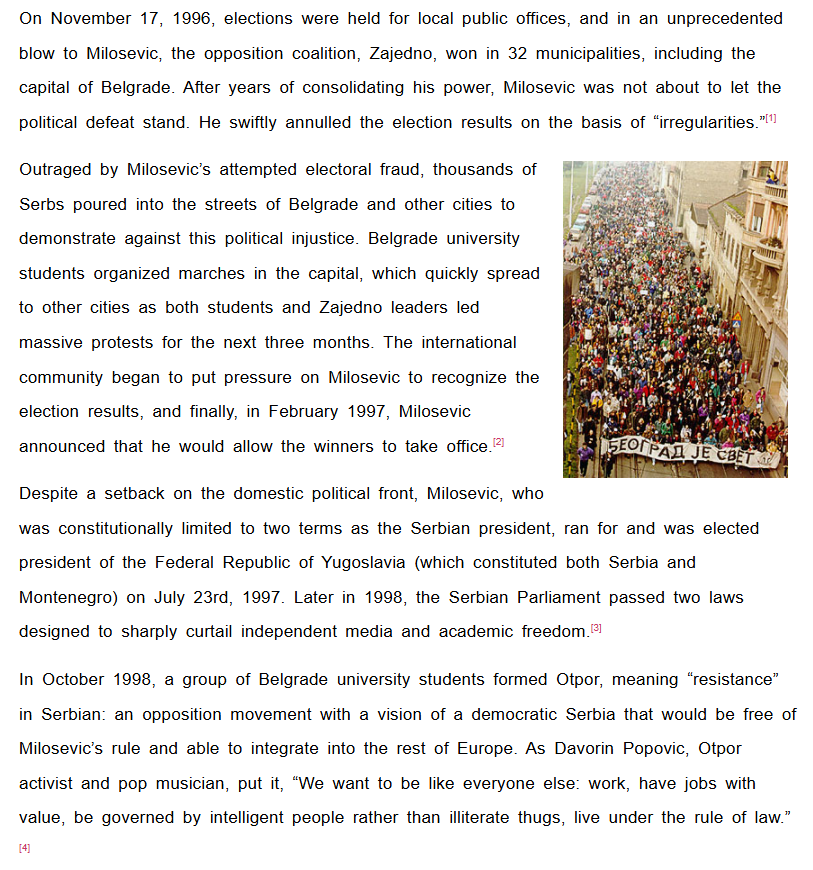
The ultimate detonator was a stolen election. Under pressure to relieve sanctions and shore up his legitimacy, Milošević called early federal elections for 24 September 2000. Otpor and the opposition had spent two years preparing for this moment, running a get-out-the-vote drive under the slogan that Milošević was finished, and on election day they deployed a parallel vote-monitoring operation, training on the order of thirty thousand observers across roughly ten thousand polling stations to document the real count.
The official results gave the opposition candidate Vojislav Koštunica over 48 percent in a five-way race, short of the outright majority needed to avoid a runoff but pointing to a certain landslide against Milošević, who trailed by around ten points.
The opposition's own count indicated Koštunica had in fact crossed 50 percent and won outright in the first round.
When the regime's Federal Election Commission refused to accept a first-round victory and called a runoff, the opposition read it, correctly, as an attempt to steal an election Milošević had already lost, and it refused to play along. That refusal was the detonator. A general strike was called, the pivotal blow being the walkout at the Kolubara coal mines that threatened the country's electricity, roads were blockaded, and on 5 October 2000 hundreds of thousands converged on Belgrade.
A protester drove a wheel loader at the state television building, the police declined to fire, the parliament was stormed, and before midnight Milošević conceded on national television. Koštunica was sworn in on 7 October.
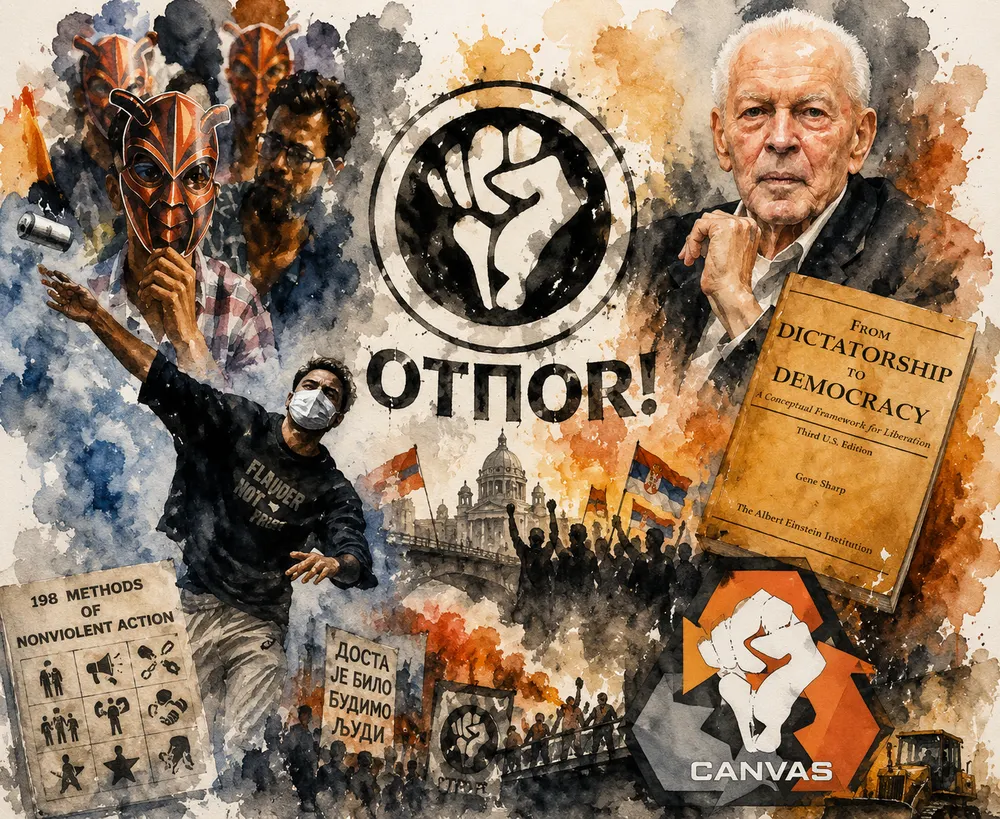
This movement gave birth to a star and the movement that would have far-reaching consequences across the globe - the OTPOR (or resistance).
So what was the trigger for the creation of OTPOR? Well, the University and Media laws of 1998 triggered Otpor's birth, and Milošević's attempt to falsify the 24 September 2000 election result triggered the uprising that ended him. Everything Otpor had built over two years- the branding, the decentralized cells, the discipline, the get-out-the-vote and monitoring machinery- was inert potential until the regime supplied the one thing the method most needs: a visible, unmistakable act of illegitimacy that the whole society could see at once.
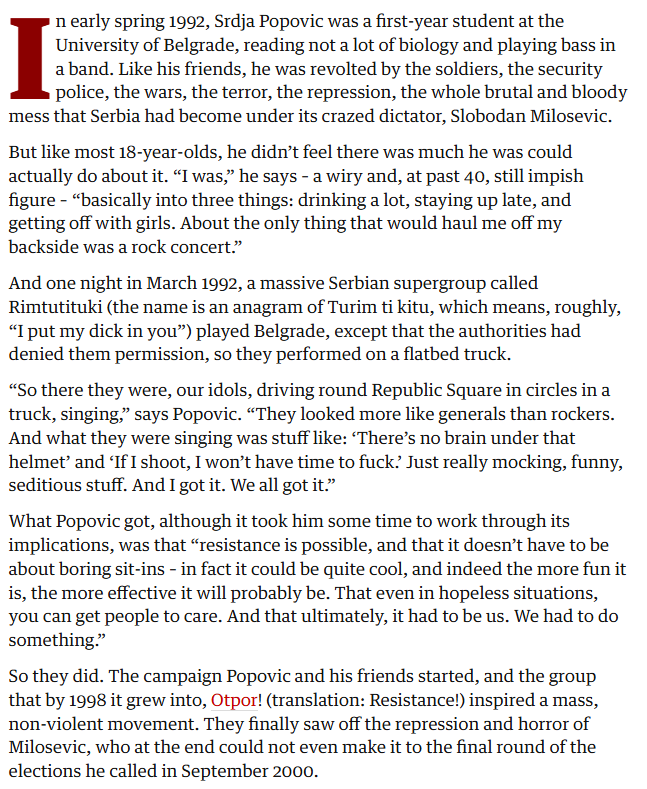
Otpor ("Resistance") was founded in Belgrade in October 1998 by University of Belgrade students reacting to repressive university and media laws. Its founders were young, culturally fluent, and allergic to the earnest solemnity of the older opposition. They understood something the fragmented Serbian opposition parties did not: that fear is the real currency of an authoritarian regime, and that ridicule is the fastest way to spend it down.
The clenched black fist, the street theatre, the pranks that dared the police to look ridiculous by arresting teenagers for stickers, all of this was designed to make defiance feel safe, cool, and contagious rather than dangerous and lonely.
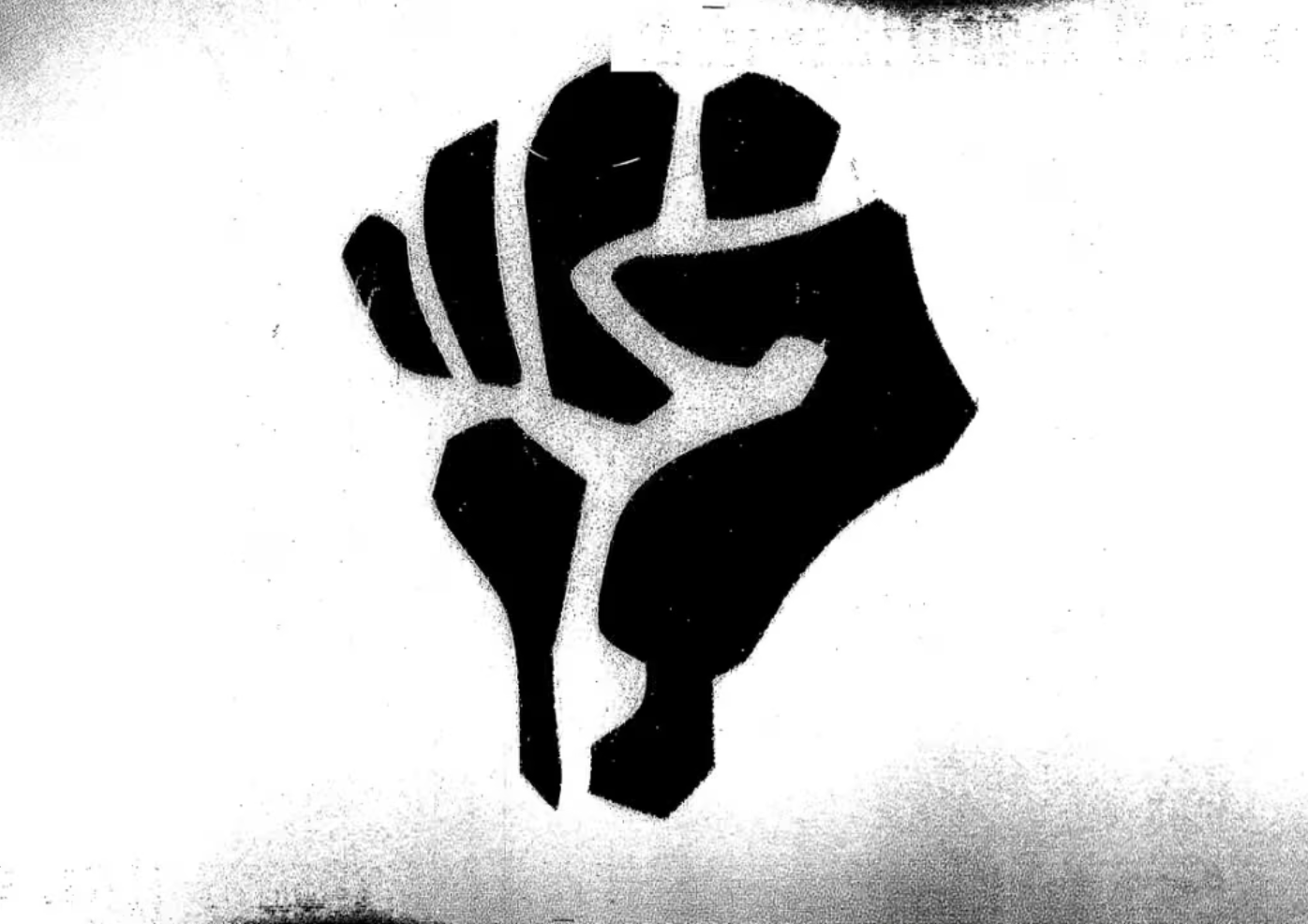
The intellectual scaffolding came substantially from Gene Sharp, the American scholar who spent decades cataloging how ordinary populations had disarmed powerful states without firing back.
Sharp's Work As the Basis
Sharp's central claim, developed across "The Politics of Nonviolent Action" and the compact field manual "From Dictatorship to Democracy," was deceptively simple.
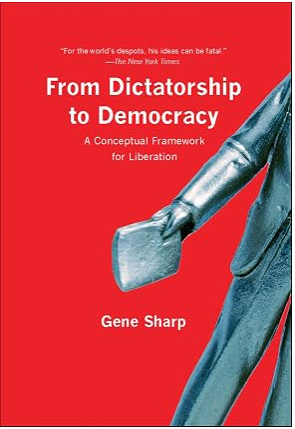
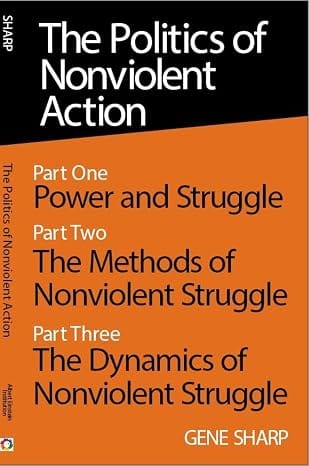
Source: The Politics of Nonviolent Struggle and "From Dictatorship to Democracy"
Power is not a monolith held by the ruler.
It is on loan from the institutions that carry out his orders: the bureaucracy, the police, the army, the media, business, the courts, organized labor.
His "198 Methods of Nonviolent Action" reads like an engineer's parts catalog for that withdrawal: strikes, boycotts, symbolic protest, parallel institutions, mass non-cooperation, and civil disobedience.
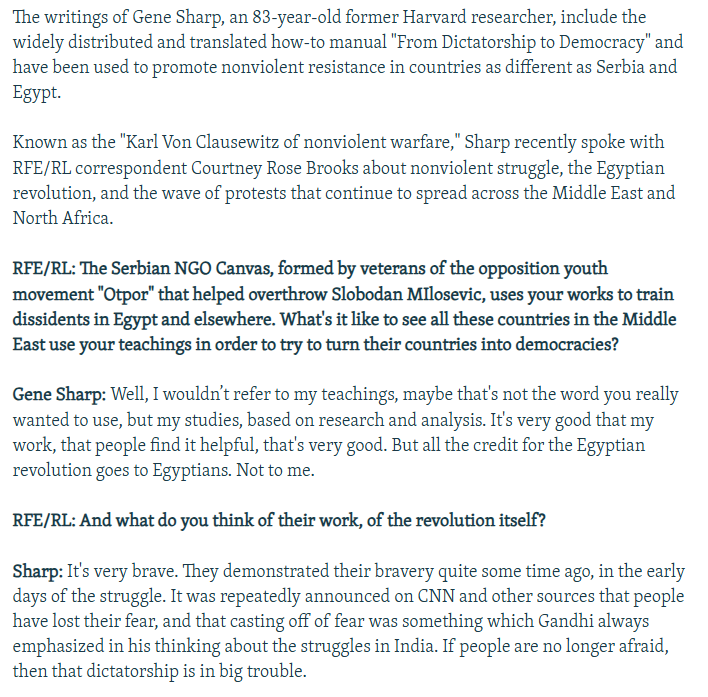
Otpor leaders have said openly that Sharp's work became a reference text. Srdja Popovic, later the movement's most visible export, has repeatedly credited "From Dictatorship to Democracy" as formative. Sharp's Albert Einstein Institution translated and distributed his writing internationally and advised activists who sought it out. So far this is a story about ideas traveling, which is unremarkable. Ideas about how to resist tyranny are supposed to travel.
The part that is unremarkable to some and damning to others is the external support. Specifically the USAID, which has been known as the front for the CIA regime change operations.
As my family moved around the world, it was clear that perceptions of the United States were far more complicated than that, and not just because of the bloody debacle in Vietnam and the racist outrages back home. In my twenties, when I told people that my father had worked for U.S.A.I.D., the inevitable knowing response was “You mean the C.I.A.” The proximity between the two agencies was hard to deny. In the sixties, America often disbursed aid as “credits” to foreign governments, which in turn supplied the equivalent amount of local currency to the U.S. Embassy. The funds were apportioned by the “country intelligence team”—which invariably included the C.I.A. station chief. The C.I.A. also partnered with the Office of Public Safety, an American program that trained police forces in Vietnam, Indonesia, the Philippines, and elsewhere. In 1973, after reports emerged that its graduates had engaged in terror and torture, Congress disbanded it. A Senate Foreign Relations Committee report lamented that the program’s notoriety had helped “stigmatize the total U.S. foreign aid effort.” In many cases, the closer U.S.A.I.D. got to hard power, the worse things went. During the war on terror, the agency was drafted into national-security efforts around the world. In 2007, its director visited Baghdad to assist with a program there; as his convoy passed through the city, security contractors hired by the private military firm Blackwater opened fire on approaching cars, killing seventeen Iraqi civilians. A few years later, an office of U.S.A.I.D. got involved in a secret program to build a “Cuban Twitter”—a messaging service intended to spark pro-democracy uprisings in Havana. When the news broke, the agency’s director, Rajiv Shah, lamely insisted that the program was not covert, but merely “discreet.” (Source: Growing Up U.S.A.I.D. / New Yorker)
It is documented, and it is documented by mainstream Western reporters, not only by the movement's detractors. Roger Cohen's November 2000 New York Times Magazine piece "Who Really Brought Down Milosevic?" and Michael Dobbs's December 2000 Washington Post investigation, "U.S. Advice Guided Milosevic Opposition," laid out the machinery in detail. American pollsters ran focus groups for the Serbian opposition.
American assistance to Otpor and the 18 parties that ultimately ousted Milosevic is still a highly sensitive subject. But Paul B. McCarthy, an official with the Washington-based National Endowment for Democracy, is ready to divulge some details. McCarthy sits in Belgrade's central Moskva Hotel, enjoying the satisfaction of being in a country that had long been off limits to him under Milosevic. When he and his colleagues first heard of Otpor, he says, ''the Fascistic look of that flag with the fist scared some of us.'' But these feelings quickly changed. For those Americans intent on bringing democracy to Serbia, the student movement offered several attractions. Its flat organization would frustrate the regime's attempts to pick a target to hit or compromise; its commitment to enduring arrests and even police violence tended to shame the long-squabbling Serbian opposition parties into uniting; it looked more effective in breaking fear than any other group; it had a clear agenda of ousting Milosevic and making Serbia a ''normal'' European state; and it had the means to sway parents while getting out the critical vote of young people. ''And so,'' McCarthy says, ''from August 1999 the dollars started to flow to Otpor pretty significantly.'' Of the almost $3 million spent by his group in Serbia since September 1998, he says, ''Otpor was certainly the largest recipient.'' The money went into Otpor accounts outside Serbia. At the same time, McCarthy held a series of meetings with the movement's leaders in Podgorica, the capital of Montenegro, and in Szeged and Budapest in Hungary. Homen, at 28 one of Otpor's senior members, was one of McCarthy's interlocutors. ''We had a lot of financial help from Western nongovernmental organizations,'' Homen says. ''And also some Western governmental organizations.'' At a June meeting in Berlin, Homen heard Albright say, ''We want to see Milosevic out of power, out of Serbia and in The Hague,'' the site of the international war crimes tribunal. The Otpor leader would also meet with William D. Montgomery, the former American ambassador to Croatia, in the American Embassy in Budapest. (Washington had by then severed diplomatic relations with Belgrade.) ''Milosevic was personal for Madeleine Albright, a very high priority,'' says Montgomery, who was yanked out of Croatia in June to head a group of officials monitoring Serbia. ''She wanted him gone, and Otpor was ready to stand up to the regime with a vigor and in a way that others were not. Seldom has so much fire, energy, enthusiasm, money – everything – gone into anything as into Serbia in the months before Milosevic went.'' Just how much money backed this objective is not clear. The United States Agency for International Development says that $25 million was appropriated just this year. Several hundred thousand dollars were given directly to Otpor for ''demonstration-support material, like T-shirts and stickers,'' says Donald L. Pressley, the assistant administrator. Otpor leaders intimate they also received a lot of covert aid – a subject on which there is no comment in Washington. At the International Republican Institute, another nongovernmental Washington group financed partly by A.I.D., an official named Daniel Calingaert says he met Otpor leaders ''7 to 10 times'' in Hungary and Montenegro, beginning in October 1999. Some of the $1.8 million the institute spent in Serbia in the last year was ''provided direct to Otpor,'' he says. By this fall, Otpor was no ramshackle students' group; it was a well-oiled movement backed by several million dollars from the United States. But other American help was as important as money. Calingaert's organization arranged for a seminar at the luxurious Budapest Hilton from March 31 to April 3. There a retired United States Army colonel, Robert Helvey, instructed more than 20 Otpor leaders in techniques of nonviolent resistance. This session appears to have been significant. It also suggests a link between the American-influenced opposition base in Budapest and the events in Vladicin Han. (Source: "Who Really Brought Down Milosevic?" by Roger Cohen / New York Times)
As we can see from this extract of Cohen's New York Times article, US Agencies were directly involved in the funding and training of the OTPOR activists.
The National Endowment for Democracy (NED) official Paul McCarthy stated that Otpor received the bulk of the roughly three million dollars NED spent in Serbia between 1998 and 2000. The International Republican Institute (IRI) paid the travel costs for Otpor organizers to attend a training seminar at the Budapest Hilton in the autumn of 1999. The principal lecturer there was retired U.S. Army Colonel Robert Helvey, a former defense attache who had adapted Sharp's theory into an operational curriculum on how to peel away a regime's security forces. USAID spending in Serbia over the relevant period ran into the tens of millions of dollars, and George Soros's Open Society network was also active. The National Democratic Institute (NDI) ran opposition training sessions, including in Budapest.
So let us understand the ingredients of the OTPOR resistance.
- Serbian discontent was real, homegrown, and earned across a decade of war, sanctions, and economic ruin; Otpor founders have said the decisive ingredient was the feeling that they had nothing left to lose.
- And substantial foreign money, polling, training, and communications support flowed to the opposition with the explicit aim of removing Milosevic.
Neither fact cancels the other. The regime-change reading errs when it treats Serbs as puppets. The democracy-assistance reading errs when it pretends the checkbooks were somehow neutral.
From Movement to a Method
Most movements dissolve into governance or irrelevance after victory. Otpor's core did something different. Several founders, principally Srdja Popovic and Slobodan Djinovic, concluded that what they had done in Serbia was not a lucky accident of local conditions but a repeatable set of techniques. Djinovic, notably, was a telecom entrepreneur (later CEO of the internet provider Orion Telekom), and the pairing mattered: a strategist and a businessman building an institution rather than a party.
In 2003 and 2004 they formalized this into the Centre for Applied Nonviolent Action and Strategies, CANVAS, headquartered in Belgrade. CANVAS was built as a training and knowledge organization rather than a protest group.
It does not, by its own account, run revolutions. It teaches. Its curriculum systematized the Serbian experience and fused it with Sharp's theory and historical case studies from Gandhi's India, Solidarity's Poland, apartheid South Africa, and Pinochet's Chile.
The recurring modules are by now familiar to anyone who has watched a modern civic uprising:
- define concrete winnable objectives instead of protesting forever; map and
- target the pillars of support;
- win small victories to build momentum and belief;
- enforce ferocious unity across fractious opposition factions;
- weaponize humor to strip away fear; and
- decentralize so that arresting a leader does not decapitate the movement.
A method abstracted from its origin becomes portable, and a portable method is, by definition, a template that can be carried into any society with the raw material of grievance.
CANVAS itself describes this as spreading "people power." Its critics describe the same portability as a franchising of destabilization. The mechanism is identical in both descriptions; only the intent attributed to it differs.
Popovic has been called, admiringly in some quarters, a dictator-slayer; CANVAS was nominated for the 2012 Nobel Peace Prize and honored by Tufts University and elsewhere. It has also been named, in Moscow and Beijing and increasingly in New Delhi, as a node in an architecture of externally sponsored subversion.
The blueprint and the funding architecture
So can we simply say that a regime (like Milosevic) can be changed just by "activists"?
Well, probably no.
The reason this debate does not resolve into a simple "activists teaching activists" story is the surrounding financial and intelligence ecology, which is unusually well evidenced.
On the funding side, CANVAS has openly listed among its partners the Albert Einstein Institution, Freedom House, and the U.S. government democracy-promotion bodies, NED, IRI, and USAID.
This is not a leak; it is the publicly stated network. More recently, the watchdog InfluenceWatch documented that CANVAS was a partner in a five-year, roughly seventeen-million-dollar USAID Civil Society Engagement Program in Georgia beginning in 2021, implemented through the East-West Management Institute alongside other contractors. The through-line from the NED money that reached Otpor in 1999 to a USAID civil-society contract two decades later is direct and traceable. Whatever one calls this activity, it is not independent of Western statecraft; it is braided into it.
On the intelligence side, the evidence is sharper and more uncomfortable. When WikiLeaks published the Global Intelligence Files in 2012, a trove of internal emails from the private intelligence firm Stratfor, CANVAS appeared repeatedly.


The emails show Stratfor treating Popovic as a source, referring to him internally by an asset code, and organizing seminars at which CANVAS briefed Stratfor analysts on its methodology, explicitly described in one internal email as the mechanics of "color revolutions," with case studies on Serbia, Venezuela, Myanmar, and Egypt. Another email offered guidance on using the CANVAS relationship to build a network of on-the-ground contacts that Stratfor's regional analysts could then work independently. An investigation reported by In These Times and Occupy.com noted that Popovic's wife worked at Stratfor for a period. Stratfor's own staff, aware of the optics, insisted internally that the firm was not "in the business of starting revolutions" and asked that the CANVAS visits stay confidential.
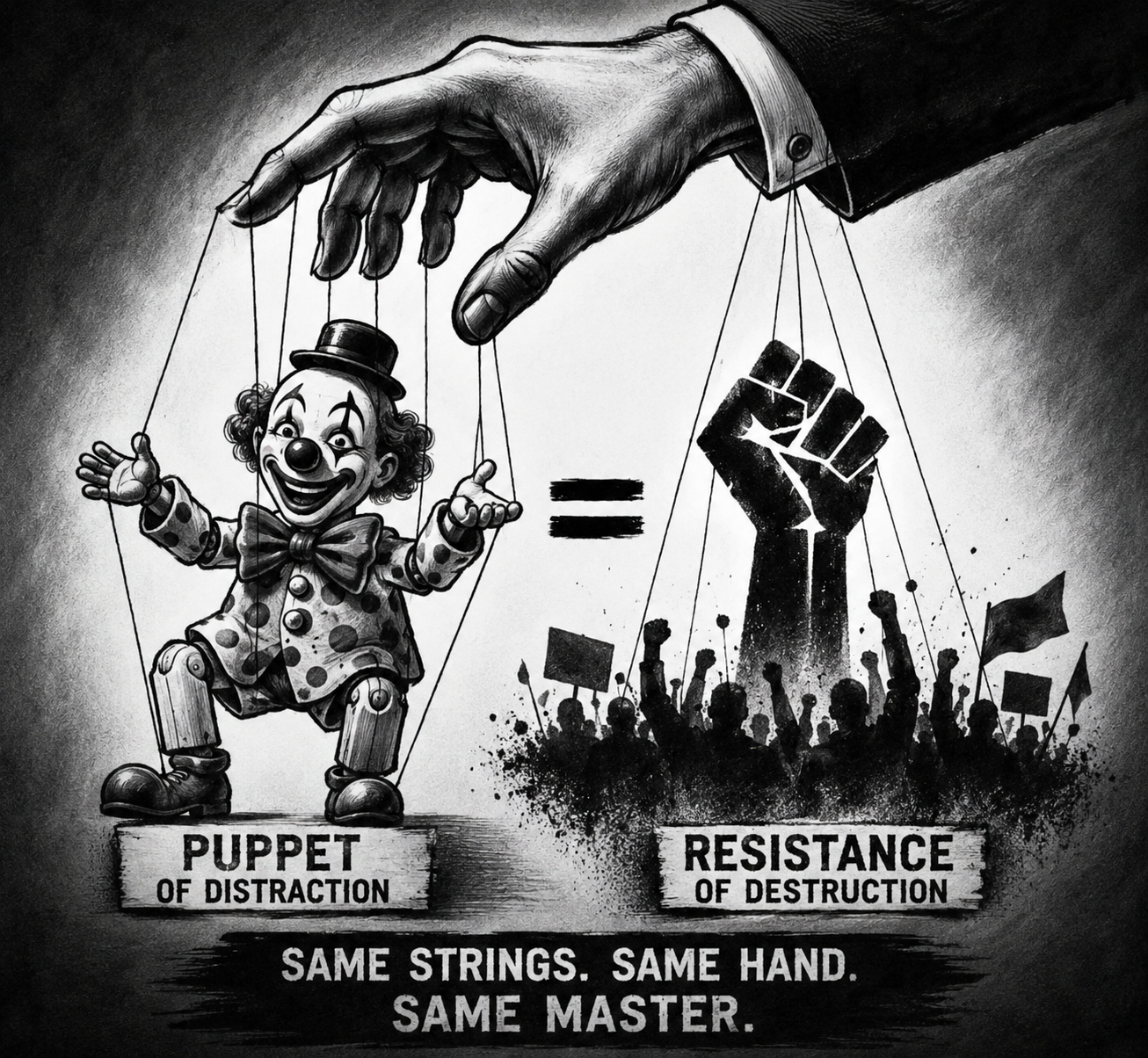
So the question obviously is whether this whole effort by OTPOR, etc., was for certain objectives by foreign actors?
The answer seems to be a resounding yes.
Use in India
Have methods by CANVAS been used in India?
Three Indian episodes clearly show the clear imprint of CANVAS/Sharp style operations.
- The first is the 2011 India Against Corruption and Anna Hazare mobilization, which deployed Gandhian symbolism, a fast unto death, decentralized urban mobilization, and sophisticated branding, all of which rhyme with the CANVAS playbook.
- The second is the anti-CAA agitation of 2019 and 2020.
- The third is the 2020 to 2021 farmers' protest, which produced the "toolkit" episode: a shared action-plan document that Greta Thunberg briefly tweeted, leading Delhi Police to arrest the young activist Disha Ravi and to allege links to the Canada-based, allegedly pro-Khalistan Poetic Justice Foundation.
The toolkit case is the closest thing India has to a live courtroom encounter with the methodology, because a "toolkit" is precisely the kind of standardized campaign artifact that the CANVAS tradition normalized.
Who Decides What is a Dictatorship?
The entire framework, OTPOR movement and the related literature points to the most important ingredient - resistance to a dictatorship.
But who decides who is a dictator and therefore liable to be thrown out?
Almost any consequential leader gets targeted because consequential leaders make enemies with resources.
Almost any consequential leader gets targeted, because consequential leaders make enemies because of lack of deference.
Let us take the example of Lee Kuan Yew
The Lee Kuan Yew paradox
By the formal reporting and consequent KPIs and metrics, Lee Kuan Yew was more coercive than plenty of leaders who were successfully color-revolutioned.
He used detention without trial under the Internal Security Act, bankrupted opponents through defamation suits, kept a tight leash on the press, and drew explicit "out of bounds" markers around political speech.
On paper he was a soft authoritarian. Yet no external network ever seriously tried to run the Belgrade playbook against him, and if they had it would have failed. Why?
Six reasons can be isolted into a sort of a theory of insulation.
- First and deepest: performance legitimacy. He delivered a standard of living, housing, safety, and mobility so tangible that the median Singaporean had nothing to be recruited away from. The playbook needs a mass grievance to convert into bodies on the street. Delivery starves it at the source. This is the single most important moat and the least glamorous.
- Second, and the one almost nobody says out loud: strategic usefulness to the powers that run the playbook. You do not get regime-changed by an ecosystem you are useful to. Singapore made itself indispensable to Western capital, shipping, and security architecture in Asia. LKY was aligned enough to be an asset and independent enough to be respected. The instruments of destabilization are pointed at inconvenient governments, not effective ones that keep the sea lanes open. Alignment bought immunity.
- Third, narrative sovereignty. He refused the West a moral monopoly. The "Asian values" argument, whatever you think of it, denied outside actors the uncontested frame of "brave democrats versus dictator." When the target talks back with a coherent civilizational counter-story, the villain script stops writing itself.
- Fourth, coercion laundered through legality. His repression ran through courts, statutes, and defamation law rather than through visible thuggery. That denied opponents the martyr image, the beaten body on camera that the entire method is engineered to manufacture and broadcast.
- Fifth, clean governance. There was no corruption handle to grab. Corruption is the universal solvent of legitimacy; its absence removed the most reliable recruiting theme.
- Sixth, a cohesive, co-opted elite and no open fracture lines. Small polity, integrated meritocratic elite, ethnic tensions managed by design. The playbook works by prying at seams. He left few seams exposed.
This gives us the basic features that create apowerful counter to CANVAS' regime change operations funded and back by the likes of NED, CIA and what is no defunct, USAID.
The General Theory of Insulation
Strip it down and a leader is targetable to the exact degree he supplies the operation's inputs.
- a genuine unaddressed mass grievance, a fracturable elite,
- an exploitable identity cleavage (ethnic, religious, regional),
- a corruption narrative,
- an excessive-force moment that produces martyrs, legibility to foreign media as a "dictator," and
- open financial channels for outside money.
You see, insulation is the discipline of denying each input.
Notice that most of these are self-inflicted. The vulnerability is rarely the foreign network; it is the domestic opening the leader leaves for it.
The frame of "reformer unfairly smeared as a dictator" is sometimes true and sometimes a rationalization that actual authoritarians use to delegitimize real dissent. The two cases look identical from outside precisely because the smear and the truth share a surface.
The tell is delivery and legitimacy: a leader who is genuinely transforming lives and winning honest mandates has little to fear and little need for heavy suppression. The reach for maximal coercion is usually a signal that the performance moat is thinner than claimed.
Countering CJP
The Cockroach Janta Party agitation recently carried every morphological marker of the method:
The Cockroach Janta Party (CJP) agitation represents a textbook evolution in contemporary hybrid activism, seamlessly merging viral internet culture with traditional street-level political protest.
1. Weaponized Digital Satire and Meme Warfare
- Low Barrier to Entry: Starting as digital satire allows a movement to bypass traditional political gatekeepers and censorship mechanisms. Humor and absurdity make the messaging highly shareable, attracting a demographic that might otherwise be disengaged from conventional politics.
- Plausible Deniability: Satire provides an initial shield against legal or political retaliation. Authorities often struggle to respond effectively to memes without appearing draconian or out of touch, allowing the movement to build critical mass in the digital shadow before it is taken seriously as a political threat.
2. The Online-to-Offline Transition
- Converting Engagement to Foot Traffic: The most critical hurdle for any digital movement is translating clicks, likes, and shares into physical bodies on the street. The CJP method leveraged pre-existing digital networks to coordinate real-world flash mobs and gatherings, creating sudden, visible physical disruption.
- Algorithmic Momentum: The initial online buzz creates algorithmic momentum across social platforms, ensuring that when the call to physically assemble is made, it reaches an audience already emotionally invested in the narrative.
3. Co-opting Traditional Moral Authority
- Legitimizing the Absurd: A movement born from satire risks being dismissed as a prank without moral gravitas. By integrating traditional Gandhian tactics—specifically a hunger strike—and associating with a credible, respected figure like Sonam Wangchuk, the agitation gained immediate moral authority and mainstream legitimacy.
- Media Framing: A hunger strike shifts the media narrative from "internet trolls causing chaos" to a serious non-violent struggle for justice, making it much harder for authorities to justify forceful suppression.
4. Decentralized and Leaderless Architecture
- Resilience Against Suppression: By avoiding a rigid corporate or political hierarchy, decentralized movements become "hydra-headed." If authorities arrest regional coordinators or shut down specific social media accounts, the broader network continues to function autonomously.
- Organic Adaptation: Local cells can adapt the overarching protest themes to their specific regional grievances, making the agitation feel grassroots and omnipresent rather than top-down and orchestrated.
5. Strategic Timing and Diaspora Orchestration
- Cross-Border Coordination: Founder Abhijeet Dipke’s arrival from the United States shortly before the protest highlights the critical role of international diaspora networks in funding, planning, and strategically launching domestic agitations.
- Calculated Execution: Rather than an impromptu uprising, the precise timing of the arrival indicates a carefully planned operational calendar where digital groundwork, international visibility, and domestic execution converge at a specific tactical moment.
So how do you counter such a movement?
Countering a movement with this morphology requires shifting away from conventional heavy-handed policing, which often plays directly into the demonstrators' hands by generating sympathy. Instead, effective counter-strategies typically involve:
- Narrative Deconstruction: Addressing the core grievances or satirized vulnerabilities before they can be weaponized into mainstream movements.
- Digital-to-Physical Monitoring: Identifying the tipping point where online meme culture begins coordinating logistical offline actions.
- Separating Satire from Serious Grievance: Engaging constructively with credible figures (like Wangchuk) to resolve substantive issues while isolating the disruptive, coordinated elements of the network.
Can India Turn the Tables on the Activists-Driven Regime Change Operations?
That is an important question.
A state wanting to “turn the tables” would likely focus on several things: mapping the movement’s pillars of support, identifying its funding and logistics channels, forcing internal fragmentation, and denying it the ability to claim moral high ground through disciplined nonviolence.
It could also run counter-messaging campaigns that frame activists as foreign proxies, intensify legal scrutiny, or create rival civic organizations that dilute trust.
There is one aspect of the whole CJP protests that we need to understand and counter - Satire.
Satire is not spontaneous or random, but deliberate.
Satire and Laughtivism as Tools of Political Subversion
Every regime, democratic or authoritarian, rests on a quantity that is invisible until it evaporates: legitimacy.
Legitimacy is the shared belief that the people in charge belong in charge. It cannot be manufactured by force, because force is what a ruler reaches for precisely when legitimacy has already gone. This is the vulnerability that satire is built to exploit. A joke does not argue with authority. It withdraws the seriousness on which authority depends.
The instant a crowd laughs at a ruler rather than trembling before him, the spell that keeps a thousand policemen obedient begins to crack, and no baton can restore it, because you cannot beat a population back into finding a man frightening once they have found him funny.
This is the mechanism behind the fairy tale of the emperor's new clothes. The child who laughs does not defeat the emperor by superior power. He dissolves the collective fiction that everyone was privately maintaining out of fear. Political humor is the industrial-scale version of that child's laugh, and understanding it as a technique, one that can liberate a society or be turned against it, is the purpose of this note.
The theory beneath the joke
Several traditions converge on why ridicule is so corrosive to power.
Henri Bergson argued that we laugh at the mechanical grafted onto the living, at rigidity where we expect suppleness. Authoritarian power is nothing if not rigid, solemn, and self-important, which is to say it is permanently exposed to laughter from below. The pompous strongman is a comic figure waiting to be noticed.
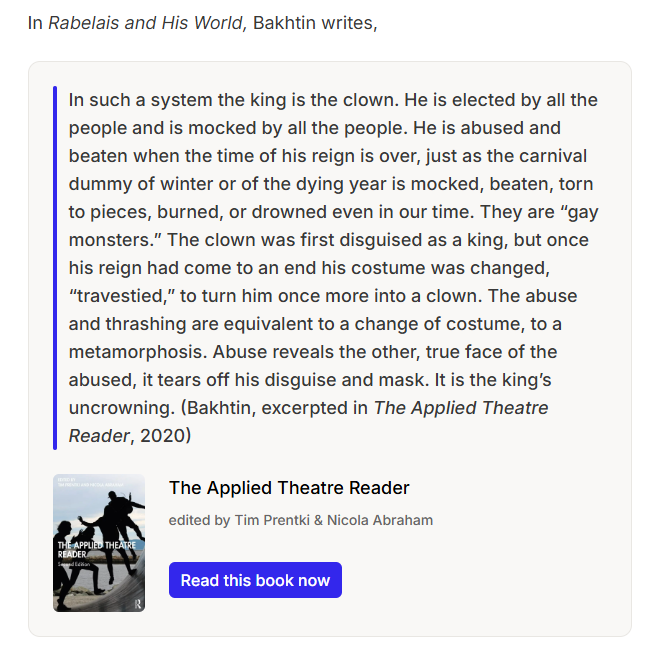
Mikhail Bakhtin gave us the carnival: the medieval festival in which hierarchy was inverted, the fool crowned, the king mocked, and the sacred profaned for a licensed interval. Carnival was permitted precisely because it was contained, yet it revealed a permanent truth, that ordinary people always hold a private, subversive counter-image of the powerful, and that a moment of collective laughter can bring that image into the open air where it becomes contagious.
James C. Scott sharpened this into the distinction between the public transcript, the deferential script that subordinates perform in front of power, and the hidden transcript, the mockery and contempt they share among themselves once the master is out of earshot.
The entire political function of satire is to smuggle the hidden transcript into public space. When a meme says out loud what everyone was already thinking in private, it does not create the contempt. It reveals how widely the contempt is already shared, and that revelation is itself a mobilizing act, because fear thrives on the belief that you are alone in your disaffection.
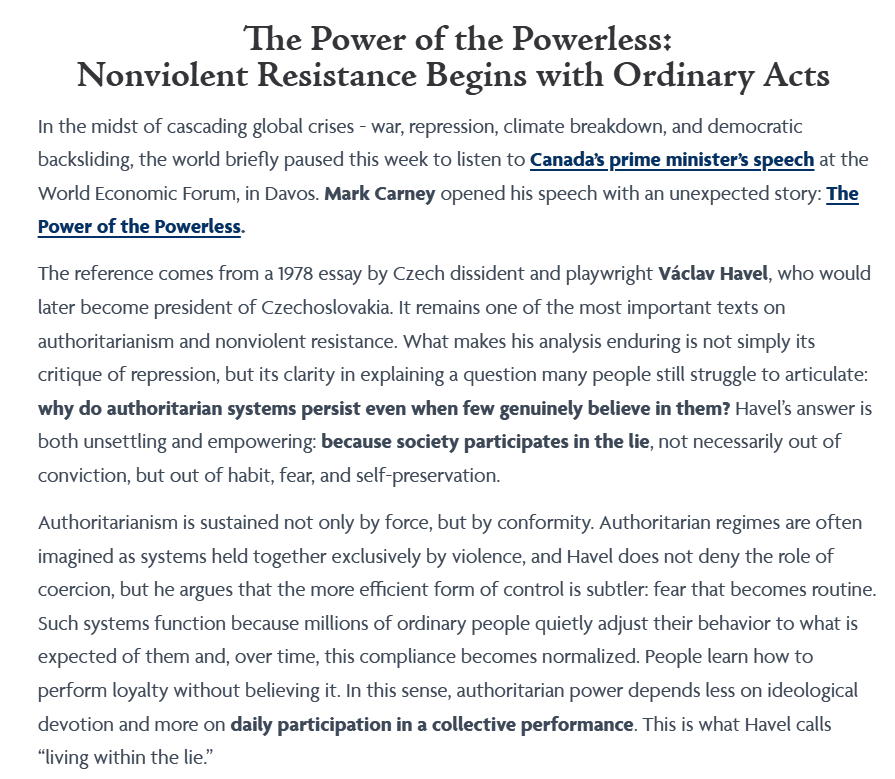
Vaclav Havel, writing under Czech communism in "The Power of the Powerless," described how an entire order can rest on a lie that no one believes but everyone performs, the greengrocer who places the official slogan in his window not from conviction but from fear. Havel's remedy, living within the truth, has a comic edge: the most efficient way to stop performing a lie is to laugh at it, because laughter is an involuntary confession that you no longer believe. A ruling ideology can survive hatred. It cannot survive being ridiculous.
Laughtivism and the dilemma of action
The Serbian activists of Otpor, and the training organization CANVAS that grew out of them, turned this theory into an operational method they branded laughtivism. Srdja Popovic has described humor as doing three things at once for a movement. It dissolves fear, because it is hard to be terrified of a figure you are busy mocking. It makes dissent attractive and even cool, which lowers the psychological cost of joining, a decisive factor for the young. And, most ingeniously, it creates what strategists call a dilemma action: a provocation designed so that every available response by the regime makes the regime lose.
The canonical Otpor example was an oil barrel painted with Milosevic's face, set up in a Belgrade shopping street with a bat beside it, inviting passers-by to pay a coin for the pleasure of whacking the president.
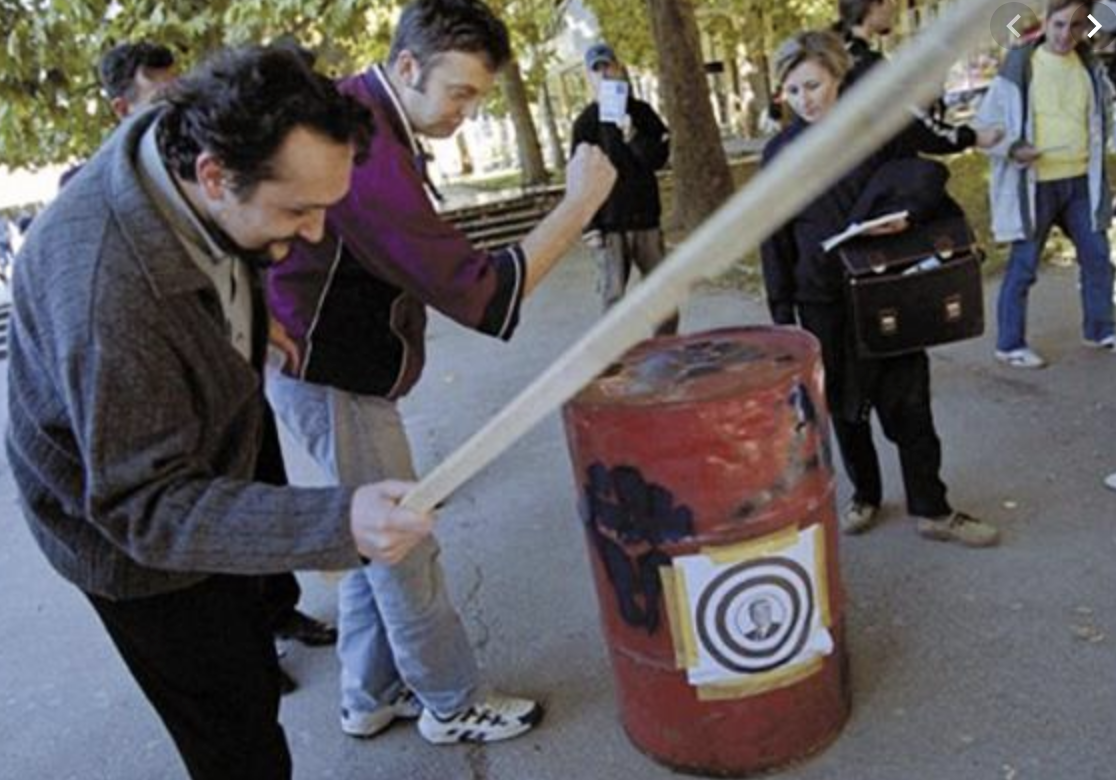
The police faced a perfect trap. Ignore it, and the mockery spread and the crowd grew. Intervene, and the world's cameras captured grown officers solemnly arresting an empty barrel, which was funnier than the original stunt and did the movement's work for it.
Poland's Orange Alternative had already perfected the form in the 1980s, when activists in Wroclaw dressed as dwarves for absurdist street happenings, forcing the communist militia into the impossible choice of tolerating the ridicule or being filmed hauling costumed dwarves into vans. The state's own machinery of intimidation was converted into a comedy prop.
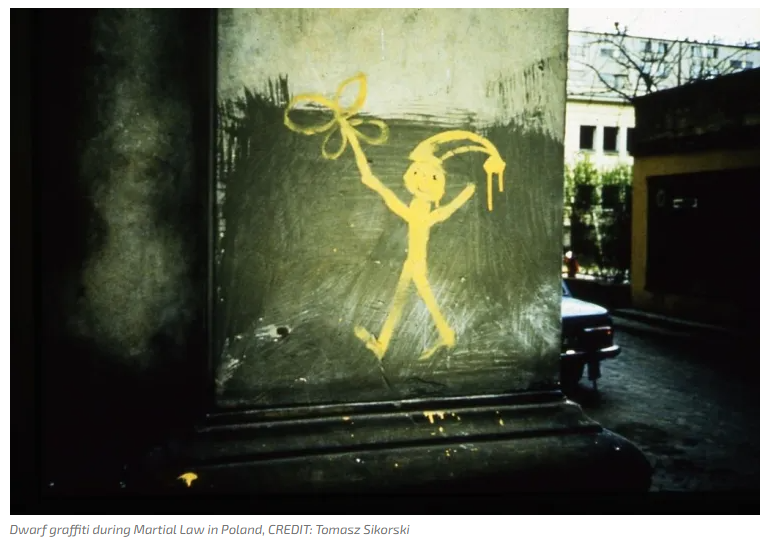
The dilemma action is the heart of why humor is a genuine strategic weapon rather than mere morale-boosting. Conventional repression assumes the protester wants to avoid the baton. Laughtivism designs the encounter so that the baton is the goal, because the image of force used against a joke transfers legitimacy from the state to the movement in a single viral frame.
The two families: Venting and Detonating
It is worth separating two things that both wear the mask of comedy, because they act on a political system in opposite directions.
The first is the satirical ballot-box vehicle, which absorbs discontent inside the system. Canada's Rhinoceros Party, founded in 1963 by Jacques Ferron, promised to repeal the law of gravity, reduce the speed of light, and pave Manitoba, on the honest platform of keeping none of its promises. It never won a seat, yet at its 1980 peak it fielded more than a hundred candidates, took around one percent of the national vote, and out-polled established parties in individual ridings. Poland's Beer-Lovers' Party went further: founded in 1990 by a comedy troupe, it actually won 16 seats in the Sejm in the 1991 election on roughly three percent of the vote before splitting, with perfect self-parody, into Big Beer and Small Beer factions. These parties are pressure-release valves. They let a disillusioned public register contempt for the political class without leaving the electoral arena, and in doing so they arguably stabilize the system by giving cynicism a harmless home.
The second family is laughtivism as detonator, which channels the same comic energy against the system rather than into it. Otpor against Milosevic, the meme cultures of the Arab Spring, Egypt's satirist Bassem Youssef turning a nation's living rooms against a presidency, and now India's Cockroach Janta Party belong here. The distinction matters because the two families feel identical from the outside, the same irreverence, the same viral spread, yet one drains pressure while the other builds it toward a rupture. A regime that cannot tell which one it is facing will mismanage both.
The Digital Mutation
What has changed in the last fifteen years is the delivery system. Bakhtin's carnival happened once a year in a town square. Scott's hidden transcript circulated in whispers. The meme collapses both into a permanent, frictionless, borderless carnival that any phone can join and any joke can win. The transition that your CJP example captures, from an online satire to bodies in the street, is the defining organizational fact of contemporary mobilization, first visible at scale in Tunisia and Cairo in 2011. The joke is now the recruiting poster, the ideology, the coordination layer, and the emotional fuel all at once, and it moves faster than any ministry of information can respond.
The CJP illustrates the pattern precisely. The name itself was a gift from the top: it weaponized a senior judicial figure's dismissal of unemployed youth as "cockroaches," turning an insult meant to diminish into a banner of identity. That is textbook laughtivism, the reappropriation of the oppressor's own contempt as the movement's flag, and it is why the subsequent crackdown was strategically self-defeating. You cannot club a punchline into silence. Every image of force used against people wearing cockroach masks confirmed the joke and widened its audience, exactly as the barrel and the dwarves were designed to do decades earlier.
The Subversion Problem: a Content-neutral Weapon
Here the analysis has to turn, because everything described so far can be read as a heroic story of the powerless disarming tyrants, and that reading is true but dangerously incomplete. Satire has no conscience. It corrodes whatever it is aimed at, and it is exactly as effective against a legitimate, elected, delivering government as against a genuine dictator. This is what converts laughtivism from a democratic weapon into a subversion tool, and it is the crux of the matter for any state that wants to distinguish liberation from destabilization.
Three properties make weaponized humor the ideal front end for an externally directed operation of the kind traced in the earlier CANVAS work.
It is manufacturable. A spontaneous meme born of real grievance and a seeded meme injected by a well-resourced actor are visually indistinguishable. Humor is trainable, which is precisely why CANVAS teaches it as a module. The techniques of the dilemma action can be taught in a weekend workshop and deployed anywhere there is a phone signal and a plausible grievance to attach to.
It carries perfect plausible deniability. Every other instrument of pressure can be denounced. A joke cannot, because the response to any objection is that it was only a joke, and the objector is instantly recast as the humorless authoritarian who cannot take a laugh. Comedy is the one payload that makes its target look bad merely for noticing it. For an operation built, as the color-revolution playbook is, on deniability, humor is the ideal delivery vehicle, because it is deniable by design.
It shifts norms rather than winning arguments. This is where the mechanism connects to the framework of prejudiced norm theory and stigma. Disparagement humor works by quietly moving the boundary of what a society treats as an acceptable target of contempt. A joke does not persuade you that a leader is illegitimate. It normalizes treating him as a legitimate object of ridicule, and once that norm shifts, the argument is already lost without ever having been held. Repeated often enough, mockery manufactures the very illegitimacy it pretends merely to observe. A campaign of engineered ridicule can therefore hollow out a government's standing regardless of that government's actual record, because the humor operates below the level of evidence, on the level of who it has become socially safe to laugh at.
Put these together and the uncomfortable conclusion follows. The same technique that freed Serbs from a genuine tyrant can be pointed at a functioning democracy by actors with entirely different objectives, and from the outside the two are not distinguishable by the humor itself. They are distinguishable only by the reality underneath: whether the grievance the joke rides on is real and unaddressed, or manufactured and amplified. That is an empirical question about the society, and it cannot be answered by studying the meme.
The Counter: why force is always the wrong reply
The strategic implication for any targeted order is severe and counterintuitive. Force is the one response guaranteed to fail, because repression is the completion of the dilemma action, the move the laughtivist is trying to provoke. Every regime that has baton-charged a joke has printed the movement's next recruiting poster with its own hands. The Milosevic police and the barrel, the communist militia and the dwarves, the response to the cockroach marchers, all follow the identical script, and the script always ends with the state as the villain of a comedy it did not write.
There are only two responses that actually work against weaponized satire, and both are hard.
- The first is to deflate rather than repress: to answer humor with humor, to absorb the mockery, to demonstrate the self-confidence that is the opposite of the brittle solemnity comedy feeds on. A leader who can laugh at himself denies the joke its oxygen, because the entire force of political satire depends on the target being too self-important to join in. Authority that can take a joke is nearly immune to being destroyed by one.
- The second, and the only durable answer, is to drain the grievance the humor rides on. Satire is a solvent, but it needs something real to dissolve. Otpor's barrel worked because Serbia was genuinely ruined. The cockroach movement gained traction because youth unemployment and exam-integrity failures were genuine wounds. Where the underlying grievance is addressed, the same joke falls flat, because a population that feels its problems are being taken seriously will laugh at the satire and then go home. Where the grievance festers, no amount of force will stop the laughter, and every crackdown will feed it. This is the same lesson that runs through the analysis of Lee Kuan Yew and of insulation more broadly: the deepest defense is delivery and legitimacy, and the shortcut of coercion manufactures the very vulnerability it means to suppress.
These two mechanisms are instructive.
The Solvent and the Shield
Laughter is the solvent of legitimacy, and legitimacy is the one asset that cannot be defended by force, because reaching for force is itself the confession that legitimacy has already thinned. That single fact explains why satire is simultaneously the most democratic weapon in politics and the most dangerous. In the hands of the genuinely powerless facing genuine tyranny, it is often the only safe weapon they have, and it has toppled real monsters with less bloodshed than any alternative. In the hands of a well-resourced operator facing an inconvenient but legitimate government, the identical technique becomes a deniable instrument for manufacturing the appearance of illegitimacy where the substance of it does not exist.
The central analytic task of our moment, then, is not to celebrate laughtivism or to fear it, but to learn to read the reality beneath the joke, to ask in each case whether the laughter is revealing a legitimacy that has already died or engineering the death of one that still lives. The meme will never tell you which. Only the condition of the society will. And the only leaders who have nothing to fear from the weaponized joke are the ones who have made themselves genuinely worth defending, because a confident and delivering order can afford to laugh along, while a brittle one is dismantled one punchline at a time.
Fighting Smoke: How Can An Established Order Counter a Decentralized, Meme-Driven Movement
A decentralized, meme-driven movement has no body to strike. It has no single leader to arrest, no headquarters to raid, no chain of command to paralyze. It is a distributed system, and a distributed system cannot be decapitated, because it has no head. This is why the instinctive responses of an anxious state, censorship, denial, prosecution, and silence, act as accelerants. They hand the movement the one thing it cannot manufacture for itself: the establishment's visible fear. The Streisand effect names the trap. Suppression is a form of attention, and attention is the currency the movement trades in. The order that hopes to prevail must abandon suppression entirely and move to the plane of narrative, where the contest is over the meaning of events rather than control of the streets.
The counter-doctrine offers five tactics. Cognitive inoculation, or prebunking, gets there first, exposing the public to a weakened form of a manipulation before it arrives so that citizens greet it with skepticism rather than absorption. It rests on William McGuire's inoculation theory and Sander van der Linden's later refinement. Narrative jiu-jitsu denies satire its oxygen: since indignation is what the joke feeds on, the target that laughs at itself and shows it is in on the joke deflates the movement's momentum. Surgical concession separates the legitimate grievance from the disruptive swarm by validating the real issue and drawing the movement's credible figureheads into genuine dialogue, leaving the residual digital network exposed as a swarm with no ethical cover. De-masking the architecture exposes hidden coordination, diaspora orchestration, or artificial amplification through transparent forensics, shifting the frame from the people against the establishment to citizens being manipulated by hidden coordinators. Algorithmic counter-flooding drowns the movement's signal in competing constructive content rather than trying to suppress the hashtag.
These tactics are unequal.
Four of the five are perception management. They lower the temperature and buy time, but they cannot manufacture legitimacy, because legitimacy is a reality to be earned rather than a perception to be managed. Only surgical concession touches reality, and it works solely when the concession is real, which is why it is the single point where the counter-doctrine and ordinary good governance become the same act. Two tactics carry sharp warnings.
Only the reality beneath the movement can. The one counter that is also a cure is to remove the grievance. Everything else manages a symptom, and a symptom managed long enough becomes the disease.
A Playbook for Countering CANVAS-like Movements
While the entire body of work suggests that BJP's approach of non-confrontation and taking the wind out of the sails was the most pragmatic one, the communication left a lot to be desired.
What India, and specifically the BJP need is what can be called as "Cognitive Inoculation."
The oldest error in information defense is to wait for a hostile narrative to go viral and then attempt to debunk it. By the time a claim is trending, the psychological anchor is already set, and correction arrives as an unwelcome guest arguing against a belief the audience has already made part of itself. The superior move is temporal: get there first.
This is not folk wisdom. It rests on inoculation theory, developed by the social psychologist William McGuire in the early 1960s, which demonstrated that exposing people to a weakened form of a persuasive attack, together with a preemptive refutation, confers resistance to the full attack later, exactly as a vaccine primes the immune system against a pathogen.
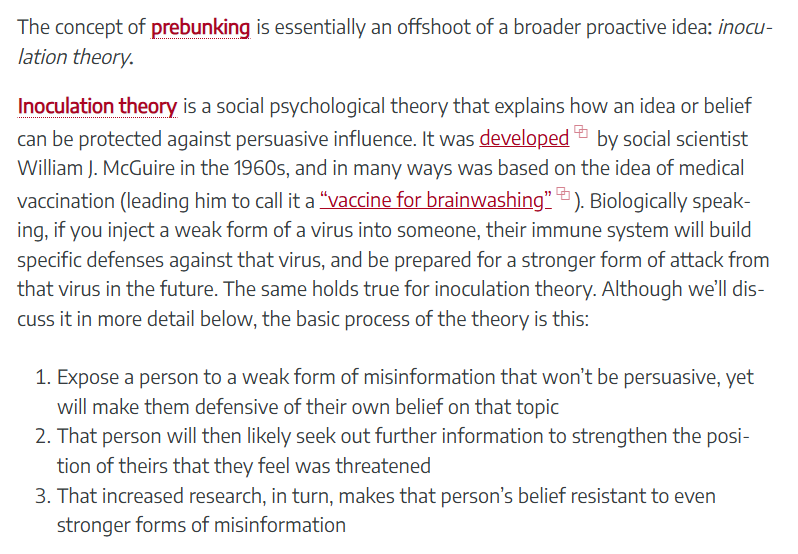
The contemporary application, refined by Sander van der Linden and colleagues at Cambridge into what they call prebunking, has two components:
- a forewarning that an attempt to mislead is coming, and
- a preemptive exposure of the technique by which it will be attempted.
Crucially, the most durable version inoculates against the manipulation method rather than any single claim, so that the audience learns to recognize a whole family of tricks, coordinated hashtag seeding, images stripped of context, manufactured engagement from accounts with no local footprint, and greets each new instance with skepticism rather than absorption.
The honest edge to name is this: a public can be inoculated against believing true things as easily as false ones. When the "manipulation" a government preemptively warns against is in fact a real grievance surfacing through irregular channels, prebunking curdles into preemptive delegitimization, a way of training citizens to disbelieve their own eyes before the evidence arrives.
The technique is clean. Its cleanliness depends entirely on whether the thing being inoculated against is actually a lie.
The other mechanism could be termed as "Narrative Jiu-Jitsu", where steps can be taken to take the oxygen out of the joke itself.
Indignation is the oxygen of meme warfare. Every time an institution answers satire with moral outrage, legal threat, or wounded solemnity, it confirms the movement's founding premise, that power is rigid, humorless, out of touch, and brittle enough to be provoked.
The satirist's entire strategy, as the study of laughtivism shows, is the dilemma action: a provocation engineered so that the target's anger becomes the next punchline. To meet that with anger is to complete the move the other side designed.
The counter is to refuse the role. A meme loses its subversive charge the instant its target demonstrates that it is in on the joke.
Self-awareness, lightness, and the visible confidence to laugh at oneself deny the satire its fuel, because ridicule feeds on self-importance and starves without it. Beyond mere deflation lies the more advanced maneuver of reframing the punchline, taking the movement's own symbol and turning it toward a constructive meaning, so that the network is forced to keep inventing new symbols instead of compounding the equity of one.
This is the cheapest and most legitimate tactic in the entire arsenal, because it manipulates no one and conceals nothing. It simply declines to be goaded. The reason states so rarely use it is that it requires a self-assurance that anxious power does not possess, which is itself diagnostic: an order that cannot laugh at itself is usually an order that senses it has something to hide.
The third step should be to separate the grievance from the swarm of narratives. A surgical operation on narratives, if you will.
This is the load-bearing tactic, and everything else in the doctrine is secondary to it. A decentralized movement acquires mass by grafting disruptive or absurd tactics onto a legitimate, widely felt grievance, which functions as its moral anchor. The cockroach masks, the dwarf costumes, the painted barrels are the delivery vehicle. The grievance underneath, youth unemployment, corruption, a rigged examination, an environmental wound, is the payload, and it is the payload that recruits the uncommitted majority who would never join a stunt but will march for a cause.
The counter is to perform surgery on that graft, cutting the valid grievance away from the disruptive actors. This has two moves. The first is rapid validation: publicly and immediately acknowledge the legitimacy of the underlying issue while withholding endorsement of the methods, which denies the movement its ethical shield and its claim to speak for the silent majority. The second is to co-opt the credible voices, inviting the movement's respected figureheads, the elders and moral authorities lent to it for legitimacy, into genuine, high-profile dialogue with real solutions on offer.
Once the moral anchor is visibly negotiating in good faith, the residual digital network is exposed as what the state wishes it to appear: a disruptive swarm with no ethical cover and no constructive purpose.
The reason this tactic is decisive is also the reason it is honest: it works only if the concession is real. You cannot surgically validate a grievance you have no intention of addressing, because the figureheads will discover the emptiness of the dialogue and walk out more credible than before, and the swarm will return with the added charge of bad faith.
Surgical concession is therefore the one point where the counter-doctrine and ordinary good governance become the same act. It is manipulation only in form. In substance it is the state doing what it should have done before the movement existed, which is why it is the only tactic here that resolves the crisis rather than merely postponing it.
All of these steps need to be backed by the demasking of the architecture and exposing the "machinery".
Decentralized movements trade on a romantic self-image of spontaneous, organic, leaderless uprising. Yet as the study of the color-revolution toolkit shows, such movements almost always rely on some hidden scaffolding: coordination nodes, diaspora or external orchestration, and artificial amplification that manufactures the appearance of a groundswell before the real one exists. Where that scaffolding is present, exposing it is legitimate and potent.
Transparent digital forensics, synchronized posting patterns, clusters of accounts with no organic history, amplification traffic routed through networks with no stake in the local issue, can be published in visual, intelligible form, shifting the public frame from "the people against the establishment" to "local citizens being played by hidden coordinators."
Since authenticity is the movement's primary social currency, demonstrating inauthenticity devalues it at the source.