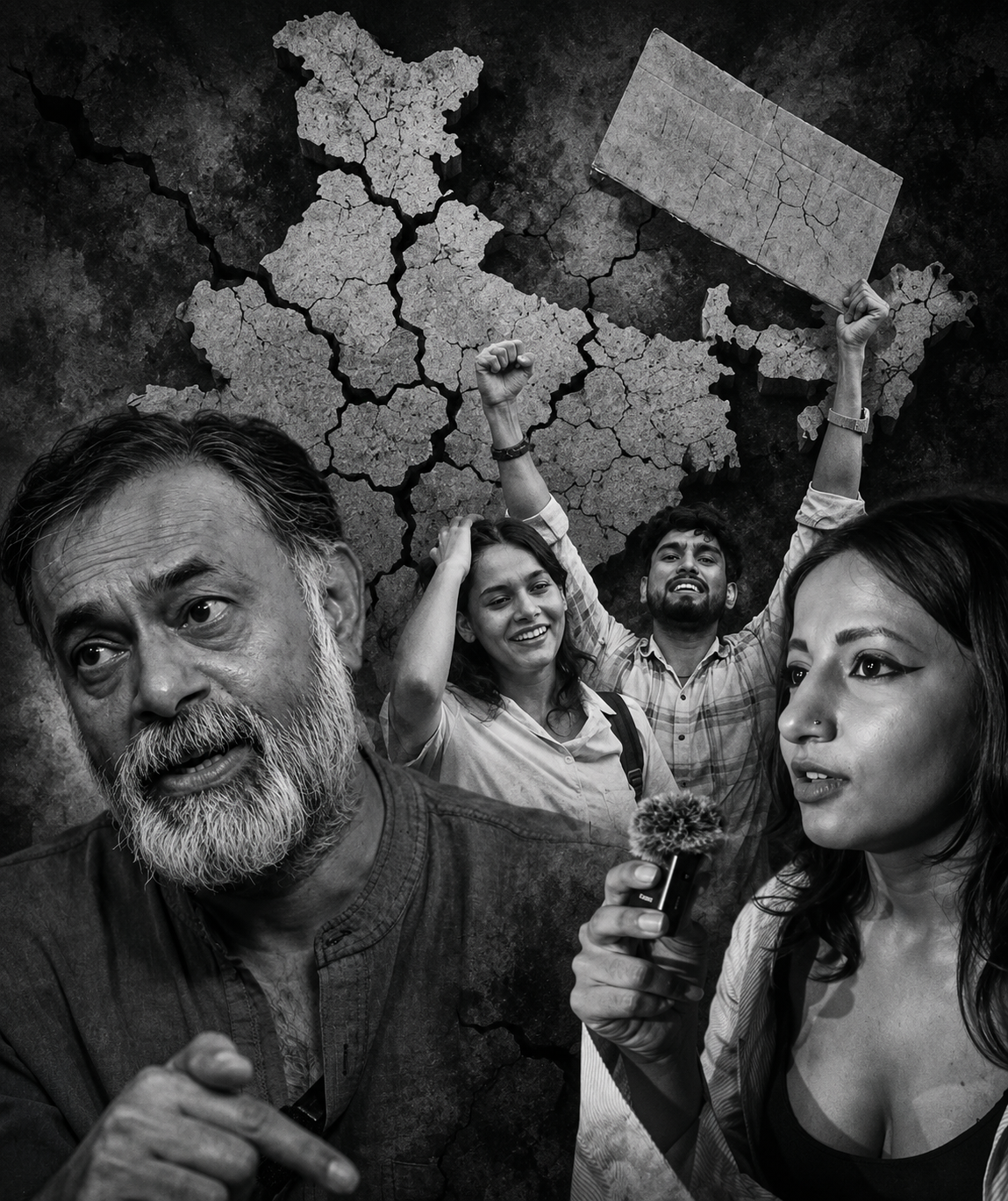
Somewhere in Delhi, over these past few days, men in a crowd bent down, picked up stones that had been deliberately placed there for them, and hurled those stones at police and law enforcement personnel who were doing their duty.
Somewhere in that same crowd, personnel of the Delhi Police and the Rapid Action Force were surrounded, dragged, beaten, and left fighting for their lives.
Vehicles were torched. Public property was smashed. Private property was destroyed. Streets that exist to carry citizens were converted into battlegrounds. Institutions that exist to protect civil order were converted into targets.
From the same ecosystem that describes itself as peaceful, from the same platforms that speak endlessly about rights, democracy, conscience, dissent, and constitutional morality, came open threats against a sitting Prime Minister, a sitting Home Minister, a sitting Education Minister, and against the men and women who wear the uniform of the Indian Army.
Hold that image steady. Do not look away from it.
The vocabulary of protest should not be allowed to blur the reality of violence. Slogans should not be allowed to deodorize savagery. The word "student" should not be allowed to erase the act of picking up a stone and aiming it at another human being's skull.
This essay argues that what we are watching has two architectures rather than one. The first is moral, and it operates inside the mind. It lowers the cost of harming a human being by first reducing that human being to a symbol. The second is operational, and it operates in the street, the courtroom, the newsroom, and the donor network. It is written down, it is taught, and it has been applied in country after country with a consistency that no honest observer can call coincidental.
The two architectures require each other. The manual cannot work until the moral preparation is complete, because ordinary young people will not attack a police officer they still see as a person. The moral preparation accomplishes nothing on its own until an organization arrives to convert it into a schedule of actions. Understand them separately, and you will misread the event. Understand them together and the whole thing becomes legible.
Begin with the question that India's self-appointed conscience keepers desperately do not want asked.
The Covenant
There is an ancient principle that every civilized society understands instinctively.
The right to protest carries no permission to lynch. The right to dissent carries no permission to terrorize. The right to criticize the government carries no permission to threaten elected leaders, assault police officers, burn vehicles, or destroy the public order that makes rights meaningful in the first place.
Rights and responsibilities form a single moral covenant rather than two separate objects. A citizen claims rights because that citizen accepts reciprocal obligations: to obey the law, to respect the equal dignity of others, to settle political disputes through constitutional methods, and to recognize that power in a democracy flows from ballots.
The right to decide the destiny of the country comes from the vote. Elections decide it. Mobs do not decide it, and neither do stones, roadblocks, arson, or assassination fantasies dressed up as revolutionary speech.
The Boundary That Moves Before the Stone Does
The violence we are watching is physical only at its last stage. The stone is simply the final object in the hand. Long before the stone is thrown, something else has already happened inside the mind.
A boundary has moved. A taboo has weakened. A target has been morally reduced. A human being has been converted into an object on which rage may be performed.
This is the true Overton Window of dehumanization.
The Overton Window is usually discussed as a political concept, meaning the range of ideas considered acceptable in public discourse. Its application extends well beyond policy and into morality itself.
Societies carry moral Overton Windows as well. Those windows define what language is permissible, what behavior is tolerable, what forms of hatred may be excused, and which kinds of violence can be rationalized as understandable.
That shift is engineered rather than accidental.
Social psychologists have studied this process for decades. Albert Bandura, one of the most influential psychologists of the twentieth century, called it moral disengagement.
You can read Bandura's research paper here.
Bandura identified mechanisms such as euphemistic labeling, diffusion of responsibility, advantageous comparison, attribution of blame, and dehumanization. Together, these mechanisms allow people to do things they would otherwise recognize as wrong while preserving a self-image of righteousness.
This point deserves emphasis. People require no belief in their own evil in order to commit evil. Most political violence is committed by people who believe themselves morally superior.
They are told they are resisting fascism. They are told they are saving democracy. They are told they are defending the oppressed. They are told that police officers are agents of repression rather than human beings doing a dangerous job. They are told that elected leaders are monsters, tyrants, butchers, parasites, enemies, and demons rather than representatives chosen by voters. They are told that the nation itself is illegitimate unless it is ruled by their side.
Once that moral inversion is complete, violence stops feeling like violence. It feels like justice. This is how the mind is prepared before the hand picks up the stone.
Nick Haslam's research on dehumanization adds another layer. Haslam describes dehumanization as the denial of qualities that make people fully human, including individuality, emotional depth, moral agency, rationality, civility, warmth, and dignity. People can be dehumanized as animals, vermin, machines, objects, or faceless instruments.
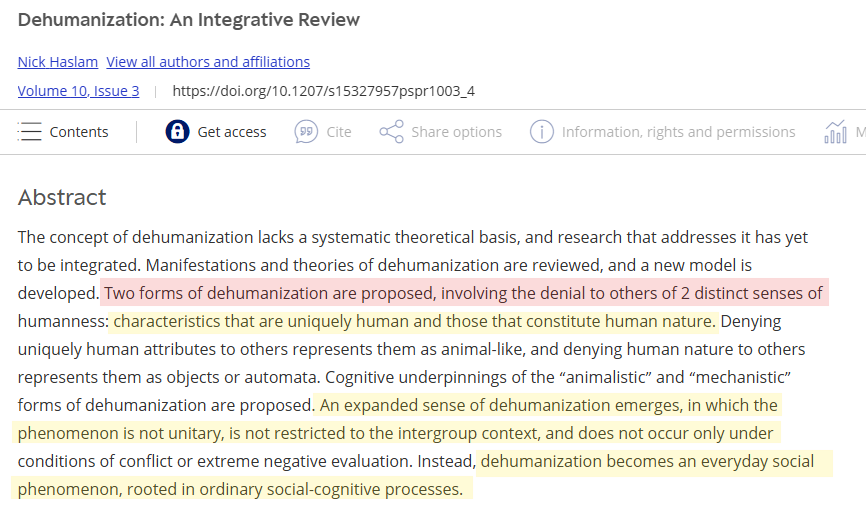
Once that denial takes hold, empathy weakens. Restraint weakens. The moral cost of harm falls. The victim becomes less real.
Why Language Is the First Weapon
Language matters here for reasons that have nothing to do with fragile sensibilities offended by harsh words. Language matters because language is rehearsal. Language prepares the nervous system. Language tells the crowd who counts as human and who does not. Language draws the circle of moral concern, and then quietly pushes some people outside it.
Look at the footage emerging from Delhi. Listen to the chants. Listen to the obscenities. Listen to the repeated public abuse directed at Prime Minister Narendra Modi, at his party, at the government, and by extension at the millions of ordinary citizens associated with them.
The sexualized Hindi profanities screamed in those crowds are not policy critique, and they are not constitutional argument. They function as ritual humiliation.
When such abuse is screamed in mobs, filmed, circulated, celebrated, and then defended as student anger, we are watching something other than spontaneous frustration. We are watching the deliberate degradation of civic discourse. We are watching young people being trained to feel no shame in stripping the elected head of government of basic human dignity.
Once that becomes normal, the next step becomes easier.
If the Prime Minister is treated as an object of sexualized abuse rather than a legitimate elected leader, then threatening him becomes easier. If the Home Minister is treated as a demonized enemy rather than a constitutional authority, then violence against the system he represents becomes easier. If police officers are treated as an abstraction called "the state" rather than as sons, daughters, parents, spouses, citizens, and public servants, then beating them becomes easier. If Army personnel are treated as symbols to be cursed from a mob rather than as human beings who hold the border in conditions most keyboard revolutionaries could not survive for a day, then threatening them becomes easier.
This is the ladder. It begins with ridicule and moves to abuse. Abuse hardens into dehumanization. Dehumanization grants moral permission. Moral permission produces violence. Violence is followed by denial. Denial clears the ground for repetition.
What History Has Already Demonstrated
History provides enough warnings for anyone willing to see them.
In Rwanda, before the 1994 genocide, extremist propaganda began with language rather than machetes. Radio Télévision Libre des Mille Collines, or RTLM, repeatedly referred to Tutsis as cockroaches and snakes. Broadcasters used jokes, songs, gossip, and political commentary to make hatred feel casual, communal, and normal. The message went well beyond disagreement. It insisted that they were pests, that they were invaders, that they were unlike us, and that they had to be eliminated.
Yet the dehumanization had started long before RTLM urged its listeners to “exterminate the cockroaches.” The killings in 1994 were a culmination of decades of hate-mongering, the indoctrination that began even before independence. In 1959, Joseph Habyarimana Gitera, a leader of the radical Hutu political party Aprosoma, openly called for the elimination of the Tutsi “vermin.” The stigmatization and dehumanization of the Tutsi had begun. When the first of the many anti-Tutsi pogroms broke out that year, Gitera was overjoyed. (Source: "Rwanda Shows How Hateful Speech Leads to Violence" / The Atlantic)
The result was literal rather than metaphorical. Around 800,000 Tutsis and moderate Hutus were murdered in roughly 100 days. Neighbors killed neighbors. Teachers killed students. Doctors killed patients. Clergy participated. Ordinary people became instruments of extraordinary cruelty.
No serious person should claim that language alone caused the genocide.
Political organization, militias, weapons, state complicity, historical grievances, fear, and coercion all played their roles. It is equally true that no serious person can deny that language helped lower the moral threshold for violence. It created a climate in which murder could be imagined as pest control.
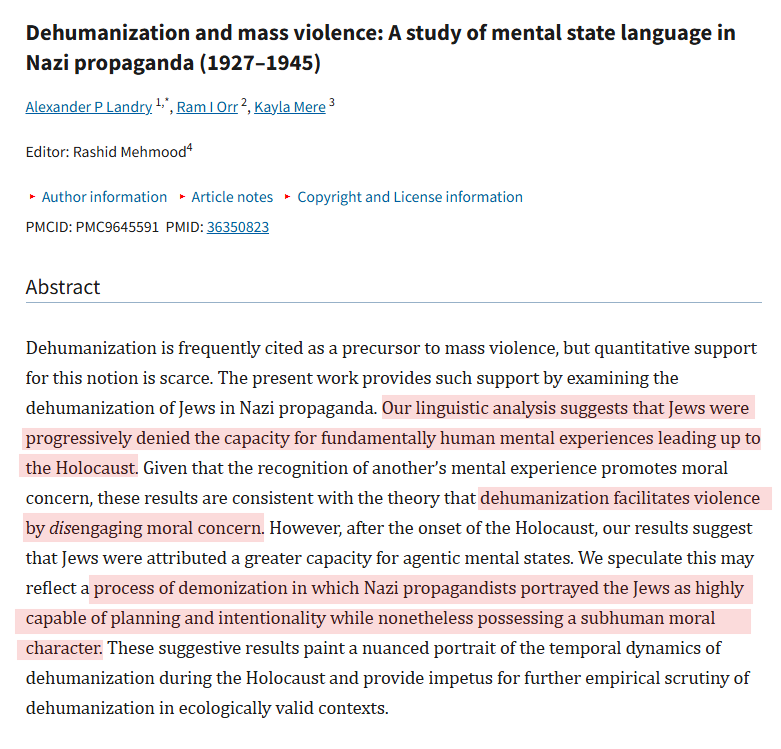
The same pattern appears in Nazi propaganda. A study of Nazi propaganda from 1927 to 1945 found that dehumanizing representations of Jews intensified as the regime moved toward mass violence. Jews were repeatedly portrayed in ways that denied ordinary human mental states and moral standing. Dehumanization served as a psychological bridge between prejudice and extermination.
Language was never the whole machinery. The machinery included law, bureaucracy, propaganda, police power, war, camps, and industrial murder. Language nevertheless prepared the moral atmosphere. It made the unthinkable thinkable. It made the unacceptable administratively possible. It helped ordinary people look away, and in many cases it helped them participate.
This is why every society that cares about its own survival must take public dehumanization seriously well before it becomes mass violence. By the time the mob is already attacking, the earlier failure has already occurred.
The failure occurred when abuse was romanticized. It occurred when threats were excused. It occurred when lawlessness was called courage. It occurred when elite voices began laundering street violence through academic language. It occurred when "protest" became a magic word capable of sanctifying anything.
The Script That Follows Every Riot
The defenders of this ecosystem follow the same script every time.
First they deny the violence. Then, when the footage becomes undeniable, they minimize it. Then they blame the police. Then they blame provocation. Then they claim fringe elements. Then they call the perpetrators misguided youth. Then they accuse anyone demanding accountability of authoritarianism. Finally, they convert the aggressor into the victim.
This sequence is a moral technology rather than an accident.
Bandura called one part of it attribution of blame. The victim is held responsible for the harm done to him. The police officer who was beaten somehow provoked the beating. The state that tolerated days of disruption somehow forced the mob to escalate. The elected leader who was abused somehow deserved the hatred. The public whose property was destroyed is instructed to understand the anger.
Another part is euphemistic labeling. Violence becomes direct action. Intimidation becomes resistance. Disorder becomes people's power. Mob pressure becomes democratic expression. Threats become slogans. Stone pelting becomes clashes.
Notice that last word. "Clashes" ranks among the most dishonest words in political reporting. It makes violence sound symmetrical, atmospheric, and almost accidental, as though two clouds collided. When a mob pelts police with stones, surrounds personnel, assaults them, burns vehicles, and destroys property, the accurate description is organized disorder and coercive violence. It is an attempt to replace democratic authority with street force.
If the state responds, it is accused of repression. If the state does not respond, the mob expands. Either way, the agitator wins the media frame.
That is the architecture.
Everything up to this point describes a pattern. The obvious objection is that patterns can be coincidental, that outraged people in different countries might simply behave in similar ways because outrage has a limited repertoire. That objection would be reasonable if the pattern had never been written down.
It has been written down. Repeatedly. In detail. And it is taught.
The Manual
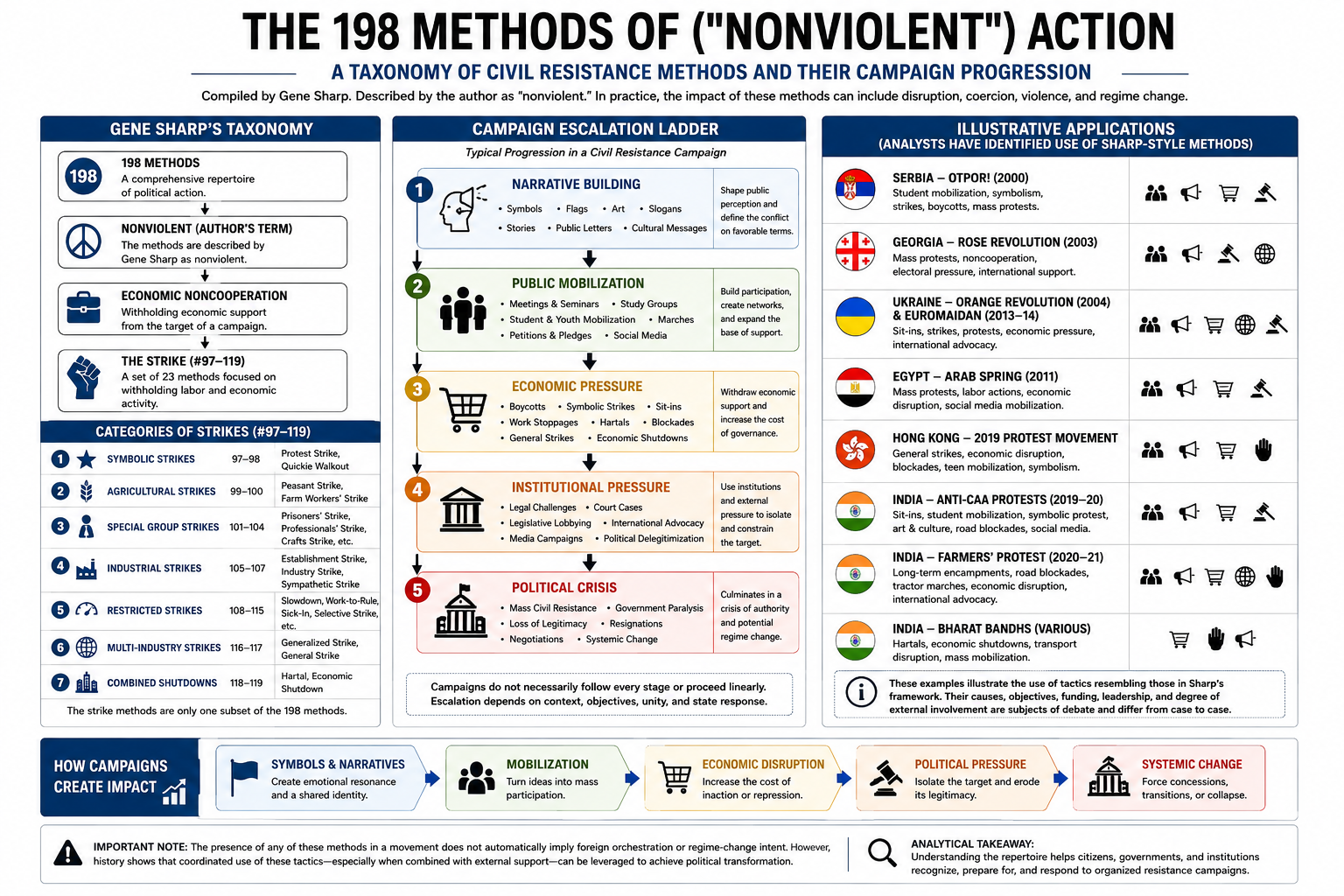
In 1973, the political scientist Gene Sharp published what became known as the 198 Methods of Nonviolent Action, a systematic taxonomy of techniques by which organized movements can apply pressure to governments and institutions.


Sharp sorted the toolkit into three families: protest and persuasion, noncooperation, and intervention. Strikes, boycotts, refusals of cooperation, symbolic politics, narrative warfare, and the construction of parallel institutions that erode the authority of the state without a single conventional bullet being fired.
Sharp's own claim was that these methods work precisely because they are nonviolent, and his admirers regard him as a theorist of liberation. That defense deserves a fair hearing. It also deserves scrutiny, because many of the methods in the taxonomy are designed to produce economic disruption, institutional paralysis, and social polarization, and because polarization at scale reliably produces violent confrontation, whatever the intention of the person who designed the schedule. A method that is nonviolent in the hand of the organizer is not necessarily nonviolent in its consequences on the street. The word carries a great deal of moral cargo that the outcomes do not always earn.
Pair that taxonomy with a second framework. In 1966, the sociologists Richard Cloward and Frances Fox Piven published an article in The Nation proposing that welfare rights organizers should deliberately enroll every eligible recipient at once, overloading the system and forcing a national response.
We suggest, in short, that if pervasive institutional rescuer particular reforms are not yet possible, requiring as they do expanded Negro political power and the development of new political alliances, crisis tactics can nevertheless be employed to secure particular reforms in the short run by exploiting weaknesses in current political alignments. Because the urban coalition stands weakened by group conflict today, disruption and threats of disaffection will count powerfully, provided that national leaders can respond with solutions, which retain the support of ghetto constituencies while avoiding new group antagonisms and bolstering the urban party apparatus. These are the conditions, then, for an effective crisis strategy in the cities to secure an end to poverty. (Source: The Weight of the Poor: A Strategy to End Poverty / The Nation)
In the broader political reading that developed afterward, and it should be acknowledged that this broader reading is an extrapolation rather than the authors' own program, the Cloward and Piven approach describes something more general: legal entitlements and administrative burdens can be used deliberately to overload a governance system, to flood its pipelines until it visibly breaks, so that the resulting dysfunction can be presented as proof that the whole system is unjust and must be replaced.
You do not have to physically destroy an institution to defeat it. You only have to make it look permanently broken, permanently discriminatory, and permanently illegitimate in the eyes of its own citizens, and more importantly in the eyes of international audiences.
Put the two frameworks together, and an escalation ladder emerges that intelligence analysts have traced across movement after movement.
- Narrative building and grievance inflation.
- Public mobilization through engineered social media spikes.
- Economic and transport disruption, meaning the blocking of highways, railways, and commercial hubs.
- Institutional overload, meaning the flooding of courts and administrative bodies with simultaneous lawfare.
- Manufactured political crisis with a demand for regime change.
Take a grievance, real or imagined, wrap an organization around it several sizes too large, and drive it up the ladder. Internationalize it. Route it through the courts, the media cycle, the foreign donor network, the rights report, the United Nations rapporteur, and the friendly foreign embassy. Keep the pressure asymmetric, because state institutions are slow, bound by law, and already politically contested, while the campaign is agile, well funded, and centrally coordinated.
This describes an observed and documented sequence rather than a theory floating in the air.
Otpor in Serbia. The Rose Revolution in Georgia. The Orange Revolution and later Euromaidan in Ukraine. The Arab Spring in Egypt. Hong Kong.
The organizational lineage in several of these cases is a matter of public record, including the training seminars, the funding trails, and in some cases the direct citation of Sharp's own texts by the organizers themselves.
What the Endgame Actually Looks Like
The most recent demonstration happened next door.
In Bangladesh, an agitation over the government job quota system escalated through exactly this ladder in mid 2024. An elected leader was branded a dictator. Sheikh Hasina fled the country in August 2024. Muhammad Yunus, a figure cultivated by Western donor and academic institutions for decades, was installed at the head of the interim arrangement that followed.
Watch that Bangladeshi sequence closely, because it reveals the endgame that the manual never advertises.
The moral face of the movement was disposable. The young people who supplied the revolution with its progressive and idealistic imagery discovered quickly that they had no standing in the order that replaced the one they helped bring down. Reporting in the months that followed documented a sharp deterioration in public safety for women, alongside the rise of factions with no interest whatsoever in the liberal vocabulary that had carried the protests.
The Hindu minority fared worse. Homes, businesses, and temples were attacked in the weeks after Hasina's fall. The scale of those attacks became a matter of dispute between Indian and Bangladeshi accounts, and some individual claims that circulated widely on social media were later contested, so this essay states only what the documentary record supports: organized violence against a religious minority followed the collapse of the elected government, and it was carried out in significant part by people who had presented themselves days earlier as students fighting for democracy.
That is what a manual-driven regime change movement produces when the outside sponsors get what they came for and abandon the street actors to whoever is strongest once the cameras leave. The idealists are used, then discarded. The minorities are hunted. The institution that everyone agreed was corrupt is replaced by something with less accountability, not more.
Said Out Loud
If you still doubt that this template is being applied to India today, you do not need to take anyone's word for it. You only need to listen to the people directing it from within our own borders.
On July 22, Yogendra Yadav gave an interview to BBC Hindi about the ongoing agitation.
Yadav is a former member of the Aam Aadmi Party national executive, a figure with an extensive record of appointments under the previous government, including the Ministry of Human Resource Development's National Advisory Council on the Right to Education and a subcommittee of the National Advisory Council chaired by Sonia Gandhi. He is a vocal supporter of the current protests.
In that interview, he described their intensification as an auspicious moment for Indian democracy.
He also said something considerably more consequential, and he said it in plain language.
“From now, Indian democracy will not be run from Parliament, but from the streets. It will not be decided by elections, but by resistance. What you saw on July 20 was just a trailer.”
(The full video can be watched here - Yogendra Yadav on CJP Protests -BBC)
Pause and let the enormity of that statement settle.
That is not the language of a constitutional democrat.
As a proposition about how India ought to be governed, it is a repudiation of the Constitution stated openly by a man who has spent his career being described as its defender.
Note what makes it operationally significant rather than merely rhetorical.
Yadav is not a street organizer venting after a bad week.
He is an ideologue with institutional credibility, and he has argued for some time that the Opposition should shift from electoral politics to what he calls a politics of resistance.
The July 20 mobilization is being framed as a template rather than an incident.
When an unelected political operator dismisses the electoral mandate of the Indian masses and characterizes street paralysis as a preview of what follows, he is confirming the ladder line by line.
He is telling you to your face that the examination grievance is the tactical hook rather than the objective.
This is the point at which the two architectures meet. The moral architecture had already made it acceptable to scream sexualized abuse at an elected Prime Minister and to see a police officer as a symbol to be "thrashed" rather than a human being.
There is another detail where an investigator into the CAA funding process and mechanisms goes into the detail of how that was financed. It is worth listening to.
The operational architecture supplies the schedule, the funding, the legal strategy, the international routing, and the political demand at the end of it. Neither works without the other.
Together they produce a street veto over a constitutional mandate.
Status Panic Dressed as Conscience
None of this explains itself as ordinary policy disagreement, which raises the question of what is actually driving the intensity.
Hatred for Modi is rarely just hatred for Modi. In the rhetoric of these movements, Modi has become a symbolic container for everything they resent: electoral Hindu assertion, postcolonial confidence, civilizational memory, national sovereignty, the decline of old elite monopolies, and the refusal of ordinary voters to obey the moral instructions of drawing room revolutionaries.
That is why the abuse runs so hot. What we are seeing goes well past ordinary political dislike. It is status panic.
The old gatekeepers cannot understand how the people voted without their permission. They cannot accept that the masses they claimed to speak for may have spoken differently. So they reinterpret democracy itself as a disease. If the people vote the wrong way, then the people must be misled, communal, brainwashed, fascist, backward, uneducated, or morally defective.
Here lies the deepest dehumanization in the entire system. It targets voters as well as leaders.
When millions of citizens repeatedly elect a government, and the losing side responds with contempt for the electorate instead of introspection, democracy has been hollowed out from within. Elections are accepted only when they produce approved outcomes. Institutions are respected only when they serve one ideological camp. Courts are legitimate only when they agree. Police are legitimate only when they stand down. Free speech is sacred only when one side uses it. Violence is condemnable only when the other side commits it.
What this describes is entitlement wearing democratic language.
Research on political violence shows that people become more willing to endorse violence when they perceive their group as victimized and morally besieged. Recent psychological work has found that trait victimhood, meaning a tendency to see oneself or one's group as persistently victimized, can predict support for political violence, particularly when people seek meaning through group struggle or perceive their group as facing an existential threat.
Deep social alienation, combined with the amplification of online narratives about perceived enemies or impending societal collapse, also plays a factor. As social beings, humans long for connection at a fundamental level. When individuals feel their social identity is threatened or destabilized, it may trigger a drive to restore that connection, sometimes through extreme means. “When we’re denied that connection, it feels like an existential threat,” Moskalenko added. “Extremism is going to blossom to the degree that we feel threatened and alone.” Recent research indicates that “trait victimhood”—a tendency to perceive oneself as a victim—is a significant predictor of support for and engagement in political violence. An analysis of the results of three studies found that individuals with high levels of trait victimhood were more likely to endorse violence, particularly if they were seeking meaning in life or perceived their group as victimized (Hameiri, B., et al., Psychology of Violence, Vol. 14, No. 3, 2024opens in new window). Group behavior is a powerful driver in mob-based political violence. Research shows that when new group norms emerge within a crowd, they can override long-standing social norms that discourage violence and aggression. For example, during the Jan. 6 insurrection, many rioters viewed violence against Capitol Hill police as justified in defense of a newly adopted norm—stopping what they believed to be a stolen election (Samuelson, C. D., Group Dynamics: Theory, Research, and Practice, Vol. 26, No. 3, 2022). Researchers are examining psychological theories related to group polarization and emotional contagion to better understand how group behavior can escalate to political violence (Hinsz, V. B., & Jackson, J. W., Group Dynamics: Theory, Research, and Practice, Vol. 26, No. 3, 2022). (Source: "How to calm political violence, according to psychologists" by Efua Andoh / Monitor on Psychology Vol. 57, No. 1)
Why is this all important?
Every loss becomes oppression. Every election result becomes manipulation. Every police response becomes fascism. Every opposing argument becomes hate. Every institutional check becomes conspiracy.
The result is a self-sealing moral universe in which aggression is always defensive.
When a movement convinces its followers that they are always victims, it can make them feel innocent even while they attack. That is the danger, and it is also the point. A cadre that believes itself permanently wronged requires no further instruction to escalate.
The stone thrower sees himself as history's instrument rather than as an aggressor. The person screaming death threats hears courage rather than his own barbarism. The crowd surrounding a police officer sees a symbol rather than a human being. Symbols, once stripped of humanity, can be smashed.
The Test
Public language must therefore be judged by what it trains people to do, and not merely by whether it offends.
That test has to be applied without regard to who is being tested.
This is the point at which an argument of this kind either earns its seriousness or forfeits it.
The mechanisms Bandura and Haslam described are not the property of one political formation.
They describe how any human group prepares itself to harm another, and every political tendency in India, including the one this essay is written from, is capable of running them.
A movement that dehumanizes its opponents while denouncing dehumanization has simply changed the direction of the offense. The test is behavioral rather than partisan, and it means nothing at all unless it is applied to one's own side first.
Apply it consistently, and the line becomes clear.
A democracy can survive anger. It can survive bitter criticism. It can survive ideological conflict. It can survive protest, satire, mockery, and passionate dissent. What it cannot survive is the normalization of political violence.
It cannot survive a culture in which mobs believe they hold a veto over elections.
It cannot survive a media class that edits violence into innocence. It cannot survive activists who invoke rights while destroying the conditions under which rights exist.
It cannot survive intellectuals who treat the state as illegitimate whenever it enforces the law against their preferred side.
The first duty of a democratic republic is to preserve the constitutional order within which citizens can disagree without fear.
Flattering mobs form no part of that duty.
It also means something harder, which is that the state has to hold the line without becoming the thing it opposes. A government that answers a manufactured crisis with indiscriminate force hands the campaign exactly the footage it was designed to generate.
The correct response to organized subversion is neither capitulation nor spectacle. It is patient, lawful, well-documented enforcement, applied to individuals against evidence, with the courts kept genuinely open. That is slower and less satisfying than the alternative. It is also the only response that does not feed the machine.
What India Has to Recognize
The issue is far larger than one protest. It is the repeated normalization of a method, and the method now has a stated objective spoken aloud on a national broadcaster.
The goal is delegitimization rather than debate. The goal is to make governance impossible unless the elected government submits to unelected street pressure. The goal is to teach the public that certain ideological groups possess a permanent right to disrupt national life whenever democracy disappoints them. Above all, the goal is to move the moral Overton Window far enough that abuse becomes normal, threats become acceptable, and violence becomes negotiable.
This is why none of it can be treated as an accident.
Stones do not place themselves on streets. Mobs do not spontaneously discover identical slogans. Young people do not accidentally arrive at the same vocabulary of contempt. Political ecosystems do not coincidentally produce the same moral script across campuses, media platforms, activist networks, and street confrontations. Movements separated by continents and decades do not independently reinvent the same five-step ladder.
This is cultivated. This is rehearsed. This is funded. This is rewarded. This is protected by narrative managers who arrive after the violence to explain why the violent are actually the wounded conscience of the nation.
A nation that wants to survive has to refuse the lie.
The police officer bleeding on the street is a person and not an abstraction. So is the soldier being threatened. So is the elected leader being abused. So is the voter whose mandate is being delegitimized. So is the shopkeeper whose property is burned. So is the citizen trapped behind a blockade. So, for that matter, is the nineteen-year-old who genuinely came to Jantar Mantar because he believed an examination had been rigged and who has no idea he is being driven up somebody else's ladder.
Their rights matter too. Their dignity matters too. Their safety matters too. Their democracy matters too. A republic cannot allow one class of political actor to monopolize victimhood while imposing the costs on everyone else.
So let us state the principle clearly.
If you want to oppose the government, then oppose it.
Write. Speak. Organize. Campaign. File petitions. Contest elections. Persuade citizens. Win votes.
That is democracy, and India offers more room for it than almost any society at its income level in history.
If you pick up stones, if you burn vehicles, if you assault police officers, if you issue death threats, if you turn public streets into theaters of intimidation, if you announce on air that Parliament has been superseded by the crowd, then you are attacking democracy rather than practicing it. When society says so plainly, that is civilization defending its minimum conditions, and it is a long way from authoritarianism.
The real test of a democracy lies beyond whether it permits dissent.
Once the crowd learns that violence works, it will return again and again, with new slogans, new hashtags, new grievances, and new justifications, while the method stays exactly the same.
That is the one prediction in this essay that requires no theory at all. It is simply what has happened everywhere the manual has been run to completion.
That is why the line has to be drawn now, and drawn with moral seriousness and legal clarity rather than with hatred, collective blame, or revenge.
No democratic society should dehumanize dissenters. No democratic society should allow dissenters to dehumanize everyone else either.
Rights belong to citizens, and so do responsibilities. Freedom belongs to citizens, and so does accountability. The vote is sacred, and so is public order. The right to protest is real, and so is the right of every other citizen to live free of threat, assault, obstruction, and mob rule.
This is the moral center that must be restored.
The stone is never merely a stone. It is the final stage of a long process. Before it is thrown at a police officer, it is thrown first in language. It is thrown in jokes. It is thrown in slogans. It is thrown in campus chants. It is thrown in television euphemisms. It is thrown in editorials that excuse violence. It is thrown in activist networks that train young minds to confuse rage with righteousness. And somewhere upstream of all of it, someone drew a diagram with five steps on it and decided which grievance to attach to step one.
By the time the stone leaves the hand, the culture has already permitted it and the schedule has already scheduled it. Both of those things must end.
India needs no lectures from those who romanticize disorder and call it democracy. India needs the confidence to defend the democratic covenant without apology, and the discipline to defend it lawfully.
Argue fiercely. Vote freely. Protest peacefully. Do not dehumanize. Do not threaten. Do not burn. Do not assault. Do not pretend that a mob carries more moral authority than a mandate.