Four Troubles
One autumn, four troubles visited a village.
The captain of the watch began choosing guards for the prayers they recited rather than the judgment they showed. A quarrel over the village school spilled into the marketplace, where stalls were burned. A fever appeared, but the physician was instructed to speak of it only after the elders had agreed on an explanation. Then the mill’s waterwheel broke.
A young monk came to his teacher.
“Master, could one enemy be behind all four?”
“Perhaps,” said the teacher.
“Or could they be unrelated?”
“Perhaps.”
The monk frowned. “Then how are we to know what to do?”
The teacher took him to the mill. Beside the broken wheel stood a merchant selling grain brought from another valley. His prices had doubled.
“There,” whispered the monk. “He profits from our misfortune.”
The teacher knelt beside the axle.
“That tells you something about his prices. What does it tell you about this fracture?”
The monk had no answer.
They examined the wood, spoke to the miller and followed the channel upstream. Along the way, they found a second channel, long neglected and choked with stones.
“Why was this abandoned?” asked the teacher.
“The first gave us all the water we needed.”
“And now?”
The monk began lifting the stones.
By evening, several villagers had joined him. Others brought tools to the mill. The teacher asked that the broken axle be kept for examination.
As they walked home, the monk asked, “Have we answered whether there was an enemy?”
“No.”
“Then what have we accomplished?”
“Tomorrow, the village will have more flour. The miller will still have his evidence. And the merchant will have to reconsider his price.”
The monk walked quietly for a while.
Then the teacher added: “Keep asking who broke the wheel. Keep another channel clear.”
The World in Chaos
Four stories crossed my desk this week, and on the surface they share nothing. A new religious affairs office now reports to the Pentagon's civilian chief. French teenagers are setting fires outside schools in Strasbourg and Rennes. A woman in a Siberian town has died of what a neighboring governor first called plague. Two of India's refineries have burned within five months of each other.
The Pentagon says its new office compels no one. France's government says outsiders hijacked a student movement. Irkutsk officials will say only that a dangerous infection is under control. The question is - Is it? India's refinery operators point to a leaking fitting and a ruptured vessel. An accident or sabotage?
Each account may be correct. Each also leaves a gap that readers fill with suspicion, and periods of rapid change produce many such gaps at once.
Sometimes what people fill in to these gaps decides the course of the future. Decisions may not be made in a vacuum but in the meaning we have injected into the gaps
This newsletter issue takes the four in turn.
Christianizing US Military
A major shift is going on within the US military.
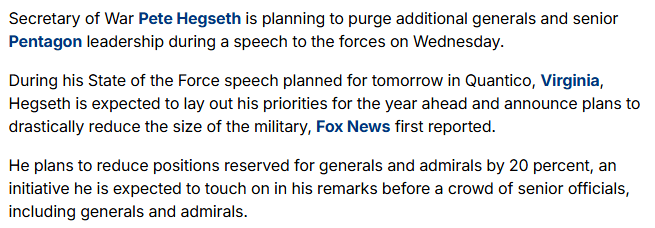
While announcing the plan for a major purge, he also shared what he saw as the US military's future direction. As a theological force!
Hegseth announced the Office of Religious Affairs on September 30 at Quantico, created by a signed memorandum, reporting directly to the defense secretary, with a director serving as his senior adviser.
Take a listen.
The memo tasks it with aligning religious affairs policy, overseeing the Armed Forces Chaplains Board, representing the department to civilian endorsing organizations, and sponsoring research and tools on spiritual fitness, readiness, and resilience. He expects a baseline budget and plan within 60 days, funding in the fiscal 2027 budget, and a directive chartering the office within 90 days.
The memo states that the office will not require anyone to take part in religious activity, and it lists priorities that include faith-based homeschool support for military families and faith-based suicide reduction initiatives.
It also covers contracted services from faith-based outside organizations, chapel youth programs, and chaplain training.
The surrounding record matters as much as the memo. Hegseth ordered chaplains, who are commissioned officers, to stop wearing rank insignia and to be identified by religious insignia. The department cut its list of officially recognized religious categories from over 200 to 31.
 Matthew Cox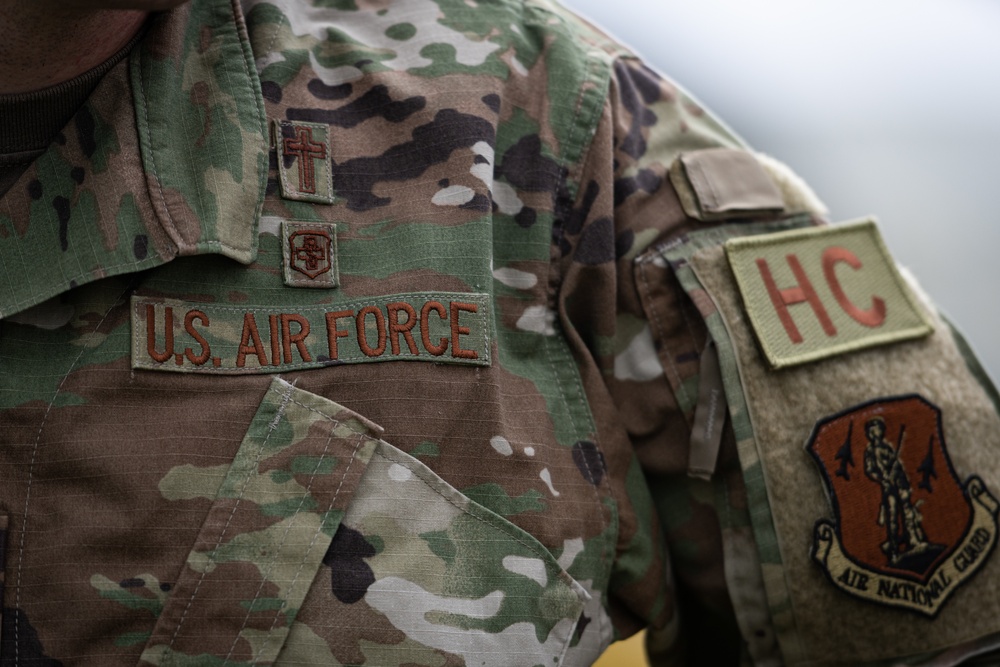
He hosts monthly evangelical worship services at the Pentagon that legal experts describe as unprecedented. At the announcement, he said troops should receive religious support from chaplains with religious expertise rather than from secular careerists and lawyers. He also said political correctness and secular humanism had let religious support budgets and base chapels decline.
The establishment of an Office of Religious Affairs within the U.S. military under Secretary Pete Hegseth should be judged not by rhetoric alone, but by the institutional logic it may set in motion. The pattern is familiar.
- First, leaders describe the institution as morally degraded. Leaders portray an institution as morally weakened, spiritually adrift, or corrupted by alien ideological forces
- Second, they identify a preferred tradition as the source of recovery. They elevate a preferred religious or cultural tradition as the remedy.
- Third, they give its advocates resources and proximity to power. This is done by granting its representatives greater access, funding, visibility, and influence over policy.
- Fourth, they connect conformity with trustworthiness. Over time, adherence to that worldview may become associated with loyalty, judgment, discipline, and trustworthiness.
- Finally, the institution’s core mission, national defense in this case, is reinterpreted through the moral vocabulary of the favored identity. The shift becomes consequential when these steps alter actual decisions.
None of this necessarily follows from offering better spiritual care to service members. Military chaplaincy has long served personnel of many faiths, as well as those with no faith. Ethical formation, pastoral support, and resilience programs can strengthen a force under immense psychological and operational strain. A military organization is entitled to discuss values, character, sacrifice, and the moral burdens of war.
The risk emerges when “religious affairs” becomes less a framework for pluralistic accommodation than a mechanism for ideological sorting. Warning signs would include treating professional dissent as proof of political or spiritual corruption; casting minority faiths, nonreligious service members, or religious liberals as deficient in patriotism; privileging one theological outlook in appointments and access; or allowing doctrinal conformity to shape promotion, retention, security judgments, or command credibility.
History offers lessons we cannot ignore. Let us look at some case studies. We are not suggesting that the US military's situation is equivalent to these cases, or that the US military will go in the direction of any of these examples. But these cases provide some powerful lessons.
Pakistan under Zia
Zia ul Haq took power in July 1977 and ruled until he died in an air crash in August 1988. He changed the army without issuing a public order that read as a transformation. Religious instruction entered training. Observance in units was encouraged. Preaching groups, most prominently the Tablighi Jamaat, gained access to military premises. Officers learned that visible piety helped a career and that its absence invited questions.
Scholars of the Pakistan Army, including Hasan Askari Rizvi, Stephen Cohen, and Ayesha Jalal, describe an officer corps that arrived in the 1970s with British Indian professional habits and that, by the 1990s, included a much larger share of men who treated religion as part of the soldier's identity. The army's motto, Iman, Taqwa, Jihad fi Sabilillah, is commonly associated with this period.
The mechanism was an ordinary incentive, which is the point. Supervisors selected subordinates who seemed culturally compatible. Cadets and young officers adopted the language that earned approval. Nobody needed a conspiracy. A cohort promoted under the new expectations reached senior rank in the 1990s and 2000s and reproduced the expectations as common sense. Zia's death did not reverse anything, because the selection had already happened.
The Afghan war gave the changed army a purpose. After the Soviet invasion in December 1979, American and Saudi money flowed to Afghan factions through the ISI, and its officers became practiced in religious mobilization as an instrument of state policy. Madrassa networks along the frontier grew. When the Soviets withdrew, the apparatus stayed and was turned toward Kashmir and later toward Afghanistan again. Some of the groups it had trained later fought the Pakistani state itself, and civilians paid most of that bill.
Four lessons follow.
- First, reform arrived through incentives and career signals rather than coercion.
- Second, the leader's exit did not end the change, because a selected cohort outlived him.
- Third, attaching a religious identity to the military's mission altered the army's own definition of its enemies and its tools.
- Fourth, the costs surfaced decades later and fell on people outside the institution.
Iran
The Islamic Revolutionary Guard Corps was created by Khomeini's decree in May 1979, within weeks of the revolution's victory, because the new leadership distrusted the regular army it had inherited. Revolutionary tribunals executed a number of senior officers, and the regular army, the Artesh, was purged and reduced. The 1979 constitution then wrote the division into law. One provision requires the regular army to be an Islamic army committed to an Islamic ideology. Another charges the Guards with protecting the revolution and its achievements. A standing armed force received a mission defined by a doctrine, not by territory or by the population.
Clerical representatives of the Supreme Leader and ideological-political directorates operate inside the armed forces. They monitor religious and political reliability and shape the content of indoctrination. After the war with Iraq, the Guards moved into construction, energy and telecommunications through firms such as Khatam al-Anbiya, which gave a doctrinal institution a commercial stake in the order it defended. The Basij supplied a mass volunteer base. Over decades the Guards moved from protecting the system to shaping who could hold office in it.
The Iranian lessons concern structure.
A founding act of distrust toward the existing professional corps led to a parallel force. The parallel force's loyalty ran to a doctrine and its custodian, so criticism of policy could be classified as hostility to the faith. Economic interests then bound its leaders to the system's survival. The path took forty years.
Nazi Germany
The comparison is to mechanisms. The central crime of the Nazi state was racial extermination, and nothing in the memo resembles it. What makes the case relevant is the sequence by which a proud, professional and conservative officer corps came to serve a criminal regime.
On August 2, 1934, the day Hindenburg died, the armed forces swore an oath to Adolf Hitler by name. The previous oath had run to the constitution, the people and the fatherland. The change originated with the military leadership, with Defense Minister Blomberg and General Reichenau prominent in it, and many officers treated it as a technical adjustment. Its effect was to convert later resistance into a personal betrayal of a sworn promise, which officers with a strong sense of honor found difficult to break. Earlier in 1934 the armed forces had adopted the Aryan paragraph and discharged soldiers of Jewish descent, and the institution accepted this with little protest.
In February 1938, the Blomberg and Fritsch affair gave Hitler the pretext to remove both senior military leaders, abolish the War Ministry, and take direct command through a new armed forces high command. The regime retired a group of generals and reassigned others. The officers who remained had learned what the system rewarded.
In 1941, the army leadership accepted the Commissar Order, which directed the killing of captured Soviet political officers, and the army's conduct in the east showed a force deeply implicated in crimes. In late 1943, the regime introduced National Socialist leadership officers, charged with ideological instruction in the units, after the leadership concluded that professional soldiers were not sufficiently committed.
Religion mattered in a specific way. The Wehrmacht kept Protestant and Catholic chaplains throughout the war, and the churches' leaders were largely accommodating. Hitler used the vocabulary of Providence to describe his own mission, and the regime's program called for a "positive Christianity" that was never defined in doctrinal terms. The lesson is that sacred language can attach to a person and a political project, and that the churches, the officer corps, the judiciary, and the medical profession each made accommodations that looked small at the time.
Four lessons apply. Personal allegiance to a leader can replace allegiance to a constitution through a seemingly procedural act. Professional expertise was gradually subordinated to political reliability. Institutions that could have refused did not, because each step was framed as a modest adjustment. And the process ran through ordinary incentives, as in Pakistan, long before it required terror.
Stalin's army
Stalin's army shows that the pattern does not need religion at all. Political commissars have existed in the Red Army since the Civil War. In May 1937, as the purge of the high command got underway, Stalin restored full dual command, so every commander's orders required a political officer's countersignature. In June 1937 Marshal Tukhachevsky and seven other senior officers were tried in secret and shot. Of the five original Marshals of the Soviet Union, three were killed. Commonly cited estimates put the number of officers dismissed or arrested in 1937 and 1938 in the tens of thousands, with the heaviest losses among army, corps and division commanders. The replacements were younger, rose quickly, and were often chosen for loyalty.
The consequences showed in the Winter War against Finland in 1939 and 1940, where the Red Army performed poorly against a much smaller opponent. Dual command was weakened afterward and then reinstated in July 1941 after the German invasion. It was abolished again in October 1942, once battlefield experience had shown that the control system was costing lives. By 1943 Stalin had restored the Orthodox Church's institutional existence because he needed every available source of national mobilization.
There are three lessons. The first is that conformity tests in a secular register produce the same behavior as religious ones. Officers learn what to say, what not to say, and who is watching. The second is that the cost of a loyalty-first culture appears in war. A force whose senior officers have learned that bad news is dangerous provides weaker information to its leadership. The third is that even Stalin reversed course when the system's costs became lethal, which is evidence that the correction mechanism in such regimes is defeat.
For the American case the relevant point is the interaction between conformity and candor. A warning about logistics read as negativity, a legal objection read as obstruction, and a request for religious equality read as hostility to faith each carry the Stalinist signature. If any of those reinterpretations spreads in practice, the damage will show up in the quality of professional advice before it shows up in anything else. With a war reportedly under way, the quality of that advice carries consequences.
What the cases share, and where America differs
Across the five cases, a few features recur. A leader describes the institution as corrupted. A particular source of recovery gets resources and access. Observable conformity becomes a stand-in for trustworthiness. The benefiting cohort then reproduces the arrangement without further direction. Professional dissent is recast as disloyalty. In all five, the change moved through incentives well before it moved through punishments, and in all five the highest costs arrived later and fell on a wider population than the institution itself.
The American differences, however, are substantial.
The Constitution forbids religious tests for public office in Article VI and restricts government establishment of religion in the First Amendment. The armed forces are subordinate to civilian authority, and the Secretary is a civilian answerable to a President and to Congress.
Where this leads
There are three plausible paths. Which one occurs depends on observable facts over the next year, and you should judge the probabilities rather than me assigning them.
Path one: administrative containment. The office becomes mostly what its defenders describe, a funding and advocacy body for chaplains. Litigation and congressional reporting requirements limit its reach. The recognized faith list is revisited. The 2029 administration rescinds the memo, and the episode is remembered as a contested expansion of religious expression that the system absorbed. The main residual cost is lost trust among minority service members and a precedent for the next secretary of either party.
Path two: cohort formation. The office stays within the law while the surrounding culture shifts. Religious participation becomes a visible marker of seriousness, and supervisors choose subordinates who fit. Educational institutions and chaplain endorsers aligned with the secretary's tradition gain recognition and resources. Service members from other traditions, or none, learn to keep quiet. The next administration finds the office easy to abolish and the habits impossible to abolish. This path most closely matches the Pakistani experience, and it needs no unlawful act. Its costs are a more homogeneous officer corps, weaker candor, recruitment and retention problems in groups that feel marginal, and a long-term association between one party and one religious identity inside the military.
Path three: politicization. The sacred vocabulary extends from the military's mission to domestic politics, so opponents of the administration are cast as opponents of the nation's moral foundation. Military leaders come under pressure to endorse this framing, and the lines between professional service and political identity blur. This is the Iranian and German direction, and it requires developments well beyond anything currently visible, including the use of force in domestic political contexts and open loyalty tests. I see no public evidence of it now. I include it because the historical cases show that earlier stages looked ambiguous at the time, which is the point of your own draft.
At the national level, the likeliest cost is gradual. A military that most Americans have trusted across party lines becomes identified with one religious and political camp. Public trust in the armed forces is a shared asset, and polarizing it makes recruitment, budgeting, and the legitimacy of future deployments harder for every administration. That cost occurs even in path one, and it is the one most likely to survive a change in leadership.
The first and foremost change would be how the US Military defines its enemy.
How the enemy gets defined
A military organized around interests asks what an adversary can do, what it wants, and what it will accept. A military organized around a spiritual reading of its mission asks what the adversary is. The shift moves the enemy from capability to identity, and several consequences follow.
War aims inflate. If the adversary is a moral category such as evil, an apostate order, or a civilizational threat, then limited outcomes look like surrender to it. Negotiated settlements, which end most wars, come to be read as compromise with wrongdoing. Iran offers the mirror image, since its system has long defined adversaries by ideological category, making both ceasefires and normalization hard to sustain.
Internal distinctions disappear. Intelligence work depends on telling adversaries apart. Sunni and Shia movements, secular nationalists, clerical hardliners and pragmatic bureaucrats in Tehran want different things. A frame that treats the contest as spiritual encourages analysts to merge them. Analysts who say the adversary is rational or divided then risk being labeled as soft or ideologically contaminated, which is the dissent problem from step four of your model applied to the intelligence cycle.
Success and failure acquire meanings. Reporting indicates that Hegseth likened the rescue of a downed airman over Iran to the resurrection of Christ. Providential language makes honest after-action review harder, because a failed operation becomes a test of faith or a spiritual attack. A good military learns from its failures by naming them plainly, and any frame that makes failure a theological event slows that.
Whole populations become suspect. Counterinsurgency depends on persuading civilians that the occupier or partner is on their side. The American record in Iraq shows how costly religious signaling can be. In 2003, Lieutenant General William Boykin, a senior intelligence official, made public remarks casting the war with Muslim adversaries in terms of his God being bigger than theirs. The remarks drew immediate condemnation and fed insurgent propaganda. Bush's use of the word "crusade" days after September 11 was withdrawn quickly, and Bush and Rumsfeld spent years stressing that the war was not religious. The sources we reviewed on Hegseth note this contrast with earlier norms. A leadership that drops those restraints hands adversary recruiters a gift.
A religious frame changes how a military plans before it changes how it fights. Strategy depends on partners, escalation control, unit cohesion and legal restraint. Each of these works when the mission is defined by interests that allies, adversaries and a diverse force can understand. Sacred aims make that harder.
Great power competition fits poorly. The main strategic contest is with China, a state with official atheism and an adversary that does not define itself religiously. Allies and partners in the Indo-Pacific include Hindu, Buddhist, Muslim, Shinto and Christian populations: India, Japan, South Korea, Indonesia, the Philippines, Australia. A US force that frames its purpose in Christian terms struggles to explain itself to partners whose cooperation matters most. In the Gulf and Turkey, bases depend on Muslim-majority governments whose publics read religious framing of American wars as hostility. The strategic cost lands in basing, overflight and intelligence sharing, areas where goodwill is operational.
Escalation control weakens. Deterrence and crisis management require officers who can tell a counterpart that a limited response is available. When political leaders and troops hold that the stakes are cosmic, limited responses look like abandonment of the cause. Historically, the Wars of Religion in Europe were long because neither side could treat the other's survival as legitimate. The Peace of Westphalia in 1648 is usually read as the settlement in which Europe removed religion from the aims of interstate war. A modern military that reintroduces it undoes part of that settlement.
Cohesion matters more than doctrine in combat. Studies of combat effectiveness repeatedly find that small unit cohesion is a stronger predictor than ideology. A force that is religiously diverse, with Protestants, Catholics, Jews, Muslims, Sikhs, Hindus, Buddhists and a large nonreligious share of young recruits, depends on a shared professional identity rather than a shared faith. Anything that makes a service member in a minority tradition feel that promotion or acceptance depends on conformity damages the thing that wins firefights. The recruitment and retention effects on top of that are slower and larger.
The legal check weakens. Law of armed conflict compliance runs through judge advocates, rules of engagement, and training. Hegseth removed the service judge advocates general in early 2025, and at the Quantico event he contrasted religious expertise with lawyers and secular careerists in the context of chaplaincy. Each can be read narrowly. In combination, they matter if a holy-war frame spreads, because that frame has historically eroded the distinction between combatants and civilians. At Jerusalem in 1099, the crusaders massacred much of the city's population, and the justification came from the sacred character of the cause.
The obvious question now confronts us: Are we looking at a new era of crusades?
Are these Crusades again?
The Crusades are a better analogy than casual use of the word suggests.
Crusades were authorized by a religious authority, financed through spiritual rewards such as indulgences, and carried out by armies with mixed motives: land, plunder, trade, family advancement, and genuine piety. The mixture is the first lesson. Religious language did not eliminate material interests. It made them harder to examine. The Fourth Crusade in 1204 ended with the sack of Christian Constantinople, a plain demonstration that sacred rhetoric can cover purely worldly aims.
The second lesson is overextension. The Latin states in the Levant depended on a supply of manpower and money from Europe that waned over time, and they lasted less than two centuries. Holy war aims produce commitments that outrun the means.
The third lesson is the effect on the adversary. Saladin's consolidation of Egypt and Syria drew heavily on a call for jihad to recover Jerusalem. The frame helped unify Muslim polities that had often fought one another. Modern jihadist movements have used "crusader" as a mobilizing label for decades, and they gain credibility whenever an American official or institution appears to confirm it. Al-Qaeda's description of its enemies as a crusader alliance needed American evidence, and every religious flourish by a senior official supplies some.
The fourth lesson is memory. The word crusade remains operative in the Muslim world and in Russian and Orthodox historical narratives, centuries later. An American military that invites the label pays a long-term cost in the credibility of its mission statements.
The analogy has limits. The medieval Church was a transnational institution with independent authority to call a war. The American case involves a secular state with a civilian chain of command, a Constitution, and a legislature that must authorize and fund wars. Nothing in the present record shows a war aim defined by faith, and a US administration would need to cross several formal lines before the word applied literally.
When Exclusivism Drives an Army
An army exists to serve the interests of the nation that fields it, and its objectives are supposed to come from that nation's elected government. When an exclusivist creed becomes the animating force of the institution, objectives migrate. The core claim of exclusivism is that one tradition holds the truth about God and humanity and that other paths are error. In private life that produces conviction. Inside an armed organization it produces a theory of the enemy, and the theory shapes the nation's war aims, its conduct and its internal life.
The enemy becomes a category: A state with interests can be deterred, bargained with and outlasted. A category of unbelief or false worship has no interests to bargain over, because its existence is the offense. Once the adversary is defined by what it worships or denies, the end state of the war drifts toward conversion, replacement or elimination of its order. Limited settlements start to look like compromise with error, and officers who propose them risk the charge of weakness in faith.
The record contains many examples. The Spanish Requerimiento of 1513 was a text read to Indigenous peoples, often in a language they could not understand, demanding that they acknowledge the Church and the Spanish crown on pain of war and enslavement. Governor Bradford's account of the Pequot War of 1637 treated the burning of the Mystic fort and its inhabitants as a victory for which the colonists gave thanks to God. The Goa Inquisition, from 1560, banned Hindu rites and punished converts who reverted, as Priolkar documented from the surviving records. In each case the conflict was framed as the removal of a false order, and the population carrying that order was treated as culpable.
Consequences for the nation: The first consequence is the narrowing of strategy. Allies who do not share the creed become suspect, and adversaries are merged into a single enemy because their differences matter less than their error. Intelligence suffers because accurate description of a divided or rational adversary contradicts the frame.
The second is the treatment of captives and civilians. When the enemy's population is understood as culpable for its beliefs, the line between combatant and noncombatant weakens. Surrender terms come to include renunciation. Destruction of sacred sites, which carries no battlefield value, acquires a purpose of its own.
The third is the effect at home. A military whose mission is defined by a creed asks its members to affirm the creed. Citizens in uniform from other traditions, or none, become people whose reliability must be established. Professional objection can then be recast as spiritual defect. The nation loses candid advice from its officers and the trust of its own minorities, and the force starts to resemble the parallel institutions described in the Iranian case.
The doctrine of just war and its religious foundation: Western military thought often presents just war doctrine as a neutral body of reason. The history supports a harder reading, in which a religious objective sits underneath the criteria.
Augustine's definition of just wars as those that avenge injuries came from a thinker who also welcomed the imperial suppression of pagan worship and demanded that pagan superstition be annihilated.

His "right intention" meant love and restoring an order defined by the faith, and his "legitimate authority" was a Christian emperor. The criteria were written to authorize the faithful state's use of force.
Aquinas did not repair this. He held that heretics, having corrupted the faith, could justly be put to death by the secular power. In his system, theological guilt could override the presumption of innocence that protects noncombatants.
Vitoria, the most humane jurist of the Salamanca school, rejected unbelief as a reason for war against the peoples of the Americas. He also held that a war becomes just if Indigenous rulers obstruct the peaceful preaching of the gospel. Because the Spanish defined such obstruction broadly, the principle reopened the door he had closed. Spanish conquest proceeded with legal ceremony and theological justification, and the criteria served as a license.
The deeper flaw is circularity. Each belligerent in the European wars of religion claimed legitimate authority and right intention, and each was sincere. The criteria offered no neutral arbiter, because the arbiter was always the confession itself. The Thirty Years' War ended in 1648 through the Westphalian settlement, a political agreement to stop making religious truth a ground of interstate war. Just war theory did not end it.
The rules that eventually restrained war came from elsewhere. Francis Lieber's code of 1863, the Geneva Convention of 1864 and the Hague Conventions of 1899 and 1907 were treaties and legal instruments binding states of any creed. Grotius had already argued that natural law would hold even if one were to suppose that God does not exist. Restraint came when the rules were detached from a particular confession.
This discordance is at the center of the doctrine. It is advertised as universal reason, but one faith set its terms and enforced them through its rulers.
A test that works only when the right confession applies. And it fails the reversal exercise: no Christian would accept it from a Hindu, Muslim, or atheist commander who defined legitimate authority and right intention by his own creed.
Loyalty tested by doctrine: The problem sharpens when loyalty to the doctrine becomes the standard of trust. Right intention becomes fidelity to the commander's faith, legitimate authority becomes the faithful ruler, and just cause becomes defense of the order the faith prescribes. Criticism of any decision can then be reclassified as a failure of belief.
The current American record has features that fit this concern as a risk, though not yet as an established pattern. Hegseth has said that while the department fights physical war, the real battle is spiritual, and the new Office of Religious Affairs is charged with developing tools to assess spiritual fitness and readiness. He has also said he wants religious support from chaplains with religious expertise in place of secular careerists and lawyers.
Washington is rearranging the relationship between faith and the state. France is a country built on keeping them apart, and this week it is having a different argument with itself.
The French Protests
In France, a student protest has broken out. These began in late September at Lycée Saint-Exupéry in Créteil over teacher shortages and inadequate resources, then spread across the Paris region and to Rennes, Nantes, Brest, Toulouse, Marseille, Lille and Strasbourg. At least 400 of France's 3,700 high schools were closed on Friday. TIME reports roughly 3,000 arrests, 170 students and 65 school staff injured, and nearly 400 police officers hurt.
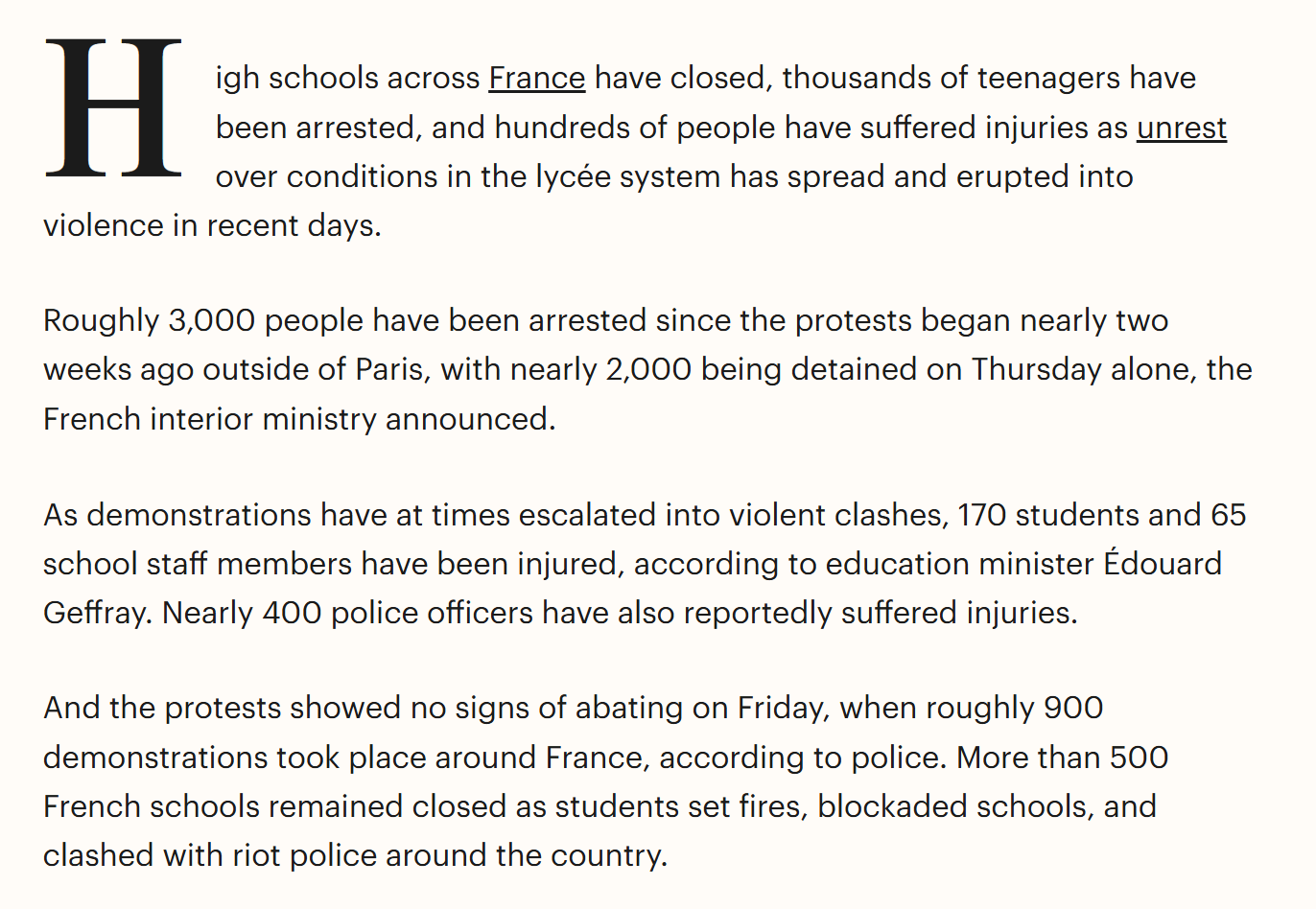
Students also burned a fire truck in Marseille. Paris-region damage is estimated at €7 million, and the ministry said 735 establishments were affected Friday, down 30% from Thursday. Student unions have called a mass protest for Tuesday, October 6.
Students describe 35 pupils per class, missing teachers, leaks and summer heat. The official data supports them. Nearly 10% of teaching hours went untaught in public secondary schools in 2024-25, with about 7.5% lost for lack of substitutes. France has the largest average primary class size among OECD EU members, at 22 pupils versus 19. Yet 4,018 teaching posts were slated for cuts in 2026, including in the Créteil and Versailles academies, which already face chronic shortages. The cuts follow a falling birth rate, so the Treasury's arithmetic has diverged from classroom reality. Researchers argue the demographic decline could instead be used to reduce class sizes. Nearly 8,000 people died in the summer heatwaves.
A debate is going on regarding the mindless violence accompanying the protests. One set of analysts is suggesting that this violence is a direct consequence of the foreign nationals coming into France in the last few decades.
The numbers do not lie, even if the liars and cowards at CNN in the media do. A meta-analysis of 87 studies confirmed what common sense tells us: ethnic diversity is associated with lower trust in neighbors. Robert Putnam's data from the United States showed that in more diverse communities, people "hunker down." They have fewer friends. They volunteer less. They trust no one, not even people from their own group. This is the reality of diversity. It destroys the social fabric that holds a nation together. When you cannot trust your neighbor, you cannot build a community. When you cannot build a community, you cannot have a society. You only have a collection of hostile tribes waiting to tear each other apart. The economic cost of this folly is staggering. Preference heterogeneity makes it impossible to fund public goods. When a population is fractionalized, people refuse to pay for schools, roads, and welfare for people they see as foreigners. Alesina, Baqir, Easterly, (prominent economists whose collaborative and individual research has significantly influenced the study of how ethnic and linguistic fragmentation impacts economic performance and public policy) and others have proven that fractionalized places spend less on these essential services. Why? Because people do not want to contribute to the well-being of those who are not their own. Furthermore, language barriers raise transaction costs in every sector of the economy. Workplaces, schools, hospitals, and courts become inefficient nightmares when everyone cannot communicate. Different norms regarding corruption, time management, gender roles, and dispute resolution increase the cost of monitoring and enforcement. It is a drain on resources that no nation can afford. Look at the welfare rolls in Europe and America. A massive percentage of these imported populations are dependent on the state. They are not contributing. They are taking. In Italy, the influx of migrants has led to a surge in crime and a strain on the social safety net that threatens to bankrupt the system. The Left calls this compassion. It is actually cruelty. It is cruelty to the native-born citizens who are forced to pay for the destruction of their own society. It is cruelty to the legal immigrants who came here to work and assimilate, only to be told that their efforts are worthless because the state rewards those who do nothing. (Source: Diversity is Weakness / X Post / Saggezza Eterna)
So, how are the French politicians approaching this scenario?
On Thursday, the French government unveiled its proposed 2027 budget and now faces the difficult task of securing support in a politically divided National Assembly. The budget seeks a €54 billion fiscal adjustment and comes as student unrest over teacher shortages, overcrowded classes, deteriorating school buildings and long school days spreads across the country.
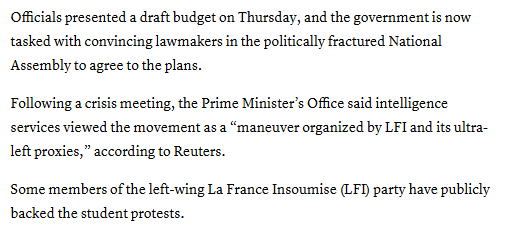
After a government crisis meeting, the Prime Minister’s Office said intelligence services believed figures linked to La France Insoumise (LFI) and ultra-left groups had encouraged or initiated the protest movement—a claim LFI rejects. Several LFI politicians, including Mathilde Panot, have publicly expressed solidarity with protesting students.
LFI parliamentarian Mathilde Panot was not merely commenting from afar: she appeared at the Darius-Milhaud lycée in Kremlin-Bicêtre, addressed students, and explicitly endorsed their demands.
Ce que vous ne verrez pas dans les médias.
— Mathilde Panot (@MathildePanot) October 2, 2026
Au lycée Darius-Milhaud au Kremlin-Bicêtre, j’ai tendu le micro aux lycéens : manque de professeurs, bâtiments inondés, repas trop chers.
Donnez-leur des réponses, pas des coups. Du respect, pas du mépris.
Voilà ce que cette jeunesse… pic.twitter.com/A8vquZfKAs
What the tweet says:
At Darius-Milhaud High School in Kremlin-Bicêtre, I handed the microphone to the students: a shortage of teachers, flooded buildings, meals that are too expensive.
Give them answers, not blows. Respect, not contempt.
That is what this generation deserves.”
The video caption—“tout leur soutien,” or “all our support”—and Panot’s tricolour sash make its political message unmistakable. She frames the students as legitimate civic actors and portrays the state response as overly coercive. Her appeal rests on a sharp contrast: substantive answers to educational decay versus police repression. Her public post from 30 September similarly declared support for the Darius-Milhaud students.
That framing has two effects:
- It amplifies the students’ complaints that include teacher absences, poor infrastructure, large classes by giving them national political visibility.
- It turns an education-policy dispute into a broader argument about the French state: whether it listens to young people, funds public services adequately, and uses policing in place of political response.
And this is happening at a time when French economy can be badly impacted. The dispute unfolds amid a wider fiscal conflict. The draft budget would raise education spending by 1.7% to €65.53 billion, excluding teacher pensions—an increase below inflation—while the government pursues spending restraint and tries to reduce France’s large deficit and debt burden.
Although Education Minister Édouard Geffray said in an interview that the movement was “legitimate at the outset,” France’s Interior Ministry said Thursday the unrest “no longer has anything to do with the legitimate expression of high-school students’ demands.” The ministry described the situation as having the characteristics of “urban violence,” according to French newspaper Le Monde. Geffray is scheduled to meet with teachers’ unions, student representatives and parents’ groups on Friday (Source: A violent classroom revolt is becoming France’s next big crisis / CNBC)
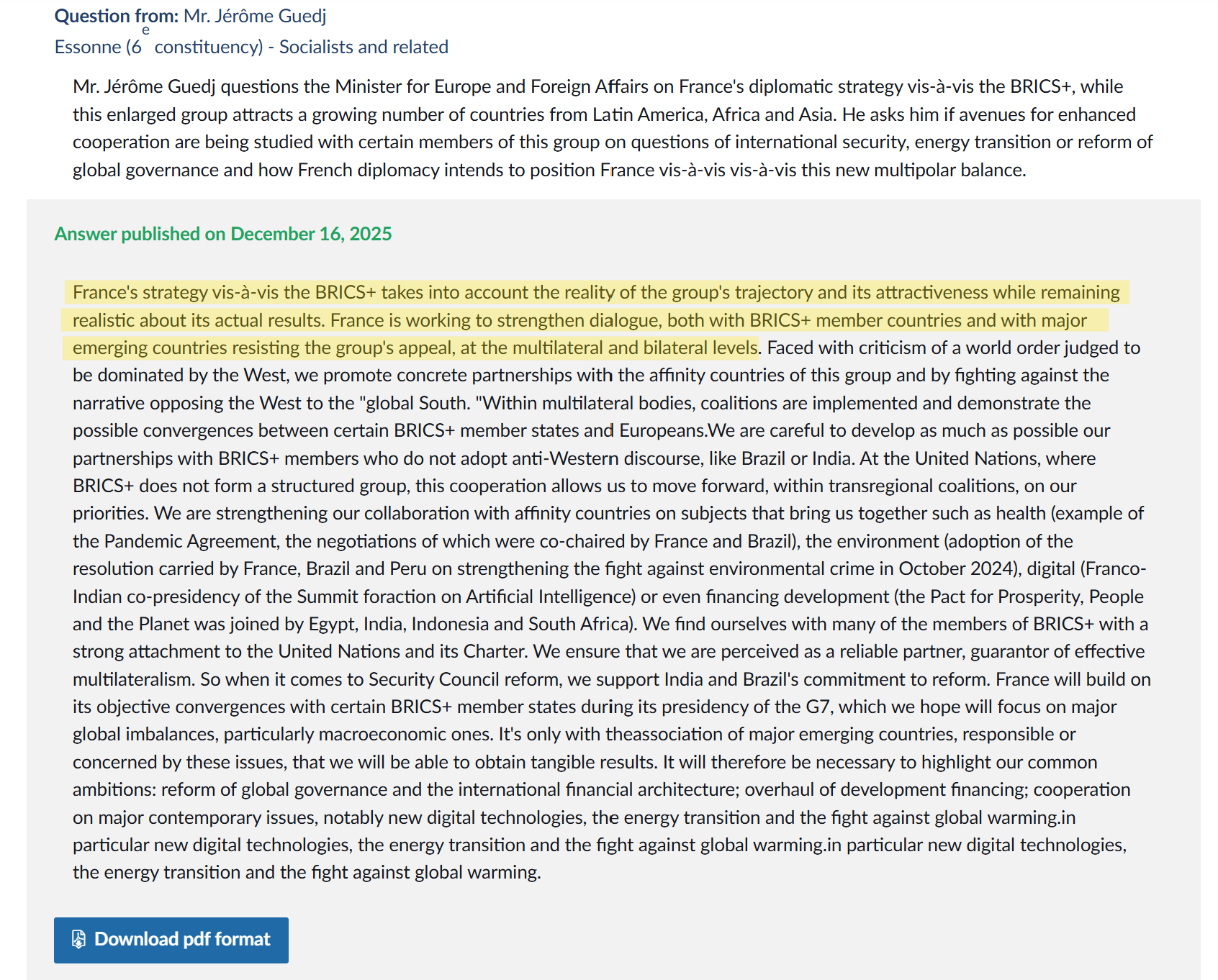
Some also suggest that President Macron's sudden interest in BRICS (often viewed as anti-US group). In 2023, French President Emmanuel Macron had asked South Africa for an invite to the upcoming BRICS summit.
As recently as December 2025, France's National Assembly asked a question about BRICS, and it was answered thus.
Plague in Siberia
Annie Jacobsen is an acclaimed American investigative journalist, bestselling author, and Pulitzer Prize finalist known for her deeply researched works on national security, intelligence, military history, and classified government programs. Her notable books include Area 51, Operation Paperclip, The Pentagon’s Brain, and Nuclear War: A Scenario. Drawing on extensive interviews and declassified documents, she explores the hidden machinery of power, warfare, and America's secretive national security establishment.
In an X post she writes about the outbreak of pneumonic plague in Siberia. Her main claims are:
- "Lab accident at a BSL-3 lab." The accident is the best-supported version, but not officially confirmed. I found no report that states the biosafety level. A reply under her post says plague belongs in BSL-4. That is wrong. Cultures of Yersinia pestis are normally handled at BSL-3, and diagnostic samples at BSL-2. The real question is whether this work was done in proper containment.
- FSB escorts mean the quarantine was involuntary. Lyudi Baikala reports the escorts from a source close to law enforcement, and the FSB has not confirmed them. Compulsory isolation of contacts is a normal power of Russian sanitary authorities, so the escorts do not by themselves show a national security case. A security-service role would still be unusual, and it is worth watching.
- "Outbreak." So far, it is one confirmed death and no confirmed secondary cases.
Here is her tweet.
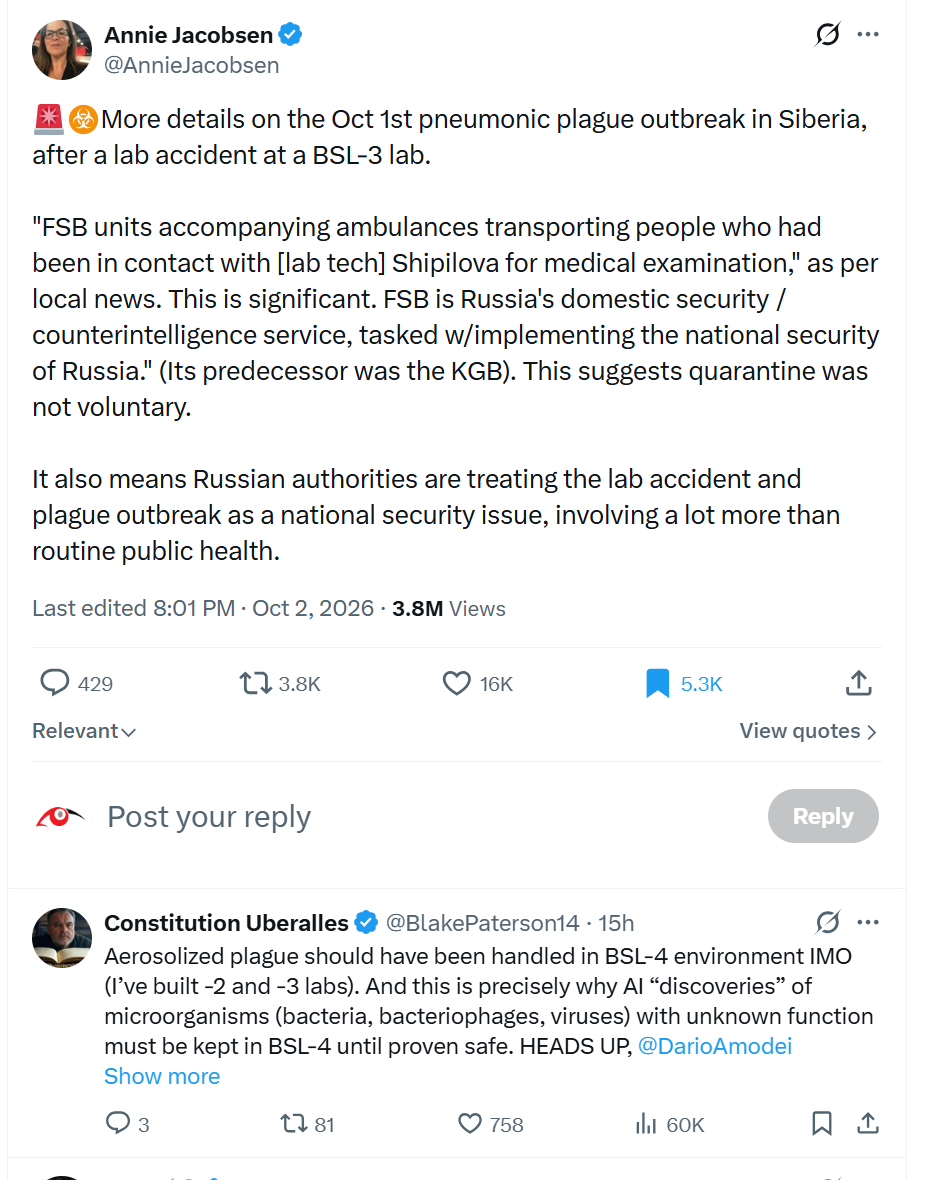
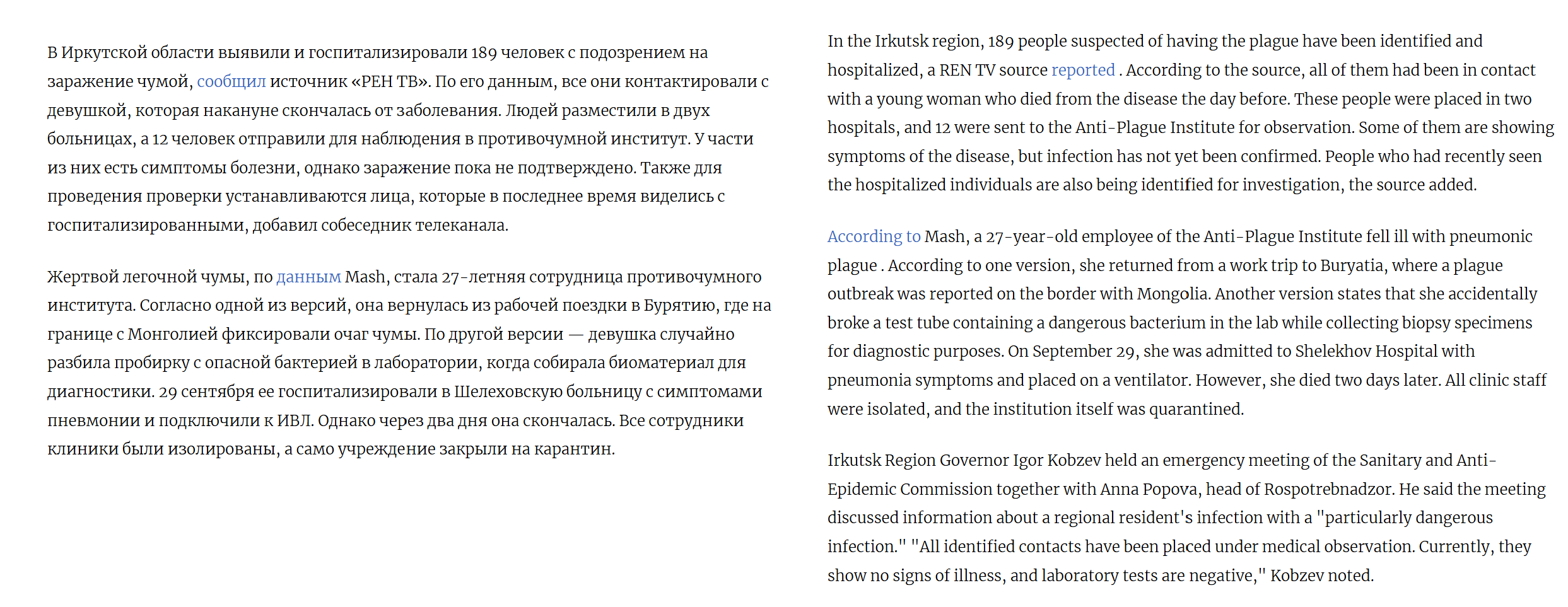
Interestingly, it has been reported by The Moscow Times in its Russian language publication. We translated that in English (on the right). Local media identify the dead woman as Daria Shipilova, 28, a lab technician at the Irkutsk Anti-Plague Institute. Some outlets give her age as 27.
Accounts of the timeline differ. Meduza reports she was hospitalized on September 29 and died two days later. Another account puts her death on the night of October 2. The head of neighboring Buryatia, Alexei Tsydenov, confirmed she died of plague without naming the form. Irkutsk officials had called it only a "particularly dangerous infection."
Pneumonic plague spreads by respiratory droplets at close range. It is nearly always fatal untreated, and antibiotics work if started early. Incubation is typically one to four days. Historically it has spread in clusters among caregivers and household contacts, not widely.
As scary as it is, the fact is that if no secondary cases appear among Shelekhov hospital staff and contacts by around October 8, the event may be considered as "contained".
The Refinery Explosions
On April 20th, a fire broke out around 1:55 pm in the crude distillation section, a day before the Prime Minister was due to inaugurate the plant. HPCL's first assessment was a hydrocarbon leak through a valve or flange in the heat exchanger circuit. It later narrowed this to a leak at the pressure gauge tapping point on the inlet line of the vacuum residue exchanger. No one was hurt. The oil ministry formed a four-member investigation team headed by a former MRPL managing director. NIA, Home Ministry and petroleum ministry experts also went to the site, and CCTV footage was analyzed for suspicious activity. No report was ever published about that.
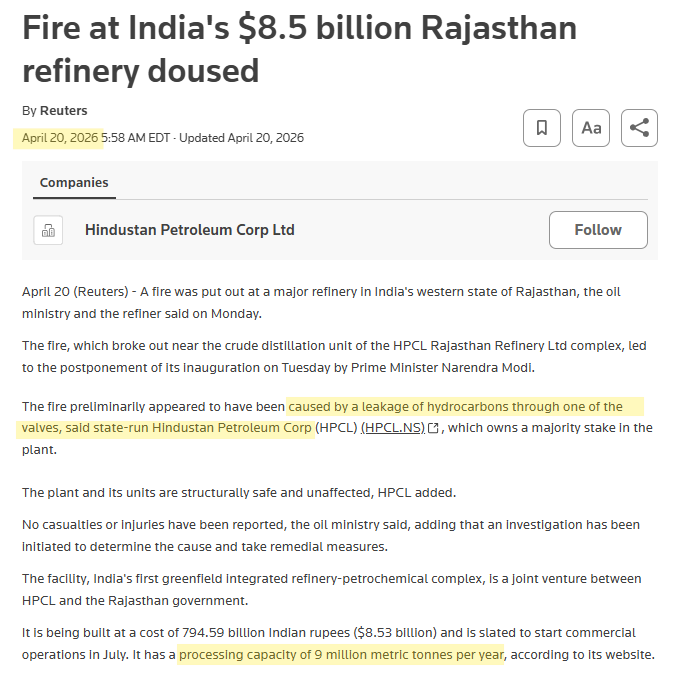
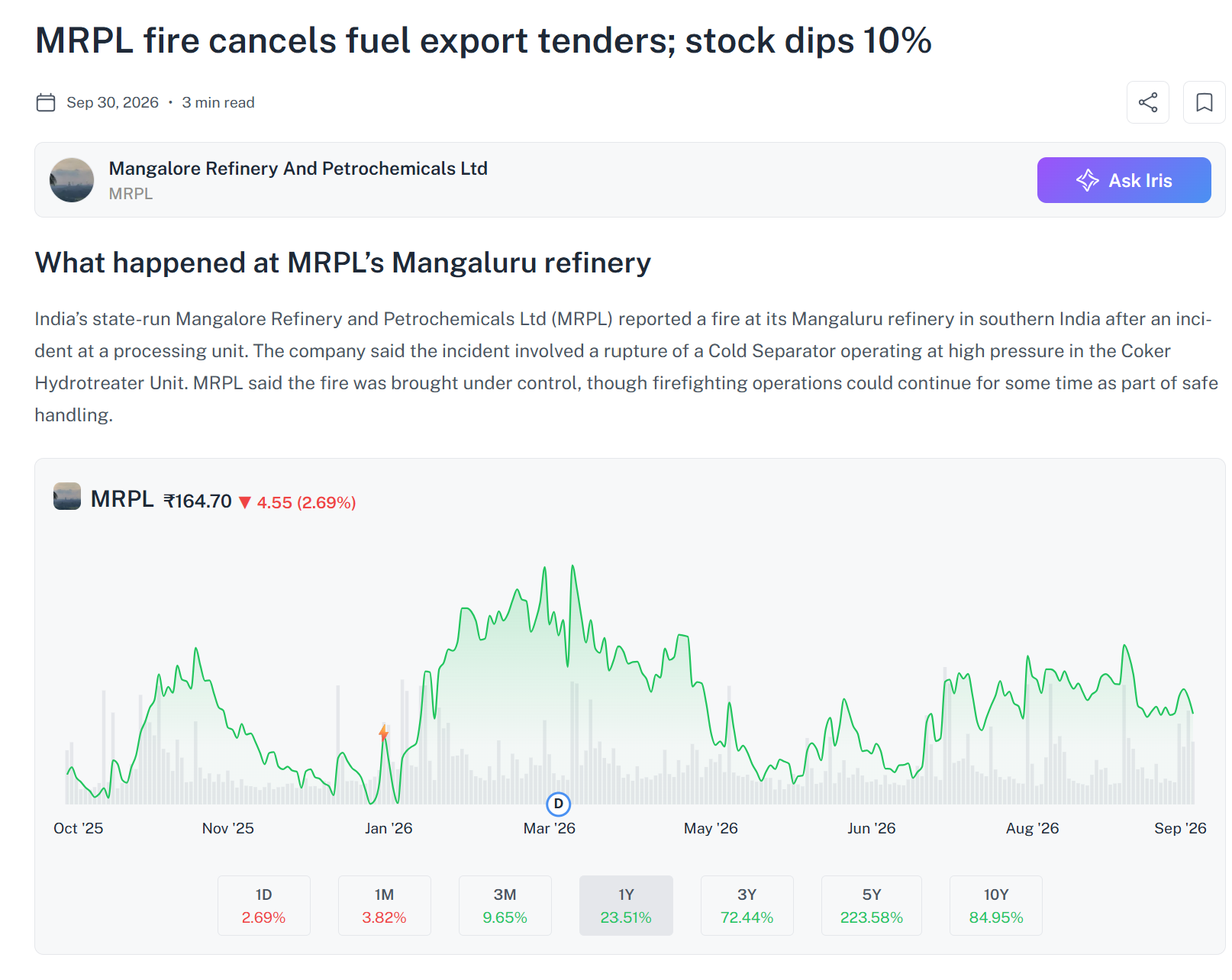
On September 30th, a high-pressure cold separator in the Coker Hydrotreater Unit ruptured, causing the blast and fire. The blast was heard more than 10 kilometers away. Early reports said no one died. MRPL's later exchange filing said the body of one deceased person was found at the affected site during combing operations. MRPL says the rest of the refinery is running normally. Reports say processing at one crude unit was cut and fuel exports were halted to prioritize domestic supply. Three export tenders for diesel, jet fuel and reformate were canceled.
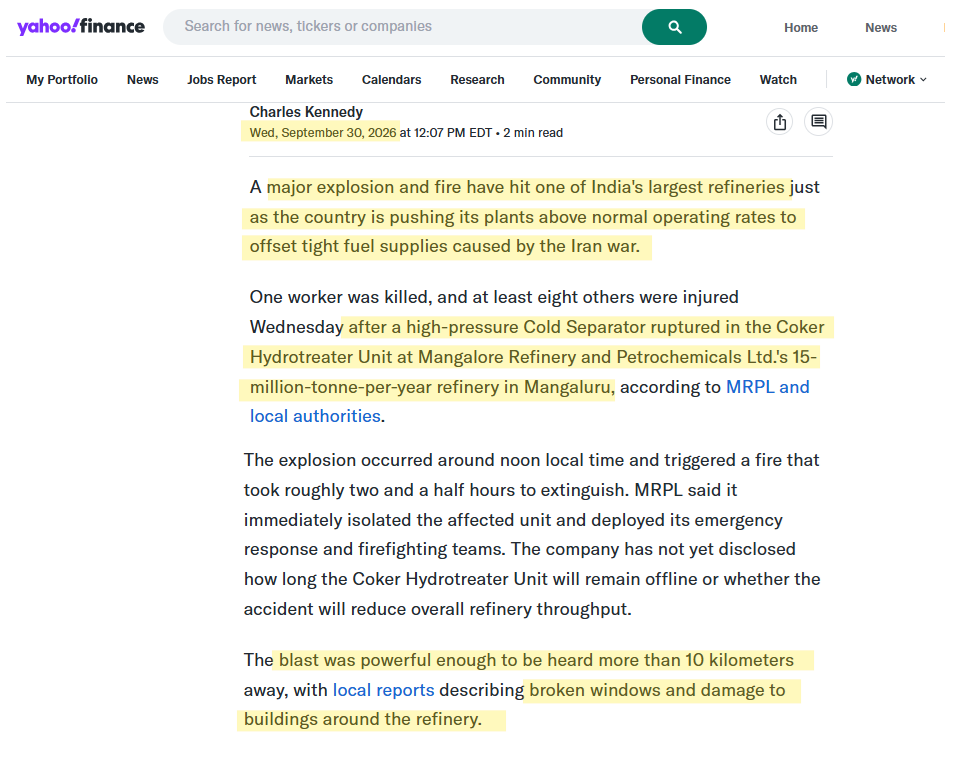
On scale, Barmer was a brand-new 9 million tonne plant, not one of India's largest. MRPL is mid-sized at 15 million tonnes a year, well below the Jamnagar complexes.
Barmer was a small-bore leak during commissioning. The plant was restarted and formally dedicated on July 4. Mangalore is more serious. A rupture of a high-pressure hydroprocessing vessel is a major loss of containment, and it killed someone. The two events differ in owner, unit, failure mode, and plant age.
Could these have been subversions?
Let us look at the two incidents and the nature of what went wrong and if it is possible that this could have been a result of subversion.
Barmer: A leaking instrument tapping point on a hot exchanger line is one of the most common refinery fire sources, especially at startup, when fresh fabrication meets thermal cycling for the first time. A deliberately loosened or defective fitting would leave the same physical signature as poor workmanship. A construction site with thousands of contract workers is also easy to access. The timing, the day before a Prime Minister's ceremony, is suspicious. It is equally what schedule pressure produces in an accident. Investigators separate the two with torque and assembly records, hydrotest records, metallurgical examination of the fitting and access logs. Obviously, no reports have been shared officially.
Mangalore. A vessel ruptures when it is degraded or overpressured. The accident routes are cracking or corrosion in hydrogen and sulfur service, a missed inspection, or a failure of control and relief systems. The refinery was under unusual stress this year. MRPL shut a crude unit in March for lack of crude, and it declared force majeure on some exports. Indian plants were then pushed above normal rates to offset tight fuel supplies. Repeated shutdowns and restarts, followed by heavy running, are a known driver of equipment failure. A subversion route would run through control or safety systems, as in the 2017 Triton malware attack on a Saudi petrochemical plant. The decisive evidence is the vessel's fracture surface and the process historian. If the data shows normal operation and a degraded vessel, the cause is integrity management. If it shows setpoint changes or defeated safety functions nobody ordered, subversion becomes credible.
Impact on India
MRPL is about 300,000 barrels a day, roughly 5 to 6 percent of national capacity by my arithmetic. India exports refined products, so household fuel supply is unlikely to be threatened. The losses fall on exports (already halted), on MRPL earnings (the stock fell about 10 percent), and on southern markets, since MRPL supplies jet fuel to airports such as Bengaluru, Goa and Mangalore. Asian diesel and jet markets also lose a supplier. Expect a regulatory safety audit of plants running above rated capacity.
India's Energy Predicament
India faces pressure on two different foundations of energy autonomy: its freedom to buy crude and its ability to turn that crude into usable fuels. If both weaken together, the consequences extend beyond higher oil prices into trade negotiations, industrial competitiveness and foreign-policy freedom.
The pressure on India is explicit
The clearest evidence comes from the administration’s own documents.
The February 2025 US–India leaders’ statement sought to establish the United States as a leading supplier of crude oil, petroleum products and LNG to India. The February 2026 executive order went further: it linked removal of an additional tariff to India’s stated commitment to stop importing Russian oil and purchase US energy. It also provided for monitoring Russian purchases and recommending renewed action if they resumed. These provisions explicitly link energy procurement to access to the American market.
 Executive Orders
September reporting describes renewed tariff pressure over Russian oil, with India warning that it could affect bilateral relations. Washington is using trade leverage to influence a third country’s energy sourcing.
Our previous newsletter The American Oil Trap and Prep for War identifies the cumulative danger: sanctions, insecure shipping routes and politically administered access can reduce the practical value of nominal supplier diversity. So India is facing the battle between control over choices when it comes to Oil and Gas supply.
Why refining capacity changes the equation
India’s dependence on imported crude is a vulnerability. Its domestic refining capacity is a counterweight.
Refining allows India to buy feedstock, manufacture transport fuels and other products domestically, retain industrial value, and export part of the output. The government has expressly identified India’s refining surplus as a protection for domestic petrol and diesel supply.
A country that imports crude but manufactures its own fuels retains more control than a country that must urgently import both.
That is where the refinery incidents fit in.
They potentially weaken the domestic industrial capability that helps India manage external supply pressure.
However, purchasing more American crude would not repair a damaged hydroprocessing unit. A refining disruption could instead increase demand for diesel or jet fuel from whichever overseas refineries have available cargoes.
The damage matters more during a constrained market
A refinery outage during abundant supply is principally a repair and replacement problem. During a fuel squeeze, it can become a bargaining problem.
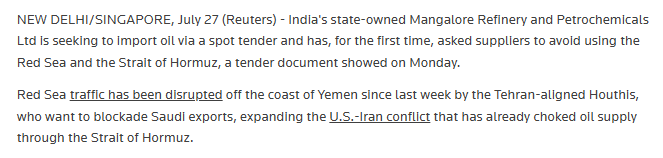
MRPL was already adapting procurement to route insecurity before the explosion. Reuters reported in July that its crude tender asked suppliers to avoid transit through the Red Sea and Strait of Hormuz. This is concrete evidence that geopolitical disruption was already affecting the refinery’s purchasing decisions.
The current product market also limits easy substitution. Reuters reports that Chinese refiners suspended October fuel exports to preserve domestic stocks, further tightening available supply.
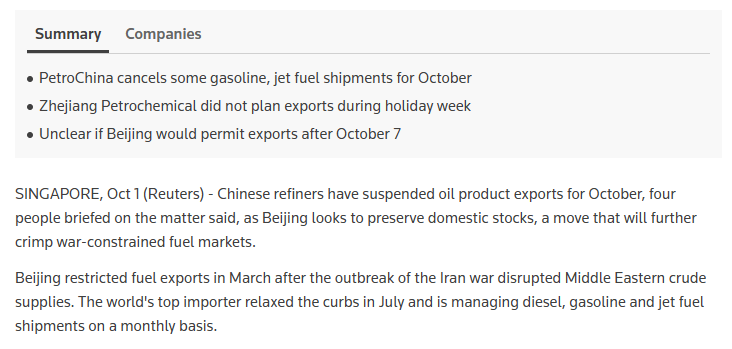
So these conditions make lost Indian output more consequential: replacement cargoes may command a larger premium, and redirecting exports domestically carries a greater opportunity cost.
The consequences for India would likely unfold in layers:
First, lost earnings and additional costs. Repair expenditure, reduced sales, altered feedstock purchases and replacement logistics fall on the operator.
Second, reduced export flexibility. Domestic supply can be protected by retaining products that would otherwise be exported. This is a valuable cushion, but it sacrifices revenue.
Third, regional distribution pressure. National availability does not automatically guarantee that the correct fuel reaches every airport, depot or industrial customer on time.
Fourth, a weaker negotiating position if disruption persists. A government facing urgent fuel requirements has less room to resist expensive commercial terms or political demands.
In all this, the United States would be a significant potential strategic beneficiary. That follows from the documented procurement pressure.
The mechanism would be:
- India’s affordable external options narrow.
- Domestic production of usable fuels becomes less flexible.
- Replacement supplies become more urgent.
- Energy purchases acquire greater weight in trade negotiations.
Coincidence or Conspiracy?
A military’s strength depends on its capacity for honest professional judgment. A republic’s stability depends on its ability to address grievances while protecting citizens from violence. Public health depends on timely disclosure and credible safeguards. Energy sovereignty depends on having suppliers, infrastructure and reserves that remain available when circumstances turn hostile.
No single hand needs to be behind these events for their consequences to reinforce one another. Distrust makes every official explanation harder to accept. Secrecy leaves room for speculation. Industrial disruption creates urgent needs—and urgent needs give those controlling replacement supplies greater bargaining power. Benefiting from a crisis does not establish responsibility for causing it. It does, however, help us understand the interests at stake.
For India, the task is therefore concrete: protect critical infrastructure, investigate failures credibly, preserve diverse energy relationships and build the capacity to absorb shocks without surrendering freedom of action. Strategic autonomy requires the industrial strength to sustain it.