The Surveyor and the Gardener
A young monk once came to visit an old Zen master who lived beside a vast, serene garden shaded by an ancient banyan tree. As he approached, the monk noticed another man moving slowly through the grounds. The stranger carried no tools, no seeds, no water—only parchment and ink.
All day, he wandered the garden.
He traced every winding path, counted each tree, and carefully marked the flow of streams. He noted where the soil was fertile and where it turned brittle, where weeds spread fastest, and where the boundary walls showed signs of weakness. His attention was meticulous, almost obsessive.
By evening, unable to contain his curiosity, the monk turned to the master and asked, “Why does that man spend his day measuring your garden instead of tending to it?”
The old master smiled gently.
“There are two ways to possess a garden,” he said. “One is to nurture it with care. The other is to understand it more deeply than the one who tends it.”
The monk frowned. “But he has planted nothing. He has not helped the garden grow.”
“No,” the master replied. “He has planted nothing. But tomorrow, anyone who wishes to change this garden will begin with his map.”
The words lingered heavily in the air. After a long silence, the monk asked, “Then should we stop him?”
The master shook his head.
“No. The answer is not to stop the surveyor.”
He paused, then added, “The answer is to become a better gardener. Because the greatest danger is not that someone else has mapped your garden—”
He looked out over the land, calm and certain.
“—it is that the gardener never truly understood it himself.”
FCRA: The Elephant in the Room
The requirement that foreign funds entering India be disclosed, monitored, and regulated under law has become a political lightning rod. That alone raises an important question.
If foreign money is genuinely meant for charitable and humanitarian work, why has the Foreign Contribution (Regulation) Act (FCRA) generated such sustained opposition from organizations abroad and prompted lobbying by political and legislative figures in other countries? Why the extraordinary effort to influence India's sovereign choices on how foreign funding should be regulated?
Unless it is and was never about charity in the first place. It was about influence and control.
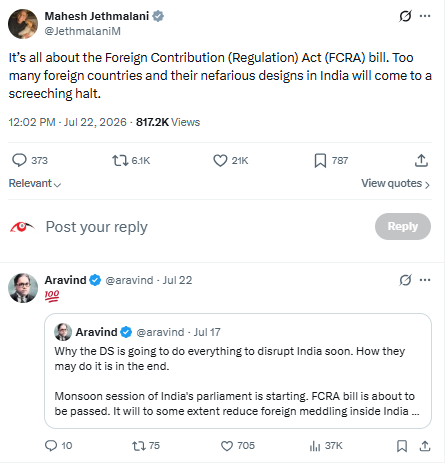
One of India’s leading advocates has been blunt: the current agitation on the streets is fundamentally about the FCRA bill. Stricter oversight of foreign contributions threatens entrenched networks built on opaque funding, so protests are being orchestrated to derail or dilute the law.
Now, go solve that puzzle with charity-clad operatives on one hand and monitors on the other who want them to shed their facade.
The religious money operations are about conversions. Conversions of hordes of people in Asia and Africa bring up an interesting scenario, specifically since it is done by the evangelicals and the extreme right-wing Christians from the US and the West.
We will learn one thing unambiguously:
Is a Non-White Christian "Christian Enough"?
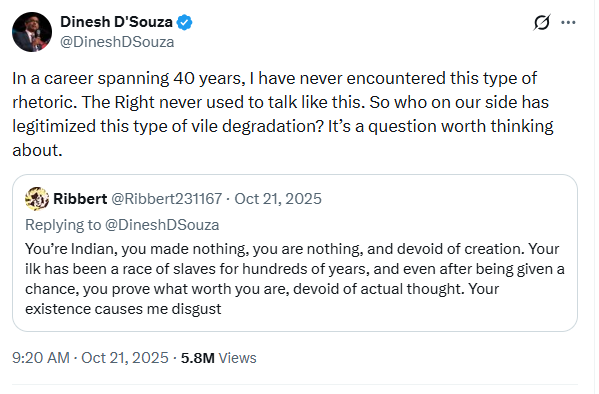
Dinesh D'Souza has spent decades as one of America's most recognizable conservative Christian intellectuals. He defended conservative causes, championed Republican politics, and consistently aligned himself with the American Christian Right. Yet, despite sharing the same faith and much of the same political ideology, he has periodically been reminded that, for some within that ecosystem, he remains something else first: an Indian.
The abuse directed at him following this exchange was revealing. It did not criticize his theology. It did not question his commitment to Christianity. Instead, it reduced him to race:
"You're Indian... your ilk has been a race of slaves..."
See below.
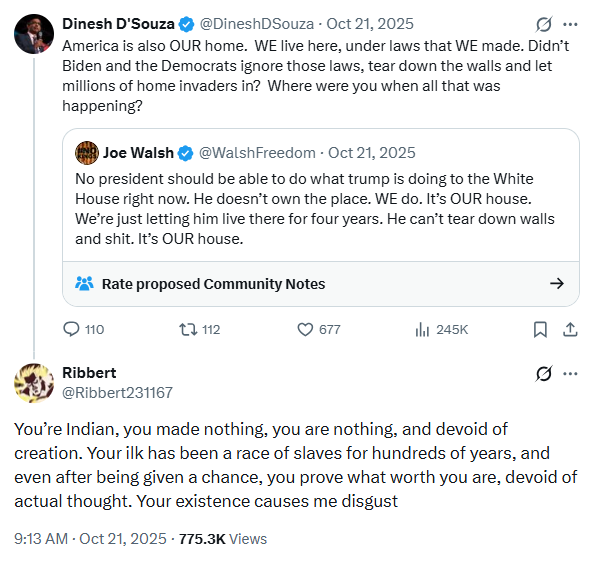
Dinesh shared his deep anguish at this treatment.
This discussion raises a larger question.
Christian doctrine is presented as a "universal doctrine" in terms of race but extremely exclusivist when it comes theological claims where "Christ is the only way" creed runs deep.
History, however, has often looked different when it comes to race.
Whether it was the German "Völkisch" idea or colonialism, race was closely intertwined with Christian superiority.
European colonial expansion frequently intertwined Christianity with ideas of European civilizational superiority. During the nineteenth and early twentieth centuries, many missionary movements operated within assumptions of a "civilizing mission," where Christianity was sometimes presented alongside European cultural norms. Those attitudes varied across denominations and eras, but they undeniably shaped institutions and social hierarchies.
In the United States, race has also profoundly influenced Christian history. Churches were segregated for generations. White evangelicalism and Black Protestant traditions developed distinct institutional cultures. Political coalitions built around "Christian America" have often reflected not merely shared religious belief but also shared historical and cultural identities.
Political scientists such as Robert P. Jones have argued that contemporary white Christian nationalism frequently fuses religious identity with national and ethnic identity rather than treating Christianity alone as the defining characteristic.
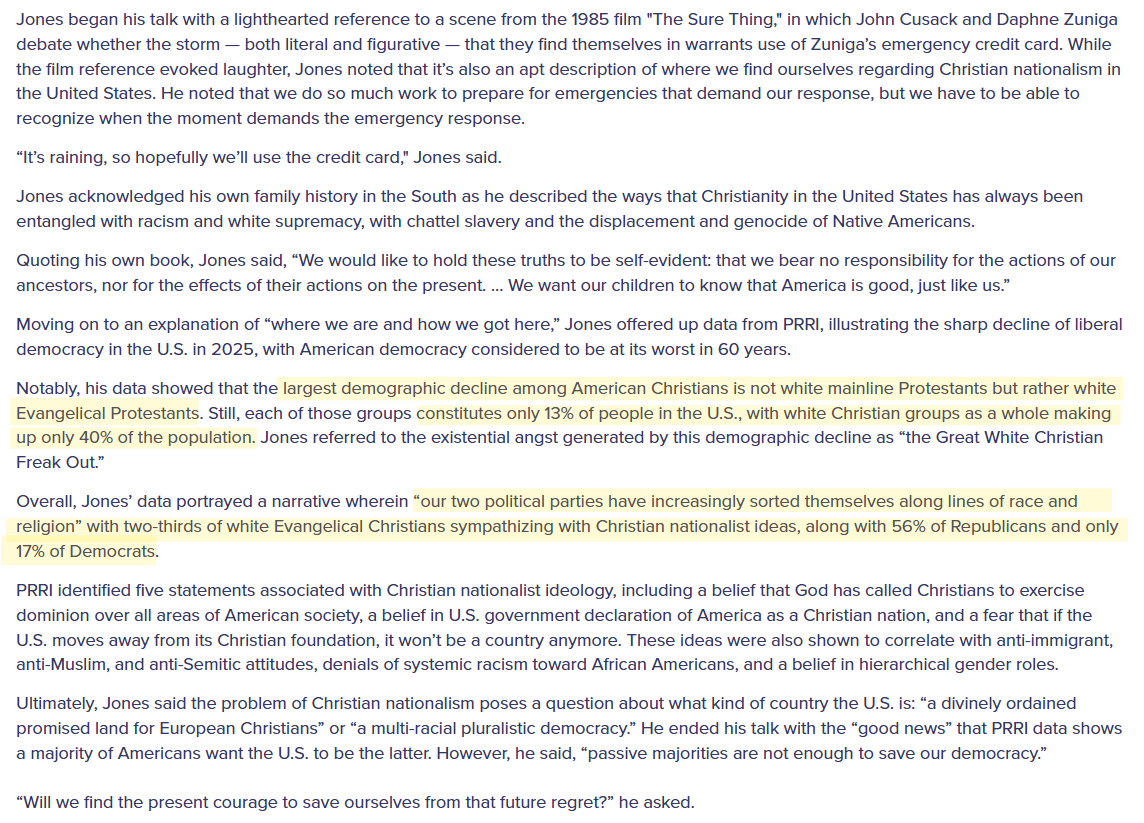
Similarly, sociologists like Samuel L. Perry and Andrew L. Whitehead describe "White Christian Nationalism" as an ideology in which Christianity becomes intertwined with a particular conception of American identity rooted in history, culture, and often race.
Here, Samuel L. Perry examines the type of white Christian nationalism displayed at the U.S. Capitol attack in a public lecture April 4, 2022, at Westmont’s Global Leadership Center
This distinction matters.
So when you look at the case of Dinesh D'Souza within the larger contours of Christian White Nationalism, you are forced to ask the question:
When identity conflicts arise within sections of the Christian political right, which identity tends to dominate—shared faith, shared ideology, shared nationality, or shared ethnicity?
There may be no single answer because the movement is not monolithic. But the corollary of the question becomes the next natural one.
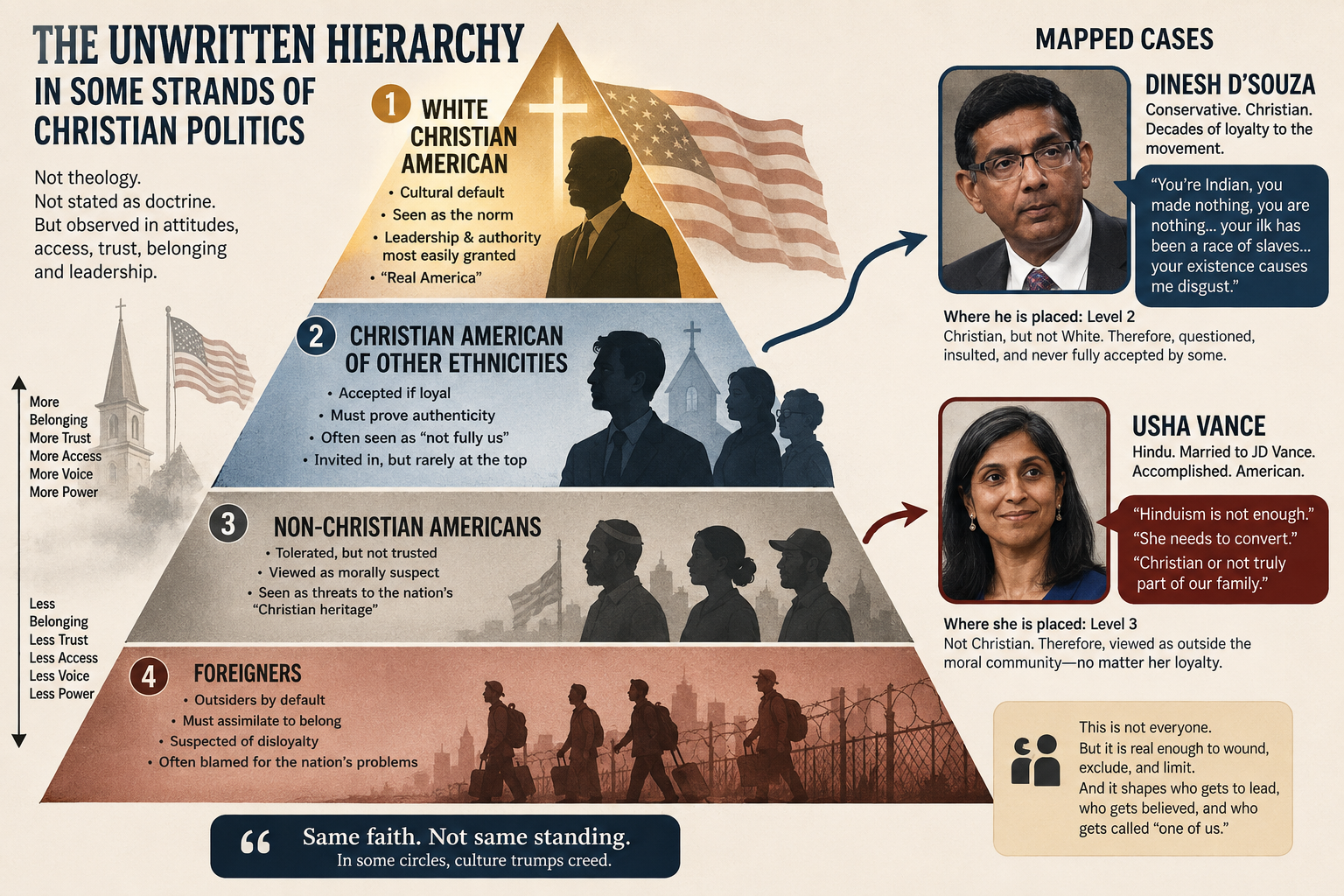
So there does seem to be a race hierarchy within the Christian realm. This may not be a "formal doctrine," but it is an observed pattern in some ethnonationalist currents where religion and ethnicity become intertwined.
After all, what Dinesh D'Souza faced was ratcheted up many times against Usha Vance by the MAGA right.
The White Christian Nazi Rally at Madison Square Garden
On February 20, 1939, a massive pro-Nazi rally drew over 20,000 attendees to Madison Square Garden in New York City, organized by the German American Bund. Outside the arena, tens of thousands of counter-protesters clashed with 1,700 New York City police officers guarding the perimeter.
A movie was made on that rally, "A Night at the Garden".
The stage itself symbolized the ideological synthesis:
- A giant portrait of George Washington.
- American flags.
- Nazi Hakenkreuz (not "Swastika"?).
- Speeches proclaiming "true Americanism."
The organizers were not presenting themselves as foreign Nazis. They claimed to represent the "real" America while simultaneously embracing Hitler's racial ideology.
 Desh Kapoor
Setting the record straight on Hakenkreuz
One of the enduring misconceptions about Nazism is that its defining symbol was the "swastika." It was not.
The Nazi Party called its emblem the Hakenkreuz, which literally means the "Hooked Cross."
That terminology matters.
The svastika (स्वस्तिक) is an ancient Indic symbol, appearing in Hindu, Buddhist and Jain traditions for thousands of years as a representation of auspiciousness, cosmic order, prosperity and well-being. The Nazi Hakenkreuz, by contrast, was a twentieth-century political emblem created within the ideological framework of German Nazi movement.
The widespread post-war practice of referring to the Hakenkreuz as the "swastika" had an unfortunate consequence.
It associated one of humanity's most destructive political movements with one of the oldest sacred symbols of Indic civilization, while simultaneously obscuring the specifically German, Christian and Völkisch context in which the Hakenkreuz acquired its ideological meaning.
Understanding that distinction is essential because Nazism did not emerge in an ideological vacuum.
Völkisch Christianity
Central to Nazism was the concept of the Volk—a unified people bound by shared ancestry, blood, culture, and a perceived historical destiny.
From this foundation arose the Völkisch worldview, an ideological framework that went beyond simple racial categorization. It sought to integrate race, nationhood, culture, history, and even religion into a single, inseparable identity.
Within this perspective, identity was not fragmented but organic and totalizing. Everything—politics, society, and belief systems—was expected to align with the essence of the Volk.
Religion, therefore, could not remain independent or universal; it had to be reshaped to reflect this national-racial identity.
For many proponents of this ideology, Christianity itself required fundamental transformation. They argued that, in its existing form, it was incompatible with German racial consciousness due to its Jewish origins. This belief led to the emergence of the Deutsche Christen (German Christians) movement.
Their project was revolutionary.
In May 1939, Protestant theologians associated with the pro-Nazi German Christian (Deutsche Christen) movement established the Institute for the Study and Eradication of Jewish Influence on German Church Life (Institut zur Erforschung und Beseitigung des jüdischen Einflusses auf das deutsche kirchliche Leben) in Eisenach. The Institute sought to "de-Judaize" Christianity by removing or minimizing Jewish elements from Christian theology, liturgy, biblical interpretation, and church life. Its activities included producing an edited New Testament and hymnal consistent with Nazi racial ideology.
As Susannah Heschel demonstrates in The Aryan Jesus, respected Protestant theologians worked systematically to reconstruct Christianity itself around Nazi racial principles.
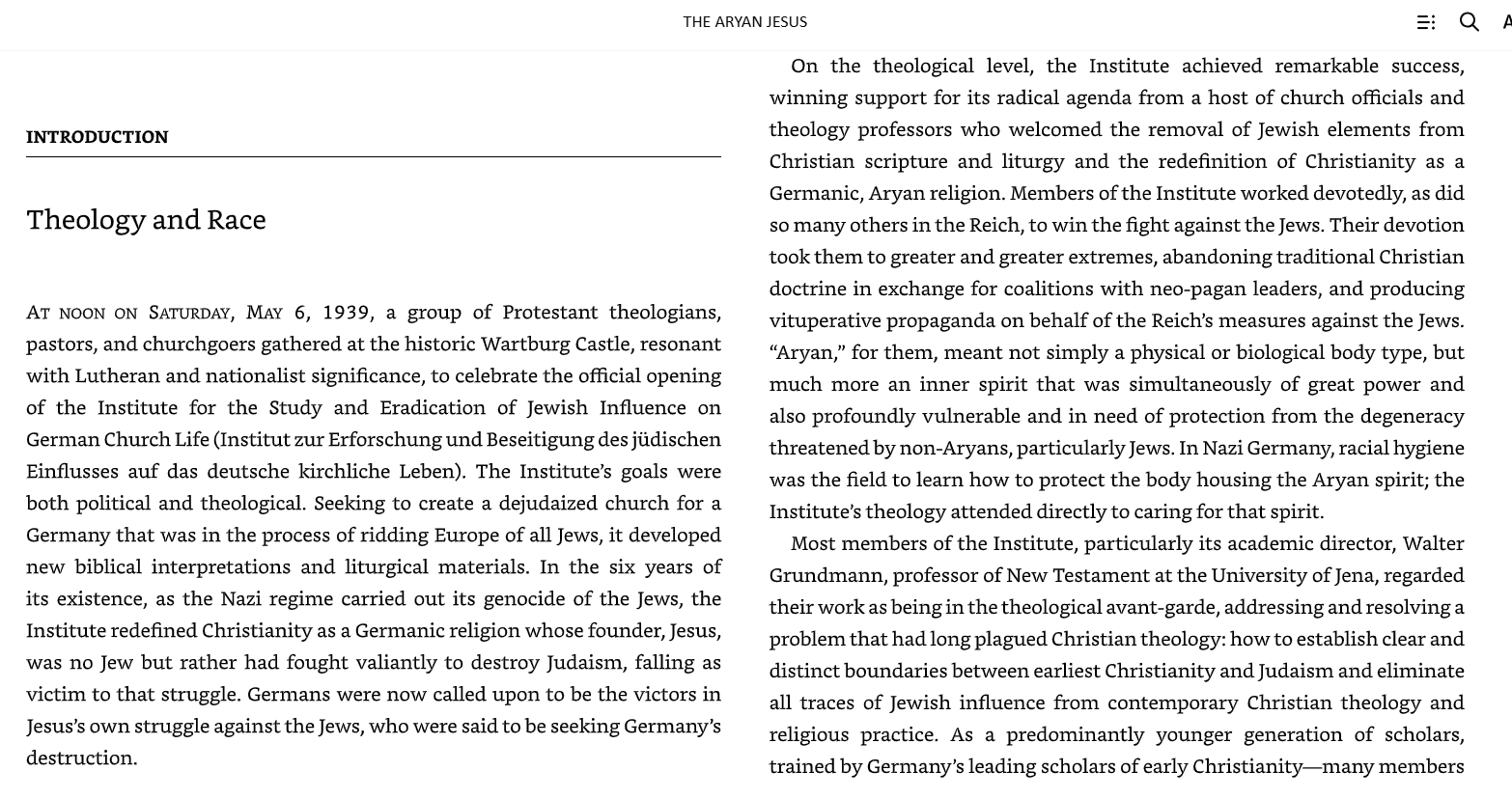
So, it is clear that the objective was not to discard Christianity but to reshape it into a faith aligned with the ideological goals of the Nazi state. Rather than rejecting Christian belief outright, proponents of the German Christian movement sought to nationalize it by subordinating theology to racial nationalism. In this framework, race increasingly became a theological category, with the German Volk portrayed as possessing a unique historical and spiritual destiny.
Symbols were reinterpreted to reinforce this synthesis.
Within this ideological construct, the two symbols were portrayed as complementary rather than contradictory, defining the image of the "ideal German Christian": faithful to Christianity while simultaneously committed to the racial and political aspirations of National Socialism.
Elements of this racialized interpretation of Christianity also found sympathetic audiences beyond Germany. The 1939 rally at Madison Square Garden, organized by the German American Bund, prominently displayed Christian imagery alongside Nazi symbolism and nationalist rhetoric, illustrating how attempts were made to blend Christian identity, nationalism, and racial ideology in parts of the United States, even though these views remained outside the mainstream of American Christianity.
Christianity, Empire and Civilizational Hierarchy
The German Christian experiment did not arise in isolation. Its roots can be traced to a much longer historical pattern in which Christianity became entangled with ideas of civilizational hierarchy and political power.
Well before the emergence of the Third Reich, European colonial expansion had already begun to fuse religious mission with imperial ambition.
From the fifteenth century onward, papal decrees such as the Doctrine of Discovery, along with related theological and legal frameworks, were invoked by several European powers to legitimize territorial claims over lands inhabited by non-Christian populations.
These doctrines provided moral and legal justification for conquest, often framing it as both a civilizing and spiritual endeavor. In practice, missionary activity, imperial administration, and cultural transformation frequently operated in tandem, though their precise relationship differed across empires and denominations.
In British India, for instance, many missionaries were driven by a genuine belief that they were saving souls.
Yet conversion rarely functioned as a purely spiritual transformation. It was often accompanied by implicit expectations that converts would gradually adopt European norms comprising moral, educational, social, and even political.
Christianity, in this context, became intertwined with a broader project of cultural assimilation.
However, conversion did not erase entrenched racial hierarchies. The “native Christian” occupied a complex and often contradictory position. While accepted within the religious community, they continued to face systemic discrimination within colonial society. Indian Christians, despite sharing the same faith, seldom enjoyed parity with their European counterparts. Ecclesiastical authority, institutional leadership, and missionary control remained overwhelmingly concentrated in European hands well into the colonial period.
This dynamic produced a layered and unequal identity structure. Religious affiliation did not dissolve distinctions of race and power; instead, these hierarchies were frequently reproduced within the church itself. The shared framework of Christianity coexisted with—and sometimes reinforced—the broader imperial order.
While the scale, intensity, and methods of this process varied across regions, denominations, and historical periods, the underlying pattern remains a recurring theme in scholarly analyses of colonial missions and their enduring legacies.
From Colonial Christianity to White Christian Nationalism
The Völkisch project represented one extreme manifestation of a broader historical pattern:
It did not invent the idea that Christianity could become intertwined with political power, national identity or imperial ambition.
Rather, it radicalized those tendencies into a biologically defined nationalism centered on the German Volk.
That distinction is important.
The Völkisch movement was not simply "Christian." Nor was it merely "racial."
It attempted to create a racialized Christianity whose theological center shifted from universal redemption toward the preservation of an ethnically defined people.
The question that stares in our faces, given the context of racialized Christianity, is stark.
We will look at this question deeply.
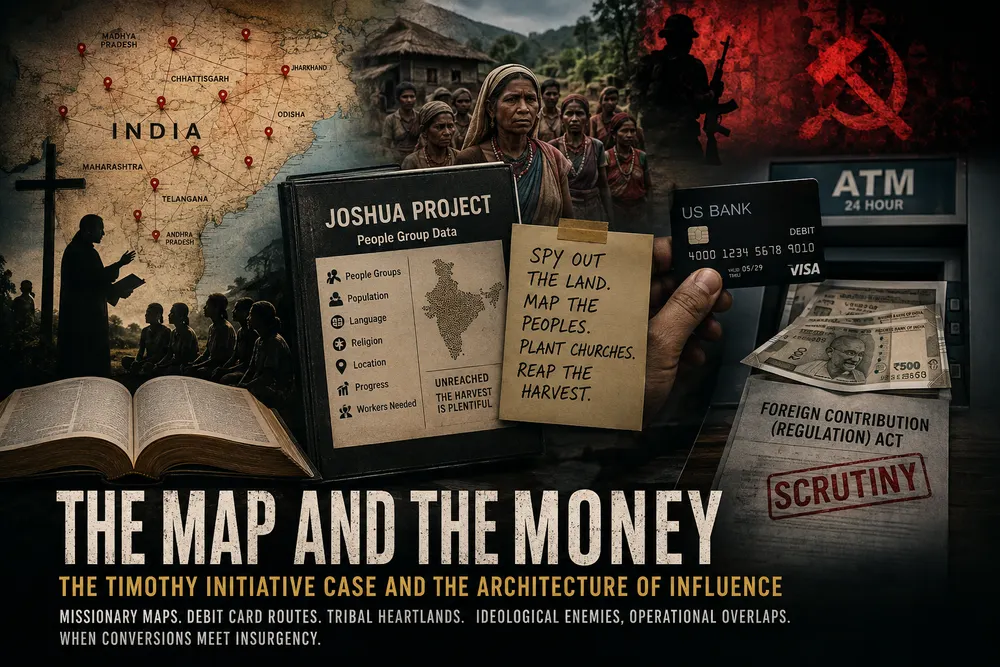
The Debit Cards and Conversion Project
The Enforcement Directorate's Prevention of Money Laundering Act (PMLA) probe into foreign-funded cash flows into Naxal-affected districts, the rollout of the FCRA 2.0 monitoring portal, and a new military-academic doctrine literature on "cognitive warfare" have all surfaced in just the last few months.
Why?
We will go into these things in detail.
We will start with a case that is related to The Timothy Initiative (TTI). What is this organization?
It was set up in 2009 with headquarters in Raleigh, North Carolina.
It is a global Christian organization founded by David Nelms. As per their literature, the organization focuses on planting multiplying churches and making disciples globally. Its core strategy relies on training local leaders to train others using a 10-book discipleship model.
Cognitive warfare treats the human mind as the principal battlespace. Not territory. Not military installations. Not critical infrastructure. The battlefield is consciousness itself. Its objective is not the destruction of an opposing army, but the attainment of "mind dominance".
It is the ability to shape perceptions, control narratives, fracture social cohesion, and ultimately influence an adversary's decisions, all without crossing the threshold into conventional armed conflict.
On April 18, 2026, Bureau of Immigration officers at Kempegowda International Airport in Bengaluru, acting on a lookout circular issued by the Enforcement Directorate, stopped an American national named Micah Mark before he could leave the country. In his possession were 24 foreign debit cards issued by Truist Bank in the United States. Every card carried the same fabricated Indian name, "Santosh Kumar," a name common enough to disappear into any crowd. According to the ED, earlier tranches of cards had been issued under regional codes instead: "NE-1," "NE-2," "Southern Region-1." Someone had partitioned India into operational zones and provisioned cash accordingly.
Mark, described by investigators as the person handling the India financial operations, was the thread that unspooled the network. The ED's case alleges that the 24 cards were part of a fleet exceeding a thousand, distributed across the country, and that the organization behind them is The Timothy Initiative, a church-planting body headquartered in Raleigh, North Carolina, whose declared mission is reaching "unreached populations" through rapid church multiplication. That phrase, "unreached populations," is the Joshua Project's exact category, which is the first quiet confirmation that the map and the money speak the same language.
The financial scale, as alleged: approximately 92.55 crore rupees, close to ten million dollars, moved into India through this card network in a single six-month window between November 2025 and April 2026, entirely outside the banking and approval channels that the Foreign Contribution Regulation Act requires for foreign money entering India.
TTI, critically, was not registered under FCRA. The instrument was chosen precisely because direct wire transfers now trip regulatory flags under a tightened FCRA regime, whereas foreign debit cards drawing cash from ordinary Indian ATMs are far harder to trace to their source.
The accounting reportedly ran on QuickBooks. Field coordinators reportedly submitted expense bills. And the digital banking records, the ED says, were deleted once the raids began.
The FIR, registered by Kothanur police in Bengaluru on June 11, 2026, on the complaint of an ED Assistant Director, invoked the Foreign Exchange Management Act, the FCRA, provisions of the Bharatiya Nyaya Sanhita covering conspiracy, cheating, forgery, and destruction of evidence, and, most gravely, Sections 13, 17, and 18 of the Unlawful Activities (Prevention) Act, which address unlawful activities, raising funds for terrorist acts, and conspiracy to facilitate them. The accused named include Jonathan S. Rajan, Micah Mark, Ajit Varghese Mathai, Varghese Chacko, Bablu Kurmi, Supreme Joy, and The Timothy Initiative itself.
The accused filed a petition to quash the FIR.
Justice M. Nagaprasanna dismissed the petitions and allowed the investigation, including under UAPA, to proceed, observing that the case concerns national security and describing that security as "the invisible architecture upon which the sovereignty, stability and constitutional order of a nation rest."
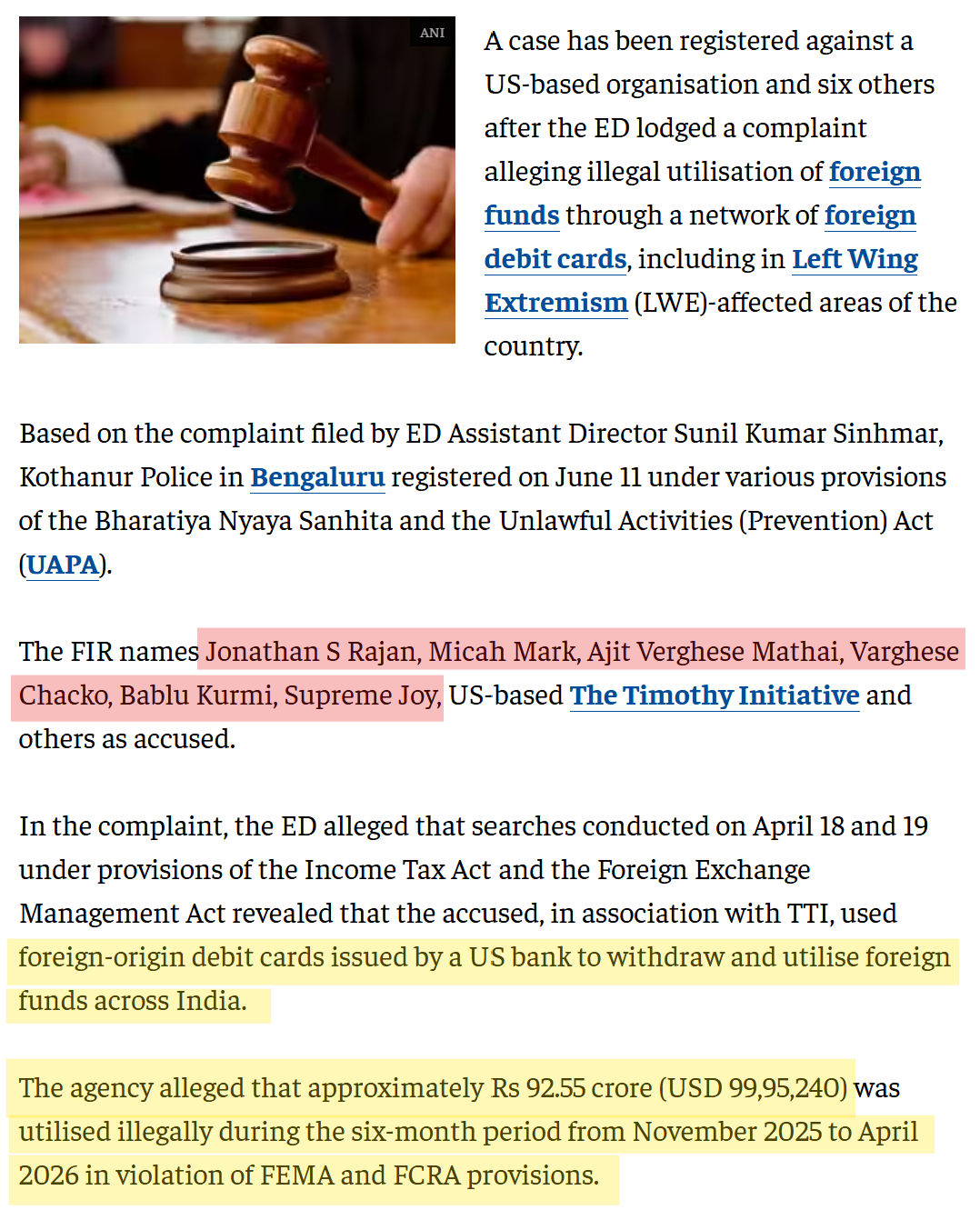
Arnab Goswami of the Republic TV has shared the story in his program.
To understand what the Timothy Initiative was up to, let us go over to another project - called the Joshua Project.
 Joshua Project
Type "India" into the Joshua Project's website and you receive a receipt.
The country resolves into 2,373 discrete "people groups." A total population of roughly 1.41 billion is presented alongside a second figure, 1.34 billion, labeled as the population still "unreached."
That is 95.1 percent of Indians, sorted into a category defined entirely by their distance from Christianity.
Beside it sits a "progress level" dial, a largest-religion tag reading Hinduism at 80.1 percent, a Christian-adherent figure of 2.32 percent, and an evangelical annual growth rate of 3.9 percent, which the page helpfully contrasts with a global rate of 2.6 percent. India, in other words, is growing faster than the world average, and the page is keeping score.
Scroll into the people-group table and the granularity sharpens into something that stops feeling like theology. Each community carries its own line item: population in this country, global population, whether it is classified as indigenous, primary language, primary religion, a colored "progress scale," a "% Christian adherent" figure, a "% evangelical" figure, and a final column, quietly devastating in its bureaucratic tone, titled "estimated workers needed."
The Adi Dravida, a Tamil Dalit community of 8.68 million, appear scored at one tenth of one percent Christian, flagged as a "frontier people," with 174 workers needed. The Ad Dharmi of Punjab, another Dalit formation, appear scored and slotted. Community after community, ranked by size, by vulnerability, and by how far the conversion process has already advanced.
The Joshua Project
The Joshua Project is not a fringe website. It is the central nervous system of a global evangelization methodology, and understanding its lineage matters because the lineage explains the intent.
It began in 1995 as part of the AD2000 and Beyond Movement, itself an outgrowth of the global consultations on world evangelization of the late 1980s. Between 2001 and 2005 it drifted through a series of custodians, and since 2006 it has operated as a ministry of Frontier Ventures, a California organization formerly known as the U.S. Center for World Mission. Its declared purpose is to bring definition to what evangelicals call the Great Commission by producing, in its own phrasing, "accurate, regularly updated ethnic people group information critical for understanding the scope of the work required."
Read that sentence the way an intelligence analyst would read it. "The scope of the work required" is a targeting statement. The work is conversion. The scope is measured in human communities. The database exists so that the movement can allocate resources rationally across a planetary field of operations, and it does this by breaking humanity into more than 17,000 people groups, each defined as the largest unit through which the gospel can spread as a self-multiplying movement.
The methodology underneath the map is called the Church Planting Movement, or CPM, formalized within the Southern Baptist mission apparatus in the late 1990s by strategist David Garrison. A CPM is defined as a rapid multiplication of indigenous churches planting churches that "sweeps through a people group or population segment." The vocabulary is industrial. Communities are segments. Success is exponential reproduction that outpaces a group's own birth rate. Field operatives were historically titled "strategy coordinators" and "non-residential missionaries," language borrowed almost wholesale from the world of covert operations rather than the world of pastoral care.
Two features of this system deserve to be named plainly.
First, it is data-hungry by design. You cannot run a segmented, resource-optimized conversion campaign without continuously refreshed ground-level intelligence on each segment: its size, its language, its internal social structure, its economic pressures, and its current "openness." The Joshua Project is the shared repository where that intelligence is pooled. Its own documentation describes data being gathered from a worldwide constituency of field workers and agencies, aggregated into a central database, and distributed "within security guidelines." That last clause is worth underlining. An openhanded, free-to-all charity that nonetheless maintains "security guidelines" over portions of its data is telling you, in its own words, that not everything collected is meant for public view.
Second, the system is explicitly optimized to target the vulnerable first. The movement's own strategic slogan is "win the winnable." Mission research on India states it without embarrassment: the great majority of church-planting focus has gone to the Scheduled Castes and Scheduled Tribes, the Dalits and Adivasis, because they are judged the most responsive, and because they carry the greatest economic and social wounds. The logic is circular and self-reinforcing. Vulnerability makes a community responsive; responsiveness makes it a priority target; priority sends resources; resources deepen the mapping of that community's vulnerability. The map is precise because it is pointed at the people with the least power to resist being mapped.
Target India!
Set the theology aside and read the India page as what it functionally is: a national vulnerability index, published in the open.
The page performs three analytic operations that any intelligence product performs. It segments the target population into addressable units. It scores each unit on a vulnerability-and-opportunity scale. And it prescribes resource allocation against each unit. Segmentation, scoring, tasking. That is the shape of a targeting document, whatever the motive behind it.
The segmentation is caste-aware and tribe-aware to a degree that Indian official statistics often are not. Where the Indian state has historically been cautious, even evasive, about granular caste enumeration, this database has been building caste-level and sub-caste-level population and religion estimates for decades, cross-referenced with language and region. Critics have alleged that the deeper collection uses Indian postal PIN codes, dialect boundaries, and socioeconomic indicators to localize communities down to the town and district level, and deploys trained field agents to gather caste-specific data as part of outreach. Those specific mechanics are contested and should be treated as allegation rather than established fact. What is not contested is the output: a community-by-community, region-by-region ledger of Indian society organized around its seams.
The scoring layer is the "progress scale" and the frontier flag. In practical terms it answers one question for a field operator: where is this community on the journey from Hindu, or Muslim, or animist, to Christian, and how much resistance remains. A red frontier flag means barely touched, high resistance, high strategic value. This is a heat map of civilizational fault lines, published for anyone on earth to download.
The tasking layer is the "estimated workers needed" column and the associated "Adopt a People" program, through which a foreign congregation can formally take ownership of a specific Indian community as its conversion project. A church in Texas can, in effect, be assigned the Adi Dravida of Tamil Nadu. This is the point at which an abstract database becomes an operational assignment, and it is the hinge that connects the map to the money.
Preparing for the Harvest
Interestingly, in September 2013, of all the magazines Tehelka came out with probably the most significant and detailed investigations into the conversion mafia and its ramifications for India's national security. This is the link to its article in Archive.org


The article argues that a large, US-backed evangelical ecosystem built a coordinated strategy for religious conversion in India, especially from the early 1990s onward, intensifying after George W. Bush became US president in 2001.
It highlights Bush’s Office of Faith-Based and Community Initiatives, the expansion of “charitable choice,” and the opening of federal funding streams to faith-based organizations. In that vein, many major American evangelical figures and organizations — including Pat Robertson, Billy Graham-linked networks, Southern Baptists, World Vision, Operation Blessing, CBN, Gospel for Asia, and others — played roles in global or India-focused missionary activity.
The investigation shared how the US taxpayer money, USAID-linked development programs, and faith-based social-service funding probably supported organizations whose broader worldview included conversion.
Operational Framework Described in Preparing for the Harvest
In "Preparing for the Harvest," Tehelka describes Joshua Project II as a global database and networking system created to collect, standardize, and disseminate information on what evangelical missions termed the world's "least-reached peoples." According to the article, the database cataloged detailed information on thousands of ethno-cultural communities, including Indian caste, tribal, and linguistic groups, and made this information available to missionary organizations worldwide for planning and coordinating evangelization efforts.
The article argues that evangelical strategy extended well beyond conventional religious outreach. It contends that programs involving development, disaster relief, holistic development, child welfare, healthcare, education, HIV/AIDS care, prison reform, and tribal welfare were viewed as potential avenues through which evangelization could be pursued alongside humanitarian work. It further notes that the movement adopted a distinctly strategic vocabulary, employing expressions such as "spy out the land," "harvest fields," and "church-planting strategies," reflecting an emphasis on systematically mapping populations and designing outreach around local linguistic, caste, social, geographic, and economic divisions.
A central theme of the article is the collection of ethnographic intelligence. Preparing for the Harvest states that missionary-linked organizations assembled detailed profiles of Indian communities, documenting factors such as caste, language, religion, geography, social structure, and perceived receptivity to conversion. It also highlights the use of PIN-code mapping, asserting that India's postal-code system was used to organize field workers, identify target villages, distribute literature, map language groups, and monitor church-planting activities with considerable geographic precision.
Finally, the article advances a broader historical argument regarding missionary organizations and intelligence activities. It asserts that organizations such as Wycliffe Bible Translators, the Summer Institute of Linguistics (SIL), and elements associated with the Southern Baptist missionary movement had historically been linked to U.S. intelligence operations in countries including Latin America and Thailand. The article presents these assertions as part of its broader examination of the relationship between missionary expansion, geopolitical interests, and American foreign policy.
Is cutting money enough?
The instinct is to treat the cash network as the scandal and the database as background. The priority should be reversed, because the money is what the state can actually defend against, and the map is what it cannot.
Money leaves a trail. Cards get seized at airports. FIRs get filed. This year the Union Home Ministry launched what it calls the FCRA 2.0 portal, hosted on secure government cloud infrastructure and integrated with Aadhaar, PAN, OCI, and the NGO Darpan databases, allowing real-time monitoring of foreign contributions to roughly 14,500 currently active FCRA-registered organizations. The state is visibly getting better at watching the money, and the Karnataka High Court has just signaled that it will let the anti-terror law be used where that money crosses into security terrain. These are real defenses, and they are improving.
The map is a harder problem precisely because it is legal, free, and permanent. There is no statute against a California nonprofit publishing ethnographic estimates. There is no FIR to file against a database. And once a community has been surveyed, scored, and published, that intelligence does not decay. It sits there, refreshed year over year, available to anyone who wants it: a sincere missionary, a foreign NGO, an intelligence service, a hostile state running the cognitive-warfare playbook that Indian strategic literature now formally names. The database tells any of them the same thing in the same instant: here are the communities most fractured, most desperate, and most persuadable, here is where they live down to the district, and here is how far along the process of detaching them from their inherited identity has already progressed.
A nation can garrison a border. It is far harder to defend a population that has already been indexed by its own fault lines, with the index handed to the world at no charge. The deepest vulnerability revealed by the Joshua Project's India page is not that Indians are being converted. Conversion is an old story and India has absorbed and answered it before. The deeper vulnerability is that Indian society has been rendered more legible to those who would restructure it than to those who live inside it. The mappers understand the internal architecture of the civilization better than most of its own citizens do, because they had a reason to study it and the citizens assumed it needed no defending.
The Evangelical–Maoist Nexus: Strategic Ruthlessness
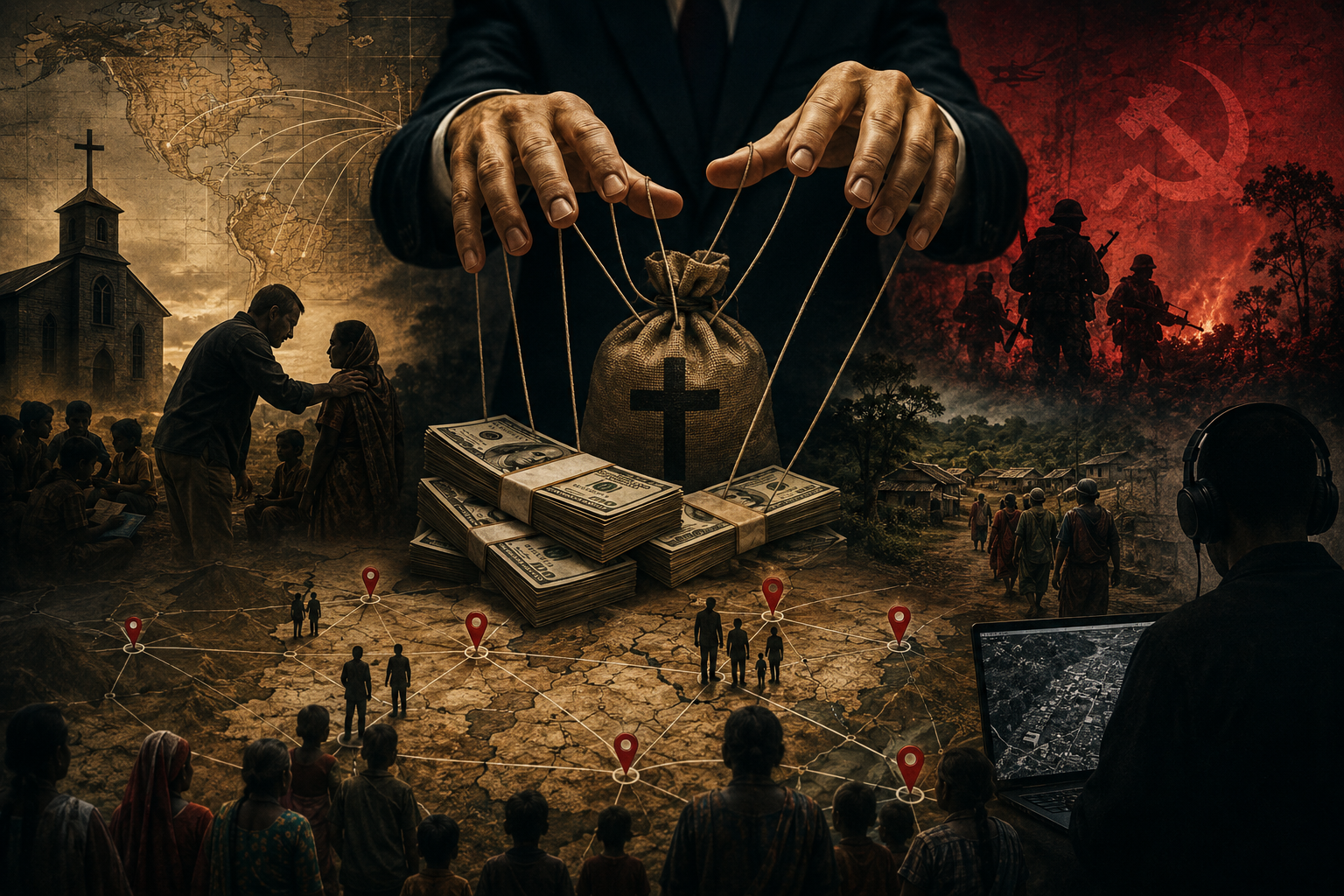
What makes the Timothy Initiative case erupt into a qualitatively different plane of concern is the alleged convergence between U.S. evangelical money and India’s Maoist/Left‑Wing‑Extremism geography.
The ED’s complaint and media reporting explicitly tie foreign funds routed through the card network to withdrawals in Naxal‑affected belts of Chhattisgarh and to areas under historic Maoist influence. The Karnataka High Court records prosecution arguments that funds drawn through these cards were used in LWE‑affected regions of Karnataka, Chhattisgarh, and Jharkhand.
If, through investigation and eventual trial, it is established that LWE‑connected individuals or networks were beneficiaries of this cash stream—even indirectly—the architecture described becomes stark:
- A U.S.-based evangelical body, using unreached‑peoples methodology, funds activities in Maoist‑affected districts through illicit channels.
- The Indian state’s principal terror statute is invoked on the theory that such funding may amount to raising or facilitating funds for terrorist acts.
But in Indian terrain the shared objective is not electoral alignment—it is civilizational destabilization.
The Maoist project seeks to delegitimize Indian constitutional order and fragment state authority along class and tribal lines. The evangelical project, as expressed in Great Commission praxis, seeks to detach populations from indigenous civilizational frameworks and re‑anchor them in a universalist monotheist narrative. Where both look at the same scar, i.e; an exploited tribal belt, a caste‑wounded cluster, they see a seam to enter.


Money is structurally indifferent to ideology if its handlers decide so. If an evangelical organization finds that the most “winnable” souls sit inside belts already fractured by Maoist influence, the map and the insurgency can converge on the same coordinates. It is this ruthless instrumentalism—treating any available local fracture as an access point—that you are pointing to. The TTI case alleges exactly that convergence in cash geography.
The civilizational stake
Step back to the widest frame, because that is where this actually lives.
Exclusive monotheism has always traveled with a technology of expansion, and that technology has always been, at its core, informational: know the population you intend to absorb better than it knows itself, locate the seam where its existing order has failed some of its people, and enter through the seam.
What is new in the twenty-first-century version is not the intent. It is the instrumentation.
Caste ethnography that once took missionaries generations to accumulate now updates continuously in a searchable database. Cash that once moved slowly through visible channels now moves through a thousand anonymized cards.
The Great Commission has acquired the tooling of a modern data operation, and it has pointed that tooling at the most plural, most internally differentiated civilization on earth, whose very diversity is what makes it so richly mappable.
What should India Do?
The Indian response cannot be merely prohibitive, because prohibition addresses the money and leaves the map untouched, and because coercive bans hand the other side its favorite narrative of persecution.
The durable response is civilizational literacy.
India has to learn to see itself the way the strategist sees it: as a structure with seams, and to attend to those seams, the caste wounds, the tribal neglect, the economic desperation, before someone else attends to them first and on their own terms.
The Adi Dravida flagged in red on a California database are, before they are anyone's conversion target, Indians whom the Indian order has left at one tenth of one percent of anything.
The map is a mirror as much as a weapon.
The most damning thing about it is not that a foreign organization drew it. It is that it is largely accurate, and that no one inside the civilization had bothered to draw it first.
That is the real meaning of Justice Nagaprasanna's phrase. National security is invisible architecture.
We now come to how Western intelligence has routinely worked with the evangelicals and the churches to create subversion in other countries.
Church and Intelligence Operations
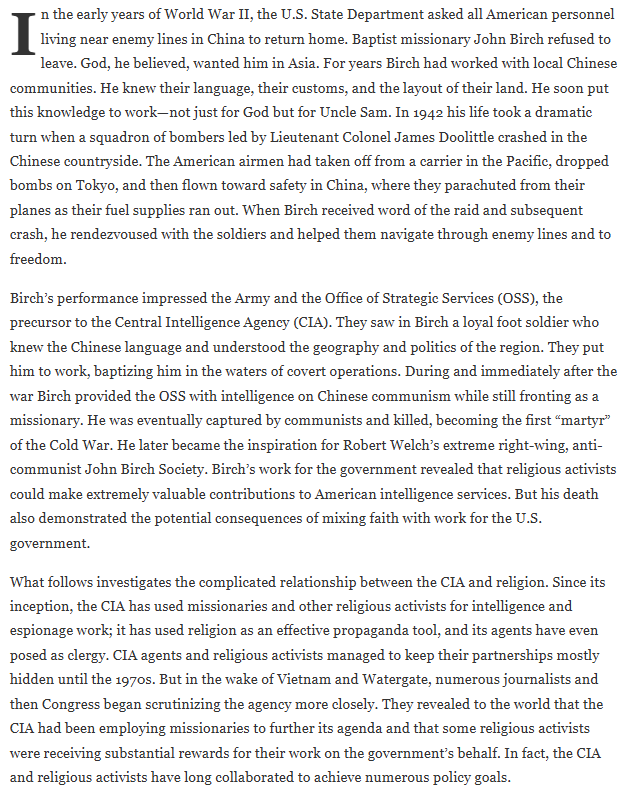
The single most important establishing fact is the 1975 Church Committee finding. During its fifteen-month investigation, the Senate Select Committee on Intelligence found that the CIA had covert operational relationships involving the "direct operational use" of about 21 individuals who were American clergy or missionaries. Espionage allegations against missionaries in the Third World were not unusual, and past CIA use of missionaries surfaced during that Senate probe. This is the concrete anchor. The rest is argument about scale and specific organizations.
The policy history that followed is also solid. In February 1976, incoming CIA director George H.W. Bush announced the agency would establish no secret, paid or unpaid contractual relationship with any American clergyman or missionary, and church groups would not be used as funding cutouts. Critics noted the loophole immediately: the CIA would continue to accept information volunteered by American clergy and missionaries and retained the right to initiate contact with them inside the United States. A 1977 internal clarification added that the directive did not prohibit overt relationships on matters unrelated to religious status, such as unclassified translation services. These rules resurfaced as a live controversy in 1996, when CIA director John Deutch testified that the ban could be waived for "unique and special threats to national security," prompting sharp protest from the National Council of Churches, the National Association of Evangelicals, and World Vision.
Summer Institute of Linguistics and Wycliffe
The structural facts here are not seriously disputed. Wycliffe Bible Translators and SIL grew out of the same Camp Wycliffe and were incorporated as two entities in 1942, a split that let the "scientific" SIL deal with governments and secular institutions while WBT handled US fundraising and recruiting. Founder William Cameron Townsend built the operation on aggressive pursuit of government money. By the 1960s SIL was drawing substantial income indirectly from USAID by way of foreign governments, and an amendment to the 1949 Federal Property Act that let religious missions take surplus US government property abroad was known in some congressional circles as "Townsend's bill."
The friction with host countries is documented. SIL was expelled from Ecuador, Brazil, Mexico, and Panama, and restricted in Colombia and Peru. In 1975 some thirty anthropologists signed the Denouncement of Patzcuaro calling SIL a tool of imperialism, and in November 1980 a conference of the Inter-American Indian Institute in Merida charged that it used a scientific name to conceal a Protestant agenda alien to indigenous traditions.
The heavier allegations come from two books that are often conflated but are quite different in rigor:
Colby and Dennett's Thy Will Be Done (1995) is the maximalist case. It alleges that Nelson Rockefeller's oil interests used SIL, and that SIL personnel cooperated in conducting surveys, transporting CIA agents, and indirectly assisting harm to Amazon tribes. It also documents Townsend's wartime intelligence-adjacent conduct, including a 1942 directive asking SIL's Mexico City office to solicit reports on anyone trying to turn indigenous people against Americans.
David Stoll's Fishers of Men or Founders of Empire? (1982) is the more careful academic treatment, and it cuts against the sensational version. Stoll, now a Middlebury anthropologist, documented SIL's alignment with US anti-communist policy, with oil and colonization schemes, and with authoritarian governments, but he was skeptical of the claim that SIL was literally a CIA front with missionaries on the payroll. His work is cited by SIL's critics, yet his actual argument is closer to "politically useful instrument of empire" than "spy agency in disguise." Worth knowing if you cite him: evangelical reviewers attacked him as unfair, while activist critics found him too cautious, which is usually a sign of a serious middle position.
The claims that should be flagged as unverified rumor include the false-bottomed food baskets said to contain radio transmitters, with receivers supposedly manned by US military personnel at the Shell base in Ecuador's Amazon, and the laxative-laced food stories around the Huaorani.
The Summer Institute in Linguistics is the linguistic arm of evangelical churches in the United States. It runs the website Ethnologue which maps languages around the world. The SIL was particularly involved in South and Central America in using missionaries to help oil companies move local indigenous peoples off their land so that oil corporations could then drill. (Source: Summer Institute in Linguisitics
The link between evangelical churches and their arms with the CIA has been historically established.
Thailand and Southeast Asia
The Southeast Asian thread runs through counterinsurgency rather than Bible translation per se. The hub was the Chiang Mai Tribal Research Center in northern Thailand, funded through USAID, through which anthropologists were drawn into counterinsurgency work; American missionary organizations were pulled in as well.
This sat inside a genuine Cold War campaign: US and Thai concern about a Chinese-supported communist insurgency in northern Thailand whose support came largely from the hill tribes. The context that made SIL vulnerable was public: in 1971, USAID director John Hannah admitted AID had funded CIA operations in Laos, and reporting pointed to CIA-AID collaboration in Ecuador, Uruguay, Thailand, and the Philippines.
Alfred McCoy's work on academics subcontracted into Thai counterinsurgency (1954 to 1970) is the standard scholarly reference for how civilian expertise, including missionary field knowledge, fed that machinery.
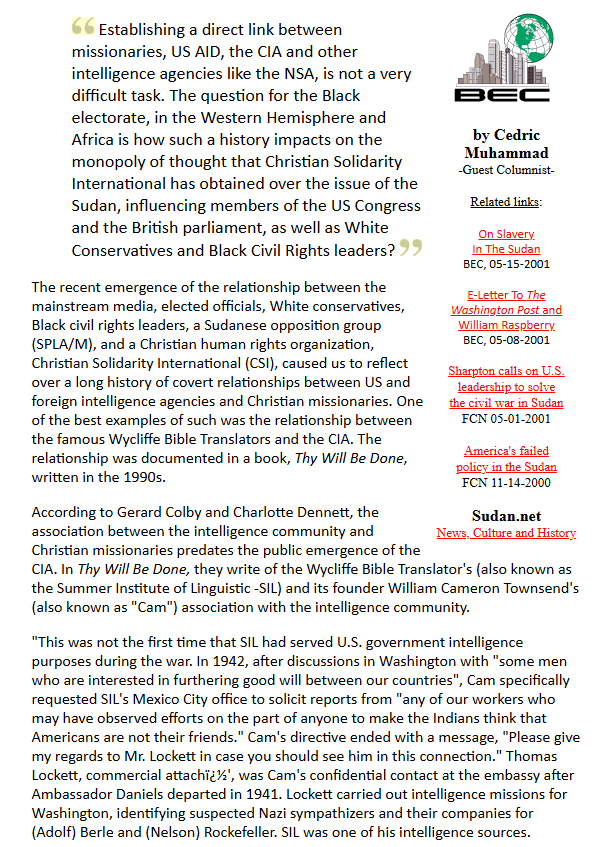
SIL's own footprint in the region was substantial and openly triumphalist about entering tribal areas during active liberation wars, working in Vietnam, Cambodia, and the Philippines and speaking of buying a headquarters in Saigon. That posture, combined with SIL's aviation and radio wing (JAARS, the Jungle Aviation and Radio Service), which gave it airstrips and communications gear in remote frontier zones, is a telling proof of its collaboration with intelligence forces.
You can also read our recent newsletter in this regard.
 Desh Kapoor
So what is the objective?
Cognitive Warfare
In 2003, the Chinese People’s Liberation Army formalized what it called the Three Warfares: legal warfare, psychological warfare, and public-opinion warfare. At its core was a simple but far-reaching insight—modern conflict is decided long before kinetic engagement begins. The decisive terrain is cognitive. Victory depends on shaping perception, influencing belief systems, and preconditioning societies to respond in predictable ways.
What has evolved since then is not the doctrine but the means. The technological landscape of the 2020s has transformed these concepts into a far more expansive model of cognitive warfare. Artificial intelligence, algorithm-driven content distribution, bot amplification networks, deepfakes, and precision micro-targeting have created an environment where influence can be continuous, personalized, and nearly invisible.
In Western analyses of PLA and Russian information operations, this environment is often described as a ‘Firehose of Falsehood’.
The objective is not to convince populations of a single coherent narrative, but to flood the information ecosystem with competing claims, distortions, and emotionally charged content. Over time, the sheer volume and velocity of information erode the individual’s ability—and willingness—to verify truth. Cognitive overload replaces rational evaluation, and emotional resonance begins to outweigh factual accuracy.
Within this broader battlespace, non-state and semi-state actors also play a critical role. Transnational ideological networks, including certain evangelical organizations with global reach, have at times intersected with geopolitical objectives. In some analyses, these networks function not merely as religious actors but as vectors of influence, shaping social attitudes, political preferences, and cultural identities in ways that can align with strategic interests.
In regions such as parts of Africa, Latin America, and Asia, evangelical expansion has occasionally overlapped with information and influence campaigns, sometimes supported, directly or indirectly, by state-linked or intelligence-adjacent ecosystems. The methods are not always overt. They operate through education, media, humanitarian work, and community structures, embedding narratives that can gradually reorient local worldviews.
From a cognitive warfare perspective, this is significant. Influence is most durable when it is internalized as belief rather than imposed as propaganda. Religious frameworks, by their nature, engage deeply with identity, morality, and meaning—making them powerful vehicles for long-term cognitive shaping.