A restricted ritual technology, once detached from initiation, qualification, occasion, and inner discipline, keeps its outward act and loses everything that governed it. What then survives is a habit that has kept the religious name after losing its critical substance.
This is the heart of the present quarrel in Bengal. Interestingly, the tradition itself, along with the man Bengal reveres most within it in modern times, saw the point long before we did.
Swami Shastri's Appeal
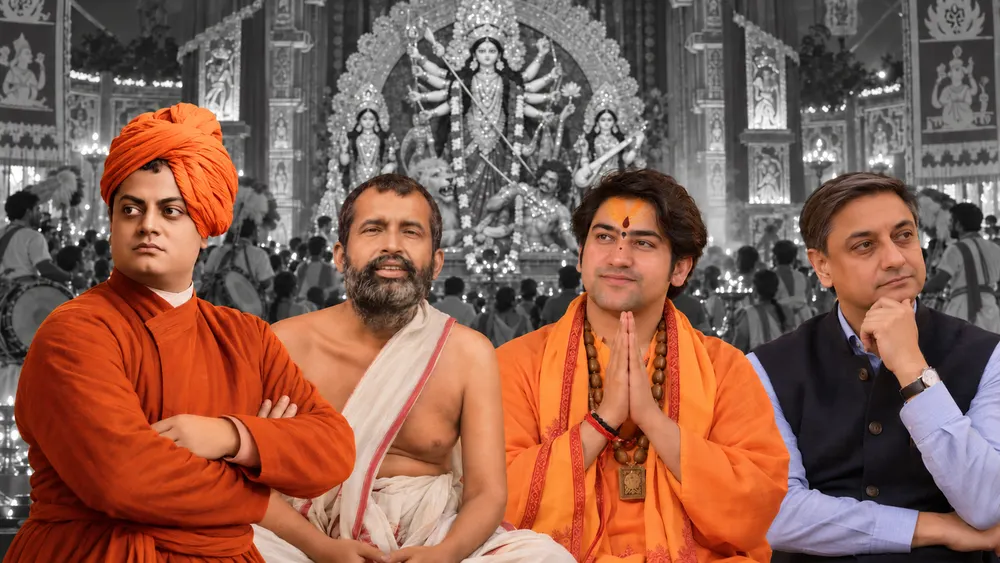
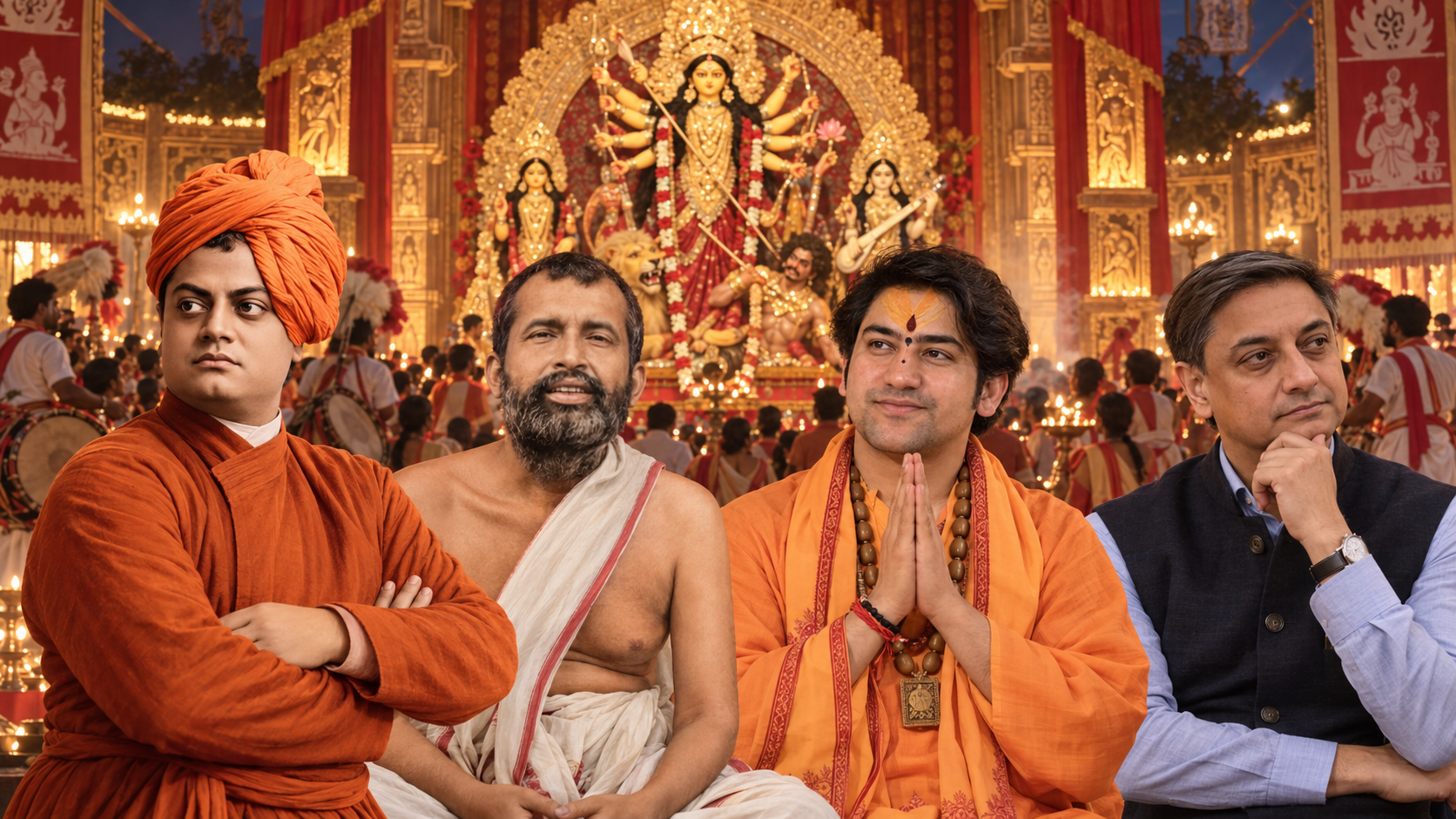
Swami Dhirendra Krishna Shastri of Bageshwar Dham spoke in Howrah and asked Bengali Hindus to keep meat and liquor away from Durga Puja and to observe Navratri with the sattvik discipline the season calls for.
And I will discuss this in more detail later.
He implored the people of Bengal to avoid meat during Navratri and to keep meat and alcohol vendors away from the Durga Puja pandals.
The reaction within Bengal was fierce.
His critics answered at once that this was a North Indian custom being pressed on Bengal. That line, when looked at deeply, does not quite hold.
The South keeps Navratri with the same sattvik restraint, through fasting, the Golu, and a vegetarian table.
So, quite clearly, the discipline is not a regional preference.
Its spiritual understanding rests on guna, which places it at the center of this argument.
As I said , the reaction within Bengal was, however, immediate, and it crossed party lines.
Even the state BJP president, Samik Bhattacharya, rejected the demand, said that no outside figure decides what Bengalis eat, and invoked Vivekananda as his authority.
VIDEO | Kolkata: Bengal BJP chief rejects Dhirendra Shastri, popularly known as Bageshwar Baba's, remarks on meat consumption, saying, "Bengalis will eat whatever they want."
— Press Trust of India (@PTI_News) September 7, 2026
Shastri's remarks have triggered a debate in West Bengal, where food, religion and cultural practices… pic.twitter.com/atcsTjnaqz
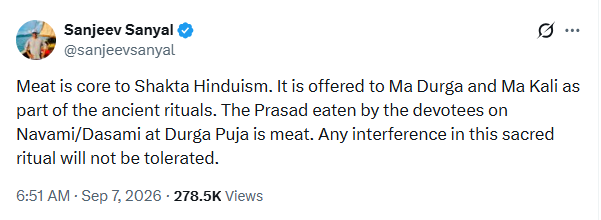
Sanjeev Sanyal put the cultural claim quite succinctly. Meat is core to Shakta Hinduism, offered to Durga and Kali in the old rituals, eaten as prasad on Navami and Dashami, and chalked the appeal of Swami Dhirendra Shastri to interference.
Two questions sit underneath the noise.
- Is meat offering genuinely part of Shakta worship?
- And does that make its mass consumption during the festival a sacred practice that stands above criticism?
The tradition answers the first with a qualified yes for only certain cases and the second with a clear no.
Understanding the difference between the two answers is, in fact, the whole argument.
Lineage Seals The Rite by Design!
Shakta Tantra is built on adhikara, the principle that a practice belongs to a practitioner who has been prepared for it while being closed to everyone else.
The Kularnava Tantra, a central Kaula text, does not present its rituals as an open inheritance or some kind of entertainment.
The entire structure depends upon:
- a qualified guru;
- examination of the disciple;
- formal initiation or dīkṣā;
- determination of the disciple’s adhikāra;
- secrecy and containment;
- mastery of the senses;
- ritual action free from ordinary appetite.
The text says that the Guru should first understand the disciple’s eligibility and only then confer authority. It compares practice without initiation to sowing seed on rock.
Most importantly, in its treatment of the pañcamakāras, the text warns that if the substances are approached in the ordinary, appetite-driven manner, even a vīra (an advanced practitioner) falls rather than rises. It then distinguishes genuine spiritual “nectar” from merely drinking alcohol.
The text sorts practitioners into three dispositions.
- The pashu is the bound person still governed by appetite and ordinary conditioning.
- The vira is the trained and initiated practitioner.
- The divya is the purified one for whom the outward act has become internal.
The pashu is forbidden even to touch the five substances of the left-hand ritual, the madya, mamsa, matsya, mudra, and maithuna.
Those substances carry a warning fixed to them. Bhaskararaya, one of the most respected Shakta authorities, cautioned that their unsanctioned use brings ruin rather than realization.
The guna scheme states it again in the tradition's own vocabulary. The right-hand path is considered sattvic and pure, the mixed path rajasic, and the left-hand path tamasic and dangerous.
Who does what with what consciousness is the core of the Shakta tradition. Otherwise, any debased person can justify large-scale animal sacrifice in the name of spirituality.
And that is the core - much of these rituals are part of a "Sadhana". They are not entertainment!
The Kalika Purana, a work of the eastern Bengal and Assam sphere, gives its Rudhiradhyaya, the chapter on blood, to the sacrifice, and it lays down which animals may be offered, on which occasions, with which mantras, and by whom.
The detail that matters here is that the offering was never a free act.
It was consecrated, occasion-bound, mantra-governed, and performed by a qualified officiant on behalf of the deity.
The latter may have originated in the former, but over time it moved beyond its ritual boundaries.
In most Bengali homes today, the disciplines that once framed the act, comprising consecration, prescribed occasion, qualified officiant, and ritual purpose, have completely disappeared.
What remains is festival cuisine carrying the cultural memory of a sacred rite.
There is nothing inherently shocking about such cultural change.
Sanyal’s formulation performs precisely this sleight of hand.
It borrows the authority of the consecrated and tightly regulated bali to sanctify the general consumption of mutton during the festival. It collapses ritual offering and festive appetite into one indivisible sacred practice.
But they are not the same.
One belongs to a restricted ritual framework; the other is a cultural habit that emerged from it.
How Ramakrishna Drew the Line
The strongest argument against conflating a tantric rite with a custom comes from the Master Bengal reveres most within this very tradition.
Ramakrishna was initiated into Tantric sadhana, worked through its disciplines, and served as priest at the Kali temple at Dakshineswar, where blood sacrifice was routine.
The Kathamrita records that on the Kali Puja of October 1884 he gave careful instructions for the worship and then, when the consecrated animal was taken for slaughter, he left the shrine and returned to his room because he could not remain to watch the killing. The priest of Kali walked out at the moment of the offering.
That was not a protest against temple ritual, which he presided over and never sought to abolish.
He was showing what happens to a person as consciousness changes.
He also named the danger plainly.
Speaking as a man who had completed the sadhana, he said in the Kathamrita that the vamachara path is not a good method and that it leads to the aspirant's downfall, and he warned that a devotee who keeps an object of enjoyment close at hand has reason to be afraid.
To make this point, the Master would tell a joke, a story of a man who used to perform Durga Puja with goat sacrifices.
This man gave up the practice in his later years. Asked why, he said he had lost his teeth and could no longer chew the meat.
Ramakrishna let the joke carry the point.
The rite had never been about the Goddess for that man. It had been about the meat, and the Goddess had supplied the license. That is the debasement stated in a sentence, and it came from the most authoritative Shakta voice modern Bengal has produced.
Ramakrishna concludes by saying that the world contains “sand and sugar” and that the wise person learns to select the sugar. See the extract below from The Gospel, “In the Company of Devotees at Syampukur”
MASTER (smiling): "Besides, all your teeth are gone. Why should you bother so much about the Durga Puja? (All laugh.) A man used to celebrate the worship of Durga with the sacrifice of goats and with other ceremonies. He continued the worship many years and then stopped it. A friend asked him, 'Why don't you perform the Durga Puja any more?' 'Brother,' replied the man, 'my teeth are all gone. I have lost the power to chew goat-meat.'"
SHYAM: "Ah! How sweet these words are!"
MASTER (smiling): "This world is a mixture of sand and sugar. Like the ant, one should discard the sand and eat the sugar. He who can eat the sugar is clever indeed. Build a quiet place for thinking of God — a place for your meditation. Have it ready. I shall visit it."
What Ramakrishna was saying is clear:
When an exceptional rite becomes “culture,” people may retain its external violence while losing its initiatory discipline, metaphysics and transformative purpose.
Caricature of Swami Vivekananda
The defenders of Bengal's meat-and-fish obsession, which they justify with spirituality, immediately reach for Swami Vivekananda.
And, somehow, love to quote him in a way that abuses him more than clarifies his stance.
Vivekananda did say that a laborer and a physically weakened person should not be presented with vegetarianism as a moral test they cannot meet, and that such judgment was humane and practical.
His ideal, though, was stated without ambiguity. He called non-injury and the refusal to eat flesh the higher spiritual condition, and he described all animals as his brothers.
His teaching on how a person reaches that condition is the part the defenders drop. Asked whether a seeker should give up meat, he answered that one need give up nothing, because the thing gives you up on its own. As consciousness rises, he said, a time arrives when the very sight of meat becomes distasteful. The whole movement of his thought runs upward, away from the appetite and toward its natural falling away. To cite this man as a warrant for defending mutton as a mark of cultural pride is to invert his argument. He treated meat-eating as a concession to a present condition that the seeker is meant to outgrow. He did not treat it as a glory to be guarded.
Sâttvika people are very thoughtful, quiet, and patient. They take food in small quantities, and never anything bad. I am always asked the question: "Shall I give up meat?" My Master said, "Why should you give up anything? It will give you up." Do not give up anything in nature. Make it so hot for nature that she will give you up. There will come a time when you cannot possibly eat meat. The very sight of it will disgust you. There will come a time when many things you are struggling to give up will be distasteful, positively loathsome. Then there are various sorts of breathing exercises. One consists of three parts: the drawing in of the breath, the holding of the breath — stopping still without breathing — and throwing the breath out. [Some breathing exercises] are rather difficult, and some of the complicated ones are attended with great danger if done without proper diet. I would not advise you to go through any one of these except the very simple ones. (Source: "Practical Religion: Breathing And Meditation" - Delivered in San Francisco, April 5, 1900 / The Complete Works of Swami Vivekananda, Vol 1)
Now, the question that comes up in one's mind is: what comes first?
Sattvik Diet or Sattvik Consciousness?
Does the Sattvik Diet Come First?
Vivekananda's line about meat giving you up as opposed to you giving up meat can be read too passively, as though the aspirant need only wait for a higher state to arrive and the craving will lift on its own.
The older tradition does not let him rest there.
The Chandogya Upanishad states the sequence directly. When the food is pure, the being becomes pure; when the being is pure, the memory grows steady, and from that steadiness comes release from every bond (7.26.2).
आहारशुद्धौ सत्त्वशुद्धिः।
सत्त्वशुद्धौ ध्रुवा स्मृतिः।
स्मृतिलम्भे सर्वग्रन्थीनां विप्रमोक्षः॥
Transliteration:
Āhāra-śuddhau sattva-śuddhiḥ;
sattva-śuddhau dhruvā smṛtiḥ;
smṛti-lambhe sarva-granthīnāṃ vipramokṣaḥ.
Translation:
When what is taken in becomes pure, the inner being becomes pure.
When the inner being becomes pure, remembrance becomes steady.
When steady remembrance is attained, all the knots are released.
Purity of ahara stands first in that chain, as the ground on which the inner change is raised. Some commentators broaden the term ahara to encompass everything the senses take in, and the point holds either way.
So, the sequence runs like this:
This is not some arbitrary nutritional formula promising liberation via a restaurant menu.
It describes how everything we admit into ourselves shapes our consciousness.
Interestingly, in Vol V, Swami Vivekananda does declare (Source: Complete Works of Swami Vivekananda, Vol 5):
He discussed all this in detail.
Purity of ahara stands first in that chain, as the ground on which the inner change is raised. Some commentators widen the word ahara to cover everything the senses take in, and the point holds either way, though it is the plain dietary reading that has carried the practice for centuries and that answers your question.
The Gita approaches the same truth from the other side. It sorts food, like worship and austerity, by the guna that rules it, and it says the fare a person prefers reveals the guna he already carries (17.7 to 17.10).
यज्ञस्तपस्तथा दानं तेषां भेदमिमं शृणु॥ (17.7)
Āhāras tv api sarvasya trividho bhavati priyaḥ
yajñas tapas tathā dānaṃ teṣāṃ bhedam imaṃ śṛṇu.
The food preferred by each person is of three kinds. Sacrifice, austerity and charity are likewise threefold. Hear from Me their distinctions.
आयुःसत्त्वबलारोग्यसुखप्रीतिविवर्धनाः।
रस्याः स्निग्धाः स्थिरा हृद्या आहाराः सात्त्विकप्रियाः॥ (17.8)
Āyuḥ-sattva-balārogya-sukha-prīti-vivardhanāḥ
rasyāḥ snigdhāḥ sthirā hṛdyā āhārāḥ sāttvika-priyāḥ.
Foods that increase life, clarity, strength, health, happiness and satisfaction (juicy, nourishing, sustaining and pleasing) are dear to the sāttvic.
कट्वम्ललवणात्युष्णतीक्ष्णरूक्षविदाहिनः।
आहारा राजसस्येष्टा दुःखशोकामयप्रदाः॥ (17.9)
Kaṭv-amla-lavaṇāty-uṣṇa-tīkṣṇa-rūkṣa-vidāhinaḥ
āhārā rājasasyeṣṭā duḥkha-śokāmaya-pradāḥ.
Foods that are excessively bitter, sour, salty, hot, pungent, dry and burning are preferred by the rājasic; they produce pain, distress and illness.
यातयामं गतरसं पूति पर्युषितं च यत्।
उच्छिष्टमपि चामेध्यं भोजनं तामसप्रियम्॥ (17.10)
Yāta-yāmaṃ gata-rasaṃ pūti paryuṣitaṃ ca yat
ucchiṣṭam api cāmedhyaṃ bhojanaṃ tāmasa-priyam.
Food that has become stale, lost its natural quality, is putrid, decomposed, left over or impure is preferred by the tāmasic.
So, if you see clearly, the Chāndogya gives the causal principle, while Gītā supplies a practical diagnostic.
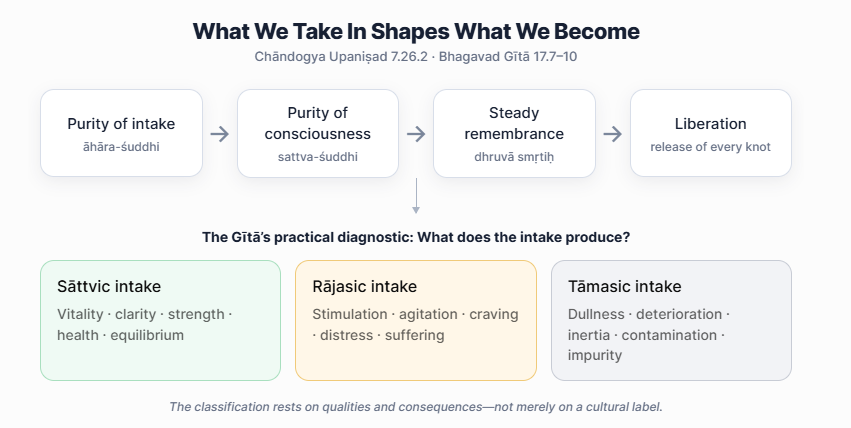
The subsequent verses within the Bhagavad Gītā are more powerful in this regard.
Krishna classifies yajña itself:
- Sāttvic sacrifice—17.11: performed according to scriptural discipline, without seeking personal reward and with the conviction that it ought to be performed.
- Rājasic sacrifice—17.12: performed for some desired result or for ostentatious display.
- Tāmasic sacrifice—17.13: performed without proper scriptural order, distribution of food, mantra, appropriate offering to the officiants or genuine faith.
This means that the Gītā does not permit someone to say:
“It is a traditional sacrifice; therefore it is sacred.”
The Gītā demands a second inquiry:
Is it conducted according to its governing discipline? Is it free of appetite, reward-seeking and display? Is it supported by knowledge, faith, mantra and proper ritual authority?
We have now come to this understanding:
Ramakrishna carried this doctrine down to the level of a single meal. He was exacting about who cooked his food and in what state of mind, because he held that the disposition of the cook entered the food and colored the mind of the one who ate it. This could have been mistaken as fastidiousness. It was not.
It was the Chandogya principle applied with unusual sensitivity. For the aspirant, the lesson is plain. Diet is the one input he can govern by choice, and so the tradition treats sattvik ahara as a deliberate discipline rather than an outcome that only shows up at the end.
We need to remember another important point:
Swami Vivekananda refused to make the plate a moral test, above all for the laborer and the weakened body that cannot bear a strict regimen, and the discipline has to answer to a person's real condition.
He and Ramakrishna agree that outward observance is empty when the inner change never comes, so a pure diet kept only for display, with the appetites and the pride left intact, misses the mark as badly as the festival mutton does. Ahara prepares the conditions.
It does not by itself produce the attainment.
Read this way, the two teachings stop contradicting each other. Purify the intake as the deliberate first step, and let the higher state, when it arrives, finish what the discipline began.
Bengal's Damning Contradiction
There is a larger reason this quarrel matters, and it has little to do with the menu.
Bengal sacralized the feminine more intensely than any other part of India. Kali and Durga sit at the center of its religious imagination, and the Mother is the ruling image of its devotion.
The record of how living women fared in that same land is very hard to hold beside this.
Bengal saw women seized and violated across the long centuries of conquest. Under colonial rule, it saw its women placed in regulated brothels to service British soldiers, and it saw its people worked and then starved through engineered famine.
It saw the atrocities of Direct Action Day in 1946 (the hanging of nude, violated women with body parts cut on butcher's hooks, and numerous gang rapes), the abductions and killings of Partition, and the rape camps of 1971 whose victims are counted in the hundreds of thousands.
In our own time, it has seen the violence around Sandeshkhali and the killing at R. G. Kar. I have set out that record at length in an earlier post, and it won't be good to compress it into a paragraph here. Please read that.
 Desh Kapoor
Obviously, I am not claiming that animal sacrifice caused any of this. That would be a stupid argument.
My claim is narrower is this -
A society can worship the feminine as the supreme cosmic power and yet see its feminine get violated and brutalized. That is precisely Bengal’s contradiction: the symbol was exalted while the living woman was diminished.
Tantric practices were never meant to become casual public custom.
They were bounded by initiation, discipline, spiritual qualification and the authority of a trained guru.
A culture confident in its greatness would have confronted that contradiction honestly. Bengal, for the most part, has chosen not to.
The debasement, and the reflex that protects it
This returns us to the thing Swami Dhirendra Shastri poked at, and Sanyal briskly but clumsily defended.
Turning a controlled tantric practice into a mass cultural practice is not a cultural achievement. It is a debasement.
A rite that the tradition sealed behind initiation, qualification, and prescribed occasion has been opened to everyone and stripped of the discipline that gave it meaning, and what outlives the opening is the outward act with its restraints removed. Ramakrishna saw this and shared his reservation through his behavior it. The texts within Sanatan Dharma have discussed it for centuries.
The reaction to Shastri exposed something worth naming. He is no upstart, whatever the secular press prefers to call him.
He heads an established lineage, carries the weight of real sadhana, whether as the fruit of long tapas or of this life's own labor or of both, and speaks to these questions with a directness that few of his years can manage.
His framing on this occasion joined a sound dharmic point to a political one that speaks directly to the demographic change which has brought Bengal to its current state. Unfortunately, the Bengali festival plate (not its spiritual argument) gave his critics an easy point to rally around.
They settle nothing about the man or his parampara, and this note will not run down one lineage to flatter another.
The deeper reflex on display was a refusal to accept any correction in matters of dharma at all, carried in the voice of injured cultural pride.
That reflex has a history.
The brutal fact is that for decades, a section of the Bengali intelligentsia gave itself to an ideology that hollowed out the state's economy, drove its capital and talent away, and normalized political violence as an ordinary feature of public life, all the while congratulating itself on its refinement.
The self-image of a great culture outlasted its substance.
The freedom to speak openly about dharma in Bengal today owes a great deal to a national political shift that broke the older monopoly on acceptable thought. It would be a small irony if the first use of that recovered voice were to insist that nothing in the inherited practice may ever be questioned.
None of this requires agreement with Swami Dhirendra Shastri. He asked a question of a society that has not yet matured in its full freedom after decades of self-inflicted wounds and centuries of brutality.
The right question is the one the tradition asks of itself.
When the answers are forgotten, and the act continues regardless, the honest word for what remains is not even culture, and certainly not spirituality.
It is a habit that has kept the religious name long after losing the religious substance.