The Gate and the River
In a certain valley, a river ran past a village, and the people drank from it freely, watered their fields, and washed their children in it. No one thanked anyone for the water, because the river belonged to no one.
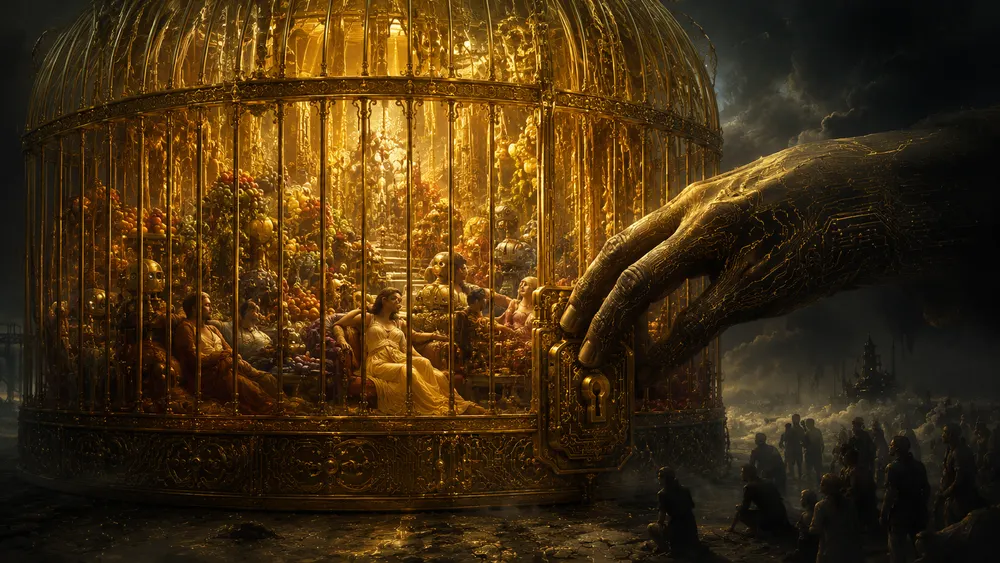
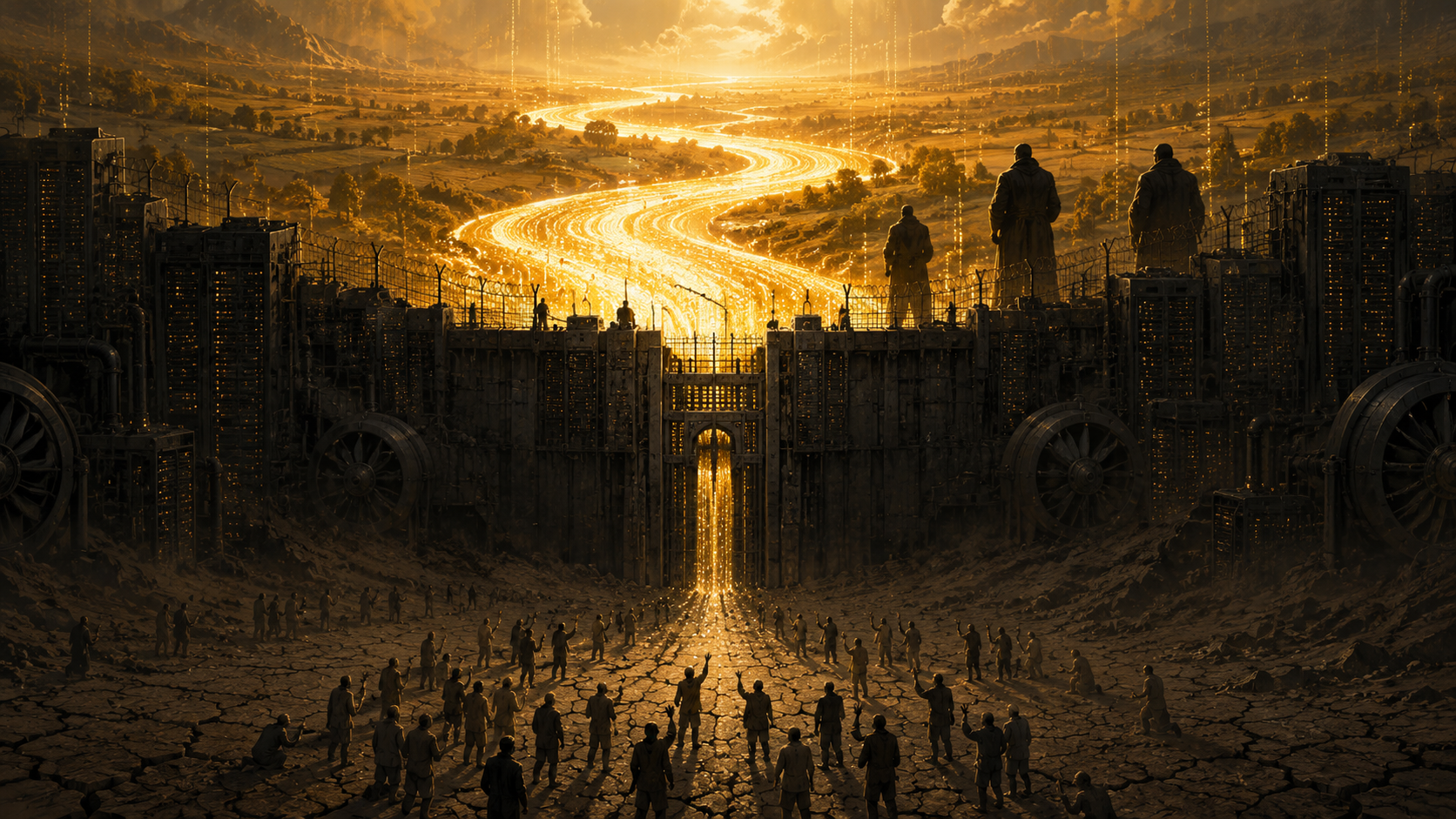
One year, a rich man arrived with a thousand machines and built a great wall across the river. Behind the wall, the water gathered into a lake larger than the village had ever seen. In the wall, he set a single gate, and each morning, he opened it and handed every villager a brimming cup.
"See how generous I am," he said. "You have never had so much water in your lives."
And it was true. The cups were full, fuller than the old river had ever given. The villagers bowed and thanked him. Some wept with gratitude. A preacher came and said the lake was a gift from heaven, and the people had only to keep their hearts open to receive it.
A traveling monk watched the morning line at the gate. That evening he sat with the village elder, who had grown comfortable serving as the gate's keeper.
"They have more water than before," said the elder. "How can they be poorer?"
The monk asked, "Before the wall, when a child woke thirsty in the night, what did she do?"
"She walked to the river and drank."
"And now?"
The elder said nothing.
"You measure the water in the cup," said the monk. "Measure the walk to the river instead."
The elder grew heated. "Would you tear down the wall? The machines are his. The lake is his. He gives freely. We are not slaves. We are fed."
"I have not asked who fills the cup," said the monk. "I have asked who may close the gate."
Word reached the rich man, who came the next day with an offer. "Tell the village I will give two cups each morning instead of one. There are even some who say I should hand over the lake itself. I do not love that idea. But more water I will gladly give."
"You keep offering them the water," said the monk. "I have not yet heard you offer them the gate."
"The gate is mine," said the rich man.
"Then you have answered the only question worth asking," said the monk, and he rose to go.
A young villager ran after him to the edge of the fields. "Master, if we should not simply be grateful for the cup, what should we do?"
The monk pointed to the still lake, where a single great fish moved among the small ones, and all the small ones turned whichever way it turned.
"When the big fish rules the pond," he said, "the small fish do not pray for a kinder mouth. They ask for a rod above the water that even the big fish must answer to, and they ask that the rod be held in many hands, before the day comes when their own hands are no longer needed for anything at all."
He walked on, and the gate opened, and the line formed, and the cups were full.
"Abundance for All!"
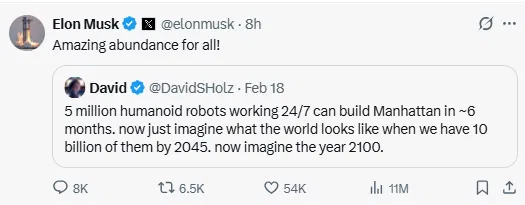
In a tweet, the overarching sentiment of which is nauseatingly familiar, Elon Musk once more emphasized that AI and its related products like humanoid robots will lead to "amazing abundance for all."
Is that how the world of AI will be? Does this sound eerily similar?
Promise of a future of material abundance has been marketed most prominently by communism and also every liberal, capitalist, technocratic, and utopian tradition.
Now watch this. On The Diary of a CEO podcast, JD Vance confirmed the administration favors a "sovereign wealth fund" approach where the U.S. government takes direct equity stakes in companies like OpenAI, Anthropic, and xAI.
In fact, the move with Intel, where the government converted CHIPS Act grants into a 10% equity stake, allegedly turning an $8.9 billion investment into a $67 billion windfall in ten months, is a great example.
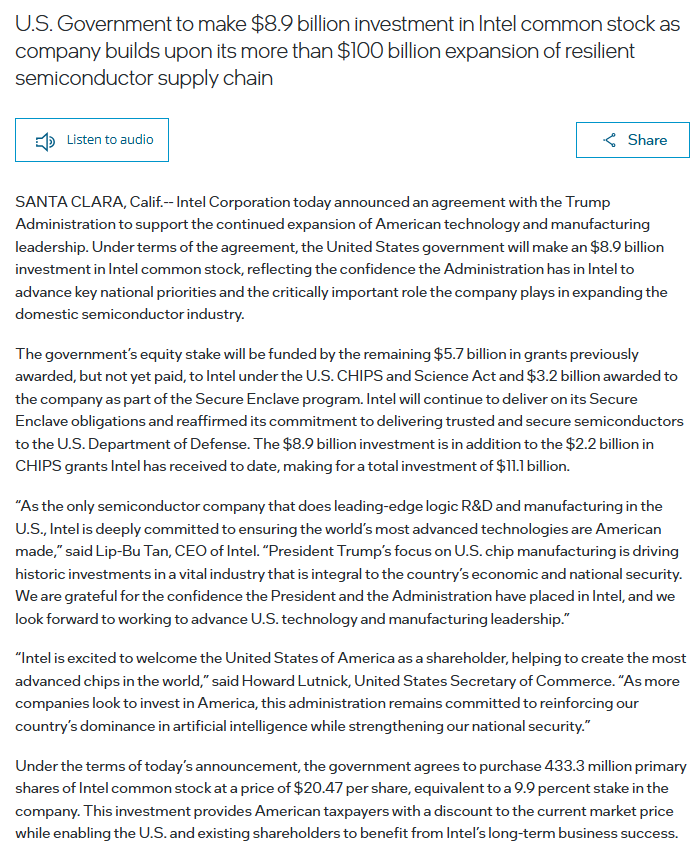
So, if applied across an estimated $5 trillion AI ecosystem, a 10% federal stake would create a $500 billion government position, making the U.S. Treasury a larger asset holder than the entire American hedge fund industry combined.
Basically, in this conversation, JD Vance argues that allowing a handful of tech monopolies to capture 100% of the wealth generated by the next Industrial Revolution while the working class stagnates will cause catastrophic civil unrest. The proposed fix isn't to break the monopolies up, but to make the public a shareholder in their compounding growth. Supposedly so.
The very first and obvious underlying irony is hard to miss - that this discussion and approach completely abandons the 40-year Republican ethos of “deregulate, cut taxes, and get out of the way.”
Instead, it signals a move toward state-backed capitalism.
When Wall Street models government risk, they use a decades-old framework: The Government is a Referee.
Under that framework, the worst thing a referee can do is blow the whistle, throw a yellow card, and assess a penalty.
That is why every financial analyst has modeled Washington’s (government in a generic sense) impact on AI as a series of operating expenses:
- “How much will Anthropic have to spend on copyright lawyers?”
- “What is the probability the FTC hits OpenAI with a $5 billion antitrust fine?”
- “How many compliance officers do they need to hire to satisfy the AI Executive Order?”
In this model, the government is an external friction. A cost to be paid.
You pay the toll, the friction goes away, and the private investors keep 100% of the underlying asset.
If Vance's thesis is the broader understanding of the Washington elite, which, from the deal with Intel, seems to be the case, then Wall Street is fundamentally misreading the room. The administration doesn't want to be the referee anymore; they want to be a co-founder.
You see, when the threat shifts from Compliance to Dilution, the fundamental financial math changes completely!
The "Cap Table" changes
A capitalization table (cap table) is the master ledger of who owns what percentage of a company.
If OpenAI hits a $1 Trillion valuation, and Venture Capital Firm X owns 10% of it, Firm X has a $100 billion asset. But if the U.S. Government steps in and says, “As a condition of securing the national grid power required for your next data center, the U.S. Treasury gets a 15% equity warrant,” the cap table instantly expands.
New shares are created out of thin air for Uncle Sam. Firm X’s 10% slice of the pie instantly gets diluted down to 8.5%. They just lost $15 Billion overnight, and the government didn't have to pass a single new tax law to do it.
"Power Law" of Venture Capital
Venture capital only functions because of the Power Law: 95 out of 100 startups in a fund will die or break even. The fund survives entirely because one company becomes Google, does a 500x return, and pays for all the losers.
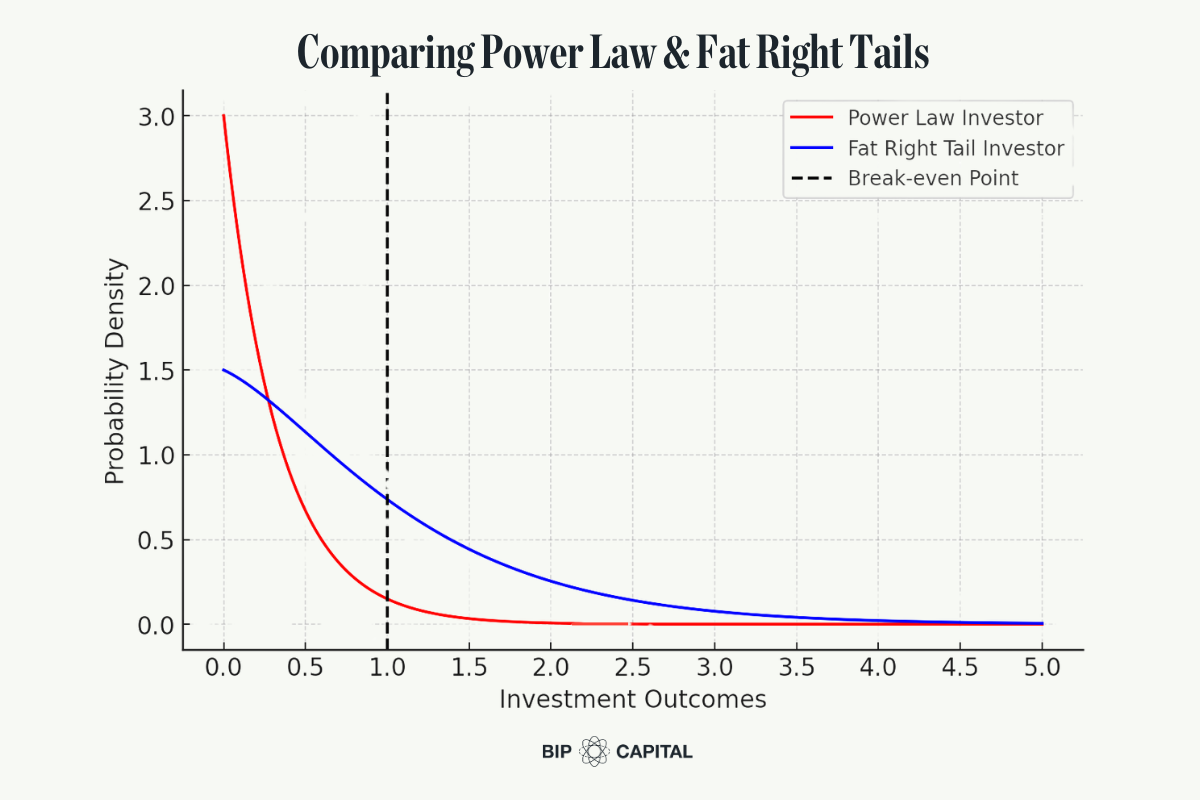
Because of this, VCs require the absolute ceiling of their single winner to be uncapped.
If the government establishes a precedent of "Top-Slicing" or letting founders take all the risk on the 95 failures, but stepping in to take 15% of the equity the moment the 1 success turns into a vital national utility, the risk-to-reward ratio of early-stage tech investing shatters. The fund's math stops working.
Fines are temporary; Equity is permanent
If the European Union fines Apple $2 Billion, Apple's stock takes a 3-day dip, they pay the cash out of their massive reserves, and on Day 4, Apple still owns 100% of future Apple.
If the government takes 10% equity, it owns 10% of the company's cash flow forever.
In the year 2041, long after JD Vance, Joe Biden, or Donald Trump are out of office, the U.S. Treasury would still be automatically sweeping 10% of xAI's global quarterly dividend into the federal coffers.
Is this the New Playbook?
If this shift is real, the "winning" AI companies won't be the ones with the most aggressive Silicon Valley growth hackers; they will be the ones that act like say, Lockheed Martin.
The smart CEO won't hire 400 lawyers to fight the Department of Justice to stay 100% private. The smart CEO will walk into the Oval Office and say:
"We will voluntarily hand the Treasury 12% Class-B non-voting shares. In exchange, we want you to designate us an official instrument of US Soft Power, grant us eminent domain for three nuclear-powered data centers in Ohio, and ban our competitors' hardware export licenses."
Wall Street is currently trying to figure out how AI companies can survive the government. The Vances' take is that the ultimate winners will be those who figure out how to be absorbed by it.
The Communist Promise: A Narrative of Abundance
Marx and later Lenin did not primarily sell communism by emphasizing dictatorship or state control. Those were presented as transitional mechanisms. What attracted millions was a much more optimistic story.
The narrative unfolded roughly like this.
Stage 1: Capitalism Creates Great Wealth, but Unjustly: Karl Marx observed a profound historical paradox at the heart of the Industrial Revolution: humanity had finally mastered the art of mass production, yet the masses remained trapped in squalor. Industrial capitalism, he acknowledged, was a breathtaking engine of innovation. Mechanized factories possessed the unprecedented capacity to flood the world with goods, effectively solving the ancient human problem of absolute scarcity.
However, Marx argued that the fatal flaw of this new economic order lay not in its productive capacity, but in its system of ownership. While the working class physically generated society's abundance, a small class of factory owners pocketed the resulting wealth.
At the core of his critique was the concept of surplus value. Marx posited that the true worth of any commodity was forged by the human labor required to make it. Capitalists compensated workers with mere subsistence wages, skimming off the excess value generated by that labor as pure profit.
Consequently, widespread poverty in the nineteenth century was not an unavoidable tragedy born of a society lacking material resources; rather, it was an entirely artificial crisis driven by unjust distribution. The economic engine systematically starved the very hands that fueled it. This diagnosis offered a very compelling framework for millions of disillusioned laborers. Amid the toxic soot, dangerously unregulated hours, and brutal deprivations of Victorian industrialization, Marx’s argument resonated deeply because it provided both an exact explanation for their daily suffering and a sweeping moral indictment of the architecture that demanded it.
Stage 2: Scarcity Is Artificial: Building on this, Marx advanced a second, even more radical premise: capitalism actively manufactures scarcity.
He argued that the market's core architecture, comprising private property, relentless competition, and an absolute mandate for profit, acts as an artificial bottleneck. In his view, these institutions deliberately choke off the immense material bounty that mechanized industry can provide. His proposed equation was remarkably straightforward: dismantle the restrictive gates of capital, and universal abundance will naturally flood society.
Do you see the striking structural echo in today’s discourse surrounding Artificial Intelligence?
- The 19th-Century Marxist Thesis: Industrial machinery can produce everything humanity needs; only the capitalist ownership of the factories prevents universal abundance.
- The 21st-Century AI Thesis: Autonomous robotics and generative models will soon produce everything humanity needs; only our outdated economic models prevent a post-scarcity utopia.
The technological substrate has evolved from steam and steel to silicon and neural networks. The underlying utopian logic, however, ironically remains remarkably identical.
Stage 3: The End of Economic Conflict: From this premise flowed an astonishingly linear domino effect: once technology secures absolute abundance, the material justification for human strife evaporates.
If everyone has enough, class conflict ceases. Without class conflict, crime drops, war becomes obsolete, and poverty vanishes. Ultimately, the State itself withers away; politics is replaced by mere administration, and “History”, understood as the chronicled struggle over scarce resources, reaches its final terminus.
It was - and still remains - a breathtakingly optimistic vision. In its purest formulation, Communism was rarely pitched to the masses as a grim exercise in forced redistribution; it was sold as the permanent abolition of scarcity itself.
Eerily similar?
Stage 4: Human Liberation: Ultimately, Marx’s vision transcended mere economics; it was a theory of human self-actualization. He believed that once the burden of survival was outsourced to the machine, the individual would finally be free to become fully human.
Rather than spending twelve hours a day as an exhausted, hyper-specialized cog, a person could pivot effortlessly between the arts, the sciences, and the soil. In The German Ideology, Marx captured this in a famously pastoral vision of the un-alienated life:
"...to hunt in the morning, fish in the afternoon, rear cattle in the evening, criticize after dinner... without ever becoming hunter, fisherman, herdsman or critic."
The machine's ultimate promise was the liberation of human identity from the job title.
Listen to the modern pitch for Artificial General Intelligence, and you will hear this exact 1840s promise wrapped in 21st-century branding.
The standard Silicon Valley prophecy that “The AI will do the chores, so humanity can do the art” is functionally identical to the Marxist ideal. We have swapped the steam engine for the server farm, but the dream remains the same: delegating the labor of existence to the machine, so we can finally get down to the business of being alive.
The Difference - Or is it?
The important differences are equally significant.
Marx wanted
- abolition of private ownership of major productive assets,
- class revolution, and
- eventual elimination of markets.
By contrast, when Elon Musk speaks about abundance, he is generally describing a future driven by private technological innovation.
However, when you bring in the arguments by JD Vance, even that difference vanishes. The state can now own innovation platforms!
The Forgotten Earl
In 1804, the 8th Earl of Lauderdale, James Maitland, formulated a remarkably subversive economic paradox. He wrote a book titled "An Inquiry Into The Nature And Origin Of Public Wealth: And Into The Means And Causes Of Its Increase."
He argued that standard economics lazily conflates two fundamentally warring concepts:
- Public Wealth: The sum of everything useful or delightful to humans (clean air, fresh water, freely shared knowledge). Its natural state is abundance.
- Private Riches: The total financial value of ownable assets. Its absolute prerequisite is scarcity. Why? Because you can only charge money for something that people cannot easily get for free.
The See-Saw Effect: From this, Maitland deduced a devastating rule: you usually cannot increase one without shrinking the other.
If you make a vital resource infinitely abundant, its price drops to zero; public well-being skyrockets, but "Private Riches" collapse. Conversely, if you take a free, clean river and put a tollgate on it, the nation’s measured GDP goes up while its citizens get thirstier.
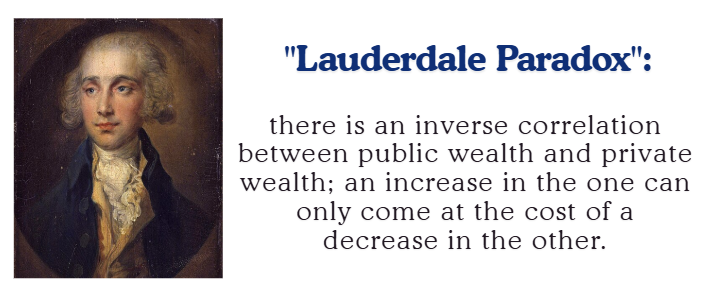
The country's financial ledger grows precisely as the country's actual well-being degrades.
The Engine of Scarcity: Therefore, Maitland was making a simple but extremely powerful point.
He documented the Dutch East India Company literally burning warehouses of spices to keep the market price high. This wasn't a glitch in the system; it was the system working as designed. Scarcity breeds price, and price breeds profit. James Maitland warned that the only thing stopping asset owners from strangling abundance everywhere at once is their inability to organize an airtight, universal monopoly.
The AI Punchline: This is the exact ghost haunting the modern Artificial Intelligence boom. Silicon Valley’s optimists promise a post-scarcity utopia of limitless, free intelligence.
Musk and Maitland
Now go ahead and read Musk's tweet again with Lauderdale in your hand.
Strip away the cheerful framing and he has just announced, in plain text, that the machines are about to commit the one act capital fears most. They are going to make things abundant. They are going to drive the exchange value of manufactured goods toward zero.
Musk is not contradicting Maitland. Instead, he is Maitland's greatest backer.
So here is the question that should follow, and that Musk carefully does not ask.
If the robots are about to make goods nearly worthless, where does the money go? Or come from (to manufacture those robots)? Why would any entrepreneur invest in a business that will make profits impossible?
So, money cannot stay in the goods, because the goods are deflating toward free. It migrates, with the cold logic that Maitland described, to whatever remains scarce.
And Musk himself, in his more candid moments, has already told us what remains scarce.
At Davos, he warned that the binding constraint on the whole AI build-out is energy, that the world will soon be making more chips than it has electricity to run.
So, there is, after all, a scarce factor that is being called out by the man who profits from it.
In a world drowning in cheap robot-made goods, the things that hold their value are the bottlenecks: energy, advanced chips, the frontier models themselves, the data, the compute clusters, and the capital required to assemble all of it.
The abundance could surely be real.
And it is precisely what allows the owners of the scarce inputs to capture everything.
You see, after all, the cheap toaster costs nothing. The grid that powers the factory that manufactures the toasters is a controlled fortress, and it has an owner.
Bounty and the Spread
This is why the sunny, techno-optimistic buzzword "Deflation" conceals the real weapon.
Deflation is never distributed evenly. We are already living in its prototype: over the last thirty years, the price of a calculator, a pair of sneakers, a flat-screen TV, and a gigabyte of data has plummeted toward zero. Over those exact same years, the price of the things that actually secure human dignity, such as a home, a university degree, and an hour with an oncologist, have skyrocketed.
In their 2014 book, The Second Machine Age, economists Erik Brynjolfsson and Andrew McAfee introduced Bounty (the flood of cheap goods) and the Spread (the chasm of who captures the wealth) as the two defining economic consequences of the digital revolution.
The framework describes how technology simultaneously generates massive wealth and unprecedented inequality.
So when Silicon Valley promises "radical AI deflation," they are promising you an infinite Bounty of zero-cost generated sitcoms, while sitting squarely inside the widening Spread.
There are three fatal traps hidden inside their version of the word:
1. The Irving Fisher Trap (The Debt Multiplier): Elon Musk repeatedly claims that AI-driven deflation will save the U.S. economy because falling prices will make the $38 Trillion national debt magically evaporate. This is an inversion of basic macroeconomic math. Irving Fisher's debt-deflation theory revealed a harsh truth: deflation does not ease debt—it steadily increases its real weight. If the general price of goods drops 20%, the fixed dollar you owe on your mortgage just became 20% harder to earn. Debt-deflation is a hydraulic press: it crushes the Debtor (the young, the working class, the leveraged) and infinitely rewards the Creditor (the static holders of capital). The "abundance" of falling prices is actually a high-velocity siphon transferring wealth from those who owe to those who own.
2. The Henry George Trap (The UBI Funnel): Now apply the Lauderdale Paradox to their ultimate olive branch: Universal Basic Income. Suppose the Treasury prints a monthly check for every citizen so they can survive this deflationary transition. Where does that cash go? It doesn't sit in checking accounts. It instantly chases the things that remain strictly scarce (housing, land, electricity, and computing), bidding up their prices. In 1879, Henry George wrote a landmark book titled "Progress and Poverty". It investigates why poverty increases alongside economic and technological progress. As Henry George realized in 1879, any universal subsidy poured into an economy with private bottlenecks flows instantly to the owner of the bottleneck. A UBI check is simply a closed-circuit pipe running from the Federal Reserve, briefly brushing against a citizen's fingertips, and depositing itself into the bank account of the guy who owns the data center or the apartment complex. It feeds the zoo animals; it does not open the cages. In fact, it reinforces the cages!
The Bottom Line: This is why the modern titans of tech are so magnanimously eager to talk about distributing the output. Giving away the digital milk costs them nothing, so long as they retain exclusive title to the physical cow. They will debate tax rates, fund UBI pilots, and celebrate consumer price drops. The only topic strictly forbidden from the room is the cap table.
Here is an interesting discussion with the Stanford economist, Chad Jones. He does not mention Lauderdale, and yet he has built a small Lauderdale machine.
His model is the weak link.
Automation replaces slowly improving humans with rapidly improving machines, link by link.
Ultimately, the scarce factor captures the value.
If machines take over seventeen of twenty links and humans still hold three, those three human links become the bottleneck, and the bottleneck commands the high share of the reward.
So even as humans do fewer and fewer tasks, the few tasks they still do can be worth more, and wages need not collapse. His proof is the radiologist, who was supposed to be automated out of existence a decade ago and is instead more numerous and better paid, because the machine took the easy scans and left the human the hard, scarce, valuable judgment.
Notice that this is simply Lauderdale in modern economic language. Value flows not to what is abundant, but to what remains scarce. That is the paradox expressed as a production function, and it leads precisely where Lauderdale's argument always does, beyond the point where Jones politely stops.
The comfort of the weak-link story depends on humans remaining the scarce link.
The declared purpose of the artificial general intelligence project, stated proudly by the very people building it, is to automate the last three links as well, leaving no task at which the human is the irreplaceable bottleneck.
The radiologist is safe until the model reads the hard scans, and the labs are spending hundreds of billions precisely to teach it to read the hard scans.
Push the model one step further, and it stops being a comfort and becomes a verdict. If the scarce factor captures the value, and human labor is no longer scarce because the robots are abundant, then what is the scarce factor in the AI economy?
It is the bottleneck Musk already named: energy, chips, the frontier models, the compute, and the capital.
Jones's own framework, carried to its conclusion, predicts that value flows to the owners of those irreducible scarce inputs, and that those inputs are exactly the ones now concentrating in a handful of hands.
When economist Chad Jones is asked who will ultimately benefit from an AI-driven age of abundance, his answer is that economics is good at explaining how to make the economic pie bigger, but not how to divide it. He argues that questions about who gets the gains belong to politics, institutions, and society rather than economics itself.
That response is understandable, but it also reflects a long-standing tradition in economics. Since the late nineteenth century, much of the discipline has focused on how markets create wealth and determine prices, while leaving questions of ownership and distribution largely to political debate. In doing so, the deeper question of who ultimately captures the wealth created by greater productivity often remains unanswered.
Yet that unanswered question is the one that matters most.
AI and robotics may dramatically expand production, but abundance alone does not determine who benefits. Ownership, institutions, and political choices do.
An economy can produce extraordinary wealth while leaving its distribution highly concentrated.
Growing the pie is only half the story. How it is divided determines whether prosperity is broadly shared or accumulates in the hands of a few. In the end, production creates the wealth, but distribution determines who actually enjoys it.
Feeding the Population
Let us go back now.
This is the oldest instrument of rule there is.
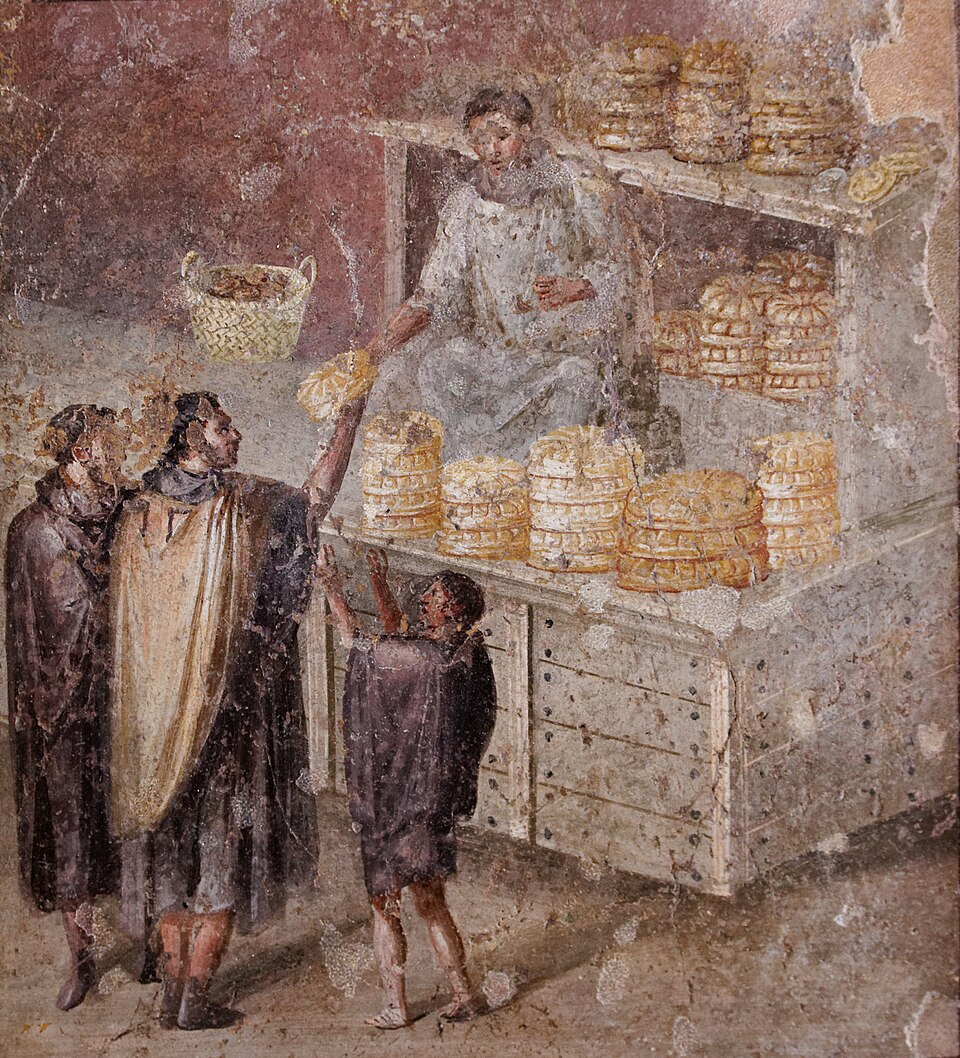
Rome called it the annona, the grain dole, bread handed down to a volatile urban crowd to keep it fed and quiet while the patrician order kept everything that mattered.
The dividend is the annona with direct deposit. It is generosity engineered to preserve ownership.
Sam Altman's proposal is more thoughtful and yet lands in the same place.
He prefers what he calls universal basic wealth to a mere check, an ownership share rather than a handout, and he floats giving every person a slice of the world's AI tokens.
One could credit him with seeing that people need a stake, not just a stipend. But a token is a claim on compute that his class owns and issues, denominated in access to their machines, revocable at their discretion.
Here is the rub - at the end of the day, it is a company scrip, the currency of the company town, redeemable only at the company store, and the company store is the cluster.
The tokens can be bought and sold, so they soon end up in the hands of those with the most money. People who need cash sell them, while wealthier people keep buying more. Within a generation, the equal distribution disappears. The system gives people a share of the output but calls it ownership, even though real ownership never changes.
The state-equity proposal, carried by Vance and Trump and pushed harder by Sanders, is the one that appears to touch ownership, and it is the most interesting and the most double-edged.
Its moral foundation is genuinely strong, and Sanders states it cleanly: AI was not conjured from thin air, it was built on the collective knowledge of humanity and on decades of publicly funded research, so the public already holds an unrecognized equity in it.
Mariana Mazzucato has long argued that many breakthrough technologies were funded by taxpayers, while most of the profits went to private companies. From this perspective, a government stake is not confiscation but a return on a public investment. Supporters point to examples like the government's roughly 10% stake in Intel, acquired through chip subsidies, which reportedly increased substantially in value.
But Lauderdale's insight, viewed alongside the Dharma conception of power, exposes a greater danger. Public ownership of AI does not automatically place society in control of technology.
It can instead merge economic power with state power.
History offers sobering examples of what can happen when those two become inseparable. In the twentieth century, systems that concentrated ownership, coercive authority, and political control in the same institutions often produced rigid elites and weak accountability, rather than the egalitarian societies they promised.
The concern becomes even more significant with frontier AI. If the same institution owns the most powerful AI systems while also exercising the state's monopoly on force, taxation, surveillance, and lawmaking, an extraordinary concentration of power emerges. The question is no longer simply who owns the means of production, but who owns the means of cognition—the systems that increasingly shape how information is created, filtered, recommended, and acted upon.
Critics point to situations where governments are simultaneously investors, regulators, subsidy providers, and public advocates for strategic industries, arguing that these overlapping roles can blur the distinction between impartial governance and ownership interests. As these relationships deepen, concerns about conflicts of interest naturally grow.
Ironically, JD Vance himself expressed concern in the same interview about AI evolving into an opaque social-credit-like system, one where algorithmic decisions could determine access to everyday aspects of life, even something as simple as buying a beer.
Whether or not that specific scenario materializes, it illustrates the broader question.
The Fish and the Rod
The classical Indian political tradition has a name for the world that emerges when power answers to no higher authority.
It is Matsya Nyaya, the law of the fishes, the condition in which the large fish devours the small fish because no force restrains it.
The Mahabharata and Kautilya's Arthashastra both describe Matsya Nyaya as the natural order in the absence of danda, the rod of righteous restraint, and present the entire purpose of sovereignty as preventing that natural state.
This is a colder and truer anthropology than the one underneath the "abundance gospel."
This gospel assumes that a properly aligned cosmos tends toward benevolence and plenty for all..
The Dharmic tradition assumes the opposite: that power, left to itself, tends toward predation, and that this predation must be bound by a structure above it, or it will run. The entire record of human history, the enclosures and the spice-burnings and the throttled harvests Lauderdale cataloged, sides with the colder yet Dharmic view.
The companion idea is danda niti, the science of restraint, and it contains the single requirement that the abundance debate is missing. The rod must fall on the king too.
Kautilya, who was no sentimentalist and who designed one of history's most formidable states, insisted that the sovereign himself be bound, that there be a rod over the rod, because an unbound sovereign is simply the largest predator wearing a crown.
Apply this to our discussion.
Above the medieval lord stood, in principle, the king and the sacred order. Above the industrial capitalist stood, in time, the organized worker and the regulatory state and the credible threat of revolt.
The owner of intelligence itself, in a world where labor and arms no longer give the many any leverage, threatens to become the first great fish in history with no rod above it at all.
And the state-ownership solution, examined through danda niti, does not solve this. It risks making it worse, because it removes even the distinction between the fish and the rod, merging them into one body that owns the cognition and wields the danda and answers to nothing.
Is Abundance Coming Or Slavery?
Lauderdale told us two hundred years ago which way the owners will push, and that nothing but the impossibility of their coordinating against us protects the public wealth from their avarice.
The terrible novelty of the AI moment is that the owners are coordinating now, fewer and richer and more aligned than any owning class in history, and the levers that once let the many push back, the scarcity of our labor and the need for our arms, are being quietly removed from our hands even as we watch the show.
The abundance is coming. On that, the prophets are right. But abundance has never once in human history distributed itself, and it will not begin now. It will go where Lauderdale said it goes, to whoever owns the thing that stays scarce, unless a rod is raised over that owner by the people themselves, in time, by right.
That is the work that is actually unfolding, beneath the cheerful tweets about deflation and the sermons about Eden.
It is the oldest work there is, the building of danda from below, the assembling of a claim that the powerful must honor rather than a favor they may withdraw. No one in the contemporary world is doing that work, because it is the one outcome none of them would survive.
It falls, as it always has, to everyone else, and the window in which it can be done is the narrow years before the machines finish making us unnecessary. See the abundance, by all means. But see the giant first.