With odd old ends stol'n out of holy writ;
And seem a saint, when most I play the devil.”
― William Shakespeare, Richard III
The Watchers on the Wall
For three winters the sentries cried the same warning. "The army will come from the north. This year, or the next, or the one after." They polished their spears and watched the northern road until their eyes ached.
The old abbot did not watch the road. Each morning he pressed his thumb into the mortar between the stones.
"Master," a young monk asked, "the enemy is to the north. Why do you finger the wall?"
"Because the enemy is patient," the abbot said, "and patience is in no hurry to be seen."
Across the valley the general never marched. He sent no ram. He let the sentries grow tired. He let one winter's frost, and then another, work into the seams the abbot touched. He whispered to the watchers on the east wall that the northern watchers were fed better than they.
By spring the sentries were quarreling among themselves, facing inward, their spears lowered.
The wall did not fall to an army. It fell one stone, loosened by frost and neglect, on a quiet morning when no one was watching the wall at all.
The abbot pressed his thumb once more into the mortar, and said nothing.
The Wolf is coming today or tomorrow or 3 years from now
A new US intelligence assessment warns that Vladimir Putin could test NATO between 2026 and 2029. It would not be a full-scale invasion though. Per the reports, Russia will seize a sliver of Baltic territory or launch an ambiguous “gray-zone” operation designed to evade an overwhelming Article 5 response.
The Newsweek report also alludes to the use of hybrid or "gray zone" tactics.
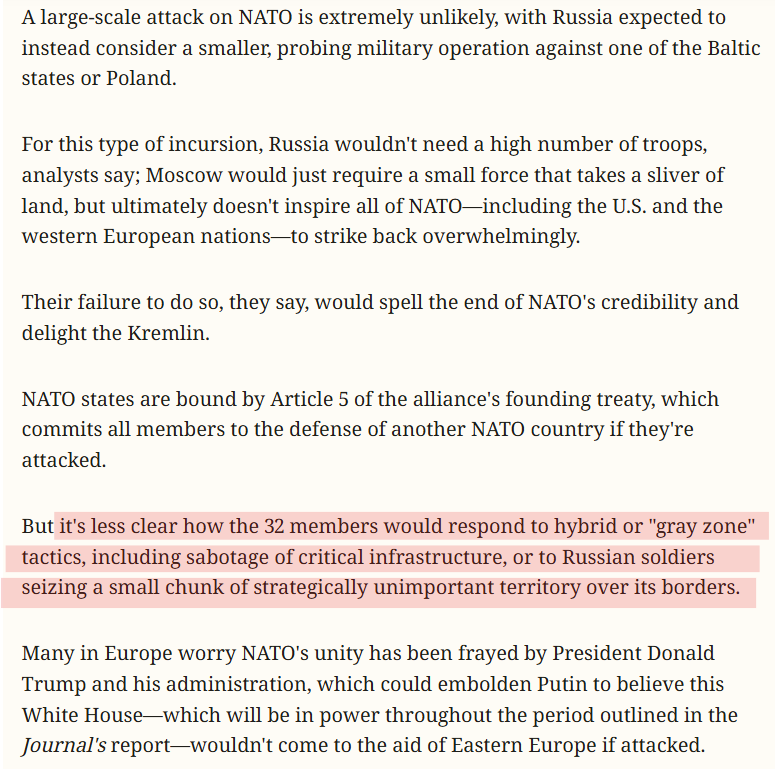
Quite frankly, as "strategic" as this report is made to sound, it is an oddly pedestrian scenario.
Combine that long-term possibility with the separate risk of near-term gray-zone probes, and the headline becomes “this autumn to 2029.”
Such a broad window is less prediction than insurance: it covers an incident next month and a rebuilt Russian force years later. Politically, it sustains American engagement and European rearmament.
Analytically, however, it reveals very little about when Russia might act.
Russia is unlikely to announce its intentions by crossing a border simply to discover whether NATO still works. There are far more sophisticated scenarios that it could use to inflict far more damage.
Moreover, Putin is not some lunatic and egotistical despot who would attack at a whim. He's intelligent with far deeper understanding of geopolitics and warfare than many in Western media would credit him for in open conversations. Why they would create such a caricature is a good question for us all to ponder.
For example, a more sophisticated strategy would use Kaliningrad to pressure Baltic reinforcement, the Arctic to stretch NATO toward Greenland and the North Atlantic, Ukraine to consume Western missiles and interceptors, and sabotage, cyberattacks and deniable provocations to fracture political consensus.
That raises a larger question.
Is this merely an intelligence warning, or strategic communication intended to prepare Western publics for rearmament, counter-operations and confrontation? Some hypothetical Estonian village cannot be a target for it will gain Russia nothing. Rather, it will open it up to justification for unleashing the combined NATO wrath on its soil.
So I would not read this as some kind of a "forecast". It ought to be seen as an instrument. Western governments want political authorization to begin treating dispersed Russian pressure as one integrated campaign. They would also want to mobilize industrially before an unmistakable invasion gives them no choice.
It is between Russian strategic compression, Western narrative preemption and Europe’s race to mobilize industrial power.
So here is the interesting thing. Putin will have understood that immediately. His likely response would be to ensure that the next phase does not resemble the warning, cannot be attributed as one campaign, and makes NATO’s mobilization itself appear to be the initiating act.
The emerging contest is therefore larger than Russian strategic compression versus European industrial mobilization.
It is also a contest between Russian operational ambiguity and Western narrative preemption.
Here are some plausible reasons why Western intelligence would have "leaked" this Russian threat into the public domain.
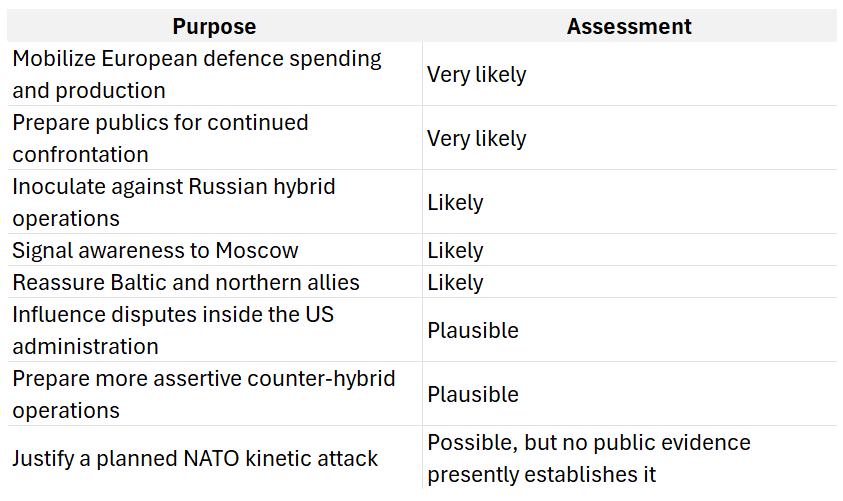
All this is being done so that Washington wants the established sequence to be:
Russian preparation → Western warning → defensive NATO response.
Moscow would, of course, have a very different take and hope on how to use this report and its aftermath. Putin's arguments, as simplistic as this report and Western media's assertions are, may go along this sequence.
Western encirclement → manufactured Russian threat → NATO escalation → necessary Russian response.
The overall goal is that whoever establishes the accepted causal sequence gains diplomatic latitude when ambiguous incidents begin.
In this milieu of narratives and counter-narratives driven news reports based on "strategic" (but naive) "leaks" comes another news.
The drones found in Bulgaria. It is the kind of incident that exposes both the relevance and the danger of the new NATO warning.
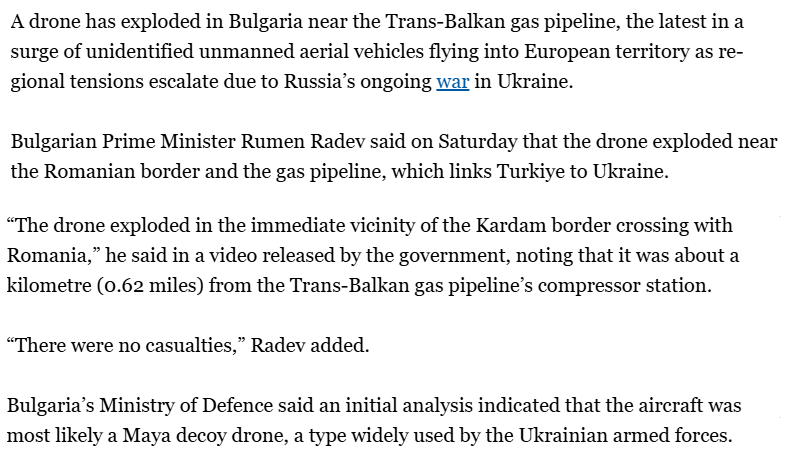
A drone exploded near the Romanian border, roughly one kilometer from a compressor station on the Trans-Balkan gas pipeline linking Turkey and Ukraine. There were no casualties. Yet its proximity to strategic energy infrastructure immediately placed the incident inside Europe’s growing narrative of Russian gray-zone warfare.
The complication in this scenario needs to be fully grasped.
Bulgaria’s preliminary assessment identified the aircraft as most likely a Maya decoy drone widely used by Ukrainian forces. That does not establish who launched it, why it entered Bulgaria, or whether the explosion was deliberate. It does, however, demonstrate why the coming confrontation may be defined by attribution rather than invasion.
Was this navigational spillover, Russian electronic manipulation, a false-flag operation, or something else entirely? Before NATO can decide how to respond, it must first determine what happened and prevent ambiguity itself from becoming either Russia’s weapon or the West’s pretext.
Falling Inventories
Meanwhile, we are also looking at these warnings.
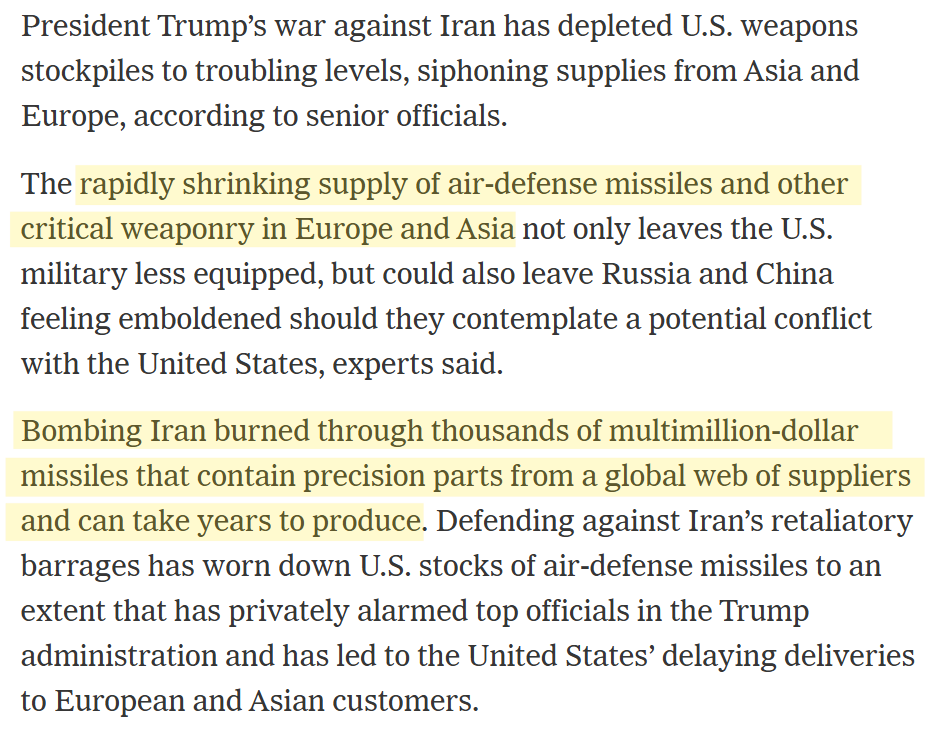
What do they signify in the light of earlier reports? The immediate danger may not be that Russia has suddenly acquired the strength to defeat NATO. It may be that Moscow sees a temporary period in which the United States cannot adequately supply Ukraine, defend Europe, sustain the Iran war, and preserve the missiles required for a confrontation with China. All at the same time!
Planned war vs Inflicted Battles
For decades, American military strategy assumed that technological superiority would compensate for smaller inventories. The United States would fight short, intense campaigns, achieve air superiority quickly and replenish afterward.
That model is colliding with prolonged missile warfare that the US and the Europeans have taken on themselves.
The US inventory is now being pulled in four directions:
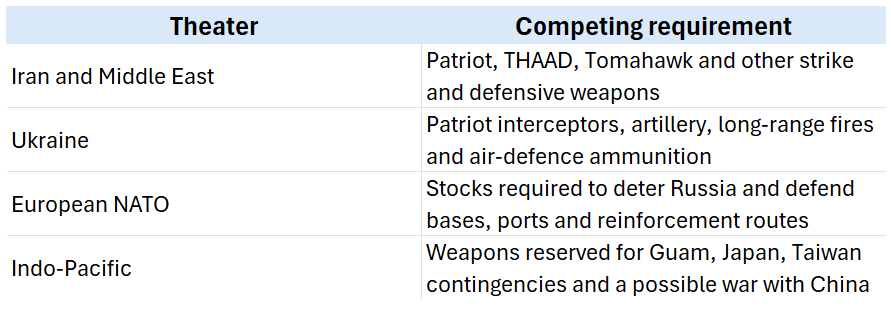
Many of these theaters need the same weapon families. A Patriot interceptor assigned to defend a Gulf airbase cannot simultaneously defend Kyiv, Poland or Guam.
This is not merely a budgetary problem. It is a problem of physical scarcity.
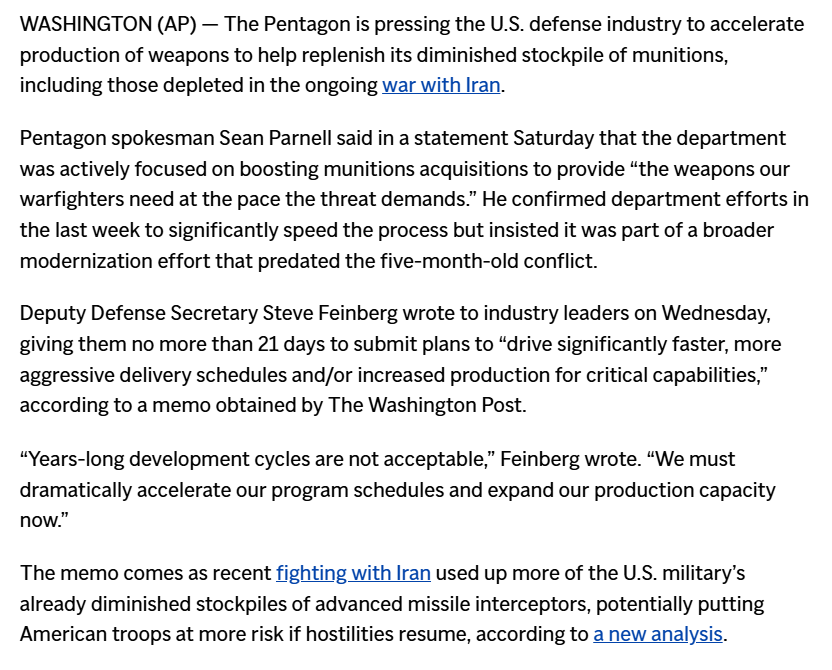
The report in the screenshot says the Iran war has consumed thousands of expensive missiles and forced Washington to draw supplies from Europe and Asia. Other reporting goes further.
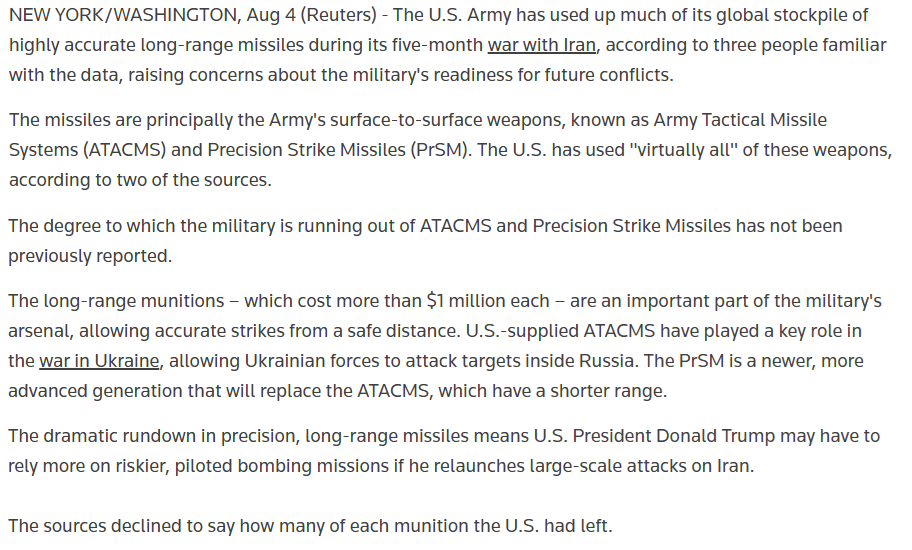
Reuters reported that the United States had used “virtually all” of certain long-range precision-missile inventories allocated for the Iran campaign, while military commanders had warned President Trump that Patriot and other defensive stocks were dwindling.
The Atlantic, citing current and former defense officials, reported that inventories of some munitions had fallen to approximately 20% of the Pentagon’s preferred levels. Mark Cancian of the Center for Strategic and International Studies estimated that replenishing some stocks to pre-war levels could take as long as five years—and approximately three years to reach levels comfortable for an Indo-Pacific contingency.
America's stockpiles have been under strain for years, but became painfully clear after Russia invaded Ukraine in 2022. The U.S. military fired hundreds of missiles, some costing millions each, during the Trump administration’s 53-day campaign last year against the Houthis in Yemen. That was followed by nearly two weeks of U.S. and Israeli attacks on Iran and the interception of Iranian missiles and drones aimed at Israel. During the first 38 days of the Iran war, the U.S. launched thousands of munitions. Hegseth has repeatedly denied any shortage, including to Trump as recently as last week, one U.S. official told us. On Capitol Hill, the defense secretary did not make a compelling case for the funding he wants, particularly to legislators who face tough reelections partly because of the war’s unpopularity. Between American voters’ frustrations with rising gas prices and Hegseth’s mixed messages and past combative relationship with Congress, “there is no goodwill for the department here,” one congressional aide told us. Still, Congress is ultimately expected to provide much of the funds the Pentagon says it needs to replenish its stores. But what the U.S. really needs is time. Depending on the weapon, replenishment to prewar levels could take as long as five years, Mark Cancian, who tracks munitions stockpiles for the Center for Strategic and International Studies in Washington, D.C., told us. Another three years would get stockpiles “to a level where the joint staff and U.S. commanders in charge of the Asia Pacific would be comfortable,” Cancian said. In theory, that gives Beijing plenty of time to take advantage of American shortages with, say, an invasion of Taiwan. (Source: How the U.S. Squandered Its Strategic Advantage / The Atlantic)
The administration and Pentagon publicly dispute claims that America is dangerously short of weapons. Exact inventories are classified, so the most alarming numerical estimates cannot be independently established. Nevertheless, the policy response strongly suggests that the shortage is not imaginary:
- The Pentagon has demanded accelerated production plans from defense manufacturers.
- Washington has signed contracts exceeding $3 billion to expand Patriot and THAAD component production.
- Production capacity is intended to triple for Patriot-related components and quadruple for THAAD.
- Tomahawk production is reportedly targeted to increase dramatically.
- A second source is being developed for critical PAC-3 rocket motors.
Governments do not urgently create alternative rocket-motor suppliers and demand emergency industrial plans unless they perceive a material capacity problem.
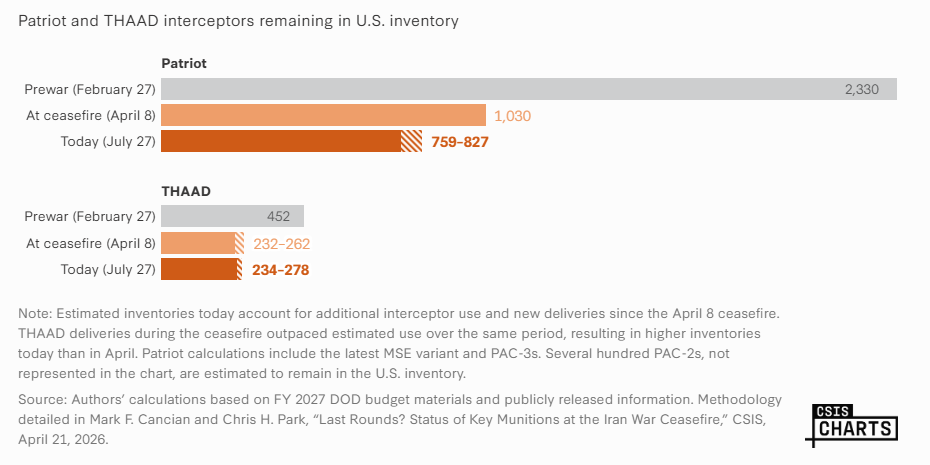
A CSIS report shares these figures.
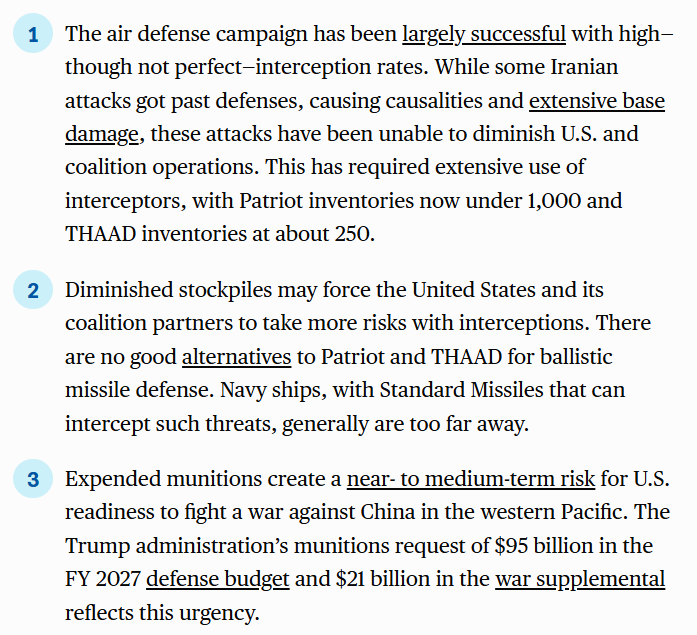
The report further shares these three points.
Admiral Samuel Paparo, commander of US Indo-Pacific Command has echoed this warning while testifying before the Senate Armed Services Committee in April 2026, Paparo warned:
“There are finite limits to the magazine.”
He expressed confidence that weapons were being used judiciously, but his choice of words was important. In military terminology, the “magazine” is the available stock of weapons that can actually be fired as opposed to some future contracts, appropriated money, or theoretical factory capacity.
 Joe Gould
Paparo had sounded a related warning before the present Iran war. In November 2024, he said the transfer of Patriot and air-to-air weapons to Ukraine was beginning to consume stocks required for US preparedness in the Indo-Pacific. His concern was not that supporting Ukraine was strategically wrong; it was that production was failing to replace weapons at the rate required to support multiple theaters.
The Pentagon’s present predicament is therefore not a surprise created entirely by Iran. Iran has accelerated and exposed a structural weakness that senior commanders were already identifying.
The most serious shortage is not necessarily bombs. It is defensive interceptors.
An air campaign can be reduced, postponed or redirected. Defence cannot be suspended so easily when missiles are approaching a city, airbase or aircraft carrier.
Patriot and THAAD interceptors contain:
- sophisticated seekers;
- guidance and control systems;
- specialized energetic materials;
- solid rocket motors;
- precision electronics;
- components produced by a limited number of suppliers;
- systems requiring extensive testing and certification.
Factories cannot simply add a second shift and produce them like artillery shells. Some components have long lead times, and new production facilities may take years to qualify.
The strategic asymmetry is severe.
Even when the defender shoots down the incoming weapon, the attacker may win the industrial exchange.
And then... Ukraine's Warning
Ukraine says its deliveries of Western missile interceptors in 2026 have fallen to roughly one-third of the 2025 level.
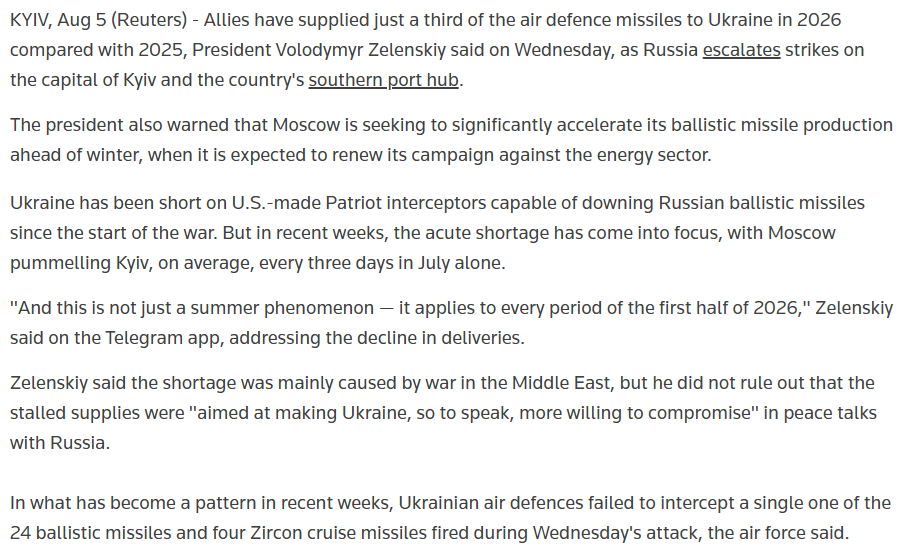
The reduction has coincided with intensified Russian ballistic-missile attacks and instances in which Ukrainian defenses were unable to intercept any of the incoming ballistic missiles.
This is how the process of weapons deployment and the ensuing crisis seems to be working.
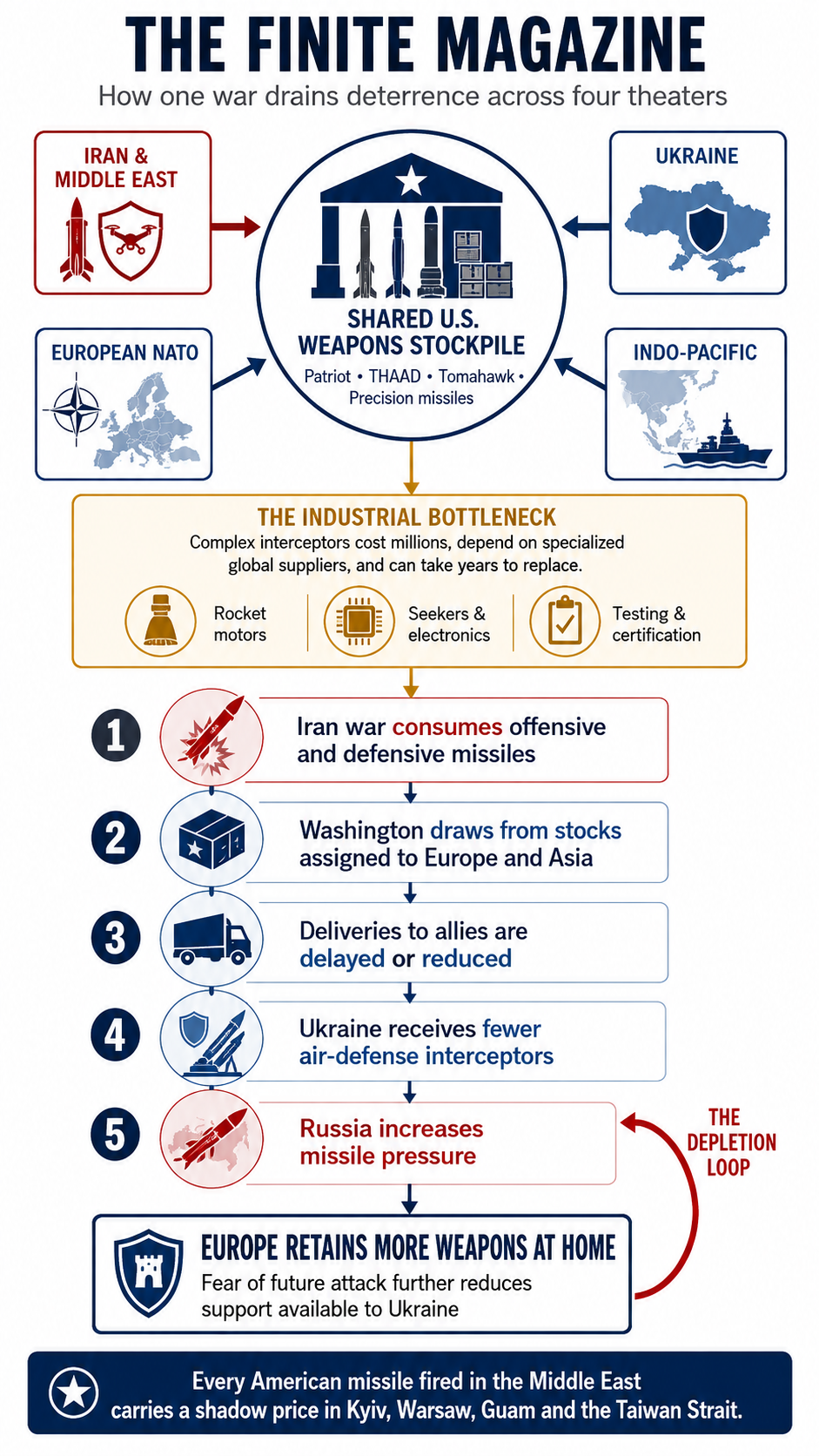
The shortage therefore compounds itself. As Ukraine becomes more vulnerable, Russia appears more dangerous. As Russia appears more dangerous, European governments become less willing to release their remaining interceptors to Ukraine.
Moscow does not have to destroy Europe’s missile stocks directly. It can make Europe afraid to part with them.
Please watch this commentary from Fareed Zakaria as well.
Zakaria’s roundup argues that several Trump-era choices are reshaping global power, often against U.S. interests.
He says pressure on NATO and Europe has inadvertently pushed European states toward greater military cohesion and autonomy, potentially weakening America’s long-standing leadership role in the alliance.
The Iran war, meanwhile, has delivered China a strategic windfall: it advances a Middle East less reliant on Washington, deepens global dependence on Chinese critical technologies, and helps Beijing appear comparatively stable and capable.
Window of Opportunity or Vulnerability?
This creates what strategists call a window of vulnerability.
Russia and China do not have to believe that the United States is permanently weak. They need only conclude that, for a limited period:
- American inventories are below preferred levels;
- replenishment will take several years;
- Europe cannot replace US air and missile defense quickly;
- the United States is politically and militarily absorbed by Iran;
- Ukraine is becoming more exposed;
- Washington must preserve weapons for Asia;
- simultaneous crises would force painful allocation decisions.
That does not automatically mean either country will begin a major war. But it can encourage more aggressive risk-taking.
Russia might intensify pressure on Ukraine, test NATO’s northern or eastern flank, increase Arctic and Baltic activity or create hybrid incidents that force NATO to expend readiness and redistribute defensive systems.
China could intensify coercion around Taiwan, increase exercises, pressure the Philippines or test American willingness to place additional scarce systems in the Indo-Pacific.
The strategic danger is not coordinated invasion on a predetermined date. It is competitive opportunism: each adversary exploiting the burdens created by the others.
Supply Chains: The Factory Behind the Factory
The interceptor shortage exposes the West’s lack of manufacturing depth. This F-35 episode reveals an even deeper problem: parts of the Western defense-industrial base remain dependent upon supply chains running through its principal strategic competitor.
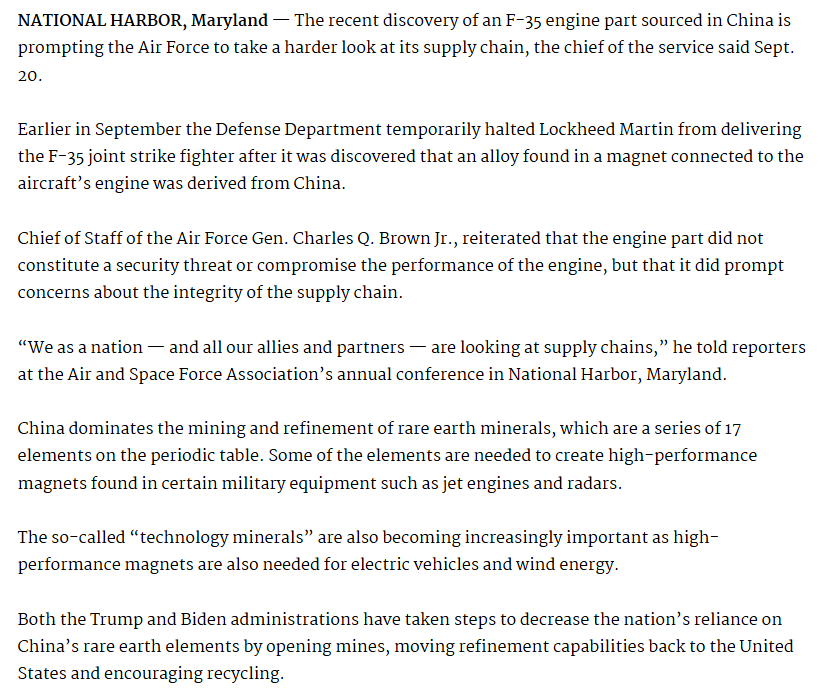
The report is from September 2022, when the Pentagon temporarily suspended F-35 deliveries after discovering that a magnet in the aircraft’s turbomachine—a unit associated with the engine’s lubrication system—contained a cobalt-samarium alloy manufactured in China. The component presented no safety, performance, surveillance or information-security risk. Nevertheless, its Chinese origin violated American defense-procurement rules. Deliveries resumed in October under a national-security waiver while an alternative source was introduced.
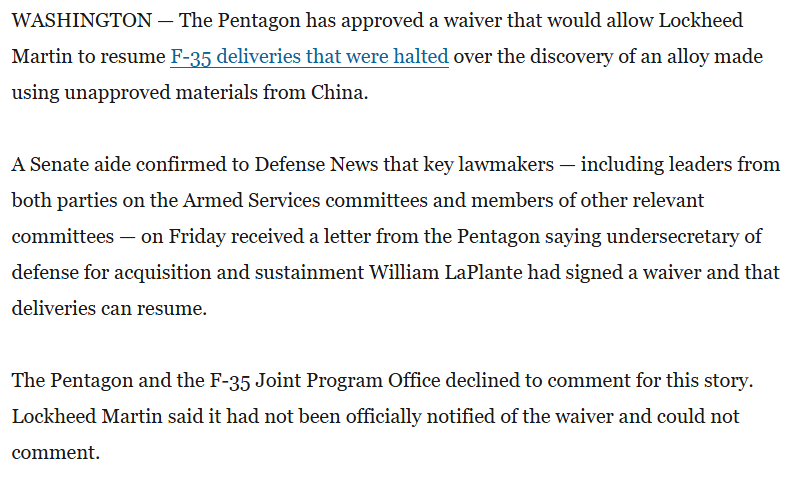
The significance lies not in one magnet. It lies in the fact that the Pentagon and Lockheed Martin did not initially know it was there.
In 2025, the US Government Accountability Office reported that Lockheed discovered additional prohibited Chinese magnets in the F-35 supply chain during 2023 and 2024. Manufacturing was paused while alternative suppliers were identified. Without Lockheed’s disclosures, the Pentagon might not have known their origin. Investigators also found Chinese-made robotic equipment on the F-35 assembly line.

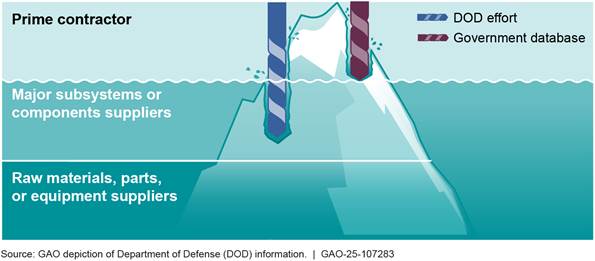
This exposes the difference between owning a weapons factory and controlling the industrial chain behind it.
The fact is that America may mine rare-earth ore domestically while still depending on foreign separation, metallization, magnet manufacture or component processing.
Every stage requires specialized chemistry, equipment, intellectual knowledge and qualified suppliers. Replacing the final Chinese component therefore does not necessarily remove the upstream dependency.
China’s greatest leverage is concentrated downstream from mining, particularly in processing and high-performance permanent magnets used in:
- missile guidance and control;
- radar systems;
- jet engines and aircraft subsystems;
- electronic warfare equipment;
- drones and precision weapons;
- electric motors and power systems.
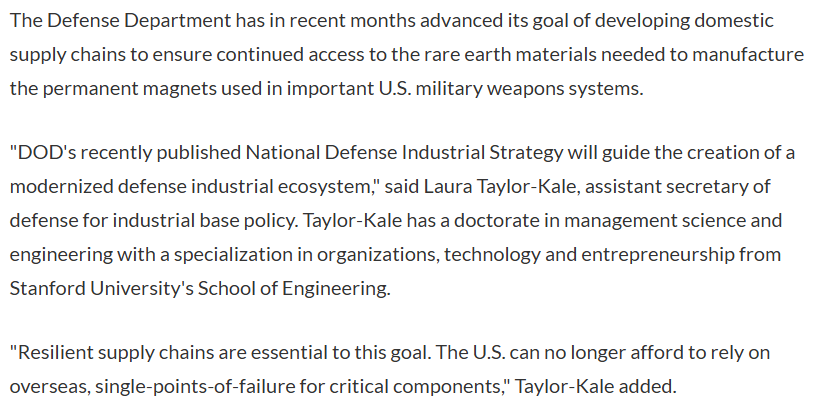
The Pentagon has invested in a domestic “mine-to-magnet” chain, including more than $439 million committed by 2024 and subsequent loans supporting heavy rare-earth separation, metallization and magnet manufacturing.
But this reinforces our previous conclusion: money precedes capability by years.
A new interceptor plant cannot produce missiles without rocket motors, seekers and qualified electronics. Those suppliers cannot produce components without processed minerals, magnets and specialized chemicals. And new suppliers cannot immediately enter a military program without testing and certification.
The F-35 incident was not evidence that China could remotely compromise the aircraft. It was evidence that the United States lacked complete visibility into its own most important weapons program.
That has profound implications for the supposed 2026–29 industrial window. Western production plans assume that critical inputs will remain available while factories expand. China could complicate that recovery without firing a missile—through export controls, licensing delays, price manipulation or restrictions on processed materials and manufacturing equipment.
The strategic race is therefore not simply between Russian reconstitution and Western weapons production. A third actor sits inside the production equation:
The West’s challenge is consequently larger than building more factories. It must reconstruct the factory behind the factory that goes from mineral processing and magnets to rocket motors, seekers and certified components.
Until then, European and American rearmament will remain vulnerable to a fundamental contradiction: the weapons intended to deter China may still depend, several layers down, upon industrial capabilities China controls.
Let us explore that now.
The Northern Arc: Kaliningrad, the Arctic, Greenland, Scotland and Ireland
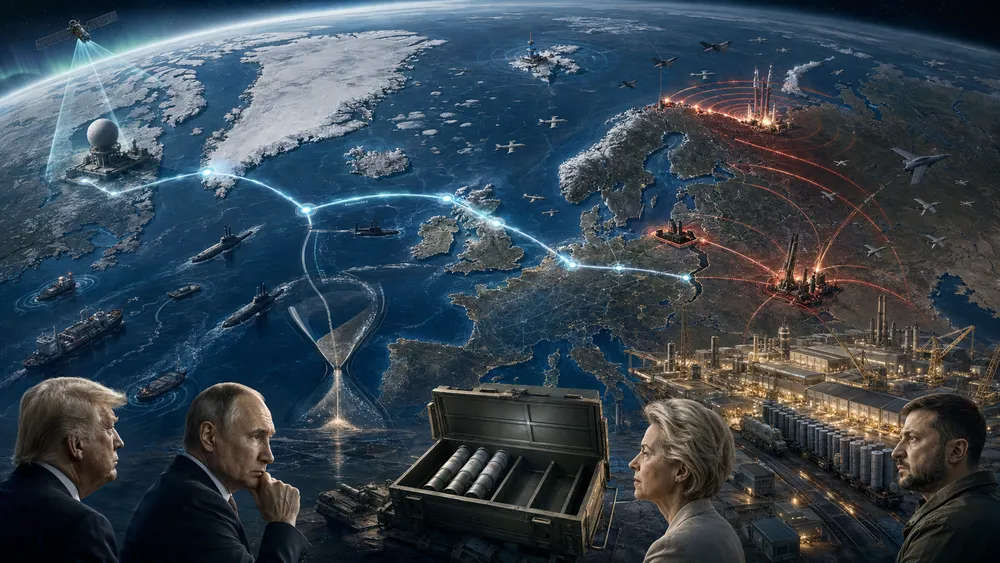
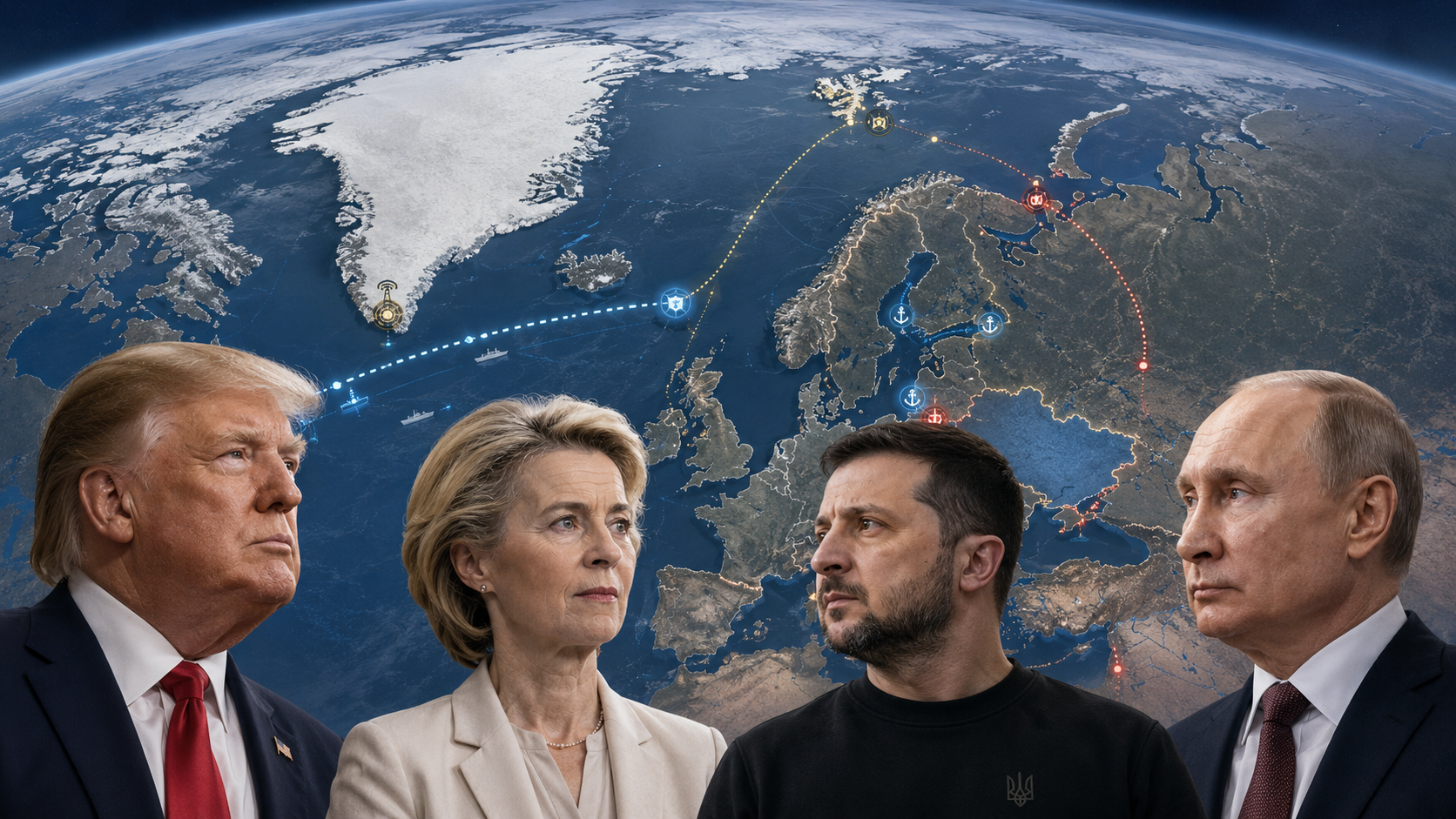
The familiar scenario of a Russian attack on NATO begins in the wrong place. It imagines Russian troops seizing a Baltic village, then waiting to discover whether Article 5 still works. But Russia’s more consequential options lie across an interconnected northern system stretching from Kaliningrad through the Kola Peninsula and Svalbard to Greenland, Iceland, Scotland and Ireland.
This is not a map of territorial conquest. It is a map of strategic warning, submarine movement, transatlantic reinforcement, nuclear deterrence, undersea infrastructure and political ambiguity.
Kaliningrad compresses NATO’s eastern flank. The Kola Peninsula places Russia’s nuclear deterrent under the Arctic shadow. Greenland watches the shortest missile routes between Russia and North America. Scotland anchors Britain’s nuclear and anti-submarine forces. Ireland sits beside the cables and maritime approaches connecting North America with Europe.
Together, these territories form the northern architecture of NATO’s power—and expose the seams through which that power could be stretched, confused or depleted.
Kaliningrad: the gun and the grievance
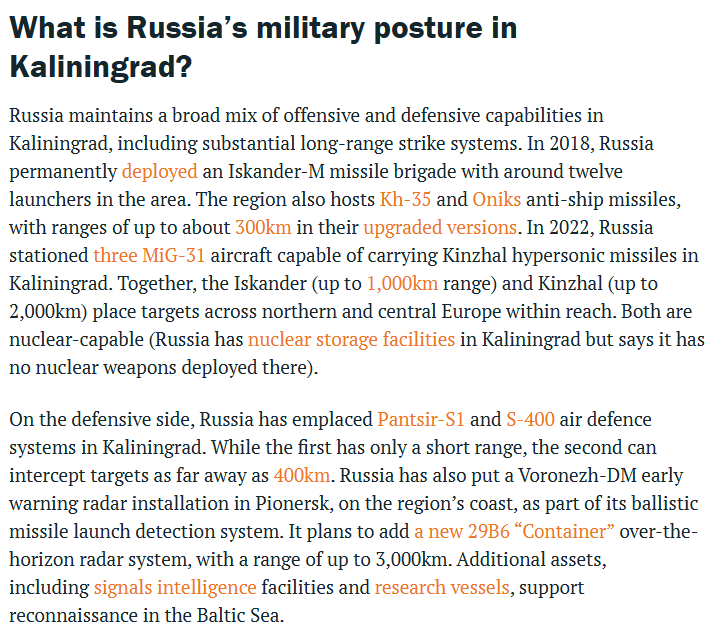
Kaliningrad is the Russian exclave between Poland and Lithuania. It hosts the Baltic Fleet, Iskander missiles, S-400 and shorter-range air defenses, coastal anti-ship systems, electronic-warfare units and substantial ground forces.
Its Iskander missiles are dual-capable: they can carry either conventional or nuclear warheads. The result is not an impenetrable Russian “bubble,” as it is sometimes portrayed, but a formidable forward complex for surveillance, area denial, coercion and escalation.
Its importance is directly connected to Western weapons depletion.
The wars in Iran and Ukraine have reduced the availability of Patriot and other high-end interceptors. Kaliningrad gives Russia the ability to force NATO to reserve those remaining missiles for airfields, ports, headquarters and reinforcement routes in Poland, Germany and the Baltic states. Russia need not launch its entire arsenal. Dispersing missiles, activating radars, increasing electronic interference and combining drones, decoys, cruise missiles and ballistic weapons could compel NATO to reposition aircraft and air-defense systems.
The purpose would be to suppress Western freedom of action through the threat of expenditure.
Kaliningrad’s sharper use, however, may be political rather than kinetic. The exclave has no direct land connection with Russia. In 2022, Lithuania applied European sanctions to categories of Russian goods transiting by rail. Moscow described the restriction as a blockade and threatened consequences before the European Commission clarified the transit rules.
That episode demonstrated the power of grievance construction. Russia could provoke a transit dispute, portray Kaliningrad as an encircled Russian territory and represent any resulting military mobilization as the defense of isolated citizens.
The nearby Suwałki corridor compounds the danger. This Polish-Lithuanian border region, approximately 65 kilometers wide in its narrowest conventional description, provides the principal overland connection between the Baltic states and the rest of NATO. Its disruption would not make Estonia, Latvia and Lithuania indefensible, but it would make heavy reinforcement much more difficult.
Yet Kaliningrad is also highly vulnerable. Finland and Sweden’s NATO membership transformed the Baltic balance. Russia’s naval forces are increasingly confined, and the exclave would be difficult to resupply during a prolonged war. Kaliningrad is therefore both a loaded gun and a hostage: useful for an opening shock, coercive pressure or a manufactured crisis, but precarious as the base for a sustained campaign.
The Kola Peninsula: where escalation becomes credible
The High North presents a more serious form of escalation.
We have looked at the importance of the Arctic Circle to NATO's calculations on Russia (and China) for a long time. In fact, it was in July 2022 that Drishtikone called out the real reason for NATO's frantic support for Ukraine to be predicated on its focus on the Arctic.
 Desh Kapoor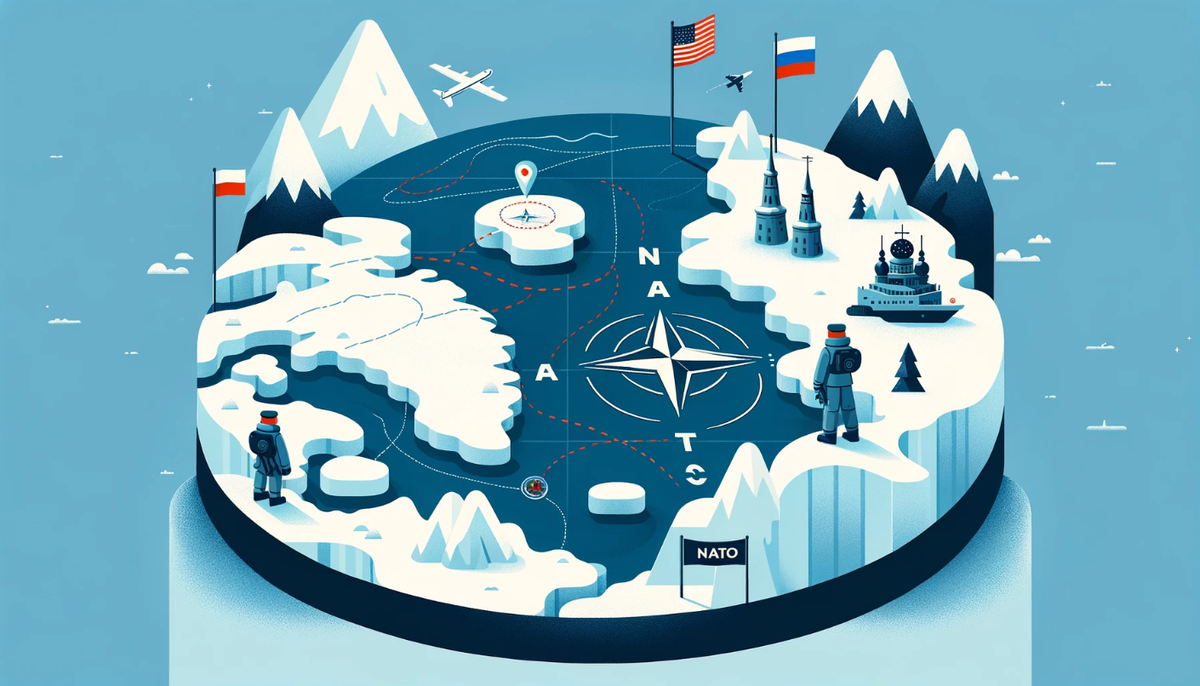
This map (via AI) details out all the important components of the Arctic rivalry between Russia and NATO.
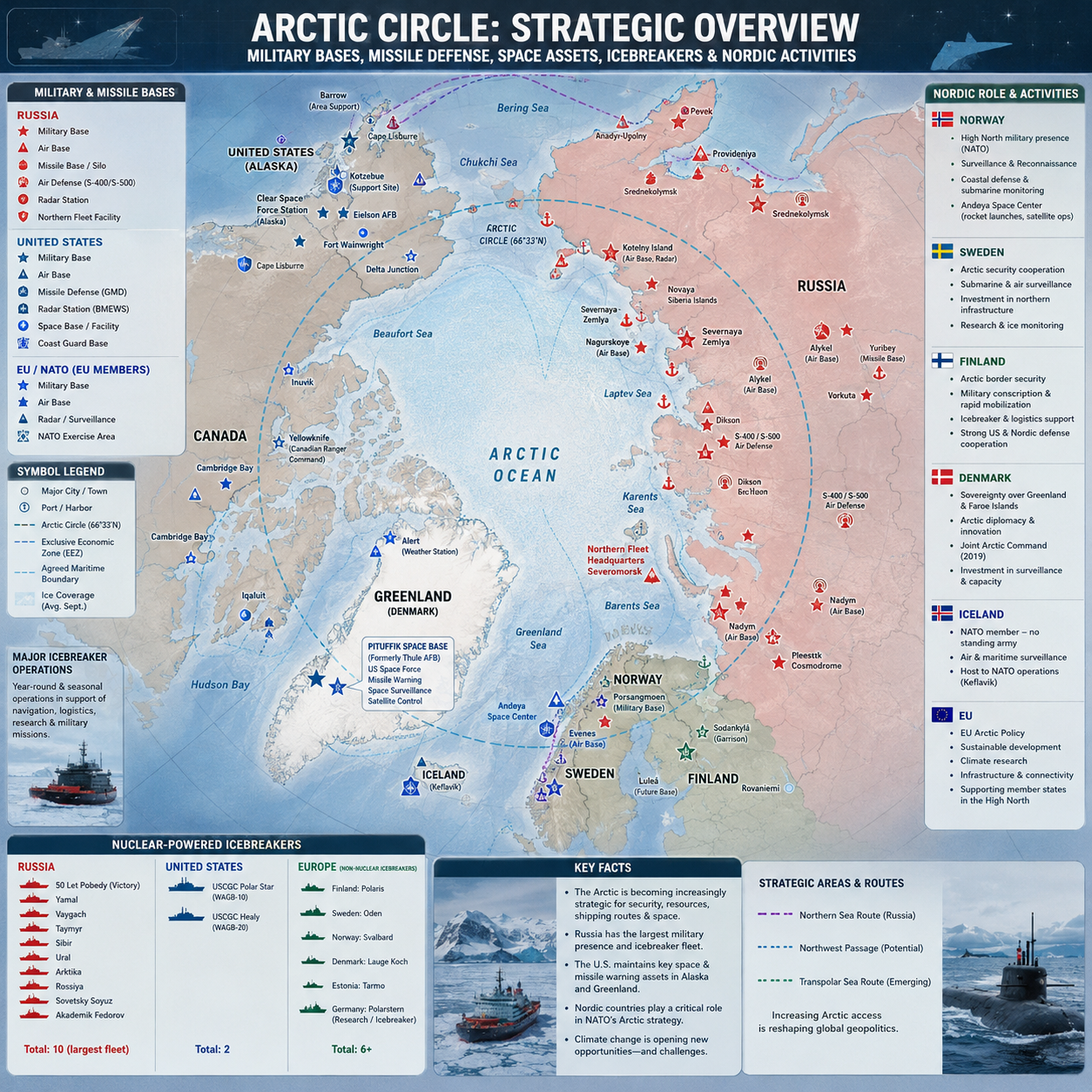
Russia possesses more than half the Arctic coastline and operates the world’s only fleet of nuclear-powered icebreakers. Its Northern Fleet is concentrated around the Kola Peninsula, which hosts a major share of Russia’s nuclear-powered ballistic-missile submarines.
 Desh Kapoor
These submarines provide Russia with a survivable second-strike capability. Even if its land-based forces and command centers were attacked, submarines hidden beneath northern waters could retaliate with nuclear weapons. Protecting them is therefore not a peripheral Russian interest. It is central to the survival of the state and regime.
The Northern Fleet briefly held military-district-equivalent status beginning in 2021. In 2024 it was absorbed into the reconstituted Leningrad Military District, but the administrative change did not reduce its nuclear importance.
Russia’s “bastion” strategy seeks to protect the Kola bases and submarine operating areas extending into the Barents Sea. This is where Russian escalation threats become most believable. Pressure near the Baltic states may involve bluff, coercion and opportunism. Pressure near Kola can be interpreted as a threat to Russia’s ultimate deterrent.
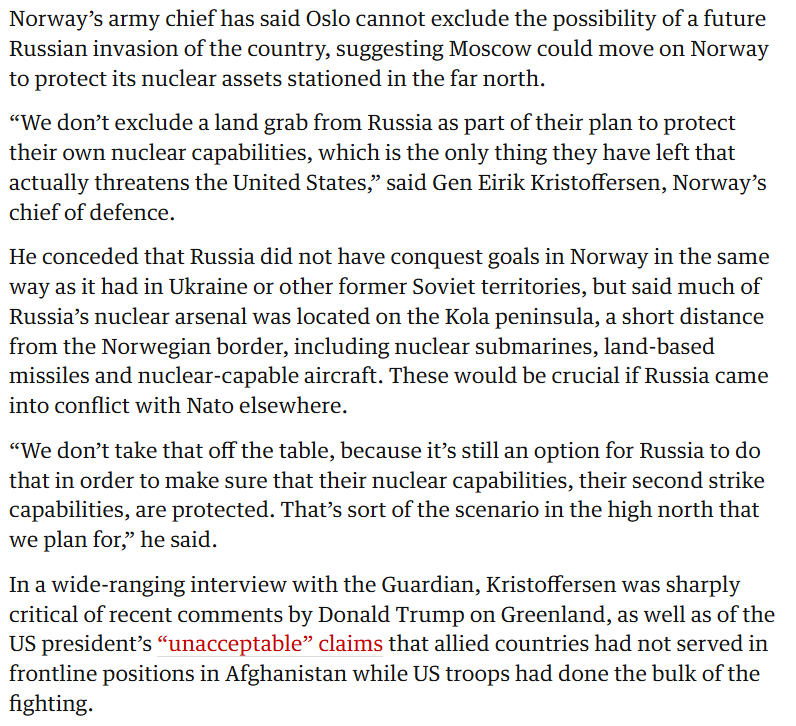
Norway’s Chief of Defense, General Eirik Kristoffersen, has warned that in a major conflict Russia might seek territory in northern Norway if Moscow considered that necessary to protect its nuclear forces.
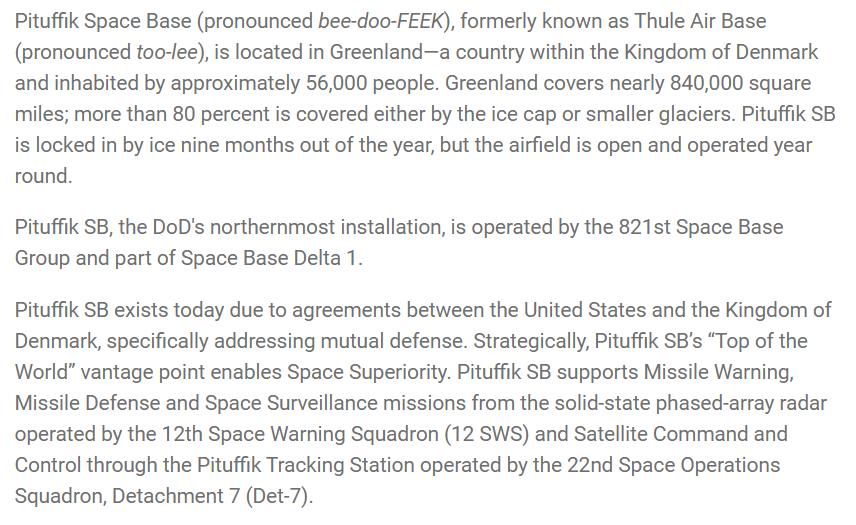
The High North is also naturally suited to gray-zone activity. Its distances are immense, infrastructure sparse and weather severe. Cables, satellite-navigation systems, isolated installations and commercial shipping can be disturbed without producing an unmistakable armed attack.
The Eagle S incident showed the problem. In December 2024, the Russia-linked tanker dragged its anchor for approximately 90 kilometers, damaging four communications cables and the Estlink 2 electricity connection. But a Finnish court subsequently found no conclusive evidence of intentional sabotage and dismissed the case on jurisdictional grounds. The physical damage was clear; responsibility and intention remained contestable.
A Finnish court dismissed a case on Friday against the crew of the Russian-linked tanker which damaged Baltic Sea cables last year, ruling prosecutors failed to prove intent and that alleged negligence must be pursued by the ship's flag state or the crew's home countries. The December 25 incident was one of a string of cable and gas pipeline outages in the Baltic Sea since Russia invaded Ukraine in February 2022, putting NATO forces in the region on high alert. Russia has denied involvement in cable cutting. (Source: "Finnish court dismisses case against crew in Baltic Sea cable breach trial" / Reuters)
This is gray-zone warfare’s ideal condition: consequences without a clean decision point.
Greenland: the eye at the top of the world
Greenland is the missing center of this northern system.
On its northwestern coast sits Pituffik Space Base, formerly Thule Air Base. It is the northernmost installation operated by the US Department of Defense and one of the most strategically important pieces of American infrastructure outside the continental United States.
 Desh Kapoor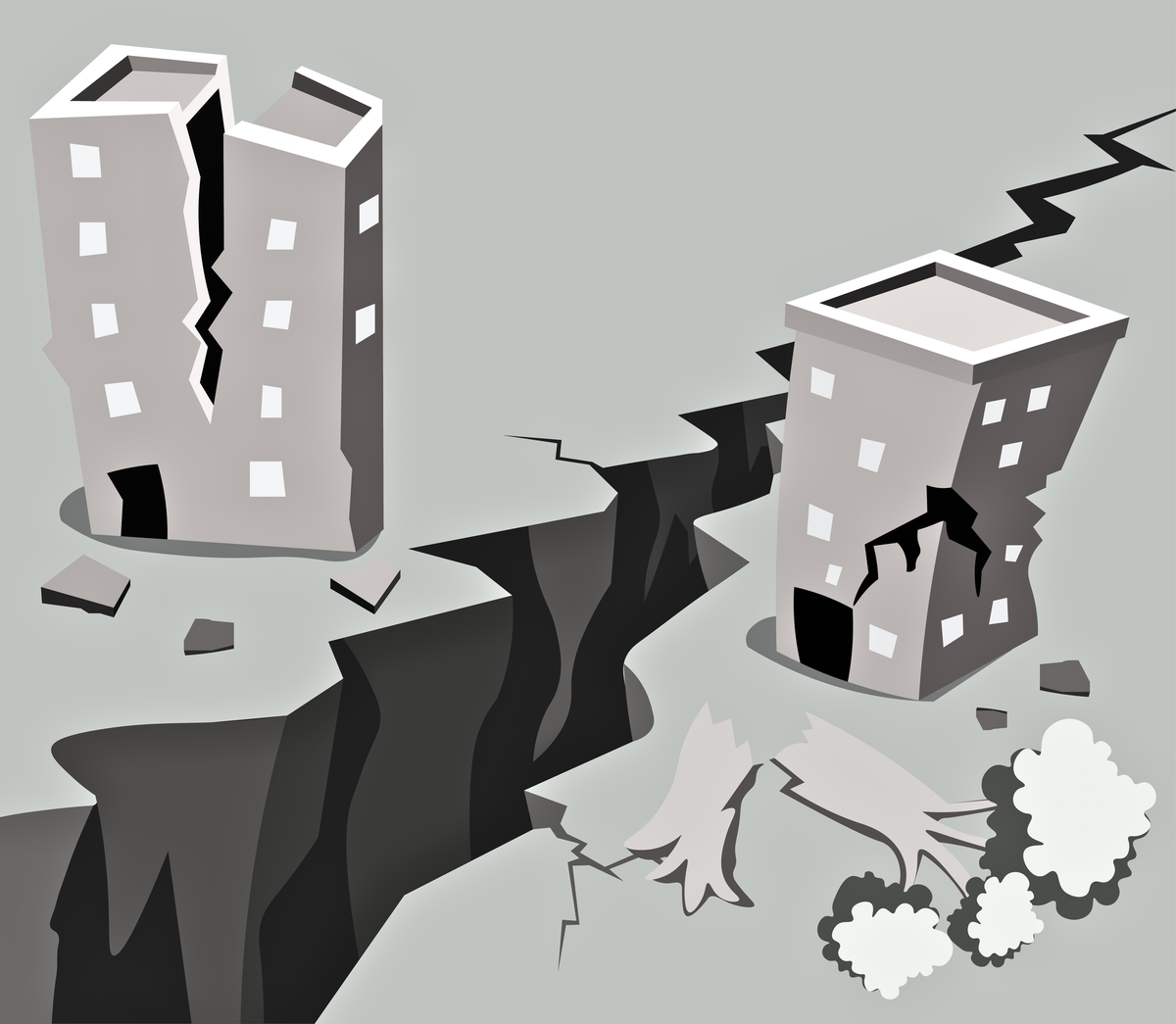
Pituffik’s upgraded early-warning radar performs three principal missions:
- detecting intercontinental and submarine-launched ballistic missiles;
- supporting missile-defense tracking and attack assessment;
- monitoring objects and activity in space.
The base also supports satellite tracking, command and control, an all-season airfield and the world’s northernmost deep-water military port. Its radar feeds information into the US and Canadian warning system through NORAD and gives American leaders additional time to identify and assess a missile attack approaching across the polar region.
The shortest routes between Russia and North America pass over the Arctic. Greenland is therefore not merely a staging location. It is part of the sensory system that allows the United States to know whether an attack is occurring, what kind of attack it is, and how much time remains to respond.
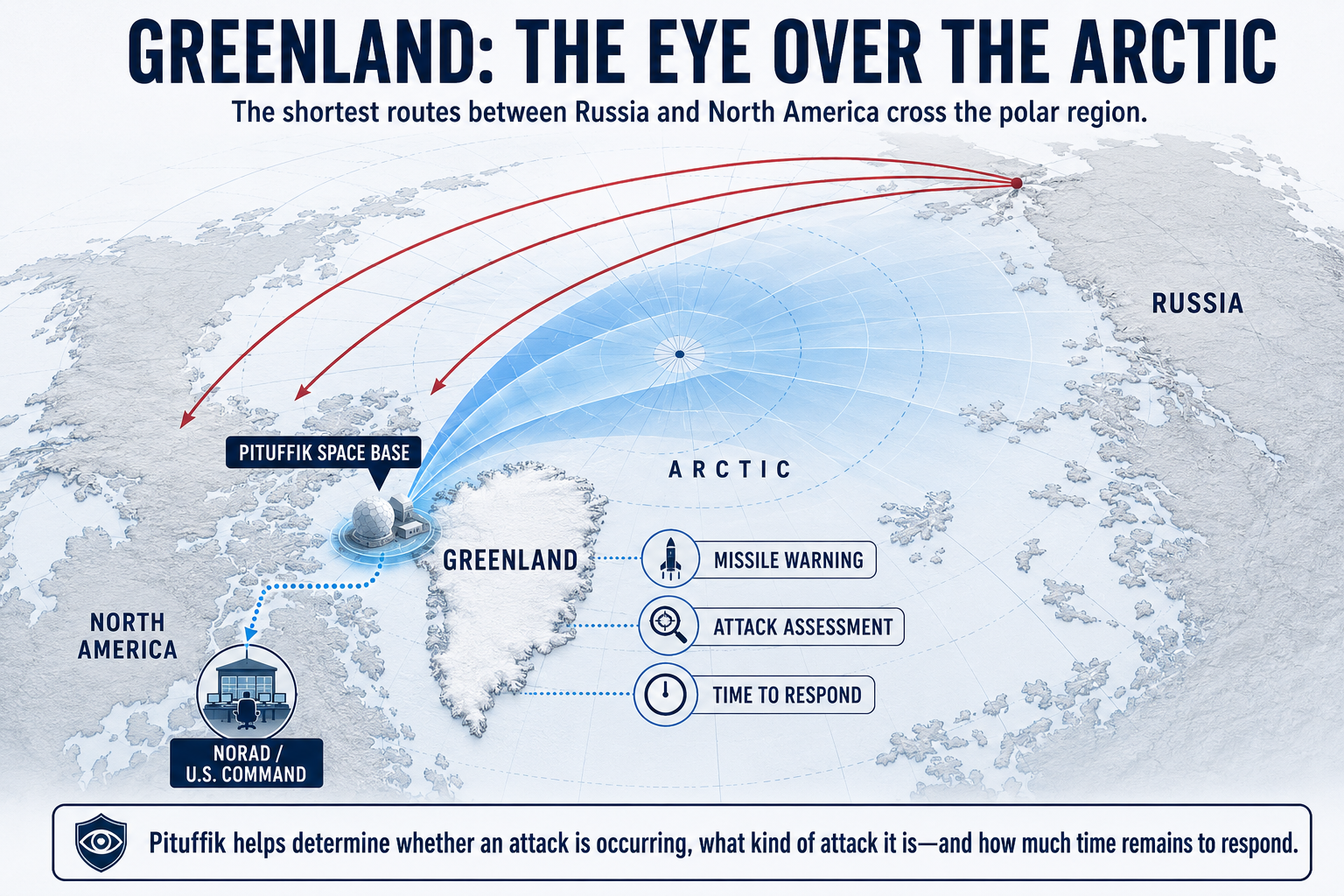
That makes Pituffik part of the nervous system of American nuclear deterrence.
Its strategic value also creates vulnerability. In a major confrontation, interference with Pituffik’s radar, communications, or satellite links could be interpreted as preparation for a larger nuclear attack. An action that might appear limited geographically could therefore produce an immediate strategic response from Washington.
Pituffik places Greenland inside the escalation ladder in a way that conventional maps conceal. Greenland is not merely territory near the Arctic. It is part of the system through which the United States watches Russian missiles, monitors space, and maintains confidence in its ability to retaliate.
This is one reason Washington considers Greenland strategically indispensable. But that does not give the United States sovereignty over the island. Greenland remains within the Kingdom of Denmark, with its own government and a recognized right to determine its political future. American strategic access rests on negotiated agreements, not ownership.
The GIUK gap: the Atlantic gate
South and east of Greenland lies the Greenland-Iceland-United Kingdom gap—the broad maritime passage through which Russian submarines and naval forces must generally move when traveling from Arctic waters into the North Atlantic.
The GIUK gap is not a physical barrier. It is a surveillance and interception zone. Aircraft, submarines, sonar networks and surface vessels can use the geography to detect, classify and follow Russian submarines moving south from the Kola bases.
In wartime, the North Atlantic would serve two vital functions:
- carrying American and Canadian reinforcements to Europe;
- providing operating space for NATO and Russian nuclear and attack submarines.
A Russian campaign would not necessarily require sinking large numbers of troopships. The credible presence of submarines could force NATO to divert warships, maritime patrol aircraft, and helicopters to escort shipping and protect reinforcement routes. That would stretch the same alliance already defending the Baltic, Arctic and Mediterranean theaters.
NATO’s northern system therefore forms a chain:
Scotland and Ireland are not literally “the last bastions” against a Russian surface invasion. Their importance lies in detecting submarine movement, protecting reinforcement routes and securing the communications architecture connecting North America with Europe.
Scotland: Britain’s nuclear and anti-submarine citadel
Scotland is unquestionably central to British and NATO strategy.
HM Naval Base Clyde comprises Faslane and Coulport. Faslane hosts Britain’s Vanguard-class ballistic-missile submarines, which maintain the United Kingdom’s continuous at-sea nuclear deterrent, as well as nuclear-powered attack submarines. Coulport stores and loads the nuclear warheads carried on Trident II missiles.
The British government describes Clyde as the home of the UK nuclear deterrent and the center of specialization for the Royal Navy’s submarine service.
 Defence Nuclear Organisation
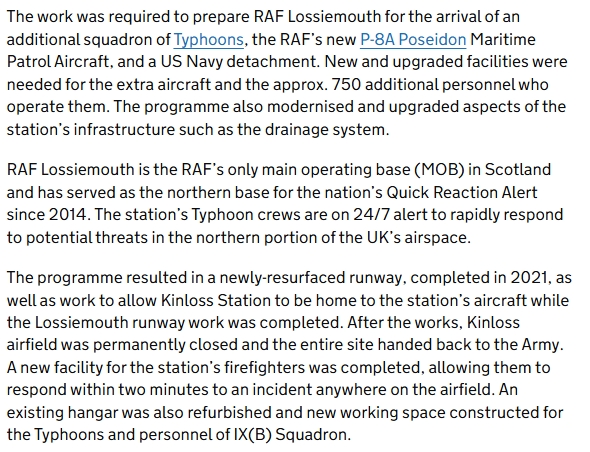
Farther northeast, RAF Lossiemouth hosts Britain’s P-8A Poseidon maritime-patrol aircraft, Typhoon fighters assigned to northern Quick Reaction Alert and facilities for a US Navy P-8 detachment. The P-8’s central mission includes finding and tracking submarines across the North Atlantic.
Scotland consequently supports three indispensable functions:
- Britain’s nuclear second-strike capability;
- anti-submarine operations around the GIUK gap;
- air defense of the northern British and Atlantic approaches.
Scottish independence would not automatically remove these capabilities from NATO. An independent Scotland could seek NATO membership and negotiate continued cooperation. But the Scottish Government’s stated policy is that nuclear weapons should be removed from Scotland after independence.
 The Scottish Government
That would create an extraordinary problem for London. Parliamentary and independent studies have repeatedly concluded that there is no obvious alternative British site combining Faslane’s submarine facilities with Coulport’s warhead-storage functions. Relocation would cost billions and take years.
The Scottish Government, in the White Paper Scotland's Future, has prioritised “early agreement on the speediest safe removal of nuclear weapons” from Scotland, with a view to the removal happening within the first term of the Scottish Parliament following independence. The simple solution for the UK Government, in the event of independence, is to move the submarines and stored warheads elsewhere in the UK. However there is no obvious alternative location and the UK Government, in its Scotland analysis: Defence paper, suggests relocating the nuclear deterrent “would cost billions of pounds and take many years.” (Source: Scotland referendum 2014: the impact of independence on Trident / UK Parliament)
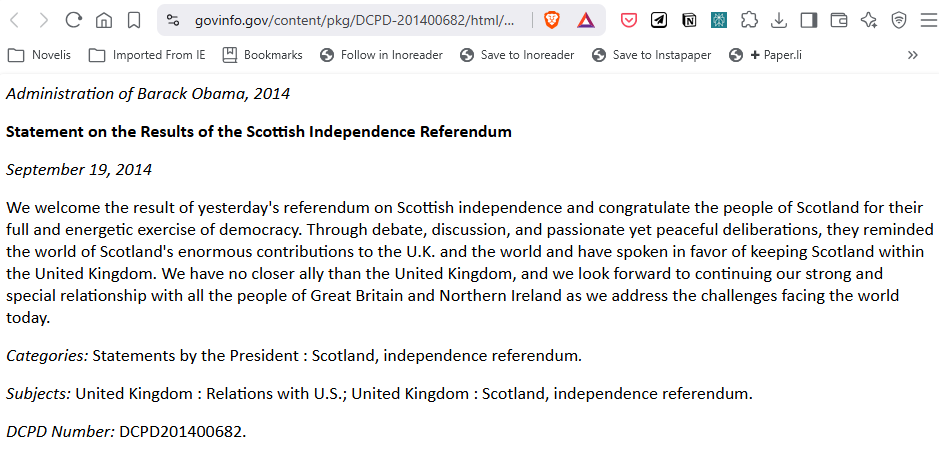
Defense is therefore plainly one reason the British state attaches exceptional strategic importance to retaining Scotland. It is also relevant to American preferences. During the 2014 referendum, President Barack Obama said that the United States had a deep interest in a strong and united United Kingdom, although he acknowledged that the decision belonged to Scottish voters.
It would nevertheless be too strong to claim that Britain and America oppose Scottish independence only, or even primarily, to retain military bases. Political union, economic integration, nuclear basing, NATO effectiveness and the broader US-UK relationship all overlap. What can be established is that independence, particularly under a nuclear-removal policy, would significantly disrupt British and NATO strategic planning.
Ireland: the unguarded southern approach
Ireland requires a different analysis because the Republic of Ireland is already independent and hosts no permanent British or American military base.
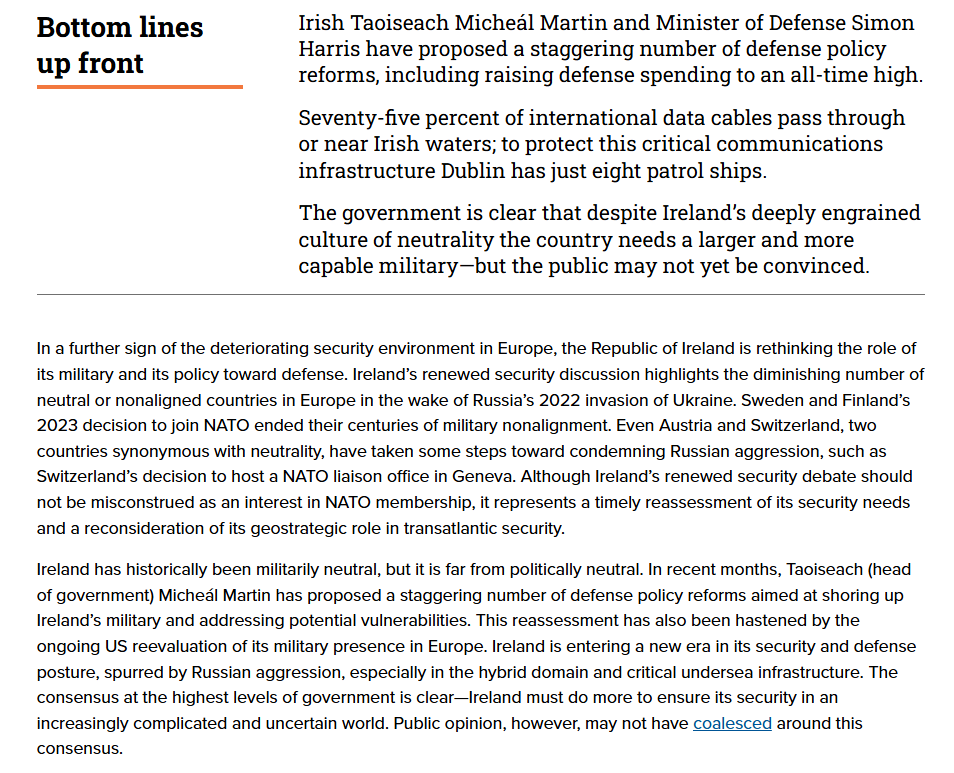
It maintains military neutrality, remains outside NATO and possesses limited air, naval, radar and undersea-surveillance capacity.
Most critically, Ireland sits beside some of the world’s most important transatlantic sea lanes and communications cables. A very large share of data traffic between North America and Europe passes through or near Irish waters.
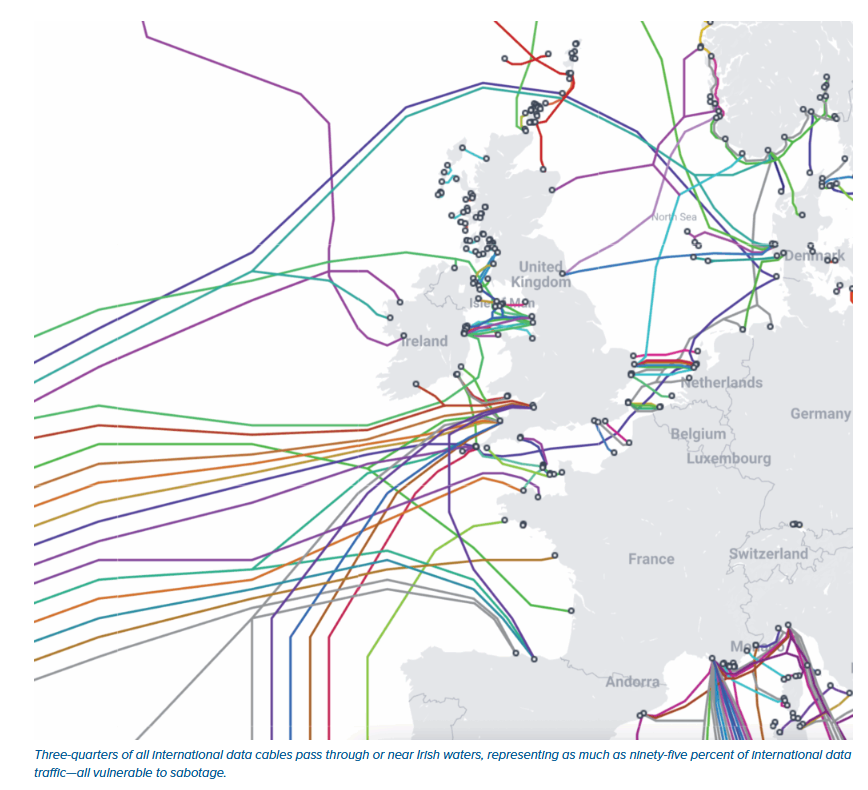
Ireland is therefore less a fortress than a surveillance gap.
Russian naval or intelligence activity west of Ireland could monitor cables, map seabed infrastructure or complicate NATO’s southern North Atlantic approaches. Ireland lacks submarines and has historically lacked the maritime-domain-awareness architecture needed to monitor such an enormous exclusive economic zone.
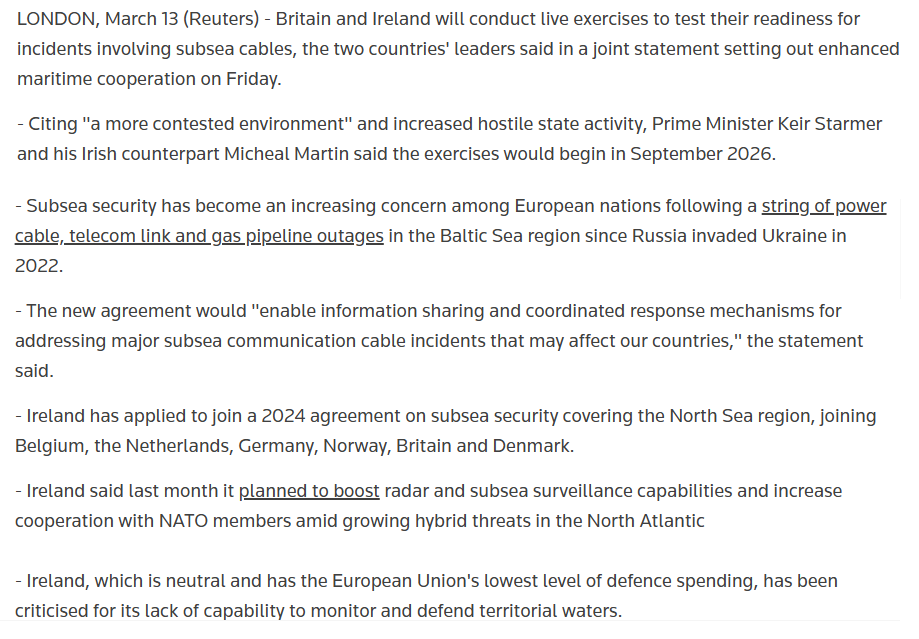
The UK and Ireland have consequently deepened cooperation. In March 2026, they agreed to conduct joint exercises addressing subsea cable incidents, improve information sharing and coordinate responses to hostile-state activity.
Shannon Airport has also been used extensively by American military aircraft for transit and refueling, but Shannon is a civilian Irish airport, not a US base. American use remains politically controversial and subject to Irish permission.
History supports the proposition that Britain has long understood Ireland’s maritime value. Under the 1921 Anglo-Irish Treaty, Britain retained control of three strategic “Treaty Ports”: Berehaven, Queenstown—now Cobh—and Lough Swilly. They were returned to Ireland in 1938. British leaders, particularly Winston Churchill, later argued that losing them complicated Atlantic convoy protection during the Second World War. (Source: Irish Documents on Foreign Policy)
That history demonstrates that control of Irish ports once figured directly in British strategic calculations. It does not prove that present British or American policy toward Irish unity is designed to obtain military bases.
Northern Ireland’s constitutional status is governed by the Good Friday Agreement and the principle of consent. (Source: Irish Government)
Both Britain and Ireland recognize that Irish unity can occur if majorities freely support it under the agreed process. The United States has consistently supported that settlement.
A future united Ireland would certainly raise defense questions: whether neutrality would continue, how northern facilities would be treated, and whether Dublin would expand cooperation with NATO.
Svalbard: legal clarity, political ambiguity
North of Norway, Svalbard remains another seam. The archipelago is sovereign Norwegian territory governed by the 1920 Svalbard Treaty. Russia maintains a civilian settlement at Barentsburg and a smaller presence connected with Pyramiden.
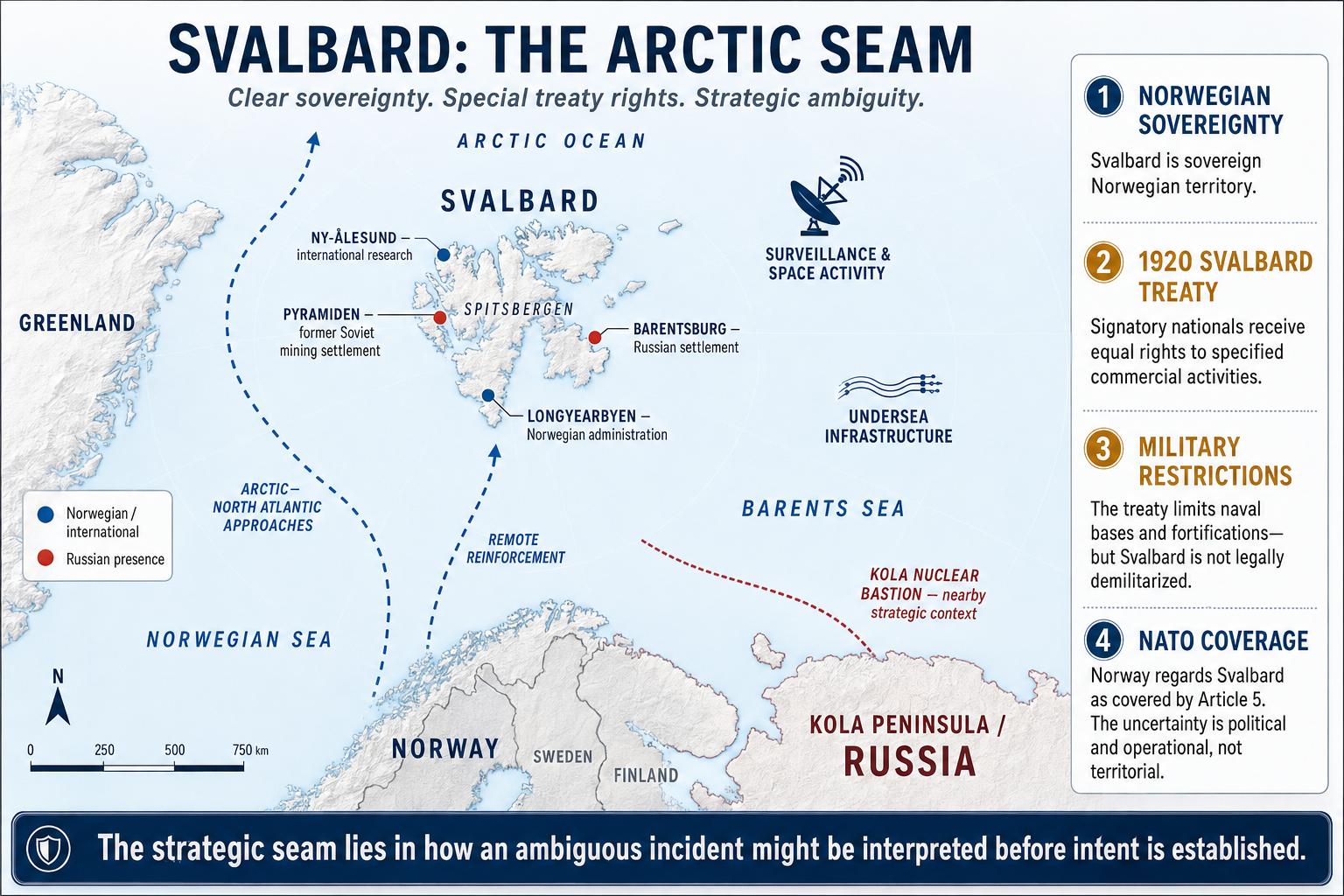
Contrary to occasional claims, Article 5’s legal applicability is not undefined. Norway explicitly regards Svalbard as part of NATO territory covered by collective defense. The uncertainty is political and operational: how allies would interpret a confrontation over treaty access, policing, commercial rights or ostensibly civilian Russian personnel before intent became clear.
Moscow has already accused Norway of militarizing Svalbard, an accusation Oslo rejects.

The value of Svalbard to Russia would therefore lie less in occupation than in creating a crisis surrounded by competing legal and political narratives, under the nuclear shadow of the nearby Kola bastion.
Factoring the Northern Picture
The northern arc now comes into focus:
- Kaliningrad threatens Baltic reinforcement and manufactures grievance.
- The Kola Peninsula houses Russia’s strategic nuclear bastion.
- Svalbard offers political ambiguity close to that bastion.
- Pituffik warns North America of missile attack and tracks activity in space.
- The GIUK gap channels Russian submarine movement toward the Atlantic.
- Scotland houses Britain’s nuclear deterrent and major anti-submarine forces.
- Ireland borders the cables and southern approaches connecting North America to Europe.
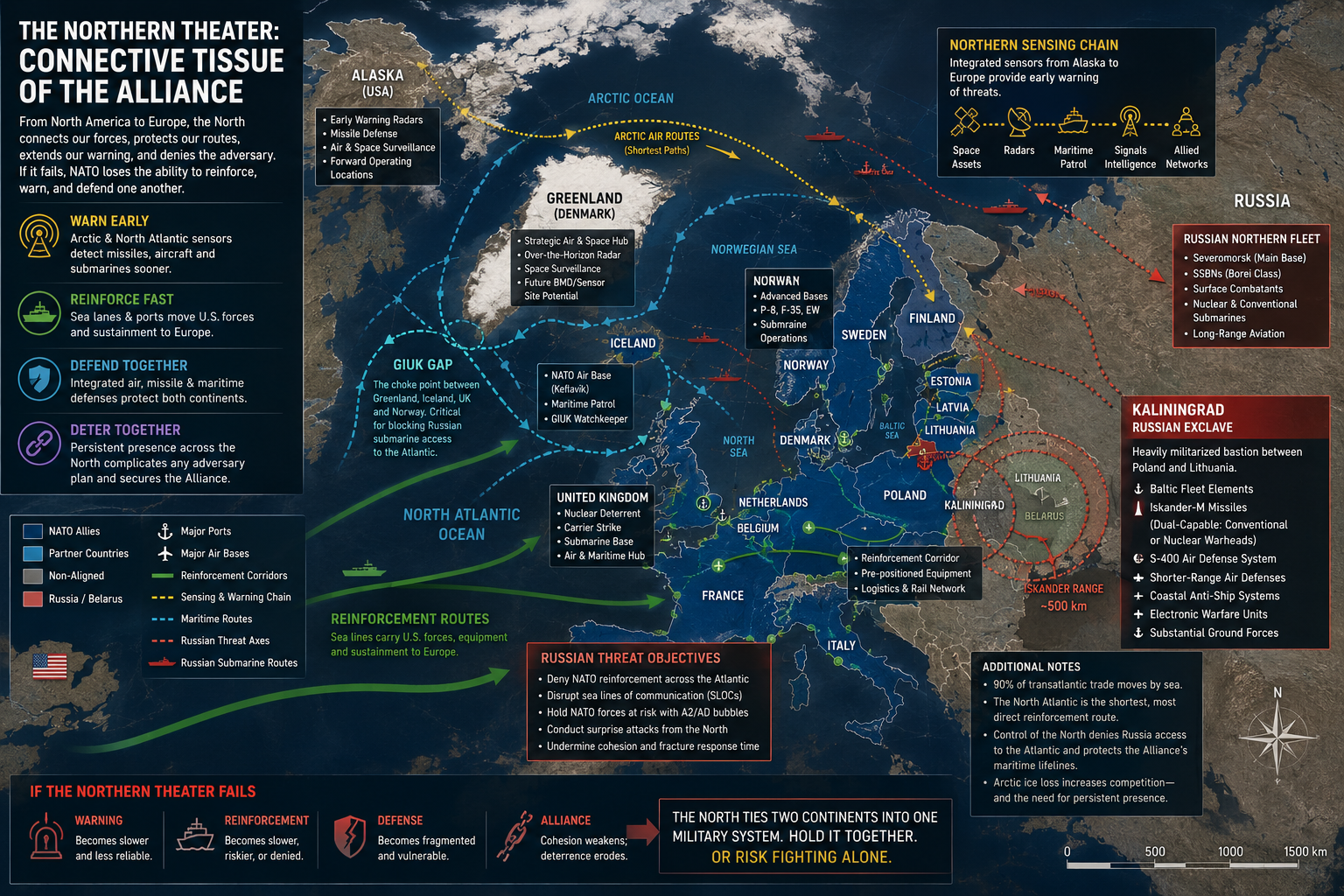
Russia does not have to conquer this system. It can pressure different nodes, force NATO to disperse scarce forces, complicate attribution and raise the cost of defending the transatlantic connection.
The Western weapons shortage makes the geography more dangerous. Every additional site requiring air defense, maritime patrols or infrastructure protection divides a finite magazine. Kaliningrad compresses NATO’s decision time. The Arctic raises the nuclear stakes. Greenland connects the confrontation to US homeland warning. Scotland anchors Britain’s nuclear and anti-submarine response. Ireland exposes the under-protected communications flank.
The strategic contest is therefore not a Russian march across Europe. It is a struggle over whether North America and Europe can continue functioning as one military system.
The decisive question is no longer merely whether NATO would invoke Article 5 over a village. It is whether Russia can disrupt the sensors, routes, magazines and political agreements that allow Article 5 to be converted from a promise into deployable power.
The northern theater is not a single front. It is the connective tissue of the transatlantic alliance.
Its importance therefore lies less in territory than in connectivity.
Arctic and North Atlantic sensors provide early warning of Russian missiles, aircraft and submarines. Greenland and northern Norway extend the surveillance architecture protecting both continents. The North Atlantic sea lanes carry American troops, weapons and supplies required to reinforce Europe. Nordic airfields, ports and bases provide depth for NATO operations, while control of maritime chokepoints helps keep Russian submarines away from reinforcement routes.
If this northern architecture fractures, NATO's problem becomes systemic. Warning becomes slower. Reinforcement becomes harder. Maritime routes become vulnerable. Air and missile defense becomes fragmented.
The North, in other words, is where NATO's two continents become one military system.
What is the "Russian Threat" then?
Europe is becoming more assertive toward Moscow, but its strategic autonomy remains incomplete. NATO has reinforced its eastern and northern flanks, European defense budgets are rising, and new production capacity is being commissioned.
Yet the alliance still depends heavily on the United States for intelligence and surveillance, strategic lift, integrated missile defense, long-range strike, space-based warning and command-and-control. Money is moving faster than metal.
That distinction matters because the West’s principal weakness is no longer technological sophistication, but wartime depth.
Ukraine and successive Middle Eastern crises have consumed expensive air-defense interceptors far faster than existing production lines can replace them. Europe and the United States possess highly capable systems, but not necessarily in the quantities required for simultaneous, prolonged crises. Factories can be expanded, yet skilled labor, specialized components, propellants and production certification impose timelines that budgets alone cannot shorten.
This makes the northern and Baltic theatres especially consequential. From Kaliningrad, Russia can combine missiles, electronic warfare, maritime pressure and manufactured grievances around transit and the Suwałki corridor.
In the High North, it can exploit the remoteness of Svalbard, threaten Atlantic infrastructure and operate beneath the nuclear shadow of the Kola Peninsula. The objective need not be territorial conquest. It may be to compress NATO’s decision time, disperse scarce interceptors, complicate reinforcement across the Atlantic and create doubt about whether Washington would accept escalation over a geographically limited or legally ambiguous incident.
The decisive contest is therefore not simply over a hypothetical village in Estonia. It is a race between Russian strategic compression and European industrial mobilization.
Moscow’s opportunity lies in the interval during which Europe’s political ambition has outrun its magazines, factories and independent enabling capabilities. Once those gaps narrow, coercion becomes harder and more dangerous for Russia. The most perilous period may consequently be not 2029 itself, but the years before Europe can convert today’s spending commitments into deployable power at wartime scale.