"Security in the Persian Gulf and the Sea of Oman is either for everyone or for NO ONE. NO PORT in the region will be safe." — Statement from the Iranian Armed Forces and Islamic Revolutionary Guard Corps, April 13, 2026 — hours after the US naval blockade of Iranian ports went live at 10am EDT
What This Signals
This is the sentence that closes the loop. For 45 days, Iran's strategy has been surgical and asymmetric — blocking Hormuz to impose economic pain on the global economy while avoiding the kind of direct military confrontation that would unambiguously restart the full war.
"No port will be safe," ends that surgical phase. Iran is no longer threatening a chokepoint. It is threatening the entire maritime architecture of the Gulf — Dubai's Jebel Ali, Abu Dhabi's Khalifa Port, Kuwait City's Shuwaikh, Qatar's Hamad Port, Bahrain's Khalifa Bin Salman — the logistics spine of the world's largest hydrocarbon export ecosystem.
Whether Iran can actually execute this threat is a separate military question. Its navy has been degraded. CENTCOM's 16 warships, including the USS Abraham Lincoln carrier group, are operating in the region. But "whether Iran can execute it" is less important than "whether the market believes it might." Lloyd's List Intelligence has already confirmed that the limited ship traffic that had resumed in the strait after the ceasefire halted completely within hours of Iran's port threat. The final JP Morgan note, published this morning, contained a sentence that should be pinned on the wall of every finance ministry in Asia: "The last tanker to clear Hormuz on February 28 is expected to reach its destination around April 20, marking the point at which pre-closure barrels are fully exhausted from the global supply chain."
April 20 is six days from today. The ceasefire expires on April 22. India's Chabahar waiver expires April 26.
Three dates in nine days. Each one consequential. Each one requires an active government response right now.
Story #1: Iran's "No Port Will Be Safe" — The Gulf-Wide Maritime Threat Explained
The Full Picture
The sequence of events on April 13-14 represents the most dangerous 48 hours for global energy supply since the war began on February 28.
At 10 am EDT on Monday, April 13, CENTCOM activated the US naval blockade of all Iranian ports and coastal areas — "enforced impartially against vessels of all nations entering or departing Iranian ports and coastal areas, including all Iranian ports on the Arabian Gulf and Gulf of Oman." Iran's immediate response came not from a diplomat but from its armed forces: a statement that security in the Persian Gulf and Sea of Oman was "either for everyone or for no one," that "no port in the region will be safe" if Iran's own ports are threatened, and a characterisation of the US blockade as "an act of piracy" under international law.
Multiple senior Iranian officials issued amplifying statements. Parliament speaker Ghalibaf — who led Iran's Islamabad delegation — addressed Trump directly: "If you fight, we will fight." Former IRGC commander Mohsen Rezaei warned that Iran had "major untouched levers" to deploy. IRGC spokesman Ebrahim Rezaei dismissed the blockade as "more bluffing than reality" but warned it would make the current situation "more complicated and make the market — which he is angry about — more turbulent." Iran's armed forces added that the US blockade would be considered "an act of piracy." Trump, within hours, warned that any Iranian fast-attack ships that came "anywhere close to our BLOCKADE" would be "immediately ELIMINATED."
The practical effect was immediate. Lloyd's List Intelligence reported that the limited shipping traffic that had resumed in Hormuz after the ceasefire announcement had halted completely. Oil prices, which had begun creeping back toward $100, surged: Brent rallied toward $103 a barrel, European gas futures spiked up to 18%, and WTI climbed toward $104.
JP Morgan published its now-definitive note: the last tanker to clear Hormuz before the war reaches its destination approximately April 20. After that, the pre-closure supply buffer is exhausted. The CNBC analysis from Trita Parsi of the Quincy Institute put the blockade's oil price implication most starkly: "Taking more oil off the market — particularly the only oil that is now getting out from the Persian Gulf — will drive oil prices to around $150 per barrel."
An important practical limitation: CENTCOM confirmed it has 16 warships in the Middle East, including the USS Abraham Lincoln carrier group, but no American warships are currently positioned in the Persian Gulf itself, which forms most of Iran's coastline and where Iran's ports are located. The US would need to move warships through the strait while it is simultaneously trying to clear the strait of mines to enforce a blockade of ports inside the Gulf.
This operational paradox has not gone unnoticed.
Britain and France publicly declined to join the blockade. UK Prime Minister Starmer: "We're not getting dragged into the war." Turkey suggested a 45-60-day ceasefire extension. Pakistan's Foreign Minister Dar said his country would try to facilitate new dialogue "in the coming days." The ceasefire expires on April 22.
🇮🇳 How This Impacts India
Iran's "no port will be safe" threat — if carried out — would directly threaten the UAE and Saudi ports that are India's primary alternative supply routes after the Hormuz disruption. Jebel Ali specifically handles approximately 15% of India's total container imports and is the re-export hub for much of India's Gulf-sourced consumer goods. India's Ministry of Shipping and Ministry of Commerce must model a scenario in which both Hormuz and the major UAE/Saudi Gulf ports are simultaneously unavailable — and identify what alternative routing (Red Sea + Suez if Houthi activity remains suppressed; Cape of Good Hope for the largest vessels; INSTC for landlocked goods) can substitute for how much volume and at what cost premium. This modeling must be complete before April 20, when the pre-closure supply buffer exhausts.
📎 References: Arab News | Bloomberg | Fortune | CNBC | AP via inquirer | Al Jazeera
Story #2: The Blockade's Economic Logic — How $150 Oil Becomes the Base Case
The Full Picture
Three analyses published in the last 48 hours converge on the same alarming conclusion: the US naval blockade, even with CENTCOM's narrowed scope, has transformed the global oil market's already-critical condition into what IEA Chief Fatih Birol called "the worst energy shock the world has ever seen — more severe than the oil crises of the 1970s and the Ukraine war combined."
The New York Times' analysis (alongside the Times of India and the TOI liveblog) documented how the blockade has added a new layer of supply compression on top of an existing catastrophe. Before the blockade announcement, the world was running approximately 4.5-5 million barrels per day short of its normal supply — a gap being bridged by coordinated strategic petroleum reserve releases and temporary sanctions waivers on Russian and Iranian oil. The blockade cuts off Iranian oil flowing to China, which accounts for roughly 13% of China's total imports. Barclays noted, "the economic scarring from attacks on energy facilities and ports in Iran and other Gulf nations could continue to keep supply under stress in emerging Asia." With the pre-closure Hormuz buffer exhausting around April 20, analysts estimate the supply gap doubles to 10-11 million barrels per day — "a supply shock without precedent in the modern oil market."
The Arab News analysis of the blockade's financial impact, citing Foundation for Defense of Democracies analyst Miad Malki, estimates the blockade could inflict approximately $435 million a day in economic damage on Iran — roughly $13 billion a month. Of that, approximately $276 million represents blocked oil and petrochemical exports; another $159 million in blocked imports.
This is significant as a pressure figure, but Trump himself acknowledged on Fox News that US gasoline prices could "stay high through November's midterm elections." The blockade is a lever that hurts both sides — and may hurt the US consumer more visibly than it hurts the Iranian government.
The critical diplomatic window: Turkish Foreign Minister Hakan Fidan suggested that the ceasefire could be extended by 45-60 days to allow for more negotiations. Pakistan's Dar is committed to facilitating a new dialogue. China's Ministry of Foreign Affairs called the strait "an important international trade route" and urged Iran and the US "not to reignite the war." None of these interventions has produced any sign of a second round of talks being scheduled. The ceasefire expires April 22 — nine days from today.
🇮🇳 How This Impacts India
JP Morgan's note — "The last tanker to clear Hormuz on February 28 is expected to reach its destination around April 20, marking the point at which pre-closure barrels are fully exhausted" — is India's most important planning deadline. By April 20, whatever is in India's pipeline of pre-closure Gulf crude has arrived. After that, India's refineries are running on whatever has been sourced from Russia, Venezuela, the US Gulf Coast, and West Africa since the disruption began.
India's downstream petroleum companies — IndianOil, BPCL, and HPCL — must each provide the government with a daily supply-status dashboard starting today.
The government must know, on a refinery-by-refinery basis, how many days of crude inventory each facility holds, what alternative supply is contracted, when it arrives, and at what production level each refinery can sustain operations if the April 20 buffer is exhausted without new supply. This is operational planning, not policy discussion. It must happen this week.
📎 References: NYT | Arab News | Times of India liveblog | CNBC blockade analysis | Israel Hayom
Story #3: Trump Says "We May Stop by Cuba" — The Doctrine of Sequential Coercion
The Full Picture
In a remark that drew less attention than it deserved, Trump told reporters on Monday that the United States "may stop by Cuba" after it is finished in Iran. The comment was brief — less than one paragraph, delivered before boarding Marine One — but it was not throwaway. Trump specified that many Americans of Cuban origin "have been treated very badly" and that many family members had been "killed or beaten up." He added that "Cuba is a failing nation" that had been "horribly run for many years." Cuba's President Miguel Díaz-Canel had warned just days earlier that "if that happens, there will be fighting."
The Cuba remark must be read as a strategic communication, not an idle boast. Trump has a documented pattern of sequencing external pressure campaigns — Venezuela, Iran, now Cuba signaled. Venezuela's Maduro was seized in January 2026 (as referenced in TIME's Iran war analysis). Iran was struck on February 28. Cuba is being named publicly as the next subject of American interest. Whether this represents actual military planning, negotiating pressure, or domestic political messaging to Cuban-American voters in Florida ahead of midterm elections is ambiguous. What is not ambiguous is the escalatory arc: Trump's America is using its military's demonstrated willingness to strike Iran as the credibility foundation for coercing other adversaries into compliance.
🇮🇳 How This Impacts India
The "sequential coercion" doctrine — using each military action to establish credibility for the next pressure campaign — has direct implications for India that require analytical attention. If the US is moving from Iran toward Cuba through Venezuela, the underlying logic is an American reassertion of the Monroe Doctrine and a renewed claim to hemispheric primacy in the Americas, combined with a Middle East power projection campaign. India's strategic calculus in this environment is clear: do not be the next country to appear to resist American preferences in a way that becomes a visible test of US resolve. The Chabahar waiver renewal — which requires India to demonstrate that its engagement with Iran is humanitarian, civilian, and not in violation of sanctions — is precisely the kind of visible compliance signal that India must provide promptly. An India that renews the Chabahar waiver through formal OFAC channels, on time, signals reliability. An India that lets the waiver lapse through administrative delay signals the opposite.
📎 References: Yahoo / DPA
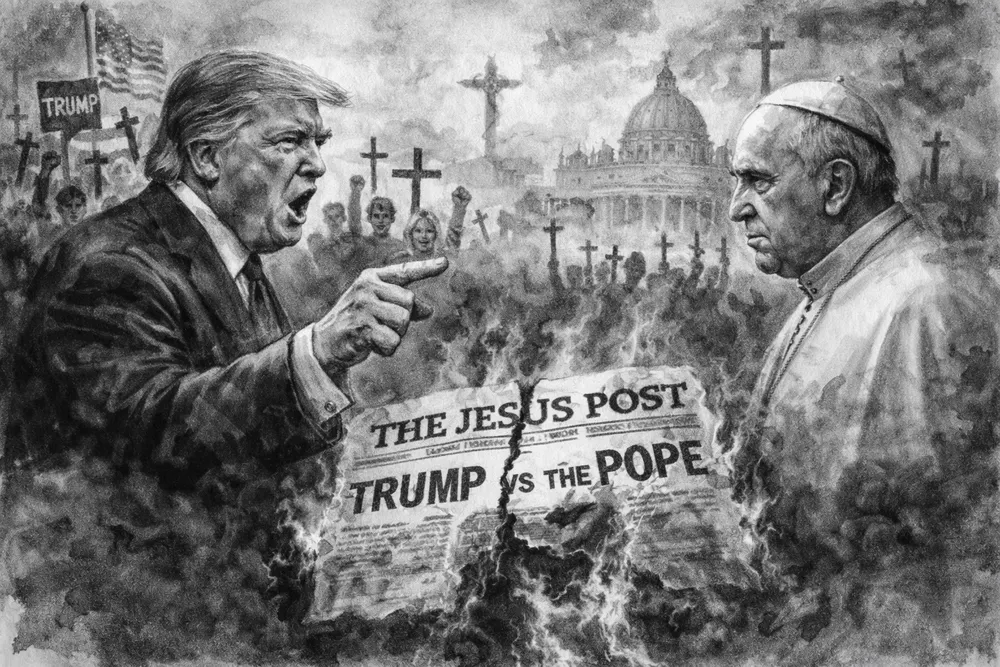
Story #4: Trump vs. the Pope — The Jesus Post, the Blasphemy Backlash, and the Christian Right's Breaking Point
The Full Picture
The most revealing domestic political story of April 13 was not about oil or diplomacy. It was about a deleted image. On Sunday night, hours after posting a tirade against Pope Leo XIV calling the US-born pontiff "WEAK on Crime, and terrible for Foreign Policy," Trump shared an AI-generated image on Truth Social depicting himself in a white biblical robe, laying glowing hands on a bedridden man as light emanated from his fingers — eagles, an American flag, soldiers-turned-angels, and a nurse looking on in apparent awe. The comparison to Jesus Christ healing the sick was unmistakable.
The backlash came immediately — and crucially, it came from within Trump's own coalition. Fox News host Joey Jones: "That picture is looney tunes." Daily Wire's Michael Knowles urged Trump to delete it, saying it was against his spiritual and political interests. Riley Gaines called it "gross blasphemy." Conservative commentator Erick Erickson: "What they really should be paying attention to are the Christian Trump supporters who have stood with him through Iran, who are waking up to his blasphemy." Former Trump ally Marjorie Taylor Greene, who now leads the 25th Amendment wing of MAGA's anti-war bloc: "It's more than blasphemy. It's an Antichrist spirit." Trump deleted the post by 11 am Monday and told reporters he thought the image depicted him "as a doctor" with a "Red Cross worker" theme — a claim that persuaded nobody. Vance said on Fox News it was Trump "posting a joke" that "people weren't understanding."
The broader Trump-Pope Leo conflict is substantive. Pope Leo, the first American pope, has been consistently outspoken against the war in Iran. He condemned Trump's "whole civilization will die tonight" threat as "truly unacceptable." At St. Peter's Basilica on the first day of the Islamabad talks, he declared, "Enough of the display of power! Enough of war!" When Trump attacked him on Sunday night, Leo responded from the papal plane en route to Algeria — where he began an 11-day Africa tour — with remarkable precision: "I have no fear of the Trump administration, nor speaking out loudly about the message of the Gospel." Three US cardinals chose the same weekend to speak jointly against the Iran war on CBS's 60 Minutes — the first time in modern memory that American Catholic clergy united publicly against a sitting president's war. A member of Trump's own Religious Liberty Commission, Bishop Robert Barron, said Trump "owes the Pope an apology." The Washington Post's analysis is correct: this feud could upend Trump's support among the Christian right precisely at the moment when the Iran war's economic costs are being felt most acutely by the voters who backed him most enthusiastically.
🇮🇳 How This Impacts India
The Trump-Pope clash has an operational dimension in India through its Catholic community. As we noted in yesterday's edition, India has 19 million Catholics — heavily concentrated in Kerala, Goa, and Karnataka — many of whom are part of the Gulf diaspora most directly affected by this war.
The Pope's Africa tour, which includes Algeria and multiple sub-Saharan stops, is also a reminder that the Vatican is positioning itself as a voice for the Global South's experience of this conflict — the fuel shortages, the food price spikes, the civilian casualties — in ways that resonate far beyond Western Christianity.
India's diplomatic messaging on the war should incorporate the Vatican's moral framing where appropriate: Pope Leo's language — "too many innocent people have been killed; someone must stand up and say there's a better way" — is entirely compatible with India's long-standing position on the conflict, and citing this moral consensus costs India nothing diplomatically while building soft power credibility.
📎 References: Washington Post | Mediaite | AP | NPR | CNN | Al Jazeera | RT
Story #5: "The White House Was Awash in Speed" — The Drug Culture Question Returns
The Full Picture
Yahoo's recirculation of the Rolling Stone investigation into the White House Medical Unit's drug dispensing practices, combined with the Yahoo article on Trump's behaviour patterns — late-night posting binges, the Jesus meme, the 3 am Truth Social tirades during the Islamabad talks, the UFC attendance while global negotiations were collapsing — has reignited serious public and medical commentary on the cognitive and behavioural condition of the 79-year-old president overseeing a global energy crisis.
The original Rolling Stone investigation documented that the White House Medical Unit during Trump's first term operated "like the Wild West," dispensing modafinil (a military-grade stimulant), Adderall, Xanax, and other controlled substances to staff with minimal oversight, no verified patient identity checks, and no formal prescriptions in many cases. The Pentagon's own inspector general confirmed thousands of doses of modafinil were ordered. Former staffers told Rolling Stone, "If you're sloppy even a little bit with controlled substances, you'll lose your medical license.
Nothing is written down because we will always get to yes." A former staffer's summary of White House culture: "You try working for him and not chasing pills with alcohol."
The DNYUZ reporting on concern about Trump's mental state — cited in the user's links — reflects a broader pattern that political scientists, neurologists, and conservative commentators have flagged increasingly openly: the combination of late-night posting patterns, the Jesus image, the sequential crisis escalations (Islamabad, the blockade, the Cuba threat, the papal feud — all within 48 hours), and Trump's own stated approach to decisions ("whether we make a deal or not makes no difference to me — we win regardless") raises genuine questions about the quality of executive decision-making at the most consequential geopolitical moment in a generation. The White House did not respond to requests for comment on any of these concerns. Vance attributed the Jesus post to a sense of humor that "people weren't understanding."
🇮🇳 How This Impacts India
India's senior diplomatic officials need to take the Trump mental fitness question seriously — not as commentary but as a risk assessment. A president who is making consequential military and economic decisions about the world's most important oil waterway at 3 am, while simultaneously watching UFC, feuding with the Pope, and posting and deleting AI images of himself as Jesus Christ, is a president whose decision-making unpredictability must be factored into every scenario India plans for.
India's contingency planning must explicitly model a "rapid escalation" scenario — where Trump, pressed by domestic political deterioration and midterm anxieties, orders a military strike that resumes the war before April 22 — and a "rapid de-escalation" scenario where Trump, equally impulsively, accepts whatever Iran offers in a phone call and declares victory. Both scenarios have happened in this war. Both could happen again within days. India must be positioned for either.
📎 References: Yahoo | Rolling Stone via Yahoo | DNYUZ
Story #6: Tina Brown and the Vance Implosion — MAGA's Heir Apparent Is Losing Fast
The Full Picture
Tina Brown's Substack essay "Fast and Furious" and Zeteo's "JD Vance Can't Stop Losing" together constitute the most comprehensive political autopsy of the Vance vice presidency published to date — and the timing, coming the day after Vance returned from Islamabad empty-handed, is not coincidental.
The Zeteo piece, reported by Asawin Suebsaeng, compiled Vance's losing streak with striking comprehensiveness: Vance advised against the war in Iran and was overruled. He was sent to Greenland — result: embarrassment. He was sent to Germany to boost the AfD — the party underperformed. He was sent to Budapest to support Orbán, Orbán lost by supermajority two days later. He was sent to Islamabad to negotiate a historic peace deal — 21 hours and no agreement. CNN's data analyst Harry Enten reported that Vance's net approval has fallen 21 points since January 2025, making him "historically the least popular vice president at this point in their vice presidency." A source "close to Trump" told Zeteo: "Trump is imploding, and he's probably going to take JD down with him unless there's a course correction."
The structural problem for Vance is one that Brown's essay captures elegantly: he has been assigned the impossible tasks not because Trump trusts him, but because they are the tasks where failure cannot be pinned on Trump himself. "If it doesn't happen, I'm blaming JD Vance. If it does happen, I'm taking full credit," Trump said publicly at an Easter lunch. Prediction markets have already moved: Kalshi shows Rubio leading for the 2028 GOP nomination at 19%, with Vance at 18%. A presidency that entered 2026 treating Vance as the heir apparent has, through the Iran war's failures, transformed him into the designated fall guy.
🇮🇳 How This Impacts India
The Rubio-Vance power dynamics within the Trump administration matter to India's diplomatic engagement planning. If Rubio — who has taken the lead on the India relationship, confirmed the May visit, and is driving the Quad FM meeting — is gaining relative power as Vance declines, India's diplomatic positioning is strengthened.
Rubio's State Department has been consistently more structured, more institutionally competent, and more predictable than the Vance-Witkoff-Kushner track that handled Iran. The Rubio visit to India in May will now be even more important as a signal of the administration's strategic direction — because Rubio is the competent adult in the room who is simultaneously rising.
India must ensure the Rubio visit is meticulously prepared, produces deliverables, and establishes a bilateral cadence that doesn't depend on Vance's survival as a political figure.
📎 References: Tina Brown Substack | Zeteo | Raw Story | Daily Beast | MSNBC
Story #7: Asia's Oil Crisis — China, Japan, Korea, Southeast Asia Running on Empty
The Full Picture
The AP's comprehensive survey of Asia's energy crisis — the most important regional consequence of the Hormuz disruption that receives insufficient attention in Western media — documents a continent already in crisis before the US blockade was announced, now facing a potentially catastrophic supply gap.
Japan holds approximately 254 days of strategic oil reserve — the most insulated major Asian economy. South Korea holds 208 days. China holds approximately 120 days and an estimated 900 million to 1.4 billion barrels of total reserves, but has already been forced to order major refiners to stop accepting new fuel export contracts to conserve domestic supply. Even China's buffer is being consumed faster than its reserves can be replenished. Long queues at petrol stations have appeared in multiple Chinese cities. The Chinese government reduced planned fuel price hikes as a political concession to domestic consumers, but the physical supply constraint is building regardless.
Southeast Asia is already in a genuine crisis. The Philippines, which imports 90% of its oil from the Middle East, has declared a national energy emergency. Thailand's government reduced fuel subsidies, causing sharp increases in pump prices and long highway queues. Vietnam Airlines canceled dozens of domestic flights. Singapore, the region's refining hub, is operating under acute supply stress, with marine fuel buyers refusing to purchase more than the absolute minimum. Australia, with approximately 30 days of reserve, is approaching its critical threshold.
For China specifically, the AP reporting confirms what the blockade announcement makes more acute: approximately 45% of China's oil imports from Gulf states pass through Hormuz, and China was purchasing roughly 90% of Iran's oil before the war. The blockade directly cuts off China's largest source of cheap oil. Beijing's response has been characteristically layered: diplomatic condemnation, domestic conservation orders, and — according to US intelligence — preparation of MANPAD shipments to Iran that, if confirmed, would represent a direct military escalation in defense of its oil supply.
🇮🇳 How This Impacts India
India's supply position relative to China, Japan, and Southeast Asia is partially advantaged — Russia has provided significant discounted crude, Venezuelan purchases have doubled, and domestic refinery capacity is being maximized. But "better than China's position" is not "secure." India's 9-10 days of strategic petroleum reserve is structurally inadequate for a crisis that the AP and JP Morgan are projecting could last through April 20 and beyond. India must announce, this week, an emergency SPR replenishment program — targeting a 30-day buffer minimum — financed through emergency petroleum ministry funds, drawing on diversified sources including US Gulf Coast crude (which American producers have been eagerly selling at record export volumes), Russian Urals, and Brazilian pre-salt crude. The government must also announce a rationing protocol — not rationing itself, but the protocol under which rationing would be triggered — so that markets and consumers understand the government has a plan.
📎 References: AP / CNBC blockade analysis | Wikipedia Iran war fuel crisis | CNBC | Atlantic Council
Story #8: The US Faces Months of Terror Attacks — The Proxy War Comes Home
The Full Picture
The Telegraph's reporting, combined with TIME's March investigation "What Does the Iran War Mean for the Threat of Attacks in the US?", draws on expert testimony that was already sobering before the US blockade activation — and is now more urgent still. The consensus from counterterrorism experts interviewed by the Telegraph: the US faces months of retaliatory attacks from Iran's proxy network, and the intelligence community's ability to detect and disrupt them has been significantly weakened.
The structural vulnerabilities documented: Iran's network of proxies — Hezbollah, Houthis, Iraqi militias, and criminal organizations with operational links to the IRGC — are activated. Hezbollah has already resumed rocket attacks on Israel. Iraqi militias have attacked the US Embassy in Baghdad and the Baghdad International Airport diplomatic support center on the first day of the ceasefire. The State Department issued a $3 million reward for information on attacks on its diplomatic facilities in Iraq. IRGC has "major untouched levers," per its own commanders — including cyber capabilities that Anthropic's Mythos model has shown could be weaponized at an unprecedented scale.
The expert from TIME's investigation, Michael Cohen, noted three additional weakening factors: resources have been shifted from counterterrorism to immigration enforcement; experienced counterterrorism officials have left government voluntarily or been forced out; and Iran is "very careful not to go beyond the tactics that have been employed against it" — meaning assassination of officials, sabotage of infrastructure, and targeted attacks on diplomatic facilities, all of which Iran's adversaries have used against it. The blockade dramatically lowers Iran's deterrence threshold against all of these tactics. "If you fight, we will fight" is not a rhetorical formula — it is operational guidance.
🇮🇳 How This Impacts India
India faces a specific variant of the proxy-attack risk that warrants direct treatment. Iran-aligned networks are present in India's neighborhood — in Pakistan, Afghanistan, and Gulf communities with IRGC-adjacent connections. The attack on the Indian crew aboard the tanker Skylight (killed on March 1) and the MKD VYOM (where an Indian sailor died) demonstrates that Indian nationals and Indian-flagged assets are already in the conflict's casualty stream. With the war escalating into the blockade phase, India's security agencies must urgently assess the risk of retaliatory actions targeting Indian interests — not because India is an adversary of Iran, but because India's neutrality may not be recognized operationally by IRGC proxies who see Indian tanker activity as support for the US-aligned Gulf oil economy. CERT-In's Iran cyber threat monitoring should be elevated to a daily briefing for the Prime Minister's Office.
📎 References: Telegraph | TIME — terror threat analysis
Story #9: Iran Calls the Blockade "Piracy" — The International Legal Battle Begins
The Full Picture
Arab News reported on the formal Iranian legal framing of the US blockade: Iran's armed forces have declared the US action "an act of piracy" under international law, arguing that a naval blockade of ports in international waters, without a UN Security Council authorization, violates both UNCLOS and the laws of armed conflict. This framing is not merely rhetorical — it has immediate implications for how insurers, flag states, and neutral shipping operators will respond.
The International Maritime Organization confirmed in its April 9 statement (cited in our earlier editions) that there is "no international agreement where tolls can be introduced for transiting international straits" — a statement directed at Iran's toll regime. The same UNCLOS framework that the IMO cited against Iran's toll regime also, legal scholars argue, prohibits unilateral port blockades by a non-UN-sanctioned naval force. Both sides are now violating UNCLOS — Iran through its toll and transit-restriction regime, the US through its port blockade — which creates precisely the kind of international law grey zone in which neutral states like India, which have legitimate interests in free navigation, must define their position with exceptional care.
Turkey has suggested a 45-60 day extension of the ceasefire. Russia has called for "immediate restraint." China called for parties "not to reignite the war." The emerging bloc of countries that will oppose both the IRGC toll regime and the US port blockade — preferring a multilateral UNCLOS-consistent framework instead — is the diplomatic ground India has been uniquely positioned to occupy since day one of this war. India's MEA statement calling for freedom of navigation under international law, without endorsing either the US blockade or the IRGC toll regime, is not just the right thing to say. It is the leadership position available to India in the post-Islamabad diplomatic environment.
🇮🇳 How This Impacts India
The "piracy" framing from Iran, combined with the UK's UNCLOS-grounded refusal to join the blockade and China's diplomatic condemnation, creates the precise conditions for the multilateral shipping security initiative India should now be proposing. India should be calling for a special session of the IMO to address the Hormuz crisis under UNCLOS — a multilateral forum in which India, as one of the world's largest maritime trading nations, has both standing and credibility. The proposed framework: freedom of navigation through Hormuz for all civilian vessels, guaranteed by a multilateral naval presence drawn from willing states, with no unilateral authority to impose tolls or blockades by any single nation. This framework would simultaneously advance India's interests in open supply chains, demonstrate India's multilateral leadership credentials, and provide both the US and Iran with a face-saving formula for de-escalation. The visit by Rubio in May is the moment to propose it with US support.
📎 References: Arab News | Al Jazeera — piracy claim | Washington Times
Story #10: Where Is Magyar Taking Hungary? — The New Budapest and What It Means for Europe
The Full Picture
RT's analysis by HSE University expert Ksenia Smertina provides — despite its source — a structurally useful analytical framework for understanding the post-Orbán Hungarian political landscape that European analysts broadly corroborate. The core insight: Magyar won a supermajority but remains a conservative, and Hungary's geopolitical realities — Russian energy dependence, Chinese manufacturing investment, Serbian border security — will constrain how much he can change, even with constitutional amendment authority.
Magyar's Tisza party won 53.6% of the vote and 138 of 199 parliament seats — enough to amend Hungary's constitution. But the analysis notes that: EU migration pact negotiations will be complicated by the fact that Magyar himself has said he will not sign it (only 29 asylum applications in Hungary in 2024, but 400,000 guest worker permits issued, primarily to Filipinos, Indonesians, and Vietnamese filling factory jobs for Chinese manufacturers like Samsung SDI); Hungary's Chinese manufacturing investment — including major battery plants — is a structural economic dependency that survived Orbán and will survive Magyar; and the €19 billion in EU funds Magyar has promised to unlock "within a month" will require complex counter-demands from Brussels on rule of law, judicial reform, and corruption accountability.
What changes: The Russian energy dependence narrative will shift. The direct sharing of EU confidential deliberations with Moscow ends. The €90 billion Ukraine loan package clears its Hungarian veto. The LGBTQ propaganda laws face parliamentary challenge. Hungary's diplomatic corps will be reoriented toward Brussels. Orbán's personal relationship with Putin becomes the opposition's problem, not the government's asset.
What stays the same: The fence on the Serbian border. The guest worker flows from Southeast Asia. The Chinese battery factory ecosystem. Conservative social values. And the electoral system Orbán engineered, which Magyar now controls — but which future opposition parties will need to navigate just as Magyar did.
🇮🇳 How This Impacts India
Magyar's Hungary is more useful to India in specific ways than Orbán's was — and less useful in others. More useful: Magyar's commitment to EU institutional engagement removes the most disruptive veto player from European trade negotiations, potentially accelerating the stalled EU-India Free Trade Agreement and the Critical Minerals Partnership that India needs for its semiconductor and EV industries. The Austrian and Czech diplomatic relationships that will gain relative importance in a post-Orbán Central Europe are natural partners for India's manufacturing and technology cooperation ambitions. Less useful: Orbán's direct Moscow back-channel, which India could observe if not utilize, disappears. Magyar's Hungary will have a conventional EU foreign policy on Russia — sanctions-compliant, Ukraine-supportive, which reduces the diplomatic grey space within the EU that Orbán had maintained. India should engage the new Magyar government within 60 days of formation and focus on trade, the area of maximum mutual benefit with minimum political complexity.
📎 References: RT analysis | CNN — Orbán concedes | Al Jazeera — Magyar wins
The Dispatch: Editor's Synthesis
Day 45. The last tanker to clear Hormuz before the war arrives at its destination on April 20. The ceasefire expires on April 22. The Chabahar waiver expires April 26. Iran says no port will be safe. Trump has signaled Cuba next. The Pope and the President are at war. JD Vance is politically collapsing. Orbán is gone. Asia is running out of fuel.
What is actually happening underneath the noise?
Two things, simultaneously.
First, the blockade is a pressure tactic both sides are using to squeeze the other side's political pain threshold.
Iran's "no port will be safe" is itself a pressure tactic — a threat calibrated to halt shipping traffic (it has already succeeded; Lloyd's confirmed traffic halted within hours) without actually attacking a specific port.
Trump's blockade is calibrated to cut Iran's oil revenues ($435M/day per FDD analysis) without ordering the resumed bombing that would clearly restart the war. Both sides are trying to force the other to come back to the table by raising the economic cost of the status quo.
Second, the opening exists but is narrow. Turkey's 45-60-day extension proposal, Pakistan's Dar committing to new dialogue, and Iran's Araghchi saying they were "inches away from an MOU" — these are not defeat signals.
They are reentry conditions.
Someone needs to design the bridge between where the talks broke down (the nuclear renunciation demand) and what Iran can accept (a verifiable non-weaponization framework with enrichment rights preserved).
That bridge is precisely what the 2015 JCPOA attempted to build. The irony of this war is complete: the US bombed Iran to prevent it from having a nuclear weapon, may have made that weapon more likely, and now needs something very like the JCPOA it destroyed in 2018 to close the deal it failed to close in Islamabad.
India's synthesis today has three parts.
Part one is the clock. April 22 (ceasefire expires), April 26 (Chabahar waiver). The government of India must be in active motion on both this week. The Petroleum Ministry must know its refinery inventory position by day. The OFAC call on Chabahar must happen today. The MEA's UNCLOS-framed Hormuz statement must be published by the end of today.
Part two is the opening. The multilateral IMO framework for Hormuz — freedom of navigation for all civilian vessels, no unilateral toll or blockade authority — is available to India to propose. It requires the courage to step into a diplomatic space that both the US and Iran have vacated. India is the right proposer. The visit by Rubio in May is the right venue.
Part three is the opportunity. Magyar's supermajority victory in Hungary opens the most consequential window for EU-India trade acceleration in years. The same week that the world's energy crisis reached its most dangerous point, the EU's most obstructive internal veto was removed. India should use the next 60 days to lock in the trade agreements that Orbán helped block. History rarely times its gifts this cleanly.
Day 45. The clocks are running. India's choices this week will shape its position for decades.