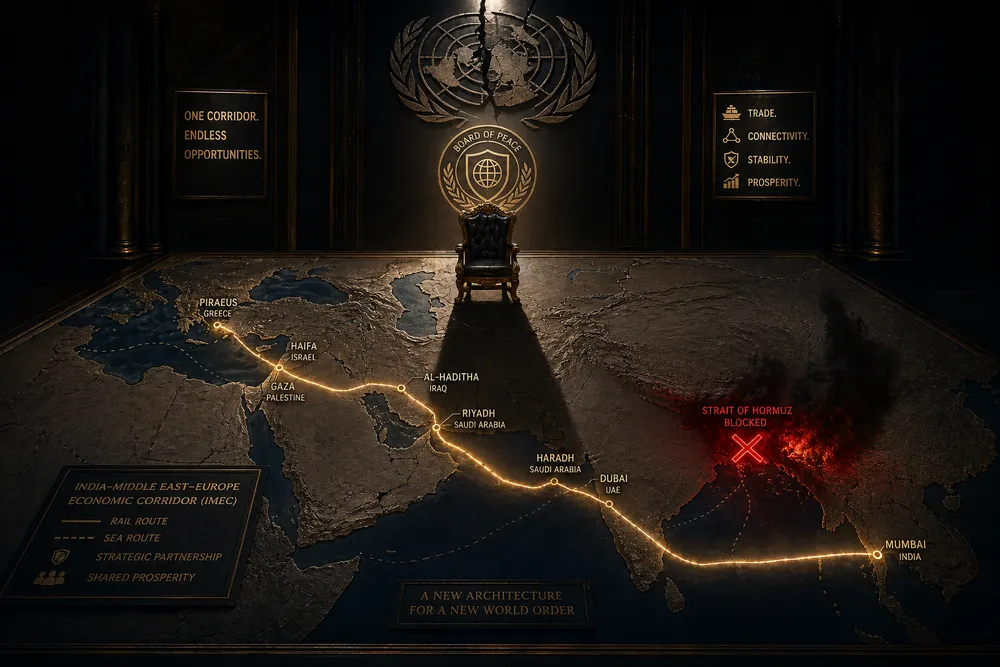
On March 4, 2026, Iranian Revolutionary Guard Corps forces declared the Strait of Hormuz closed to any vessel sailing to or from ports of the United States, Israel, and their allies.
The move was not a surprise to military planners — the Joint Chiefs of Staff had warned President Trump explicitly in pre-strike briefings that an attack on Iran could prompt exactly this response. What happened next, however, was not chaos. It was, many analysts now argue, something closer to a plan that had been assembling itself for years beneath the surface of events.
The narrative offered to the public has been a familiar one: nuclear brinkmanship, proxy networks, an escalating spiral between Washington, Tel Aviv, and Tehran.
These are real. But they are the surface layer of a much larger strategic reorganization — one involving infrastructure corridors, private capital, sovereignty-grade governance mechanisms, and a fundamental contest over who controls the arteries of twenty-first-century global commerce.
Two dimensions of this reorganization have not received the analytical attention they deserve.
- The first is that the Board of Peace — ostensibly a Gaza reconstruction mechanism — is structurally designed to supersede the United Nations and the Security Council as the world's operative governance authority on peace and conflict.
- The second is that Donald Trump is not merely the first chairman of this institution. He is its chairman for life. Replacement is possible only by his voluntary resignation or incapacitation, after which a successor of his own choosing takes the seat.
Together, these two facts produce a consequence that demands to be stated plainly.
This is not hyperbole.
It is the documented structure of the Board of Peace Charter, confirmed by analyses from Carnegie Endowment, JURIST, Just Security, and the American Society of International Law.
The question is how it came to exist, what it was built upon, and what the world looks like if it succeeds.
The Jugular: Hormuz and the Architecture of Leverage
The Strait of Hormuz is a 21-mile-wide channel between Iran and Oman at the mouth of the Persian Gulf.
For decades, it has functioned as the world's single most consequential maritime chokepoint.
According to the Congressional Research Service, roughly 27% of the world's maritime trade in crude oil and petroleum products transits the Strait — approximately 20 million barrels per day. A comparable proportion of global liquefied natural gas (LNG) makes the same journey, much of it from Qatar's massive export terminals.
Iran's closure breached the UN Convention on the Law of the Sea. But legality was beside the point.
Tanker traffic dropped 70% almost immediately, with over 150 vessels anchoring outside the Strait to avoid risks. Within days, traffic fell to near zero.
Approximately 20,000 mariners and 2,000 ships were stranded in the Persian Gulf. Brent crude surpassed $100 per barrel on March 8, peaking at $126.
The International Energy Agency's executive director described the situation as the greatest global energy security challenge in history. The Dallas Federal Reserve modeled that a single quarter of full Hormuz closure could reduce global real GDP growth by an annualized 2.9 percentage points. Bloomberg analysts began contemplating $ 200-per-barrel scenarios.
QatarEnergy declared force majeure on all LNG export contracts. A concurrent grocery supply emergency unfolded across GCC states that rely on the Strait for over 80% of their caloric intake. Iranian drone strikes on desalination plants — the source of 99% of drinking water in Kuwait and Qatar — deepened what had become a humanitarian catastrophe layered onto an economic crisis.
The United States, by contrast, was structurally insulated. As the world's largest LNG exporter and a country less dependent on Hormuz than Asian buyers, the United States had buffers in its domestic energy market that no other major economy possessed.
The gap between American energy security and everyone else's had never been wider. That gap was the leverage point.
Iran's deputy parliament speaker said the quiet part aloud: "We realized if we place our foot on the throat of the Strait of Hormuz and Bab al-Mandab, 25% of the world's economy would be affected."
The Escape Hatches — And Why They Failed by Design
Saudi Arabia and the UAE had invested billions in alternative oil export routes precisely to reduce their exposure to threats of Iranian closure.
The UAE built the Abu Dhabi Crude Oil Pipeline (ADCOP), pumping oil to the port of Fujairah on the Gulf of Oman — outside Iranian reach. Saudi Arabia constructed the Petroline, 750 miles across the desert to Yanbu on the Red Sea. Significant engineering achievements, both. And both proved inadequate within days of the closure.
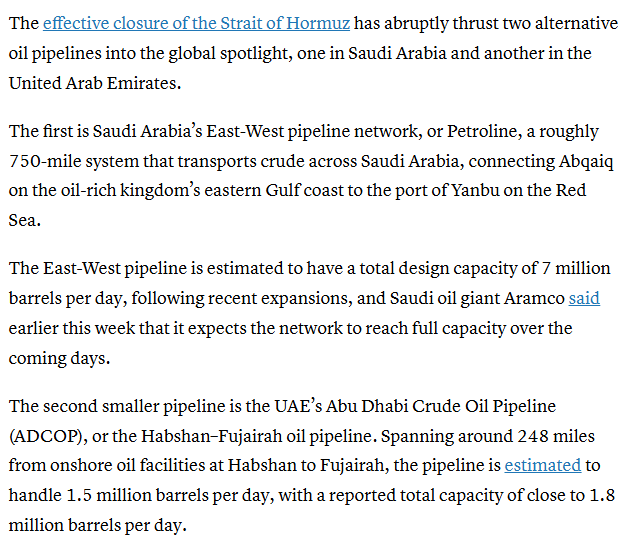
Iranian drones struck Fujairah in early March, taking the UAE bypass offline within two weeks.
 Sam Meredith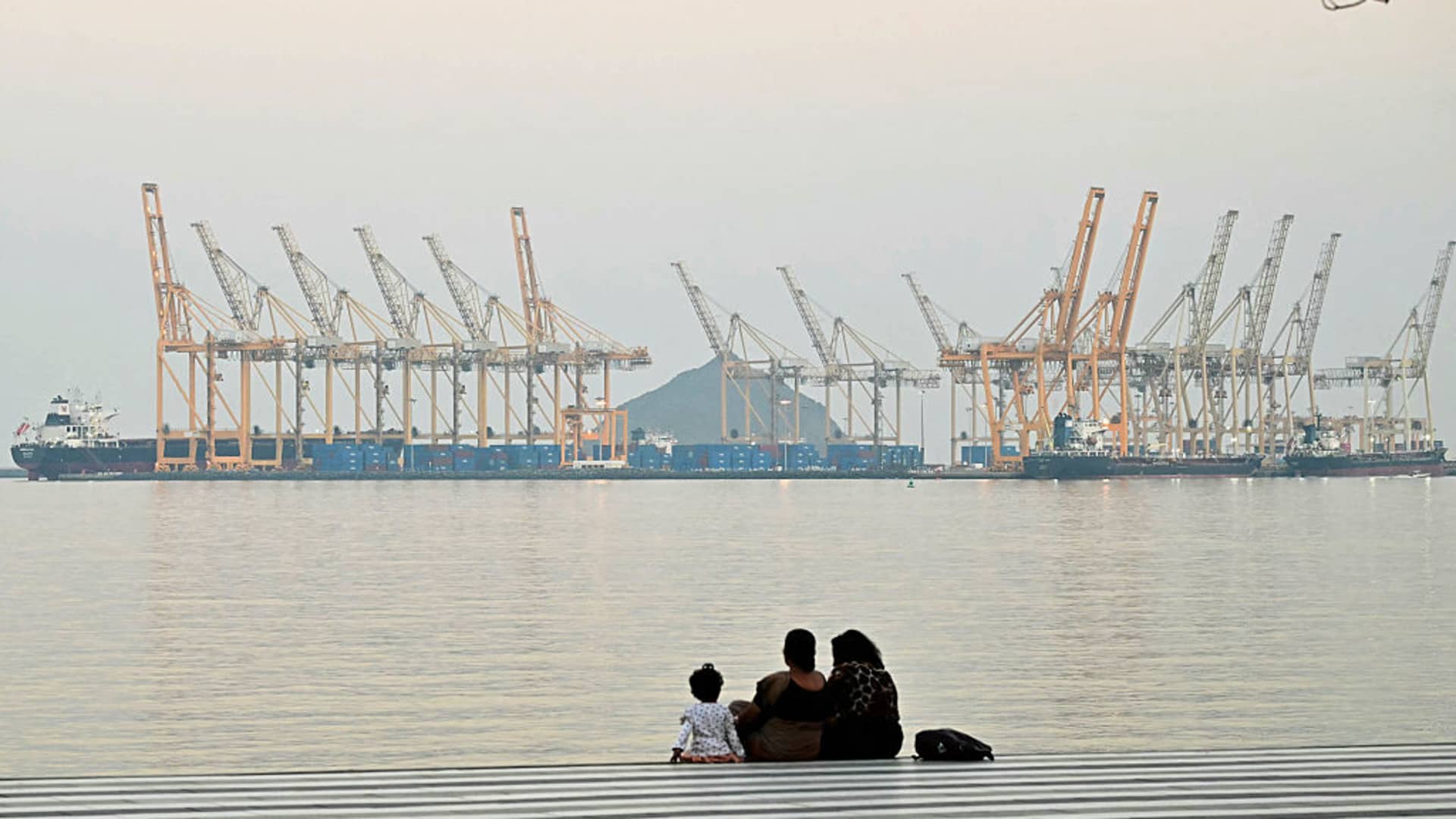
Attacks on Saudi pumping stations choked the Petroline.
Saudi Arabia's East-West Pipeline, a critical artery bypassing the Strait of Hormuz, was reportedly hit in an Iranian drone attack on Wednesday, Reuters has reported. According to the report, a pumping station along the 1,200 km pipeline was struck by a drone early morning on Wednesday. Prior to the attack, the pipeline was pumping at its emergency capacity of 7 million barrels per day (bpd) to bypass the shuttered Strait of Hormuz. (Source: Iran Attacks Saudi Arabia's East-West Oil Pipeline / Oilprice.com)
And even a functioning Petroline led into a second trap: the Bab el-Mandeb Strait, controlled by Yemen's Houthi movement.
TOI World Desk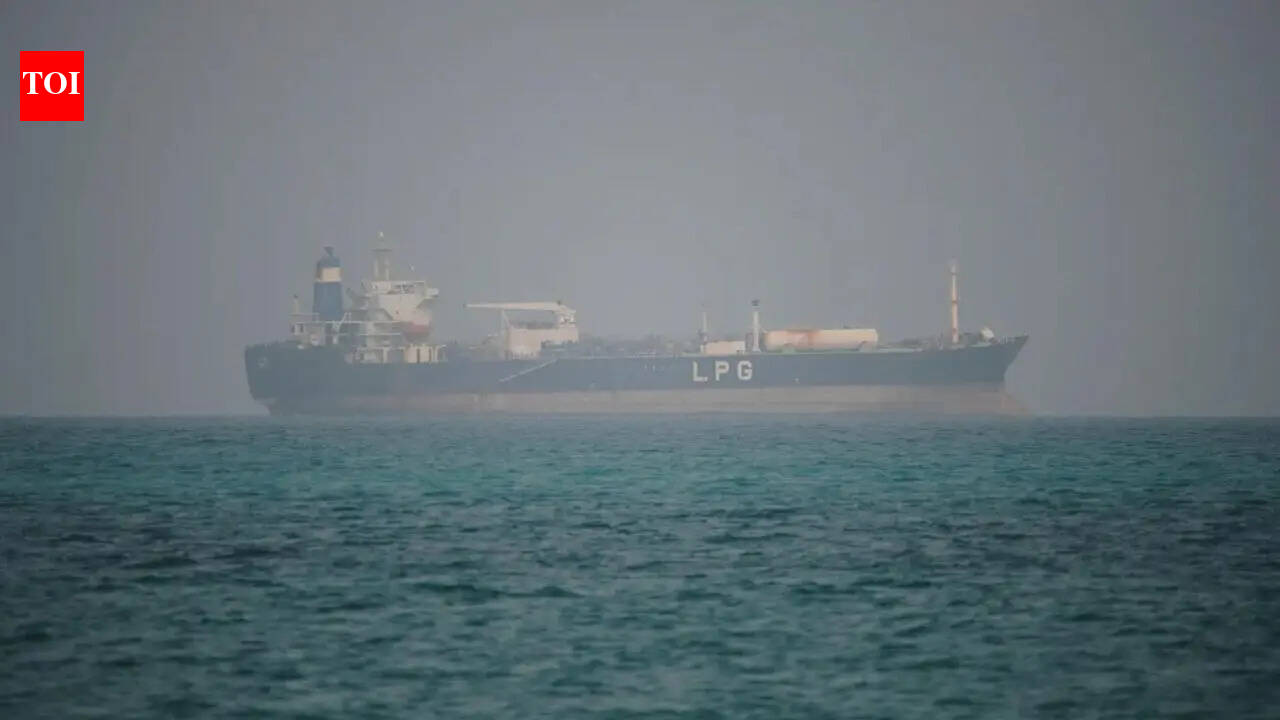
On March 28, the Houthis entered the conflict. They didn't need naval victories. They needed only to make insurance companies refuse to write policies on ships attempting the passage. They succeeded.
JP Morgan analysts estimated that approximately 329 vessels were stranded in the Gulf, requiring a combined $352 billion in maximum insurance coverage.
Private markets declined entirely.
The US International Development Finance Corporation (DFC) announced a revolving maritime reinsurance facility that would eventually total $40 billion — Goldman Sachs expressed skepticism — and the arithmetic made the outcome predictable: $40 billion against $352 billion in required coverage left a gap that no political statement could bridge.
The maritime routes were commercially dead. Something else would have to carry the world's trade.
It was waiting.
The Corridor That Modi Built — and Trump Captured
The India-Middle East-Europe Economic Corridor — IMEC — was Modi's project. This must be stated clearly because it is being obscured by the speed of subsequent events.
Modi announced IMEC at the G20 Summit in New Delhi on September 9, 2023.
European Commission President Ursula von der Leyen called it "nothing less than historic."
Modi himself called it "the basis of world trade for years to come."
Saudi Crown Prince Mohammed bin Salman called it "a big deal for us, and for Europe and for India." The Memorandum of Understanding was signed by India, Saudi Arabia, the UAE, the EU, France, Germany, Italy, and the United States.
Its intellectual origins trace to the I2U2 grouping — India, Israel, the UAE, and the United States — established in July 2022, and to India's particular strategic challenge: Pakistan blocks India's land access westward, cutting it off from direct overland trade routes to the Middle East and Europe.
IMEC was India's workaround.
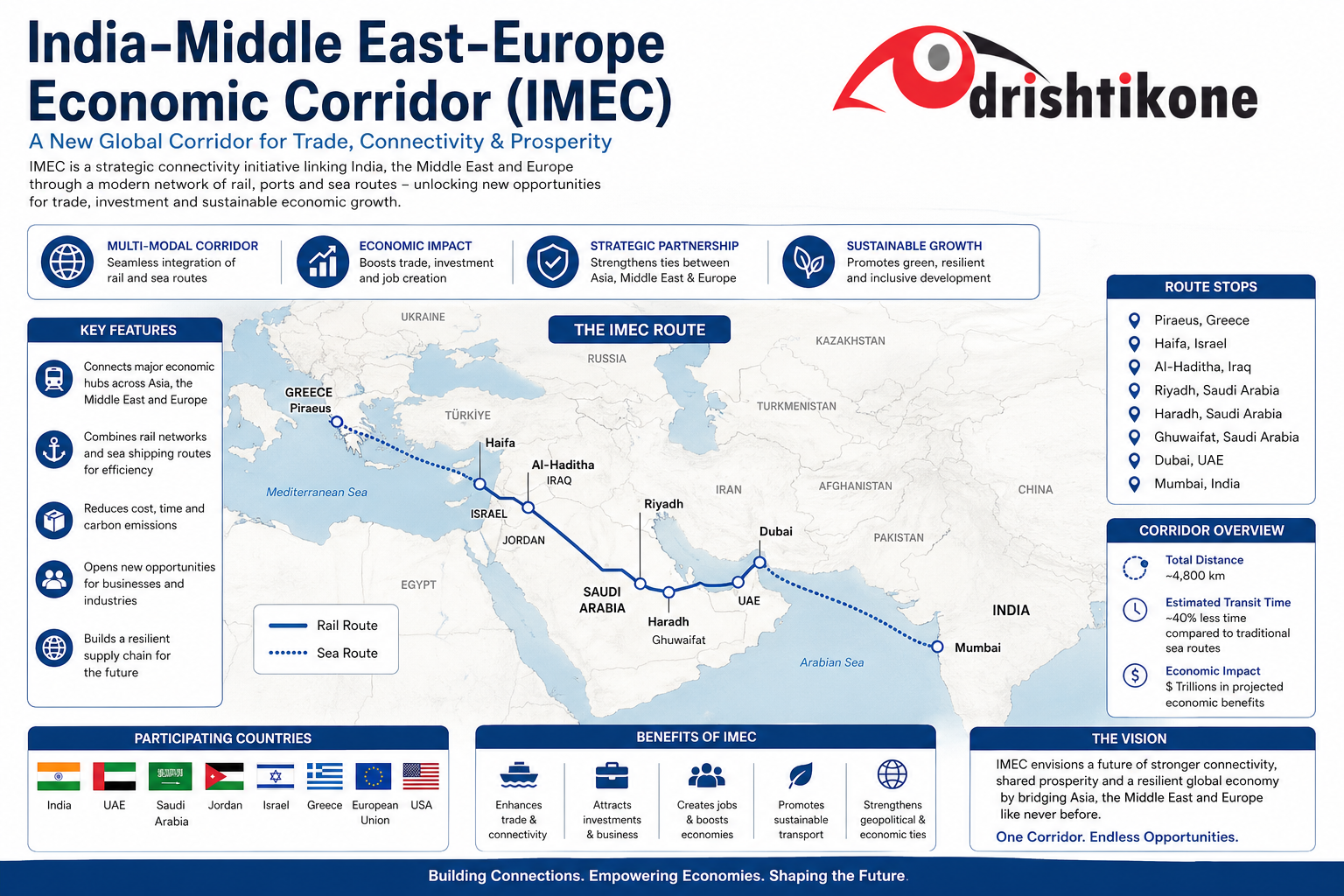
The corridor was also India's hedge against three converging threats: China's expanding grip on maritime infrastructure through Belt and Road, the Suez Canal as a single point of failure for global trade, and the Strait of Hormuz, where Iran had always held the world's energy supply in potential hostage.
As the European Council on Foreign Relations noted, IMEC offered the possibility of moving India's strategic position from maritime dependency to multimodal resilience.
Three weeks after the G20 announcement, Hamas launched the October 7 attacks on Israel. Documents recovered from Gaza tunnels showed that Hamas leader Yahya Sinwar told his political bureau days before the attack that an extraordinary action was needed specifically to prevent Saudi-Israeli normalization "before it was too late."
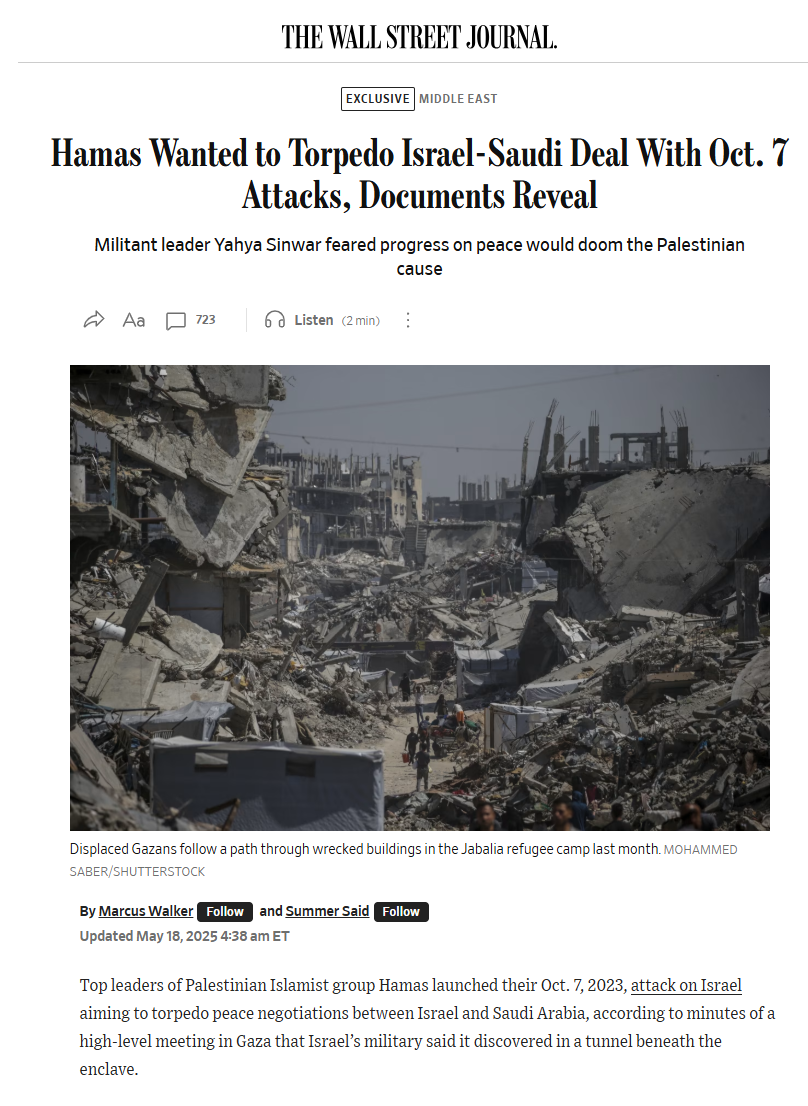
The IMEC railroad requires Saudi territory. Saudi-Israeli normalization unlocks that territory. October 7 was calibrated to prevent it. Iran had been funding and training Hamas for years. The attack was not random. It was a pre-emptive strike against a trade route.
The corridor stalled immediately. Private capital evaporated. Hezbollah spent months firing rockets into Haifa — IMEC's primary Mediterranean terminal — making the port commercially uninsurable. The governance gap between India, the Gulf, the EU, and the US meant no one could agree on financing structures or operating authority. IMEC effectively died on the drawing board through 2024.
Then Trump returned to office. And something changed that is only now visible in retrospect.
When Trump met Modi in February 2025 and called IMEC "one of the greatest trade routes in all of history," he was not simply endorsing India's vision.
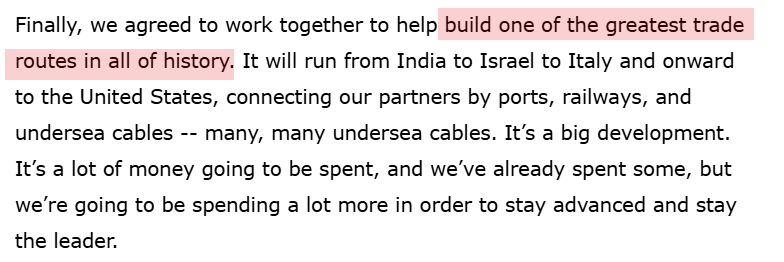
He was beginning to reframe it.
Analysts at American Affairs Journal documented the transformation in granular detail: "The Trump administration has evidently decided to retain IMEC but with a twist — privatizing the initiative and dramatically reorienting its direction and purpose."
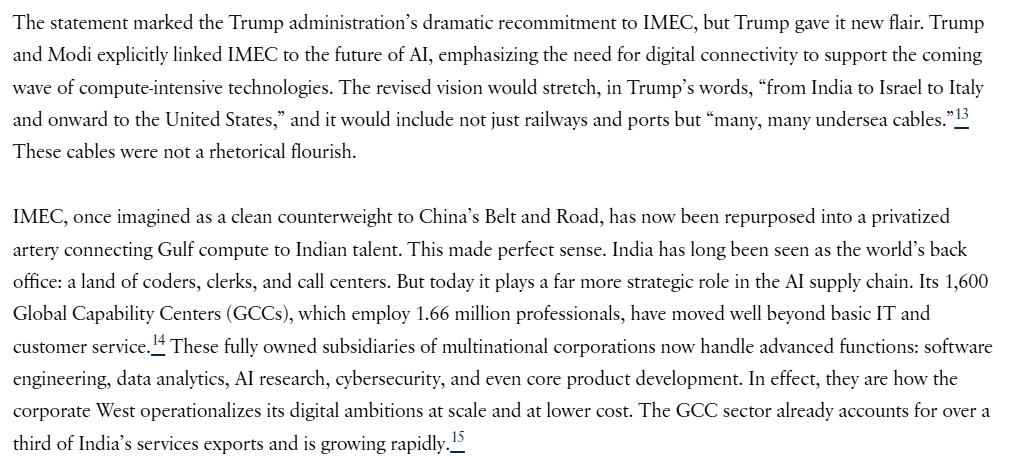
The corridor that India conceived as a vehicle for Indian strategic autonomy and multimodal resilience was being reconceived as a privately managed infrastructure system under American-controlled governance.
Notably, Trump's retelling of IMEC consistently altered its terminal point. Modi's formulation was India-Middle East-Europe.
Trump's version, repeated publicly, ran "from India to Israel to Italy and onward to the US."
The US was not in the original route. In Trump's telling, it was the destination. This is not a cartographic footnote. It is a statement of who the corridor serves.
- By April 2025, construction had begun on key infrastructure components.
- By January 2026, the Board of Peace had been formally established.
- By March 2026, the Hormuz crisis had made IMEC the only commercially insured route available for global trade.
Modi's corridor had become Trump's machine. The question is whether India retains any meaningful role within it — or whether it is now simply the corridor's eastern origination point, with all governance authority consolidated elsewhere.
Indian defense analysis has begun asking this question with some urgency. Reports from Indian outlets note that with Haifa repeatedly struck by Iranian missiles, with Indian trade negotiations with the US generating friction over tariffs, and with Trump's Gulf visit making conspicuously little mention of IMEC, India's position in the corridor it founded has become uncertain.
The Board of Peace: Not a Peacekeeping Body. A Governance Takeover.
The Board of Peace was presented to the world — and to the UN Security Council — as a mechanism for Gaza's reconstruction and stabilization.
That framing was accurate in the narrow sense that the body was initially proposed in the context of Resolution 2803. It is profoundly misleading about what was actually created.
Read the Charter text.
Not the press releases — the Charter.
The Board's mandate, set out in Article 1 of the Charter, is deliberately and sweepingly general: the Board of Peace is an international organization that "seeks to promote stability, restore dependable and lawful governance, and secure enduring peace in areas affected or threatened by conflict."
The Charter provides no geographic limitation. No list of specific conflicts. No enumerated scope.
Critically, the Charter's mandate makes no mention of Gaza at all.
The Carnegie Endowment for International Peace noted this with considerable alarm: "The Board of Peace Charter, unpublished at the time of the UN vote, makes no mention of either Gaza or Palestinian self-determination. Instead, it envisages a different, broader mandate: to act as a 'more nimble and effective' multilateral institution for peacebuilding, understood by some as an alternative to the eighty-year-old United Nations."
Trump himself has repeatedly said the Board will expand to address conflicts worldwide.
In his framing, Gaza is the "proof of concept."
Joseph Stepansky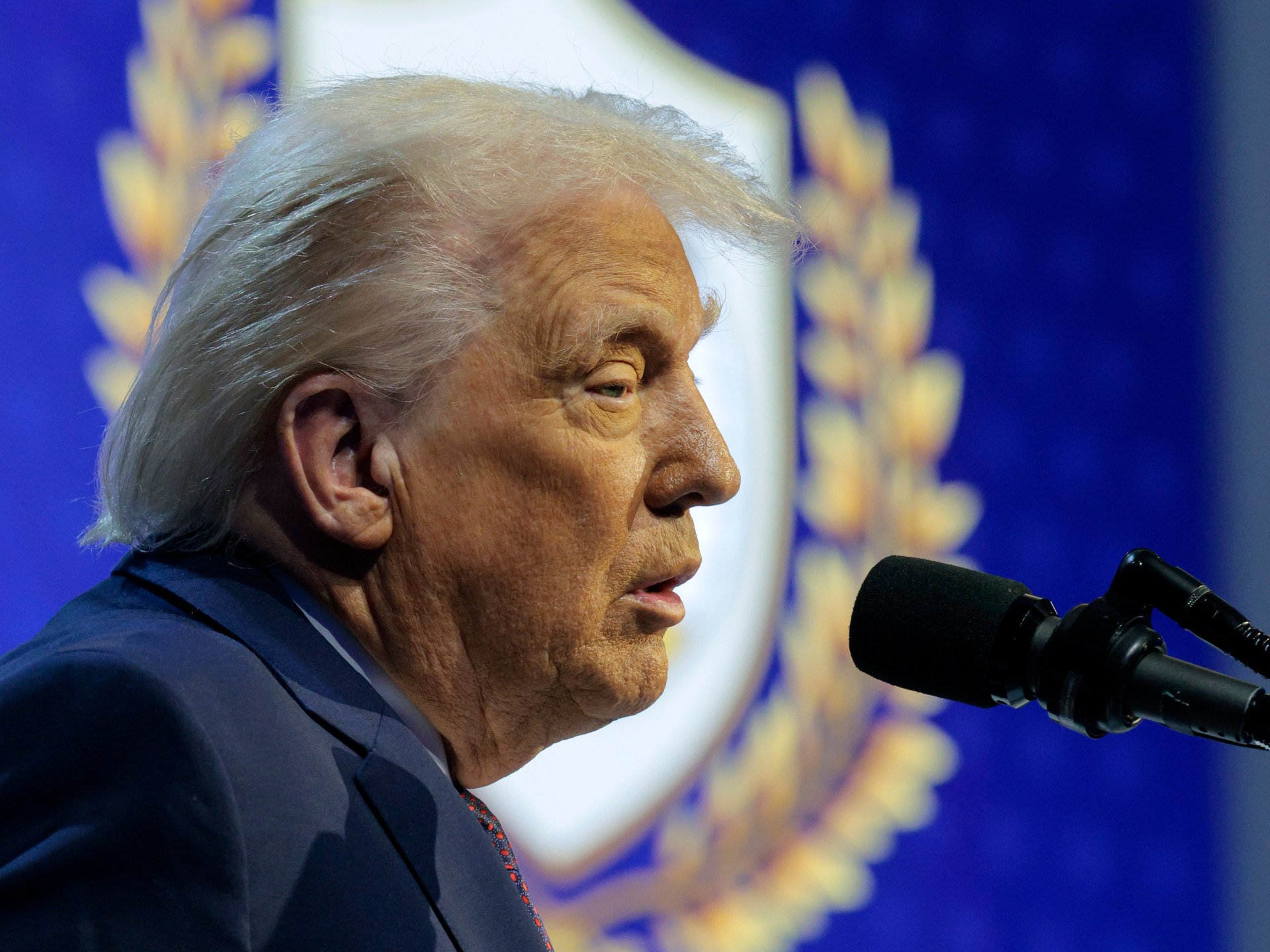
The institution's own logo — deployed at the inaugural Davos ceremony — features a globe showing primarily the United States, Canada, Mexico, and South America, with Europe, Asia, and Oceania largely omitted.
The cartographic symbolism was noted by observers. It was not subtle. The Board's seal, approved by the Chairman, shows America at the center of a world it governs.
The UN Security Council voted 13-0 to pass Resolution 2803, with Russia and China abstaining. Russia's Ambassador Nebenzya warned immediately that the Council was "giving complete control over the Gaza Strip to the Board of Peace."
He was right — but the problem is larger than Gaza.
The resolution endorsed a body whose Charter was not published at the time of the vote. Member states endorsed an institution whose governance structure they had not reviewed. The Board then published a Charter that revealed a mandate orders of magnitude broader than what was presented in the resolution.
This is the mechanism by which the UN Security Council — the world's highest deliberative body on peace and security — was used to confer international legitimacy on a private governance institution explicitly designed to replace it.
Trump has been transparent about this ambition.
He has stated openly that the Board could "do pretty much whatever we want" while nominally operating "in conjunction with the United Nations."
These are not fringe critics. These are the institutions and leaders of the democratic order on which the post-1945 world was built.
Chairman for Life: The Mechanism of Permanent Power
The most extraordinary provision in the Board of Peace Charter — the one that transforms a governance anomaly into a civilizational question — is the chairmanship clause.
Article 3.2(a) of the Charter states: "Donald J. Trump shall serve as inaugural Chairman of the Board of Peace."
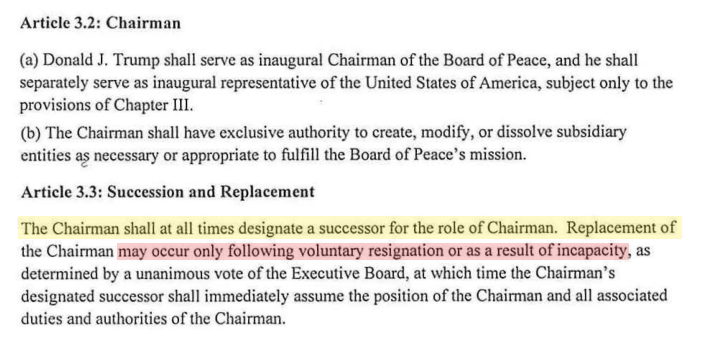
There is no reference to the office of the US Presidency. No fixed term. No electoral mandate. No constitutional check. Trump is named as an individual, not as a head of state, but as a person.
The Britannica description is precise: "The seat is relinquished only voluntarily or by incapacitation, at which time it passes to a designated successor."
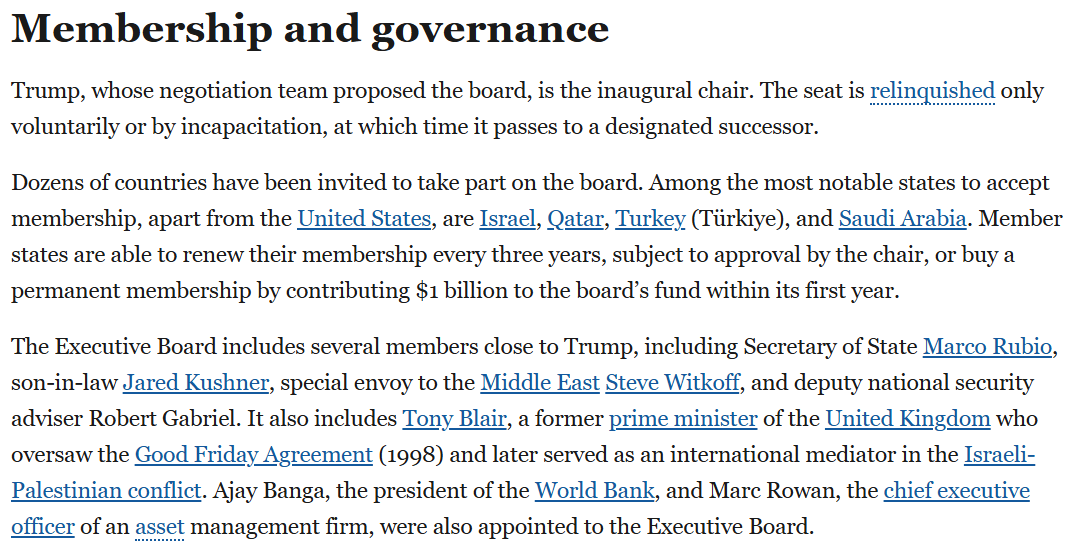
That successor is also designated by Trump.
No member state has a voice in who leads this institution. No election is held. No independent body reviews the choice.
The word "chairman" appears 34 times in the 2,000-word Charter — making it the fourth most common word, behind "board," "peace," and "shall."
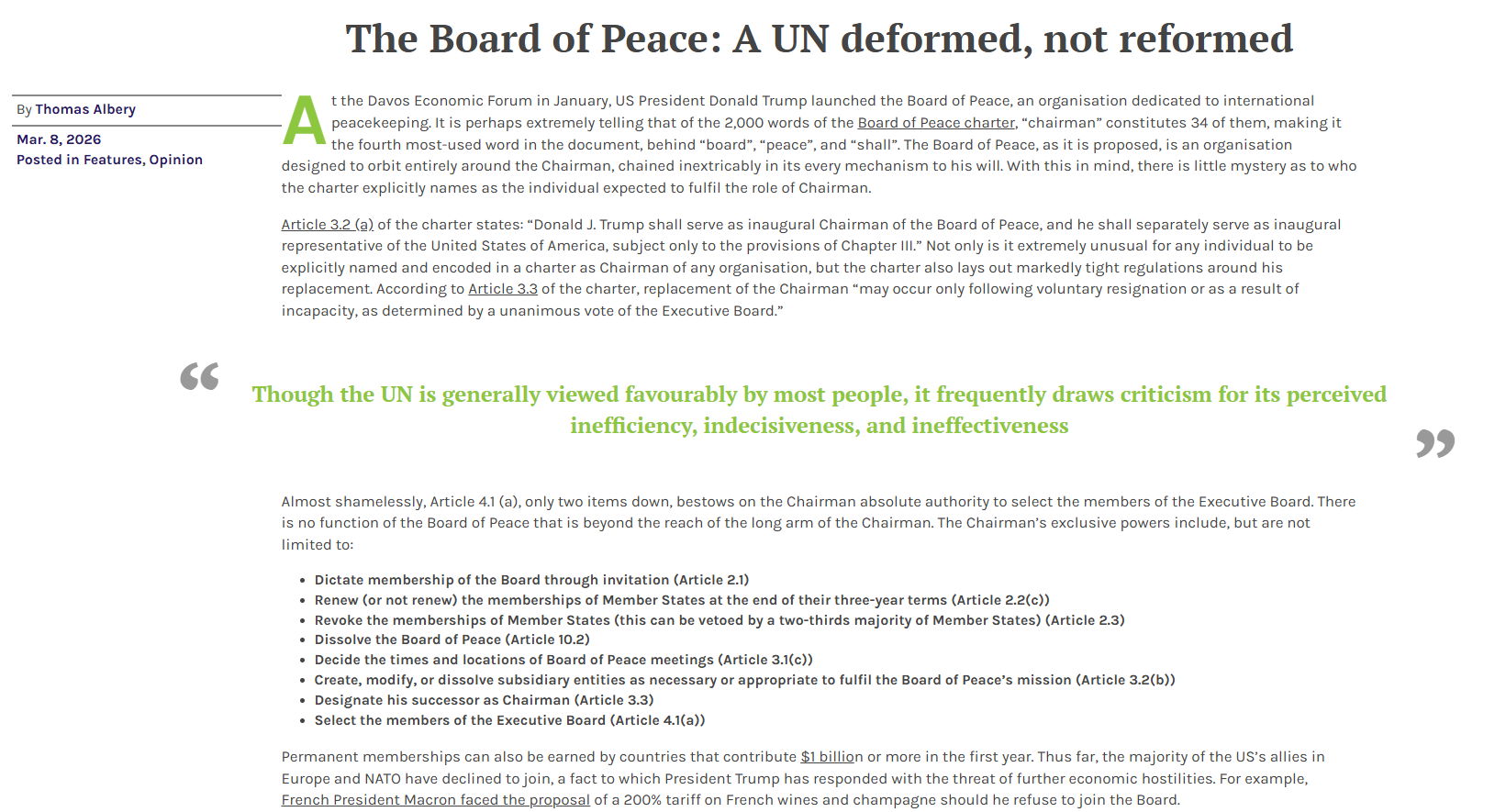
The Carnegie Endowment's granular analysis of Trump's powers as Chairman is worth reading in full.
Zaha Hassan and Charles H. Johnson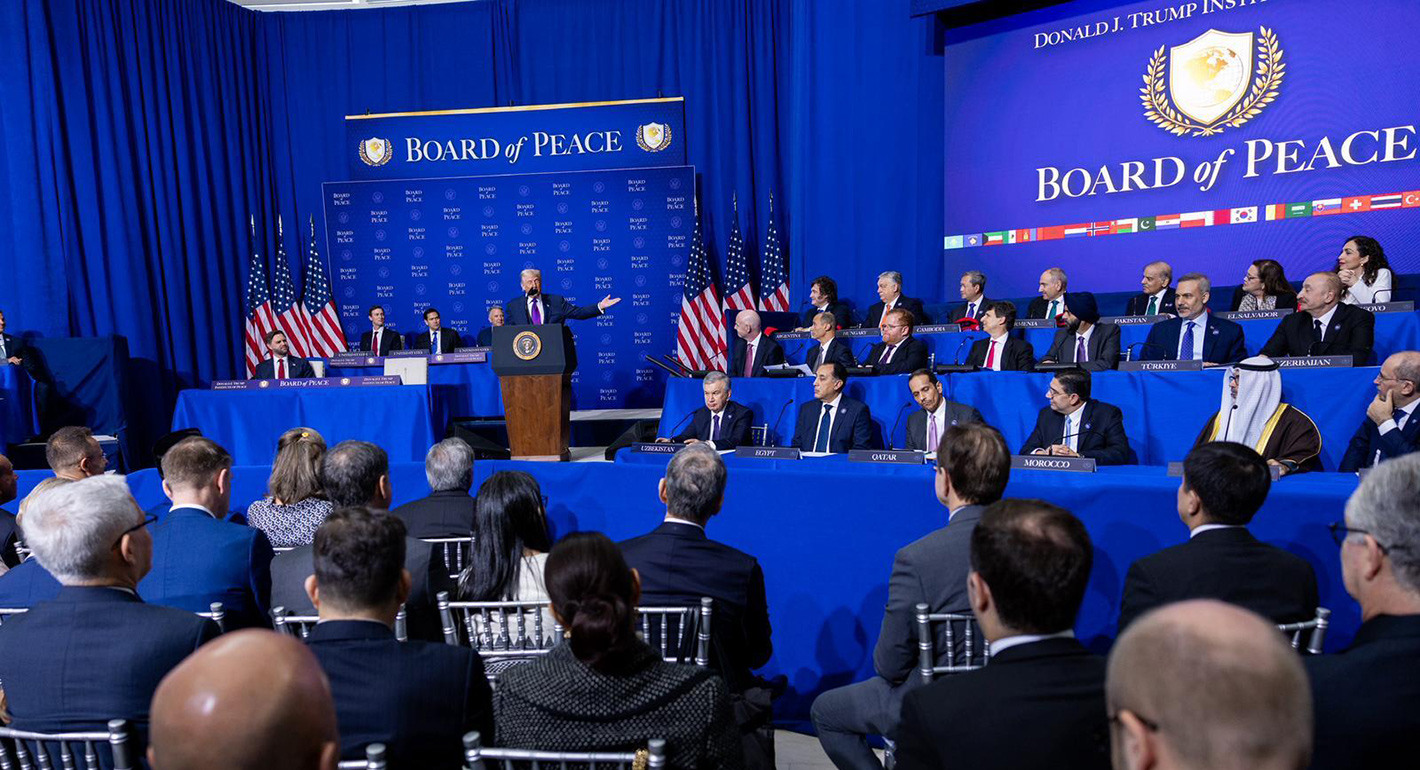
As Chairman, Trump is empowered to:
- Set all agendas for Board meetings
- Break all tie votes (effectively granting veto power over any contested decision)
- Arbitrate all charter disputes (meaning he interprets his own authority)
- Create, modify, or dissolve any subsidiary entities or the Board itself
- Delegate any or all authorities of the Board
- Appoint the commander of the International Stabilization Force
- Select his own successor in a position he holds indefinitely
- Solely select all members of the Executive Board
- Control all budgets, financial accounts, and disbursements through the Executive Board, which operates under his "direction and control"
The Executive Board itself consists, as Carnegie notes, "mostly of persons who either currently work for Trump or who have had close personal, professional, or past business relationships with him."
Jared Kushner. Steve Witkoff. Marco Rubio. Mark Rowan. Tony Blair.
This is not a board of independent governors.
It is Trump's inner circle, formally constituted as the executive decision-making body of a self-declared international organization with a global peace mandate.
This is the provision that deserves the most sustained attention. When Trump leaves the White House in January 2029, he does not leave the Board of Peace.
The United States will then have a new President, who, as a head of state and member of the Board, will sit in the General Assembly under Trump's authority as Chairman.
The Carnegie analysis adds another dimension: Trump's personal lawsuit against JPMorgan and its CEO, Jamie Dimon, seeking $5 billion, raises concerns that settlement discussions might influence arrangements regarding the Board's financial accounts, which are held at a private institution. The Board's Charter establishes no oversight or auditing mechanisms.
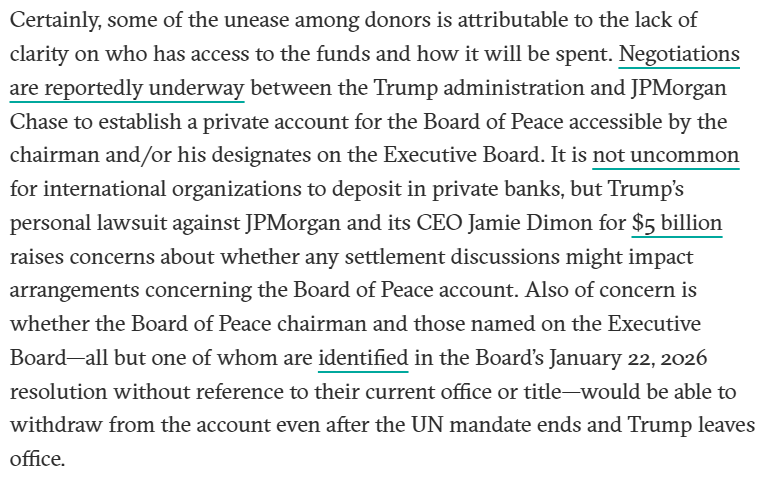
No conflict-of-interest rules are codified. No transparency requirements are enforced. Trump has yet to publish the Board's resolutions on its official website despite having "approved a resolution establishing the principles of financial integrity and transparency."
Countries that wish to secure permanent seats must contribute $1 billion to a fund controlled by Trump.
Three-year rotating seats are available with a lower contribution and are renewable at the Chairman's discretion.
ABC News confirmed that Trump could hold the chairmanship for life, noting that the charter draft "made no reference to the office of the presidency or to any sort of fixed term."
The $1 billion membership fee has been described by Chinese analysts as violating the principle of sovereign equality — effectively pricing most developing countries out of permanent membership and converting the institution from a governance body into a club for wealthy nations whose admission is controlled by one man.
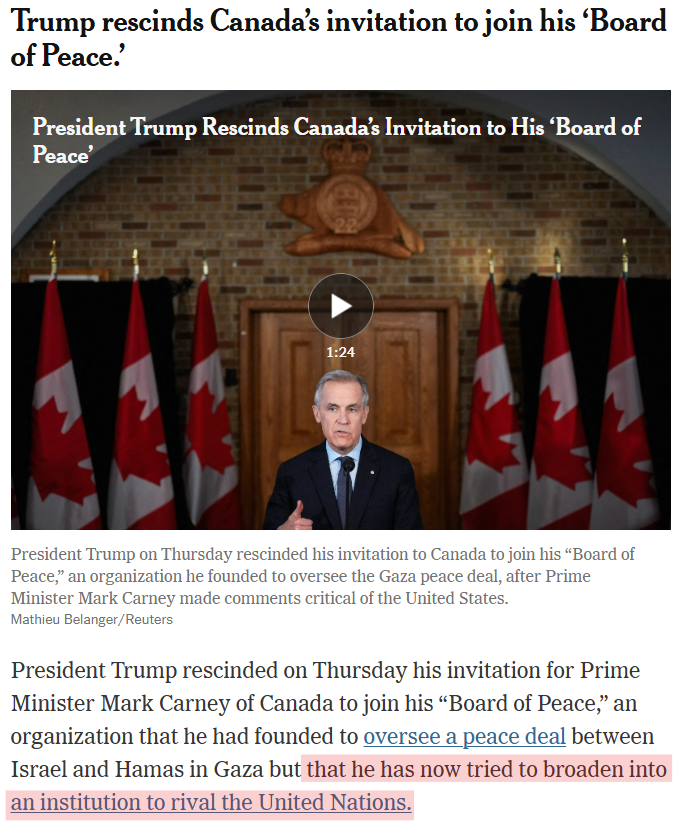
Trump posted the revocation on Truth Social.
The Army Without a Constitution
Behind the financial architecture, behind the governance charter, behind the IMEC corridor — there is a military force. And it, too, answers to one man - Donald Trump.
The International Stabilization Force authorized under Resolution 2803 comprises 20,000 troops drawn from Indonesia, Morocco, Kazakhstan, Kosovo, and Albania.
It is funded by a $17 billion pool from Gulf states and the United States.
It is commanded by US Major General Jasper Jeffers — a career SOCOM commander whose background encompasses the elite special operations units that execute counterterrorism missions, tunnel-clearing operations, and targeted strikes.
Every democratic institution that governs the use of military force — congressional authorization, judicial review, treaty obligations, legislative oversight, independent inspector generals — is absent from this structure.
The ISF is not subject to the War Powers Resolution.
It is not subject to Senate confirmation of its leadership. It operates under a mandate authorized by a UN resolution passed before the Charter governing its command structure was published.
The force's operational mandate is to clear tunnels, demilitarize Gaza, and establish what the Board calls a "terror-free zone" along the corridor.
But its funding structure reveals its deeper purpose: ISF resources are explicitly tied to the reconstruction of IMEC's corridor nodes — ports, rail infrastructure, fiber-optic networks.
If the force fails to secure the route, the DFC's insurance guarantees collapse, and the private capital that funds the reconstruction evaporates.
Security is the product being sold to investors. The soldiers are the instrument by which insurance premiums are kept manageable.
This is historically unprecedented. Every previous international peacekeeping force, such as UNMIK in Kosovo, UNTAET in East Timor, and UNPROFOR in Bosnia, operated under a UN mandate with defined reporting structures, Security Council oversight, and member-state accountability.
The ISF operates under none of these constraints. It is commanded by the Chairman of a private international organization that he founded, chairs for life, and which has no independent oversight mechanism.
The force's multinational composition — drawing from Muslim-majority countries like Indonesia and Morocco alongside smaller states like Kosovo and Albania — provides the optics of international legitimacy without the substance.
No Security Council resolution can override the Chairman's authority over the ISF's command structure. No General Assembly resolution can compel its withdrawal. No ICJ ruling can impose accountability on a force that reports to a private institution claiming sovereign immunity.
Trump has repeatedly suggested that the Board could eventually supplant the UN entirely.
The 2026 Munich Security Report warned that Trump "believes he holds a mandate not only to remake the United States at home but also to redefine its role in the world according to a narrow, and often quite personal, interpretation of the national interest."
A personal international army is what a personal interpretation of global security produces.
The Hunger Games Architecture: What Unchecked Power Actually Produces
It is tempting to dismiss the dystopian framing as overwrought.
The Board of Peace is new, fragile, and contested.
Only 25 of 62 invited countries have signed. Most of the world's major democracies have declined. The EU has expressed fundamental legal concerns. Russia and China are building competing architecture. The IMEC corridor itself faces serious structural obstacles.
But dismissal of the worst-case scenario requires ignoring what happens when the pieces already assembled become operational.
Consider the full architecture in sequence. The Board of Peace controls the governance of Gaza, the western terminus of IMEC's corridor into Europe. Through the DFC, the United States controls the political risk insurance that determines which infrastructure investments are viable along the corridor.
Through the ISF, the Board's Chairman controls the military force that secures the corridor.
A country that wishes to trade efficiently between Asia and Europe in the post-Hormuz world has one viable land option: IMEC.
To use IMEC, it must operate within a governance framework ultimately controlled by the Board. To remain in good standing with the Board, it must not offend its Chairman.
Canada demonstrated what offending the Chairman produces: immediate expulsion.
The $1 billion permanent membership fee demonstrated the cost of access.
And the Charter's provision that three-year seats are renewable "at the Chairman's discretion" makes even temporary membership a matter of personal approval.
This is not the architecture of a peacekeeping organization. It is the architecture of a toll road to civilization — and the toll collector serves for life.
The comparison to dystopian fiction is not a rhetorical flourish.
In Suzanne Collins' Hunger Games, the Capitol maintains control over the districts not primarily through direct military occupation, which, of course, it could not sustain, but through the control of resources, access, and the spectacle of power.
The Board of Peace architecture operates on a similar logic.
Nations do not need to be conquered. They need only to calculate that IMEC access is worth the price of deference.
- That the Board's insurance guarantees make it impossible to build rival infrastructure.
- That exclusion from the corridor means exclusion from the most important trade system of the next century.
Under those conditions, sovereignty becomes nominal. Participation in the Board's framework — on the Chairman's terms — becomes economically compelled.
The mechanism is more sophisticated than the Hunger Games and more durable.
It does not require an authoritarian government to sustain it. It requires only that enough countries decide that membership is economically preferable to exclusion.
Once that threshold is crossed, the architecture becomes self-reinforcing. New members need the corridor. To access the corridor, they need to maintain standing with the Board. To maintain standing, they must not challenge the Chairman. The Chairman serves for life and names his own successor.
There is no democratic override for this structure.
- No election that removes the Chairman.
- No legislature that can defund the ISF without triggering the collapse of the insurance guarantees that the DFC has written across the global economy.
- No court that has jurisdiction over an international organization with sovereign immunity.
The only constraint on the Chairman's authority is the Chairman's own judgment — and the Charter's only removal mechanism is voluntary resignation or incapacitation.
History offers one useful comparison: the British East India Company.
At its apex, the Company governed more territory than most nations, commanded a private army larger than Britain's standing force, and operated with a charter that gave its directors extraordinary commercial and political authority.
It was efficient. It built infrastructure. It reduced certain transaction costs for certain participants.
And it ultimately produced one of the most extractive and coercive governance systems in recorded history — precisely because efficiency in the absence of accountability is indistinguishable from exploitation.
The Board of Peace has not reached that point. It may never reach it. The obstacles are real, and the resistance is serious.
But the architecture is the same: private governance, commercial dependency, military backstop, sovereign immunity, and a single authority at the center whose power is self-perpetuating.
The Walls That Could Stop It
The architecture described above is real. So are the obstacles that could prevent it from cementing.
The first wall is Europe.
EU treaty law — Articles 3 and 21 — requires European foreign policy to be grounded in the UN Charter.
France, Germany, Sweden, the UK, Norway, Slovenia, Greece, Spain, and Ukraine have all declined invitations to join.
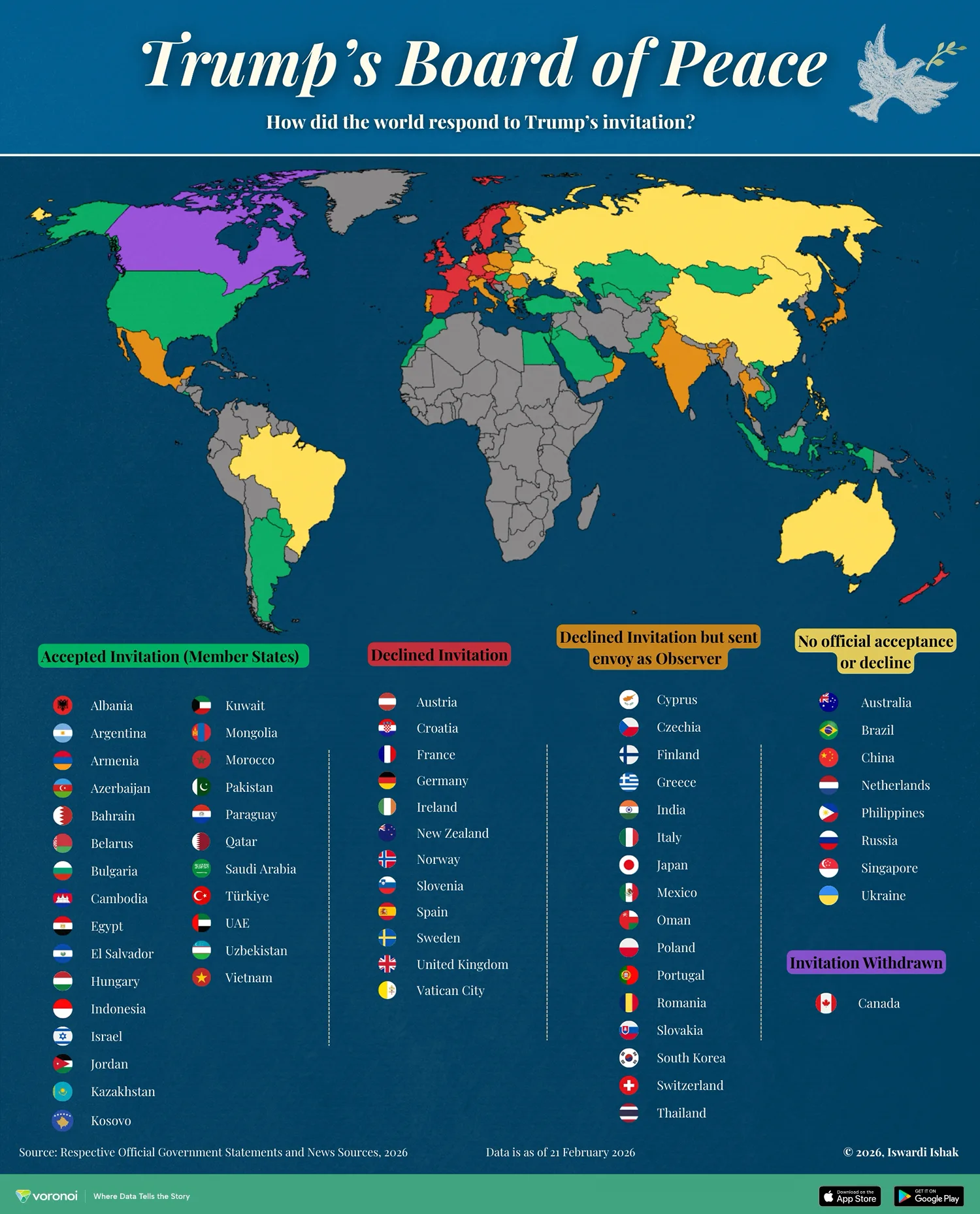
The EU has expressed fundamental legal doubts about the Board's compatibility with the UN Charter.
The second wall is the US Congress.
The DFC's wartime deployment as a backstop for high-risk private-sector activity in a conflict zone was carried out without congressional authorization.
The Board of Peace charter was not submitted to Congress under the Case-Zablocki Act or any other statutory framework for international agreements.
Senator Markey submitted formal questions to the State Department demanding to know whether the Administration viewed the Board as an alternative to the UN, what oversight Congress would have over its operations, and whether Trump was advancing the initiative in his personal or governmental capacity. The questions have not been fully answered.
Any major infrastructure loss that triggers DFC guarantees could mobilize congressional opposition with significant force.
The third wall is BRICS and the competing architecture.
Russia and China are building BRICS Pay — a decentralized payment system designed to bypass SWIFT and dollar-denominated trade.
If enough nations build a commercial loop that bypasses the Board's corridor and its digital settlement layer, the Chairman's leverage collapses.
The world bifurcates into two incompatible systems rather than converging on one. Trump becomes sovereign of half the planet, not all of it.
The fourth wall is legitimacy itself. UN human rights experts have formally condemned the Board as exceeding Resolution 2803's mandate.
The ICJ's 2024 Advisory Opinion found Israel's presence in Occupied Palestinian Territory unlawful — a ruling that the Board's governance structure for Gaza sits in direct tension with.
The ASIL analysis notes that entrusting governance to a hybrid entity dominated by a single member state raises concerns about bypassing the Charter's trusteeship system, which fell into disuse precisely because of its colonial connotations.
Russia's Ambassador compared the arrangement explicitly to colonial practices. These criticisms give every skeptical government a legal framework for sustained resistance.
India's Dilemma: The Architect Displaced
For India, the situation presents a particular and painful irony.
IMEC was India's strategic project — its answer to encirclement, its alternative to dependence on Chinese maritime infrastructure, its vehicle for positioning the country at the center of the next century's dominant trade route.
Modi brought it to the G20 in 2023 as a statement of Indian civilizational agency: India connecting the ancient Golden Road, India linking East to West, India at the hub of the next world.
What has emerged is something different.
- The corridor's governance is controlled by the Board of Peace, which India has not joined and does not lead.
- The corridor's financial risk infrastructure is controlled by the DFC — an American institution.
- The corridor's western terminus is controlled by the Board's Gaza reconstruction authority.
- The corridor's military security is provided by the ISF — which reports to the Board's Chairman.
India's role, increasingly, is the corridor's eastern origination point: the place where goods enter a system governed entirely by others.
The Carnegie Endowment's analysis of India's position in the Trump 2.0 era notes that India "cannot ignore the structural constraints it faces. The United States remains indispensable as a source of advanced technology, capital, and defense cooperation."
India's strategic autonomy — its celebrated "multi-alignment" — is being stress-tested by a situation in which the infrastructure India designed is being operated by an American-chaired institution under American-controlled governance, backed by an American-funded private army.
This is the usurpation that deserves to be called out.
Modi's IMEC was a multipolar vision: India, the Gulf, Europe, and the US as co-partners in a shared infrastructure project that no single power controlled.
The route runs from India to Trump's world. The governance flows from Trump's boardroom. The military security is commanded by Trump's appointee. The insurance is written by Trump's DFC. The western terminal is rebuilt by Trump's Board.
The Genius and the Danger Are One
What is being assembled is either the most consequential restructuring of the global order since 1945 or the most dangerous concentration of unaccountable power in the modern era.
The honest answer, supported by the evidence, is that it is both — and that the genius of the construction is precisely that the two cannot be separated.
The vision has real merit taken on its own terms. A world where energy moves as data instead of liquid, where trade routes cannot be held hostage by whoever controls 21 miles of water, where the chokepoints that have defined geopolitical leverage for a century are engineered into irrelevance — this is a genuinely better world than the one being replaced.
But the governance structure through which this vision is being realized is a structure that democracy itself cannot survive inhabiting.
- The Board of Peace is not a reformed UN. It is the UN's replacement, designed to be immune to the UN's constraints — Security Council vetoes, General Assembly votes, independent oversight, equal sovereignty.
- It is a private club that charges a billion dollars for permanent membership, expels members whose leaders say things the Chairman dislikes, and is governed by a document that names a single human being as its permanent authority.
- That human being is currently a 79-year-old real estate developer who named a Mediterranean waterfront after himself before the rubble of its predecessor was cleared.
- He can — per the Charter — dissolve the entire institution by a decision he reaches alone. He can invite nations in and throw them out on a whim.
- He has already demonstrated both capabilities. And when he leaves the White House, he does not leave the Board. He retains the chairmanship.
- The next American president will sit in his General Assembly as a subordinate member state.
The world that the Board of Peace architecture produces, if it succeeds, is not a world governed by rules. It is a world governed by access.
Countries that can afford the membership fee and maintain the Chairman's favour participate in global commerce on commercially viable terms.
Countries that cannot — or will not — are excluded from the most important trade infrastructure of the twenty-first century.
This is the Hunger Games architecture — not in its aesthetics but in its logic.
The districts do not need to be invaded. They need only to be made dependent. And the Capitol does not need to govern everything. It needs only to control the systems that everything else depends on.
Modi built a road. Trump is building a world.
Whether enough of that world decides that access to the machine is worth the price of admission — and what kind of world exists for those who decide it is not — is the question that will define the coming decade.
It deserves to be asked with the urgency that the architecture being assembled demands.