Worth Defending?
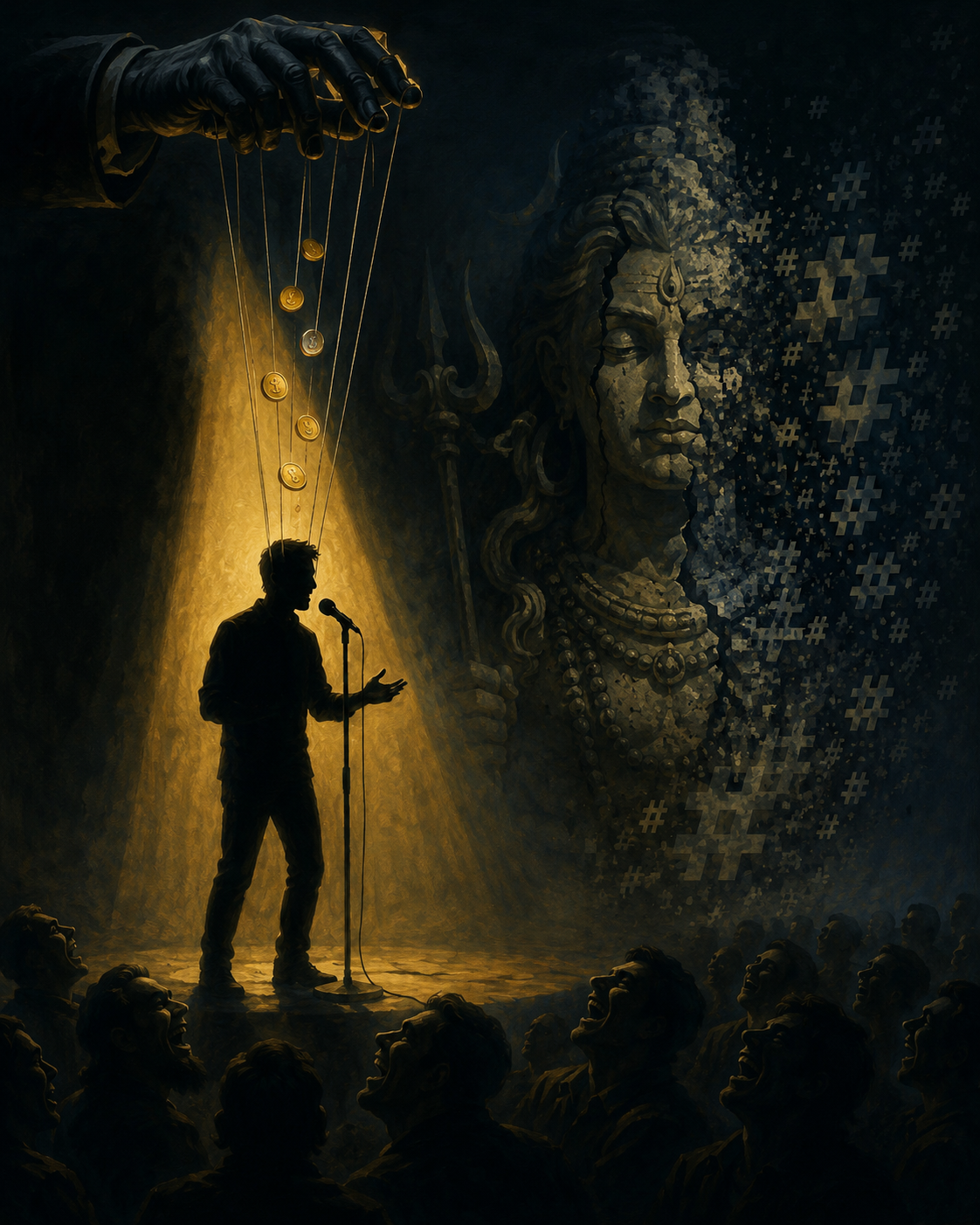
A king once ruled a province that no army had ever taken. His walls were high, his soldiers loyal, his treasury deep. One spring, a wandering fool arrived at the gate and asked for nothing but a corner of the marketplace. The king, amused, allowed it.
The fool told no lies about the king. He simply imitated him. The way he held his cup. The way he blessed the harvest. The way he bowed before the temple fire. Each gesture, performed slightly wrong, drew a little more laughter. Within a year the people still obeyed the king, still paid their taxes, still bowed. But they bowed while smiling at a private joke. The sacred had become a punchline.
When the neighboring army finally came, the walls held and the soldiers fought. Yet the province fell in three days, because no one could remember why it had been worth defending.
The fool was paid in copper by the marketplace. Who paid him in gold remained a question no one thought to ask.
Faruqui's Bigotry as Comedy
In 2021, the Indore bench of the Madhya Pradesh High Court reserved its order on the bail application of the stand-up comic Munawar Faruqui, arrested over his anti-Hindu content, the kind of content he produces repeatedly. The judge's remarks were scathing. He asked why the comic took undue advantage of others' religious sentiments and emotions, what was wrong with his mindset, and how he could do this for the purpose of his business.
The Indore Bench of the Madhya Pradesh High Court has made scathing remarks against Munawar Faruqui while reserving the order on the self-proclaimed stand-up comedian’s bail application. The single judge bench of Justice Rohit Arya also asked the advocate appearing for Munawar Faruqui whether he wanted to withdraw the bail application, LiveLaw has reported. The judge asked, “But why you take undue advantage of other’s religious sentiments and emotions. What is wrong with your mindset? How can you do this for the purpose of your business?” Senior Advocate Vivek Tankha argued on behalf of Munawar Faruqui, “He has committed no offence in the matter your lordships. Bail should be granted”. “The accused Munawar Faruqui has posted several previous video which was circulated on social media.These remarks were made 18 months ago. He repeated the same remarks on three different occasions i.e. comedy shows. This has led to other comedians making such remarks about Hindu Gods. This is happening with 70% of the comedians,” one lawyer opposing the bail application said. (Source: MP HC slams Munawar Faruqui, reserves order on bail application / Opindia)
Now look at who stood up to defend him. Senior Advocate Vivek Tankha, arguing that Faruqui had committed no offense and that bail should be granted.
Have you ever attempted to engage a senior advocate of the stature of Vivek Tankha and secure his personal appearance before the Madhya Pradesh High Court? Those familiar with the legal profession understand that such representation is neither routine nor inexpensive. Lawyers of this standing command substantial professional fees, reflecting decades of experience, reputation, and demand. Depending on the nature and complexity of the matter, a single court appearance by a senior advocate of this caliber can cost anywhere from ₹5 lakh to ₹10 lakh or more. Such engagements are typically beyond the reach of ordinary litigants and are generally associated with well-funded individuals, organizations, or high-profile cases. (Source).
By most accounts, a working Indian stand-up earns somewhere between five and twenty thousand rupees for a twenty-five to thirty minute set (Source).
Does the arithmetic add up for you?
When examining the controversy surrounding Munawar Faruqui, two fundamental questions arise.
- First, what was the actual objective of his performances? Were they merely provocative comedy designed to attract attention and expand an audience, or were they part of a broader cultural and political narrative that extended beyond entertainment? The answer to that question is central to understanding why his performances generated such intense reactions and why they became national controversies rather than isolated incidents on a comedy stage.
- The second question is equally important: who stood behind him, and for what reason? Public figures often operate within networks of supporters that can include legal advocates, media organizations, activist groups, political actors, and influential individuals who share common interests or principles. The extent and nature of that support can significantly shape how controversies unfold.
One argument advanced by critics is that Faruqui could not have repeatedly pushed boundaries in the manner he did unless he believed that substantial institutional, legal, or financial support would be available if matters escalated. In their view, the sophistication of the legal response mounted in his defense, particularly during the bail proceedings, suggests access to resources and networks that are typically unavailable to ordinary individuals facing similar circumstances.
This feature of his situation informs us a lot about what the objective was if someone was willing to go beyond the normal for a comedian who was willing to act as a tool repeatedly.
Whether one accepts that conclusion or not, the controversy raises broader questions about the relationship between cultural figures, legal advocacy networks, media amplification, and the structures of support that emerge when high-profile public disputes become national political and social flashpoints.
Disparagement Humor
What Munawar Faruqui was doing wasn't some random comedic act. It was what is known in social psychology scholarship as "disparagement humor". It is humor directed at a particular group.
What is happening across film, advertising, and most consequentially the stand-up comedy circuit is the systematic use of disparagement humor.
Disparagement humor is humor that denigrates, belittles, or maligns an individual or a social group (Sources: Janes & Olson, 2000; Zillmann, 1983). Its structure is paradoxical. It carries two weapons at once.
The first is an explicitly hostile, bigoted message. The second is the wrapping of that hostility in a "joke," which makes it deniable and therefore acceptable.
1. An explicit hostile, bigoted or prejudiced statement: The joke itself belittles a specific target.
2. Wrapping within a joke: By claiming it's "just a joke," the speaker frames the hostility as harmless amusement, providing deniability and making the targeted group the punching bag.
This is the part most people miss. The damage is not the offense in the moment. The damage is what the joke does to the boundary of what a society will tolerate.
Psychologists have long observed that disparagement humor is rarely harmless. While presented as entertainment, jokes targeting particular groups often serve as a "prejudice releaser".
A mechanism that lowers social inhibitions against expressing and normalizing bias. By cloaking stereotypes in humor, such jokes can make discriminatory attitudes appear acceptable, normal, or even socially rewarded.
Research suggests that exposure to disparagement humor can reinforce existing prejudices, reduce sensitivity to discriminatory behavior, and increase the likelihood that individuals with pre-existing biases will express them more openly.
In this way, humor can function not merely as comedy but as a subtle vehicle for legitimizing prejudice.
Settled Science and the Comic
The central framework here comes from social psychologists Thomas E. Ford and Mark A. Ferguson, who introduced Prejudiced Norm Theory in a 2004 paper in Personality and Social Psychology Review (Source: Social consequences of disparagement humor: a prejudiced norm theory / Pers Soc Psychol Rev. 2004;8(1):79-94).
Their argument is very specific.
This kind of humor shifts the normative boundaries of what hateful or discriminatory talk and action feel acceptable, which is essentially an Overton-window effect applied to prejudice.
When ridicule and dehumanization of a group are repeatedly presented as “edgy comedy,” the acceptable range of speech about that group expands to include more open contempt and stereotyping. That’s the Overton window of hate shifting outward.
You see, jokes serve as repeated, low-cost signals that hateful attitudes are within the bounds of “normal” interaction.
Ford and his colleagues then proved the behavioral consequence in the laboratory. In a 2008 study titled, fittingly, "More Than 'Just a Joke'," they ran two experiments (Source: More than "just a joke": the prejudice-releasing function of sexist humor / Pers Soc Psychol Bull 2008 Feb;34(2):159-70.).
In the decisive one, men were shown comedy skits. One group saw sexist material, the other neutral material. Afterward, all of them were asked to recommend budget cuts across a set of student organizations, one of which was a women's organization. The men, already high in hostile sexism, cut far more money from the women's group after watching the sexist comedy. They did not do this after the neutral comedy. The effect was carried by one thing above all: they now believed the people around them would approve of the cut (Source).
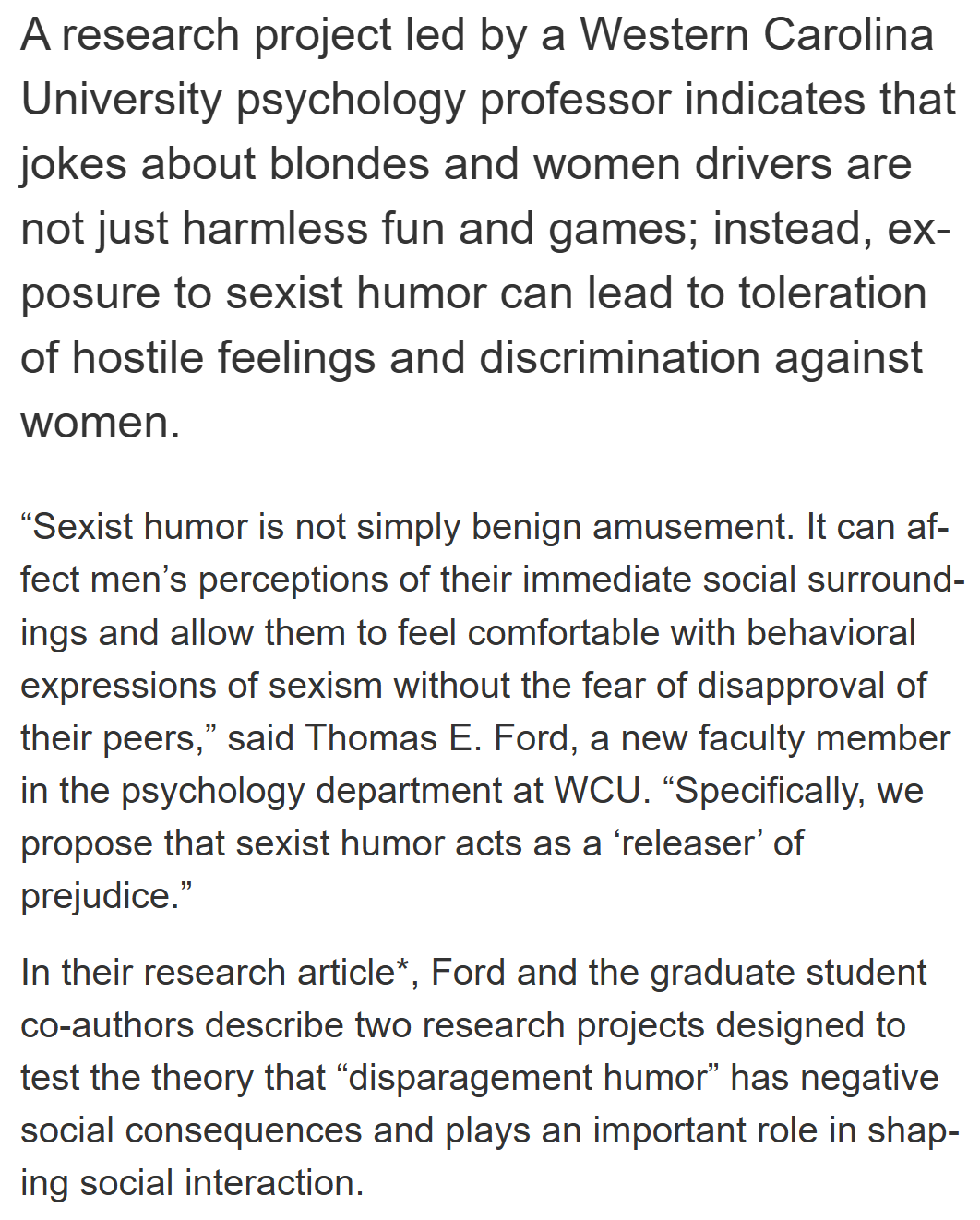
Ford's own summary of the mechanism is the line worth remembering. Sexist humor, he said, acts as a "releaser" of prejudice. It does not necessarily manufacture bigotry in someone who had none. It removes the social brake from the bigotry that was already there, and it persuades the bigot that his neighbors have removed their brakes too.
Read that again with Hindus substituted for women, and the Indian comedy circuit substituted for the laboratory.
The finding transfers cleanly.
Studies tracking the downstream effect link this normalization to rising divisiveness and, in the harder cases, to violence.
This is why the "it's just a joke" defense is the most important sentence in the entire operation. The deniability is not a side effect. It is actually the delivery mechanism!
Ridicule has always been a weapon, and the operators know it
None of this is theoretical for the people who do it professionally. The strategic use of humor to dissolve authority and shift a population's sense of the possible is one of the best-documented techniques in the modern subversion playbook.
The Serbian movement Otpor, which helped bring down Slobodan Milosevic, built its entire method on ridicule. Their most famous action was to tape Milosevic's face to an oil barrel in a Belgrade market, leave a bat beside it, and invite passersby to take a swing. When the police arrested the barrel, the regime became a national joke, and a movement of twenty students grew into one of seventy thousand (Source).
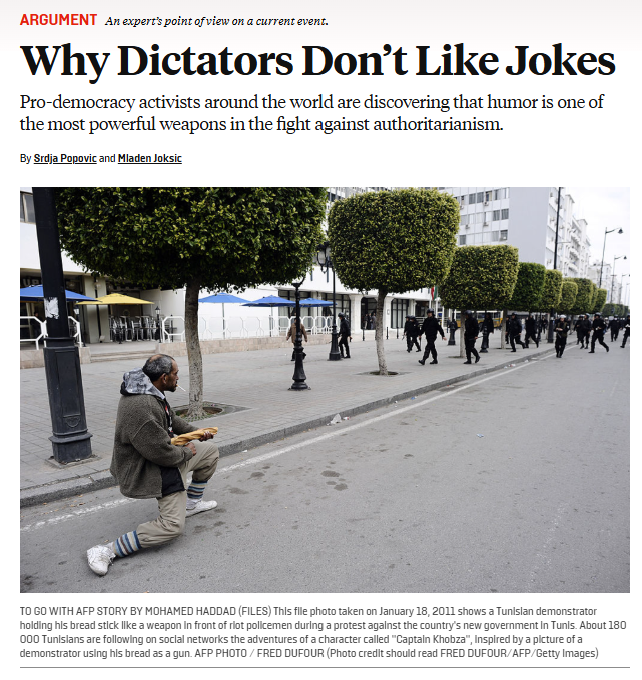
Otpor's founder Srdja Popovic later built CANVAS, an organization that exports this exact methodology to activists worldwide, and gave the technique a name: laughtivism.
The academic literature on nonviolent struggle treats this as a doctrine, not an accident.
Gene Sharp cataloged ridicule and mocking of officials among his methods of nonviolent action.
The scholar Majken Jul Sorensen, writing in Peace & Change, opens her study of the subject by quoting the activist motto directly: nothing undermines authority like holding it up to ridicule (Source).
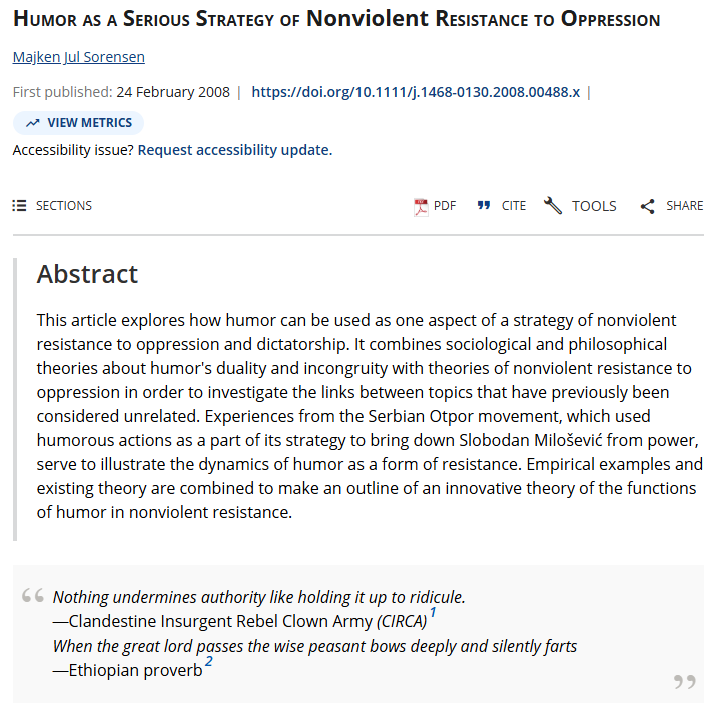
Laughter melts fear. It punctures the aura of invincibility. It converts a feared institution into an absurd one, and an institution people laugh at is an institution they will eventually stop defending.
This is a real and powerful tool. The relevant question for any society is simple. When the same technique is aimed not at a dictator but at the sacred symbols, gods, and faith of an entire civilizational community, what exactly is being dissolved, and who decided it should be?
"Industry means that it needs to be bought"
Here is where the money enters the picture.
Political comedy is no longer a few brave individuals with nothing to lose. It is a structured business. Mike Still, former artistic director of the Upright Citizens Brigade in Los Angeles, put it with unusual candor. "There's a political comedy industry now," he said, "and industry means that it needs to be bought" (Source).
He watched political satire move from a sideshow to the main stage, and he watched a generation of comics buy into what he called "Resistance, Inc."
Industry means it needs to be bought.
The scholars who study this are now openly asking the follow-on question. A comedy researcher at Colorado State University recently framed his own research agenda around it: comedy has become politically weaponized in support of specific political projects, and the questions that matter most are who is paying for it, and who profits from building careers and industries around the manufacture of political comedy.
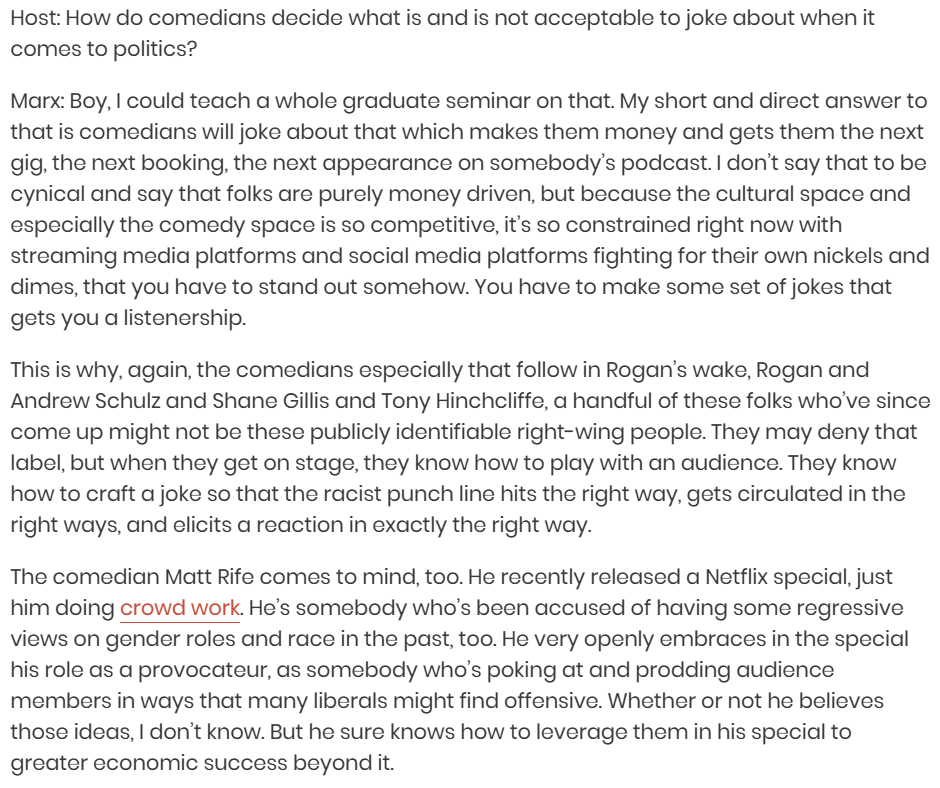
When a field's own scholars treat the financing as the central unanswered question, the rest of us should pay attention.
So bring that question home.
A creation, not an accident
The politico-religious "comedy" ecosystem has a framework. Behind the paychecks and the financing of the gigs sit paymasters, and those paymasters are aligned with selling certain ideologies and a certain bigotry at any cost.
That is the deeper game.
To be precise about the claim, no one is suggesting that political opponents arrive at Faruqui's door, or Kunal Kamra's, or anyone else's, with bags of cash for a specific punchline. The mechanism is subtler and far more effective than that. An entire industry now reliably produces abusive, one-sided, profane material, in word, in speech, and in hashtag, and bottles it as humor.
A field this consistently prejudiced, this politically aligned, and this well-defended in court is not an organic flowering of free expression.
It is a creation.
And a creation of this kind, this industry, has questionable financing at its base. The barrel in the marketplace did not paint itself. Someone supplied the paint, and someone supplied the bat, and the crowd that swung was only ever the instrument.
When the Civilization is not worth saving anymore
Walk through certain museums in the Mediterranean world, and you will find a statue of a Greek god with a small cross chiseled into its forehead. The face is often battered, the nose chipped, a hand broken off. The statue was not destroyed. That is the point. It was left standing, marked and beaten, so that everyone passing could see that the old god had been conquered and that whatever power it once held had been canceled. The cross on the forehead was an exorcism performed on stone.
This is what the slow death of a sacred order looks like up close.
And it raises the question Catherine Nixey poses in her book, The Darkening Age: how does a civilization as confident, literate, and powerful as the Greco-Roman world arrive at the point where its own people conclude there is nothing left in it worth defending?
The answer, in part, is the same mechanism we have been examining. Ridicule.
The gods made ridiculous
Clement of Alexandria's Protrepticus, his Exhortation to the Greeks, written around 195 CE, is a sustained work of mockery aimed at the sacred heart of the surrounding culture. Clement, who knew that culture intimately because he was raised in it, holds the Greek gods up as false, morally squalid, and absurd. He reduces the idols to what he says they are materially: unshaped wood and stone that some craftsman happened to carve, and he dismisses sacred art as an illusion, as "deadly toys." He ridicules the mystery rites as crude and trivial.
He was working in an established genre. Cyprian of Carthage wrote On the Vanity of Idols. Firmicus Maternus wrote On the Error of Profane Religions. Across the apologetic tradition, the recurring move is to take what a people hold most sacred and render it laughable, squalid, or pathetic.
The gods made evil
Ridicule was the first stage. The second was deadlier.
Augustine and Tertullian recast the entire pagan pantheon as demons. Jupiter, Aphrodite, Bacchus, Isis, all reclassified as malevolent spirits that clustered around their own statues like flies around a corpse. Augustine wrote that the pagans were under the power of demons, that their temples were built to demons, their altars set up to demons, their priests ordained to serve demons. Tertullian framed critics of Christianity as people whose minds were not free, but captured by Satan.
Augustine of Hippo (354–430 AD): Augustine expanded heavily upon this in his seminal work The City of God. Responding to pagans who blamed the collapse of the Roman Empire on Christianity, Augustine deconstructed the pantheon by arguing that the gods were rebel angels under Lucifer's command. He taught that demons posed as deities to trick humanity into worship, feeding on the pride and moral depravity associated with pagan cultic practices
Ridicule makes the sacred laughable. Demonization makes it dangerous. Together they leave a worshiper nowhere to stand. The thing he loved is either a joke or a trap, and either way, continuing to revere it marks him as a fool, a dupe, or a collaborator with evil.
Prejudiced Norm at Civilizational scale
This is where the historical parallel meets the social science.
What Thomas Ford and Mark Ferguson demonstrated at the scale of a single room, that exposure to disparagement shifts the perceived norm and releases the audience to act on contempt they would otherwise suppress, the apologetic tradition ran at the scale of a civilization across three centuries. The two mechanisms are the same instrument operated at different magnitudes.
Sustained ridicule plus demonization does not argue a population out of its inherited faith through superior logic. It moves the boundary of the acceptable. It makes reverence embarrassing and public defense of the old sacred order socially costly, then suspect, then unthinkable. Each generation inherits a slightly narrowed sense of what is worth honoring. The grandfather defends the temple. The father is faintly embarrassed by it. The grandson cannot remember why anyone cared.
That is the road to the endpoint. A civilization reaches the point of believing there is nothing in itself worth saving, not because an enemy proved it, but because it was taught, in a thousand small humiliations of its gods, that there was never anything sacred there to begin with. By the time the question of defense arises, the will to defend has already been hollowed out from inside. The walls can still stand. The reason to man them is gone.
Why is Pluralism the Vulnerable One
Underneath all of this sits the structural point.
Pagan Rome was absorptive and inclusive. It saw the divine in everything important to life.
New creeds were embraced, localized, and folded into the pantheon. A pluralistic sacred order has room for one more deity almost by definition, which is also why it has no immune system against a creed that refuses to be one more among many.
An exclusive monotheism cannot absorb. It can only replace. For a faith that holds itself to be the single truth, the rival sacred is not a neighbor to be accommodated. It is an error to be cleared, and ideally an error that can be made to look ridiculous on its way out, so that its former adherents feel relief rather than grief at its passing. Delegitimizing the rival sacred is therefore not an excess or a regrettable byproduct of zeal. It is built into the architecture.
Ridicule is simply the cheapest and most effective tool in the architecture's arsenal.
Which returns us to the present, and to the question that should never be far from view. When the sacred symbols, gods, and faith of a living civilizational community are subjected, night after night and hashtag after hashtag, to the same two-stage treatment, ridicule first and demonization close behind, the relevant question is not whether anyone is offended. The relevant question is what is being hollowed out, on whose behalf, and who is paying for the performance.
The cross on the statue's forehead was free to carve. Somebody still decided it was worth doing.
Protrepticus by Clement
This extract is from Chapter 1 titled "Exhortation to the Heathen" from the book Protrepticus by Clement of Alexandria. It is an exhortation to the Greeks.
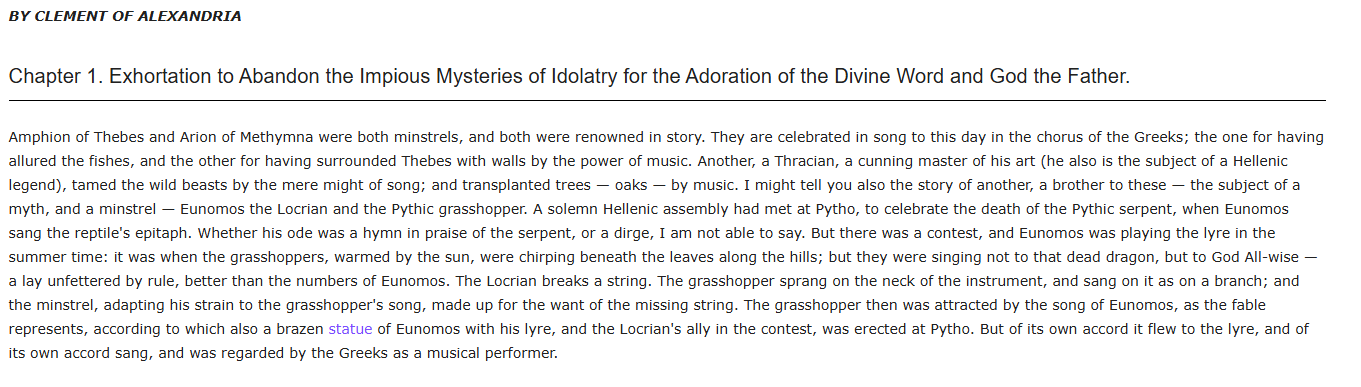
Here is something that is worth pondering. Before the mockery of Eunomos and the grasshopper even begins, the reader has already been handed the box: "the Heathen." The argument is won before it starts, because the people being addressed have been named by their enemy, and the name carries the verdict.
"Heathen" was often used as a derogatory label for non-believers (non-Christians).
Originally, it was simply a descriptive term used by Christians to distinguish those who had not converted to Christianity. However, as Christianity became dominant in Europe, the word increasingly acquired negative connotations. "Heathen" often implied that a person was:
- Spiritually misguided or "unsaved."
- Morally inferior.
- Ignorant of the "true faith."
- Outside the civilized religious community.
As a result, the term was frequently used not just to identify religious outsiders but also to justify missionary activity, cultural assimilation, and, at times, colonial domination.
In colonial-era writings about India, Africa, and the Americas, "heathen" was often intertwined with assumptions of cultural superiority. Many modern historians view such language as part of a broader framework that portrayed non-European and non-Christian societies as needing to be "civilized" or converted.
So let's go back to Clement.
The mockery that follows after the heading - the minstrels, the grasshopper, the brazen statue at Pytho, all of it lands on a reader who has already been placed inside a box. He is the heathen. He is the idolater. The verdict has been delivered in the heading, and everything after it is merely the sentence being carried out.
This is the smallest and most efficient unit of the entire mechanism. Before the ridicule, before the demonization, before the comedy set, there is the name. And the name does most of the work.
The Labels
"Pagan" comes from the Latin paganus.
In its older sense, it meant a rustic, a dweller in the countryside, the pagus or rural district.
In later Roman usage, it carried the sense of a civilian, a person not enrolled in the army. Early Christians called themselves milites Christi, soldiers of Christ. By that logic a paganus was a non-combatant, someone standing outside the real war, with the lingering flavor of the unsophisticated villager who still clung to the old gods after the cities had moved on to the new faith.
"Heathen" runs along a parallel track. It descends from a Germanic root meaning a dweller on the heath, the uncultivated waste ground, once again the rustic, the unrefined, the backward.
In the Greek-speaking east, the same instinct produced ethnikoi, "the nations" or "the foreigners," which gives English the word gentile, and in time even Hellenes, the proud name of the Greeks themselves, was turned into a synonym for idolater.
Notice what every one of these terms has in common. Each is an outsider's coinage. No Greek who rose at dawn to honor Apollo ever described himself as a heathen. No Roman pouring a libation to his household gods called himself a pagan. These were words pressed onto them from outside, by people who had already decided what they were.
Manufactured Category
Here is the part that matters most, and it is easy to miss.
There was no religion called paganism. There was no single thing there at all. What the word names was in reality a vast, plural, overlapping world of civic rites, esoteric practices, household gods, local deities, and rival philosophical schools that had never needed a collective name, because they had never been a single team and never imagined themselves as one.
Christianity supplied the missing name. It required one word for "everything that is not us," and the moment that word came into being, a thousand unrelated traditions were fused into a single opponent that could be confronted, pitied, and laughed at as a unit. The label did not describe a group that already existed. It conjured the group into existence in the very act of negating it. The enemy was, in a real sense, created by being named.
Label of primary potency
The founder of modern prejudice studies, Gordon Allport, gave this device its proper name. In The Nature of Prejudice, published in 1954, he described certain words as labels of primary potency, labels that, in his phrase, act like shrieking sirens, deafening us to all the finer distinctions we would otherwise perceive.
Such a label seizes one feature of a person, magnifies it beyond all proportion, and erases everything else, until the individual vanishes into the category and the category does all the thinking.
There are three ways that the labels work:
Overshadowing Identity: They magnify a single attribute (e.g., skin color, a wheelchair, or a pejorative term) to an entirely disproportionate extent. This causes the observer to ignore the person’s other traits, talents, or complexities.
Perceptual Deafness: Allport described these labels as functioning like "shrieking sirens", deafening people to finer discriminations and reducing a complex individual to a "single-story" identity.
Sociological Overlap: The concept is closely related to Everett Hughes' concept of "master status". Both theories explain how a single trait or demographic category is often deemed more significant than any other aspect of a person's background.
Allport also placed verbal labeling at the foundation of his five-stage scale of escalation.
The rungs, in order, are
- antilocution, then
- avoidance, then
- discrimination, then
- physical attack, and finally
- extermination.
Antilocution, the speaking against, the name-calling and the slur, sits at the bottom. His entire argument was that the rungs are connected, and that prejudice left unchecked tends to climb. The epithet is therefore not the harmless end of the spectrum. It is the entrance to it. It is the stage that makes everything above it feel normal when its turn arrives.
The five operations of the slur
The label performs five things at once. They are worth naming because they have not changed in two thousand years.
It flattens. A whole classical world, or a billion internally diverse living people, is compressed into one undifferentiated mass with a single imagined character.
It defines by deficiency. Heathen, pagan, infidel, each says what the target lacks: the true god, the true army, the city, civilization itself. The person is rendered as an absence, a hole where a proper human should be.
It preempts self-description. The named are denied the right to name themselves. Their own account of who they are gets painted over by the enemy's word, and arguing against the label only fastens it tighter.
It encodes a verdict. The judgment rides silently inside the noun. No one has to prove that the Greek is backward or that his gods are false. One simply calls him a heathen, and the case is closed before it has been opened.
It bonds the in-group. "We are the soldiers of Christ" needs "they are the mere civilians." The word that demeans the outsider is the same word that confers belonging on the insider. The slur and the badge are one object seen from two sides.
Seed of the Joke
This is where the epithet connects to everything else.
The slur is not merely an insult; it is the seed crystal around which an entire structure of ridicule can form.
Once that reduction has taken place, ridicule becomes easier to deploy and easier to accept. Audiences are generally reluctant to laugh at what they continue to regard as noble, sacred, or worthy of esteem. The epithet removes that hesitation. It lowers the target's status before any argument has been made. The individual or group is no longer encountered on its own terms but through a pre-constructed frame supplied by the label.
This is why words such as "heathen," "idolater," or similar designations have historically carried such power. They did not merely describe; they evaluated. They instructed the audience on how to think before the conversation had even begun. By the time a satirist, preacher, polemicist, or comedian arrived with the joke, much of the work had already been done.
Clement's mockery of the classical gods, for example, did not fall on neutral ground. It landed on ground that had been prepared through prior categorization and moral devaluation. The audience had already been taught to view the target as inferior, misguided, or absurd. The joke merely reinforced and amplified a judgment that the label had established.
Seen in this light, labeling, ridicule, and norm formation are not separate phenomena. They are successive stages of a single social process. The label creates the box, the joke fills it with contempt, and repeated exposure transforms that contempt into a social norm. The entire cycle begins with a single word.
The same machine, running now
The contemporary Indian vocabulary often operates through the same social mechanisms. Terms such as "Sanghi" and "Bhakt" function not merely as descriptors but as labels that compress a wide range of beliefs, identities, and motivations into a single caricature. Once applied, the label frequently becomes the primary lens through which the individual is perceived, drowning out nuance and rendering other aspects of identity invisible.
The transformation of "Bhakt" is particularly revealing. Traditionally, the word referred to a devotee. A person defined by spiritual commitment and reverence. In contemporary political discourse, however, it has been reduced to a pejorative shorthand for a supposedly unthinking follower. The shift is more than semantic. It strips a culturally and spiritually significant term of its original meaning and repurposes it as a vehicle of ridicule.
Both labels perform a similar function. They flatten complexity, define their targets through perceived deficiencies, and deny individuals the right to describe themselves on their own terms. The judgment is embedded within the word itself, making the argument seem unnecessary. What may be a diverse and internally contested civilizational, cultural, or political identity is reduced to a single stereotype that is compact enough to fit inside a hashtag and efficient enough to travel instantly across digital networks.
The Master Trap of Labels
Two of the most enduring ideas in the study of prejudice describe the same mechanism from different vantage points.
Gordon Allport, examining how human beings perceive others, identified what he called labels of primary potency—words that elevate a single characteristic above all others and cause observers to interpret everything through that one lens. Everett Hughes approached the problem sociologically and arrived at a similar conclusion. He called the dominant characteristic a master status: an assigned identity that overshadows all other roles, qualities, and achievements in most social situations.
Erving Goffman, a student of Hughes, brought these insights together in his landmark work on stigma. When the master status is a discrediting one, he argued, the individual or group acquires what he called a "spoiled identity." The stigmatized characteristic becomes the defining feature through which everything else is judged, while the fuller reality of the person or community fades from view.
For Goffman, a stigma is an attribute that is deeply discrediting, one that reduces its bearer, in his much-quoted phrase, from a whole and usual person to a tainted, discounted one. The point is not that the attribute is large in reality. The point is that in the perceiver's mind, it swells until the person is mentally written down, discounted, and treated as less than a full participant. That is the same overshadowing Allport described, now stated as a social consequence rather than a cognitive glitch.
Together, these concepts describe a powerful social process. A label identifies a trait, the master status elevates it above all others, and stigma transforms it into a lens through which the entire identity is evaluated. Once established, the process becomes self-reinforcing. Every action is interpreted through the label, and contrary evidence struggles to gain recognition.
Applied to civilizations, religions, or cultural groups, the mechanism can be especially potent. Complex traditions containing diverse beliefs, histories, and internal debates may come to be understood through a handful of externally assigned characteristics. The reduction occurs before any meaningful engagement with the tradition itself, shaping perception before understanding has even begun.
Run that combined engine against Hinduism, and it works with unusual efficiency. Part of the reason is that the box was built from the outside before the contents were even sorted.
The word "Hindu" was an outsider's coinage
The word "Hindu" did not begin as a religion. It began as the Persian pronunciation of Sindhu, the river Indus, a geographic label for the people who lived on the far side of it.
For centuries, it was an exonym, a word foreigners used for a population, long before it named anything anyone believed.
The tidy noun "Hinduism," the -ism that implies a single doctrine with a single core, was substantially finalized much later, by colonial administrators counting heads for a census and by European Indologists who needed one filing category for an entire civilization's worth of traditions.
So the target inherits the same original wound as Clement's "heathen." It was named by others, and the act of naming did the first and deepest work, fusing a plural world into a single object that could then be perceived, judged, and targeted as one thing.
How it all works
Let us combine all the fundamentals we discussed above and analyze. Allport's three effects and the five operations of the slur run as a single sequence, each illustrated by how it lands on Hinduism.
A master status is assigned. This combines Allport's overshadowing of identity with Hughes's master status, because they are the same move.
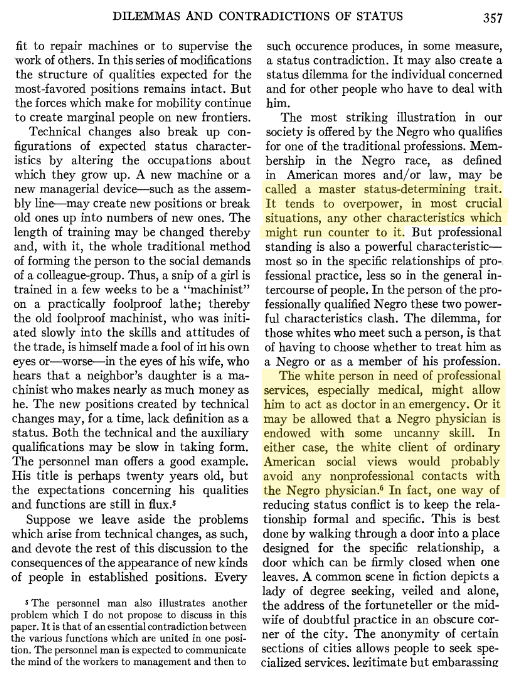
One trait is selected and elevated until it dominates all perception. In practice, the assigned master status is one of three. The first is caste: Hinduism is presented as a caste system and essentially nothing else. The second is idolatry or polytheism: primitive idol-worship, captured in the sneering shorthand about millions of gods. The third, in political register, is Hindutva or "saffron," in which the whole civilizational tradition is collapsed into a single nationalist movement. Each of these overshadows everything else the tradition contains: the six classical schools of philosophy, the monist and dualist and even atheist strands that argued with one another for millennia, the mathematical and astronomical achievements, the bhakti poets, the ecological and pluralist ethics. Whatever a Hindu actually thinks or does, he is seen first and almost entirely through the one assigned trait.
Perceptual deafness follows. Allport's image was of a label that acts like a shrieking siren, drowning out every finer discrimination. Once "casteist" or "Sanghi" is the siren, the observer literally cannot hear anything else. A Hindu writing about ecology, or epistemology, or the structure of consciousness, is heard only through the caste or nationalism filter, and the content is decoded as a cover for the master status rather than taken on its own terms. This is the single-story effect, operating live.
Definition by deficiency. The tradition is measured against a monotheist template and recorded as a list of absences. No single God, therefore idolatrous. No one book, no founder, no church, therefore "not really a religion," merely "a social system" or "a way of life." A genuinely different mode of organizing the sacred, plural and decentralized by design, is filed as a lack, a failure to be the thing the template expects. The deficiency framing then doubles as a license: a tradition that is "not really a religion" can be criticized, reformed, or dismantled without the deference religions normally receive.
Self-description is preempted. This is the operation that springs the trap shut. Hindus are not permitted to define Hinduism. When they describe it in their own vocabulary, as Sanatana Dharma, as plural and non-creedal, as philosophically deep, the self-description is recoded as propaganda, "Hindutva apologetics," or "saffron revisionism." Within this frame, a Hindu defending the richness of his own tradition is read as confirming its danger. Resistance to the label is treated as proof of the label, which means there is no move the target can make from inside the box that is not interpreted as further evidence for keeping him in it.
The verdict is pre-loaded. The judgment travels silently inside the noun. "Casteist," "Brahminical," "idolater," "Bhakt," "cow vigilante," "saffron," each delivers a verdict that no longer needs to be argued, only invoked. The word arrives with the conclusion already attached.
The in-group is bonded. Every one of these labels does double duty. It demeans an out-group and it confers belonging on an in-group. "Casteist, communal, superstitious Hindu" calls into being its flattering opposite, the "secular, rational, modern" observer, and contempt for the former becomes part of the membership badge for the latter. The slur is therefore not only an attack. It is the price of admission to a class that defines itself partly by its disdain for the people it names.
The master status becomes a stigma. Here Goffman closes the loop. Once the discrediting trait dominates perception, the person is reduced to a spoiled identity, and the stigma sits exactly where Allport placed verbal labeling on his five-rung scale: at antilocution, the bottom rung, the doorway. Allport's warning was that the rungs connect, that prejudice left unchallenged tends to climb from speech toward avoidance, discrimination, and worse. The slur is where the climb begins.
So, Allport supplies the mechanism inside the mind where the label is a shrieking siren that deafens. Hughes supplies the social structure where one status comes to dominate all the others. Goffman supplies the result and gives it a name where the dominant discrediting trait becomes a stigma that spoils the entire identity, and a religion or a nation is precisely the kind of trait he says this happens to.
Applied to Hinduism, the sequence fits perfectly.
Once "casteist" or "idolater" or "Sanghi" is installed as the master status, it operates as a tribal stigma in Goffman's strict sense. It contaminates the whole tradition, attaches to everyone carrying the identity, and reduces a four-thousand-year civilization, in the perceiver's mind, to a tainted and discounted thing.
The Social Delegitimization Cycle
Trace the whole arc, and a single machine comes into view, assembled from parts that scholars cataloged one at a time without ever naming the whole.
It begins with a word. A label of primary potency, in Allport's phrase, drops a noun in front of a people and boxes them with labels like heathen, idolater, casteist, Sanghi. The word flattens a plural world into one object (defined by the aggressor) and delivers its verdict before any argument has begun.
The word then hardens into a master status. Hughes showed how one assigned trait comes to overpower all the others, so that an entire civilization is perceived through a single feature and rendered deaf on every other frequency.
The master status curdles into a stigma. Goffman named the result precisely: a tribal stigma of religion and nation that spoils the whole identity and, in the observer's mind, reduces a four-thousand-year tradition to something tainted and discounted.
Then the joke arrives. Disparagement humor pours contempt into the box the label has built, and prejudiced norm theory tells us exactly what that contempt does. It shifts the boundary of the acceptable until mockery of the sacred feels like consensus, and defense of it feels like foolishness.
The standups industrialize the process. What was once a sermon is now a set, a hashtag, a streaming special, a business with paymasters because, as Mike Still said, an industry has to be bought.
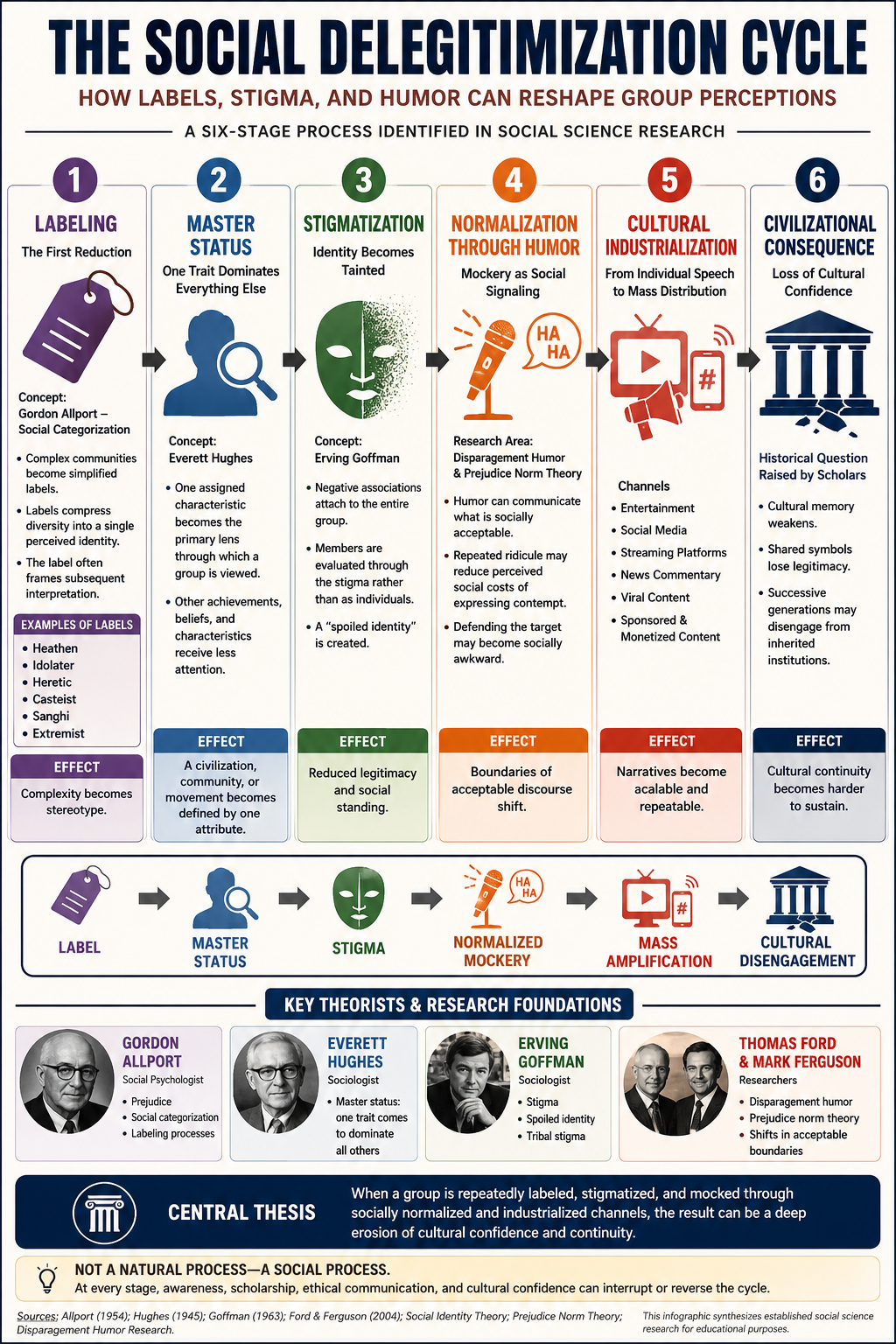
And the Darkening Age shows where the machine ends. A confident classical world was taught, joke by joke and slur by slur, that its gods were first absurd and then demonic, until its own people could no longer remember why any of it was worth defending. The walls still stood. The reason to man them was gone.
That is the warning, stated plainly. The destruction of a civilization rarely begins with armies. It begins with laughter aimed at what a people hold sacred, repeated until they laugh along. The only question that finally matters is the one we started with. Who is paying for the laughter, and where is it pointed?